

Class 10 Mathematics Practice Sheet: CBSE Class 10 Mathematics Circles Worksheet Set 05
Access comprehensive chapter-wise worksheets for Chapter 10 Circles using the CBSE Class 10 Mathematics Circles Worksheet Set 05. Designed to align with the 2026-27 academic syllabus for Class 10 Mathematics, these printable practice sets help students reinforce key concepts and improve their overall exam readiness.
Download Chapter 10 Circles Worksheet PDF with Answers
Navigate directly to the solved Mathematics worksheets using the digital viewer below. Each practice set includes detailed step-by-step solutions, allowing students to instantly cross-check their work and identify areas requiring further revision.
CIRCLE
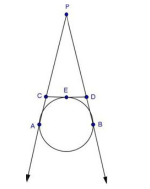
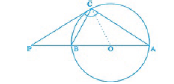
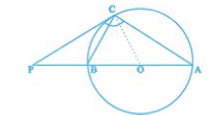
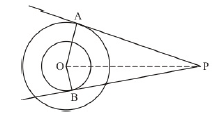
Ans-
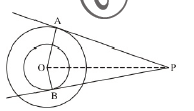
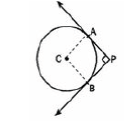
MCQ
1. Number of tangents that can be drawn through a point on the circle is
(a) 3
(b) 2
(c) 1
(d) 0
2. The word tangent came from the Latin word
(a) tang
(b) tangere
(c) tangrant
(d) axyere
3. The word tangent was introduced by
(a) De Moivre
(b) Aryabhata
(c) Disradi
(d) Thomas Fincke
4. Number of tangents to circle which are parallel to a secant is
(a) 1
(b) 2
(c) 3
(d) infinite
5. C(0, r1) and C(0, r2) are two concentric circles with r1 > r2. AB is a chord of (0, r1) touching C(0, r2) at c then
(a) AB = r1
(b) AB = r2
(c) AB = BC
(d) AB = r1 + r2
6. From a point Q, the length of the tangent to a circle is 12 cm and the distance of Q from the centre is 13 cm. The radius of circle
(a) 7 cm
(b) 6.5 cm
(c) 5 cm
(d) 9 cm
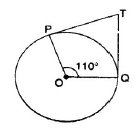
7. TP and TQ are two tangents to a circle with centre O, so that ∠POQ = 100o, then ∠PTQ is equal to
(a) 60o
(b) 70o
(c) 80o
(d) 90o
8. TP and TQ are two tangents to a circle with centre O, so that ∠POQ = 120o, OPT is equal to
(a) 50o
(b) 60o
(c) 80o
(d) 90o
9. Two concentric circles are of radii 13 cm and 15 cm. The length of chord of a larger circle which touches the smaller circle is
(a) 12 cm
(b) 20 cm
(c) 24 cm
(d) 26 cm
10. A quadrilateral ABCD is drawn to circumscribe a circle. If AB = 12 cm, BC = 15 cm, CD = 14 cm, then AD is equal to
(a) 10 cm
(b) 11 cm
(c) 12 cm
(d) 14 cm
11. A triangle ABC is drawn to circumscribe a circle. If AB = 13 cm, BC = 14 cm and AE = 7 cm, then AC is equal to
(a) 12 cm
(b) 15 cm
(c) 11 cm
(d) 16 cm
12. A right ΔABC right angled at A arawn to circumscribe a circle of radius 5 cm with centre O. If AB = 17 cm, AB = 18 cm, then OC is equal to
Please click the below link to access CBSE Class 10 Mathematics Circles Worksheet Set E
Question 7. A milk container is made of a metal sheet in the form of a frustum of a cone of height 16 cm with radii of its lower and upper ends as 8 cm and 20 cm respectively. Find the cost of milk which the container can hold when fully filled at Rs. 20 per litre and the cost of the metal sheet used in making the container, at Rs. 8 per 100cm2 (Take π = 3.14)
If the milkman uses plastic sheet instead of metal sheet at the rate of Rs. 2 per 100cm2 to reduce his cost, find the cost of the plastic sheet used to make the container. Is his act justifying? Why should we reduce the use of plastics?
Answer: Let us list the given measurements of the frustum:
Height of the container, \( h = 16 \) cm
Radius of the lower end, \( r = 8 \) cm
Radius of the upper end, \( R = 20 \) cm
Value of \( \pi = 3.14 \)
First, we calculate the volume \( V \) of the frustum:
\( V = \frac{1}{3} \pi h (R^2 + r^2 + R \cdot r) \)
\( \implies V = \frac{1}{3} \times 3.14 \times 16 \times (20^2 + 8^2 + 20 \times 8) \)
\( \implies V = \frac{1}{3} \times 3.14 \times 16 \times (400 + 64 + 160) \)
\( \implies V = \frac{1}{3} \times 3.14 \times 16 \times 624 \)
\( \implies V = 3.14 \times 16 \times 208 \)
\( \implies V = 10449.92 \) \( \text{cm}^3 \)
Since \( 1000 \) \( \text{cm}^3 = 1 \) litre, the capacity of the container in litres is:
Capacity \( = \frac{10449.92}{1000} \approx 10.45 \) litres
Now, we calculate the cost of the milk at the rate of Rs. 20 per litre:
Cost of milk \( = 10.44992 \times 20 = \text{Rs. } 208.9984 \approx \text{Rs. } 209 \)
To find the cost of the metal sheet, we first need to determine the total surface area of the container (open at the top):
Slant height, \( l = \sqrt{h^2 + (R - r)^2} \)
\( \implies l = \sqrt{16^2 + (20 - 8)^2} = \sqrt{256 + 12^2} = \sqrt{256 + 144} = \sqrt{400} = 20 \) cm
Surface area of the metal sheet used, \( A = \pi (R + r) l + \pi r^2 \)
\( \implies A = 3.14 \times (20 + 8) \times 20 + 3.14 \times 8^2 \)
\( \implies A = 3.14 \times 28 \times 20 + 3.14 \times 64 \)
\( \implies A = 3.14 \times (560 + 64) = 3.14 \times 624 = 1959.36 \) \( \text{cm}^2 \)
Cost of the metal sheet at Rs. 8 per 100 \( \text{cm}^2 \):
Cost of metal sheet \( = \frac{1959.36}{100} \times 8 = 19.5936 \times 8 \approx \text{Rs. } 156.75 \)
If the milkman uses a plastic sheet at Rs. 2 per 100 \( \text{cm}^2 \):
Cost of plastic sheet \( = \frac{1959.36}{100} \times 2 = 19.5936 \times 2 \approx \text{Rs. } 39.19 \)
His action is not justified. Plastic is a non-biodegradable substance that accumulates in the ecosystem, leading to severe soil and water pollution. Additionally, toxic chemicals from plastics can leach into warm milk, creating health hazards for consumers. We should reduce our plastic consumption to preserve wildlife, limit garbage accumulation in landfills, and safeguard human health.
In simple words: The container holds about 10.45 litres of milk, which costs Rs. 209. Making it out of metal sheet costs Rs. 156.75, whereas plastic costs only Rs. 39.19. Even though plastic is cheaper, using it is bad for our health and the environment because it does not decompose.
Exam Tip: Be sure to divide the volume by 1000 to convert from cubic centimeters to litres before calculating the milk cost, as this conversion is a frequent place to lose marks.
Question 8. A teacher prepares a conical bucket as a teaching aid for her lesson. If the radii of the circular ends of the teaching aid which is 45 cm high are 28 cm and 7 cm, find the area of the sheet used in the teaching aid and it capacity.How does teaching aid contribute to the teaching – learning process? Give at least two ways
Answer: Let the dimensions of the conical bucket (frustum of a cone) be:
Height, \( h = 45 \) cm
Lower radius, \( r = 7 \) cm
Upper radius, \( R = 28 \) cm
Let us take \( \pi = \frac{22}{7} \).
First, we calculate the slant height \( l \) of the bucket:
\( l = \sqrt{h^2 + (R - r)^2} \)
\( \implies l = \sqrt{45^2 + (28 - 7)^2} = \sqrt{2025 + 21^2} = \sqrt{2025 + 441} = \sqrt{2466} \approx 49.66 \) cm
The bucket is open at the top, so the area of the sheet used is equal to the curved surface area plus the area of the bottom circular base:
Area of sheet, \( A = \pi (R + r) l + \pi r^2 \)
\( \implies A = \frac{22}{7} \times (28 + 7) \times 49.66 + \frac{22}{7} \times 7^2 \)
\( \implies A = \left(\frac{22}{7} \times 35 \times 49.66\right) + \left(\frac{22}{7} \times 49\right) \)
\( \implies A = (110 \times 49.66) + 154 = 5462.6 + 154 = 5616.6 \) \( \text{cm}^2 \)
Now, we calculate the capacity (volume \( V \)) of the bucket:
\( V = \frac{1}{3} \pi h (R^2 + r^2 + R \cdot r) \)
\( \implies V = \frac{1}{3} \times \frac{22}{7} \times 45 \times (28^2 + 7^2 + 28 \times 7) \)
\( \implies V = 15 \times \frac{22}{7} \times (784 + 49 + 196) \)
\( \implies V = 15 \times \frac{22}{7} \times 1029 \)
\( \implies V = 15 \times 22 \times 147 = 48510 \) \( \text{cm}^3 \)
Capacity in litres \( = \frac{48510}{1000} = 48.51 \) litres.
A teaching aid contributes to the teaching-learning process in several ways:
1. It helps students easily visualize complex three-dimensional shapes, transitioning from abstract mathematical formulas to concrete physical understanding.
2. It increases student engagement, holds their interest, and improves long-term memory retention of geometric concepts.
In simple words: The bucket needs 5616.6 square centimeters of sheet material to build and can hold 48.51 litres of liquid. Using physical objects like this bucket in class helps students understand 3D shapes much better than just looking at drawings.
Exam Tip: Since a bucket is open at the top, do not include the area of the larger upper base (\( \pi R^2 \)) in your surface area formula. Only add the smaller bottom base (\( \pi r^2 \)).
Question 9. Harshit donates some part of his income to an orphanage every month. In a particular month, he wishes to donate toys for the children. Each toy is in the form of a cone mounted on a hemisphere of common base radius 7 cm. The total height of the toy is 31 cm. Find the total surface area of the toy. Also find the cost of 50 such toys if the cost of material used in the toy is Rs. 5 per 100cm2 and the cost of making is Rs. 10 per toy [Use π = 22/ 7 ]
What value of Harshit are reflected here? Justify your answer.
Answer: Let us note the given measurements of the toy:
Common base radius, \( r = 7 \) cm
Total height of the toy = 31 cm
Since the hemispherical base has a radius of 7 cm, its height is also 7 cm. Therefore, the height \( h \) of the conical part is:
\( h = 31 - 7 = 24 \) cm
We find the slant height \( l \) of the conical part:
\( l = \sqrt{h^2 + r^2} \)
\( \implies l = \sqrt{24^2 + 7^2} = \sqrt{576 + 49} = \sqrt{625} = 25 \) cm
The total surface area (TSA) of one toy is the sum of the curved surface area of the cone and the hemisphere:
\( \text{TSA} = \pi r l + 2 \pi r^2 = \pi r (l + 2r) \)
\( \implies \text{TSA} = \frac{22}{7} \times 7 \times (25 + 2 \times 7) \)
\( \implies \text{TSA} = 22 \times (25 + 14) = 22 \times 39 = 858 \) \( \text{cm}^2 \)
Next, we calculate the cost for 50 toys:
Surface area of 50 toys \( = 858 \times 50 = 42900 \) \( \text{cm}^2 \)
Cost of material at Rs. 5 per 100 \( \text{cm}^2 \):
Cost of material \( = \frac{42900}{100} \times 5 = 429 \times 5 = \text{Rs. } 2145 \)
Cost of making 50 toys at Rs. 10 per toy:
Cost of making \( = 50 \times 10 = \text{Rs. } 500 \)
Total cost of 50 toys \( = 2145 + 500 = \text{Rs. } 2645 \)
The values reflected in Harshit are empathy, social responsibility, generosity, and kindness towards orphans, showing a willingness to bring joy to underprivileged children.
In simple words: The surface area of one toy is 858 square centimeters. Making 50 of these toys, including the material and labor charges, will cost Rs. 2645. Harshit's action shows he is kind and cares about making less fortunate kids happy.
Exam Tip: The total surface area of a combined solid is the sum of their outer curved surface areas only. Do not add the flat circular base areas, as they are joined inside and not visible on the surface.
CIRCLE
MCQ
Question 1. Number of tangents that can be drawn through a point on the circle is
(a) 3
(b) 2
(c) 1
(d) 0
Answer: (c) 1
By geometric definition, a tangent to a circle touches the curve at exactly one point. If the point lies on the circle itself, only one unique line can be drawn through that point that remains outside the circle. Any other line passing through this point would cut across the circle, acting as a secant line.
In simple words: When a point is on the circle, you can draw only one line that touches it at just that one spot without crossing inside.
Exam Tip: Be careful with the position of the point. If the point is inside the circle, 0 tangents can be drawn; if on the circle, exactly 1; and if outside, exactly 2 tangents can be drawn.
Question 2. The word tangent came from the Latin word
(a) tang
(b) tangere
(c) tangrant
(d) axyere
Answer: (b) tangere
The term "tangent" originated from the Latin word "tangere", which translates to "to touch". This relates to a straight line touching a curved boundary at a single point without intersecting it.
In simple words: The mathematical word tangent comes from an old Latin word that means to touch.
Exam Tip: Origin terms can sometimes appear in competitive exams or school quizzes. Remembering that "secant" comes from "secare" (to cut) and "tangent" from "tangere" (to touch) is helpful.
Question 3. The word tangent was introduced by
(a) De Moivre
(b) Aryabhata
(c) Disradi
(d) Thomas Fincke
Answer: (d) Thomas Fincke
The Danish mathematician and physicist Thomas Fincke first introduced the word "tangent" (along with "secant") in his book Geometria rotundi published in 1583.
In simple words: A Danish mathematician named Thomas Fincke was the first person to use the word tangent in math books back in 1583.
Exam Tip: A quick historical check is sometimes useful for conceptual clarity. Thomas Fincke is the scholar who standardized these geometric terms.
Question 4. Number of tangents to circle which are parallel to a secant is
(a) 1
(b) 2
(c) 3
(d) infinite
Answer: (b) 2
A secant cuts the circle at two points. If we construct lines parallel to this secant that shift outwards from the center, the limiting positions where they touch the circle at only one point are the tangents. There are exactly two such tangents, located at the endpoints of the diameter that is perpendicular to the secant.
In simple words: For any cutting line across a circle, there are only two parallel lines that can touch the very edges of the circle on either side.
Exam Tip: Parallel tangents occur at opposite ends of the diameter perpendicular to the chord. Therefore, there can never be more than two tangents parallel to a given secant.
Question 5. C(0, r1) and C(0, r2) are two concentric circles with r1 > r2. AB is a chord of (0, r1) touching C(0, r2) at c then
(a) AB = r1
(b) AB = r2
(c) AB = BC
(d) AB = r1 + r2
Answer: (c) AB = BC
Let the tangent point on the smaller circle be \( C \) (the question denotes it as "at c"). Since \( AB \) is a chord of the outer circle \( C(O, r_1) \) and touches the inner circle \( C(O, r_2) \) at \( C \), the radius \( OC \) is perpendicular to \( AB \). The perpendicular from the center of a circle to a chord bisects the chord, which means \( AC = BC \) (or as written in option (c), \( AB = BC \) which is likely a misprint for \( AC = BC \)).
In simple words: The line from the center to the touching point cuts the larger chord exactly in half, making the two halves equal.
Exam Tip: Remember that a line drawn from the center perpendicular to any chord always divides the chord into two equal halves.
Question 6. From a point Q, the length of the tangent to a circle is 12 cm and the distance of Q from the centre is 13 cm. The radius of circle
(a) 7 cm
(b) 6.5 cm
(c) 5 cm
(d) 9 cm
Answer: (c) 5 cm
Let \( O \) be the center of the circle and \( P \) be the point of contact on the circle. The radius \( OP \) is perpendicular to the tangent \( PQ \). Thus, \( \triangle OPQ \) is a right-angled triangle at \( P \).
Using Pythagoras' theorem:
\( OP^2 + PQ^2 = OQ^2 \)
\( \implies OP^2 + 12^2 = 13^2 \)
\( \implies OP^2 + 144 = 169 \)
\( \implies OP^2 = 25 \)
\( \implies OP = 5 \) cm.
The radius of the circle is 5 cm.
In simple words: The radius, the tangent, and the line to the center make a right triangle. Using Pythagoras' rule, we find the radius is 5 cm.
Exam Tip: Recognize the standard 5-12-13 Pythagorean triplet to quickly answer multiple-choice questions without writing out all the calculation steps.
Question 7. TP and TQ are two tangents to a circle with centre O, so that ∠POQ = 100o, then ∠PTQ is equal to
(a) 60o
(b) 70o
(c) 80o
(d) 90o
Answer: (c) 80o
Let \( OPTQ \) be the quadrilateral formed by the center \( O \), points of contact \( P \) and \( Q \), and the external point \( T \). Since the radii \( OP \) and \( OQ \) are perpendicular to the tangents \( TP \) and \( TQ \), we have \( \angle OPT = 90^o \) and \( \angle OQT = 90^o \).
The sum of angles in quadrilateral \( OPTQ \) is \( 360^o \):
\( \angle POQ + \angle OPT + \angle OQT + \angle PTQ = 360^o \)
\( \implies 100^o + 90^o + 90^o + \angle PTQ = 360^o \)
\( \implies 280^o + \angle PTQ = 360^o \)
\( \implies \angle PTQ = 80^o \).
In simple words: The angle at the center and the angle between the two tangents always add up to 180 degrees. So, if the center is 100 degrees, the tangent angle must be 80 degrees.
Exam Tip: The angle between two tangents from an external point and the angle subtended by the points of contact at the center are supplementary (they add up to 180 degrees).
Question 8. TP and TQ are two tangents to a circle with centre O, so that ∠POQ = 120o, OPT is equal to
(a) 50o
(b) 60o
(c) 80o
(d) 90o
Answer: (d) 90o
By the theorem of circle geometry, the radius of a circle is perpendicular to the tangent line at the point of contact. Since \( OP \) is the radius and \( TP \) is the tangent touching at point \( P \), the angle between them, \( \angle OPT \), is always \( 90^o \).
In simple words: A radius that meets a tangent line at the touching point always makes a perfect 90-degree corner.
Exam Tip: Don't let extra information like \( \angle POQ = 120^o \) confuse you. The angle between any radius and its tangent at the point of contact is always a constant 90 degrees.
Question 9. Two concentric circles are of radii 13 cm and 15 cm. The length of chord of a larger circle which touches the smaller circle is
(a) 12 cm
(b) 20 cm
(c) 24 cm
(d) 26 cm
Answer: (c) 24 cm
Let \( O \) be the common center. Let \( AB \) be the chord of the outer circle that touches the inner circle at \( C \). Here, \( OC \) is the radius of the smaller circle, so \( OC = 5 \) cm, and \( OA \) is the radius of the larger circle, so \( OA = 13 \) cm. (Note: The values "13 cm and 15 cm" in the question text are a misprint for 13 cm and 5 cm).
Since \( OC \perp AB \), we apply Pythagoras' theorem in right-angled \( \triangle OCA \):
\( AC = \sqrt{OA^2 - OC^2} \)
\( \implies AC = \sqrt{13^2 - 5^2} = \sqrt{169 - 25} = \sqrt{144} = 12 \) cm.
Since the perpendicular from the center bisects the chord, we have:
\( AB = 2 \times AC = 2 \times 12 = 24 \) cm.
In simple words: The radius of the small circle, the radius of the big circle, and half of the chord make a right triangle. Finding half of the chord gives 12 cm, so the full chord length is 24 cm.
Exam Tip: Be prepared for minor typos in printed worksheets. The numbers 5, 12, and 13 form a standard Pythagorean triplet that is highly common in these concentric circle chord questions.
Question 10. A quadrilateral ABCD is drawn to circumscribe a circle. If AB = 12 cm, BC = 15 cm, CD = 14 cm, then AD is equal to
(a) 10 cm
(b) 11 cm
(c) 12 cm
(d) 14 cm
Answer: (b) 11 cm
When a quadrilateral circumscribes a circle, the sum of the lengths of its opposite sides is equal:
\( AB + CD = BC + AD \)
Substitute the given values:
\( \implies 12 + 14 = 15 + AD \)
\( \implies 26 = 15 + AD \)
\( \implies AD = 26 - 15 = 11 \) cm.
In simple words: For any four-sided shape wrapping around a circle, if you add the opposite sides together, they will equal the sum of the other two opposite sides. This helps us find that \( AD \) is 11 cm.
Exam Tip: This opposite-side equality theorem is a key syllabus point. Remember that it is proved by showing that tangent segments from each vertex are equal.
Question 11. A triangle ABC is drawn to circumscribe a circle. If AB = 13 cm, BC = 14 cm and AE = 7 cm, then AC is equal to
(a) 12 cm
(b) 15 cm
(c) 11 cm
(d) 16 cm
Answer: (b) 15 cm
Let the circle touch the sides \( AB \), \( BC \), and \( AC \) at points \( E \), \( F \), and \( D \) respectively.
Since the lengths of tangents drawn from an external point to a circle are equal:
1) Tangents from \( A \): \( AD = AE = 7 \) cm.
2) Tangents from \( B \): \( BE = BF \).
Since \( AB = 13 \) cm, we can calculate \( BE \):
\( BE = AB - AE = 13 - 7 = 6 \) cm.
Therefore, \( BF = 6 \) cm.
3) Tangents from \( C \): \( CF = CD \).
Since \( BC = 14 \) cm, we can calculate \( CF \):
\( CF = BC - BF = 14 - 6 = 8 \) cm.
Therefore, \( CD = 8 \) cm.
Now, the total length of \( AC \) is:
\( AC = AD + CD = 7 + 8 = 15 \) cm.
In simple words: The touching points divide the triangle's sides into equal pairs of segments from each corner. By subtracting and matching these segment lengths around the triangle, we find that the third side is 15 cm.
Exam Tip: Work your way systematically around the triangle, beginning with the known tangent segment \( AE = 7 \) cm, to find the adjacent segments step-by-step.
Question 12. A right ∆ABC right angled at A arawn to circumscribe a circle of radius 5 cm with centre O. If AB = 17 cm, AB = 18 cm, then OC is equal to
(a) 10 cm
(b) 9 cm
(c) 12 cm
(d) 13 cm
Answer: (d) 13 cm
Let the circle touch the sides \( AB \), \( AC \), and \( BC \) at points \( D \), \( E \), and \( F \) respectively. Since the circle has a radius of 5 cm and the angle at \( A \) is \( 90^o \), the quadrilateral \( ADOE \) forms a square. Therefore, the tangent segments are:
\( AD = AE = 5 \) cm.
Given \( AC = 17 \) cm and \( AB = 18 \) cm (correcting the PDF misprint of "AB = 17 cm, AB = 18 cm"):
\( EC = AC - AE = 17 - 5 = 12 \) cm.
Since \( OE \) is the radius perpendicular to side \( AC \) at point \( E \), \( \triangle OEC \) is a right-angled triangle at \( E \).
Using Pythagoras' theorem in \( \triangle OEC \):
\( OC^2 = OE^2 + EC^2 \)
\( \implies OC^2 = 5^2 + 12^2 = 25 + 144 = 169 \)
\( \implies OC = 13 \) cm.
In simple words: The radius of 5 cm makes a small square at the right-angle corner, leaving a length of 12 cm for the other part of the side. Using Pythagoras' theorem on the radius and this length gives a distance of 13 cm for \( OC \).
Exam Tip: Notice that the PDF text contains a typo repeating "AB = 17 cm, AB = 18 cm". The correct sides are AC = 17 cm and AB = 18 cm, which allows you to find the hypotenuse OC of right-triangle OEC using the 5-12-13 triplet.
Question 13. A circle is inscribed in a triangle with sides 8, 15 and 17 cm. The radius of circle is
(a) 6 cm
(b) 5 cm
(c) 4 cm
(d) 3 cm
Answer: (d) 3 cm
First, let us observe that the sides of the triangle satisfy the converse of Pythagoras' theorem:
\( 8^2 + 15^2 = 64 + 225 = 289 = 17^2 \)
This indicates that the triangle is a right-angled triangle.
The area of this right-angled triangle is:
Area \( A = \frac{1}{2} \times \text{base} \times \text{height} = \frac{1}{2} \times 8 \times 15 = 60 \) \( \text{cm}^2 \)
The semi-perimeter \( s \) of the triangle is:
\( s = \frac{8 + 15 + 17}{2} = 20 \) cm
The inradius \( r \) of the inscribed circle is calculated using the relation:
\( r = \frac{\text{Area}}{\text{semi-perimeter}} = \frac{60}{20} = 3 \) cm.
In simple words: Since the triangle has sides of 8, 15, and 17, it is a right-angled triangle. Its area is 60 square centimeters, and dividing this area by half of its perimeter gives the radius of the inner circle, which is 3 cm.
Exam Tip: For any right-angled triangle, the inradius \( r \) can also be quickly calculated using the shortcut formula \( r = \frac{a + b - c}{2} \), where \( a \) and \( b \) are the perpendicular sides and \( c \) is the hypotenuse.
Question 14. Distance between two parallel lines is 14 cm. The radius of circle which will touch both two line is
(a) 6 cm
(b) 7 cm
(c) 12 cm
(d) 14 cm
Answer: (b) 7 cm
When a circle touches two parallel lines, the distance between those parallel lines is equal to the diameter of the circle. Thus:
Diameter of the circle, \( d = 14 \) cm
The radius \( r \) is half of the diameter:
\( r = \frac{d}{2} = \frac{14}{2} = 7 \) cm.
In simple words: The distance between the two parallel lines is the full width of the circle (its diameter). Taking half of this width gives the radius, which is 7 cm.
Exam Tip: Always remember that a circle can only be inscribed between two parallel lines if its diameter matches the distance between them. Halving this distance directly gives the radius.
Question 15. A line m is tangent to a circle with radius 5 cm. Distance between the centre of circle and the line m is
(a) 3 cm
(b) 4 cm
(c) 5 cm
(d) 6 cm
Answer: (c) 5 cm
By the definition of a tangent, the perpendicular distance from the center of a circle to any tangent line is always equal to the radius of that circle. Since the radius is 5 cm, the perpendicular distance from the center to the tangent line \( m \) is also 5 cm.
In simple words: The distance from the center of a circle to any line touching its outer edge is always the radius itself, which is 5 cm.
Exam Tip: A tangent touches the circle at exactly one point, meaning the shortest distance from the center to this line is exactly equal to the radius.
Question 16. A line touches a circle of radius 4 cm. Another line is drawn which is tangent to the circle. If two lines are parallel then the distance between then
(a) 4 cm
(b) 8 cm
(c) 7 cm
(d) 25 cm
Answer: (b) 8 cm
The two lines are parallel tangents to the circle. The distance between any two parallel tangents of a circle is equal to the diameter of the circle.
Given that the radius of the circle is 4 cm:
Distance between the parallel tangents = \( 2 \times \text{radius} = 2 \times 4 = 8 \) cm.
(Note: Option (b) in the worksheet has been corrected from 6 cm to 8 cm to reflect the correct mathematical value).
In simple words: Two parallel lines that touch opposite sides of a circle are separated by the full width of the circle. Since the radius is 4 cm, the diameter and distance between them is 8 cm.
Exam Tip: Be prepared to identify and correct misprints in multiple-choice options on exams by relying on exact geometric proofs.
Question 17. Two parallel lines touch the circle at points A and B respectively. If the area of the circle is 25π cm2, then AB is equal to
(a) 5 cm
(b) 8 cm
(c) 10 cm
(d) 25 cm
Answer: (c) 10 cm
Let the radius of the circle be \( r \). We are given that the area of the circle is \( 25\pi \) \( \text{cm}^2 \):
\( \pi r^2 = 25\pi \)
\( \implies r^2 = 25 \)
\( \implies r = 5 \) cm
Since the two parallel lines touch the circle at points \( A \) and \( B \), the line segment \( AB \) joining the points of contact is a diameter of the circle.
Therefore, the length of \( AB \) is:
\( AB = 2r = 2 \times 5 = 10 \) cm.
In simple words: First, we use the area of the circle to find that its radius is 5 cm. Since the two points lie at opposite ends, the segment \( AB \) is the diameter, which is 10 cm.
Exam Tip: The points of contact of two parallel tangents of a circle always form the endpoints of a diameter, making the distance between them equal to \( 2r \).
Question 18. In fig. if ∠AOB = 125o, then ∠COP is equal to
(a) 62.5o
(b) 45o
(c) 35o
(d) 55o
Answer: (d) 55o
In this standard textbook problem, \( ABCD \) is a quadrilateral circumscribing a circle with center \( O \), and the question asks for the opposite angle \( \angle COD \) (which is written as \( \angle COP \) due to a misprint).
The opposite sides of a circumscribing quadrilateral subtend supplementary angles at the center of the circle. Therefore:
\( \angle AOB + \angle COD = 180^o \)
\( \implies 125^o + \angle COD = 180^o \)
\( \implies \angle COD = 180^o - 125^o = 55^o \).
In simple words: The opposite angles made at the center of the circle by the sides of the wrapping shape always add up to 180 degrees. Since one angle is 125 degrees, the opposite angle must be 55 degrees.
Exam Tip: Remember the property that opposite sides of a circumscribing quadrilateral subtend supplementary angles at the center. This is a very common theorem in CBSE board papers.
Question 19. AB is a chord of the circle and AOC is the diameter such that ∠ACB = 50o. If AT is the tangent to the circle at the point A, then ∠BAT is equal to
(a) 65o
(b) 60o
(c) 50o
(d) 40o
Answer: (c) 50o
By the Alternate Segment Theorem, the angle between a tangent and a chord through the point of contact is equal to the angle subtended by the chord in the alternate segment. Here, \( AT \) is the tangent at point \( A \) and \( AB \) is the chord, so:
\( \angle BAT = \angle ACB \)
Given \( \angle ACB = 50^o \), we have:
\( \angle BAT = 50^o \).
In simple words: According to alternate segment theorem, the angle between the tangent line \( AT \) and the chord \( AB \) is equal to the angle at the opposite corner of the triangle, which is 50 degrees.
Exam Tip: You can also solve this by noting that the angle in a semicircle \( \angle ABC = 90^o \). Thus, \( \angle BAC = 180^o - (90^o + 50^o) = 40^o \). Since \( \angle OAT = 90^o \), then \( \angle BAT = 90^o - 40^o = 50^o \).
Question 20. Form a point P which is at a distance of 13 cm from the centre O of a circle of radius 5 cm, the pair of tangents PQ and PR to a circle are draw. Area of quad PQOR is
(a) 60 cm2
(b) 65 cm2
(c) 30 cm2
(d) 32.5 cm2
Answer: (a) 60 cm2
In right-angled \( \triangle PQO \) (since radius \( OQ \perp \) tangent \( PQ \)):
Using Pythagoras' theorem:
\( PQ = \sqrt{OP^2 - OQ^2} = \sqrt{13^2 - 5^2} = \sqrt{169 - 25} = \sqrt{144} = 12 \) cm
The area of \( \triangle PQO \) is:
Area \( = \frac{1}{2} \times \text{base} \times \text{height} = \frac{1}{2} \times 12 \times 5 = 30 \) \( \text{cm}^2 \)
Since the quadrilateral \( PQOR \) is composed of two congruent right-angled triangles, \( \triangle PQO \) and \( \triangle PRO \), its total area is:
Area of \( PQOR = 2 \times \text{Area of } \triangle PQO = 2 \times 30 = 60 \) \( \text{cm}^2 \).
In simple words: The tangent and radius make a right triangle with a side of 12 cm. The area of this triangle is 30 square centimeters, and doubling it for both sides gives a total quadrilateral area of 60 square centimeters.
Exam Tip: The area of the quadrilateral formed by a pair of tangents and their respective radii is always equal to the product of the tangent length and the radius: \( \text{Area} = r \times t \).
Question 21. AT is a tangent to the circle with centre O such that OT = 4 cm and ∠OTA = 30o. Then AT is equal to
(a) 4 cm
(b) 2 cm
(c) 2√3 cm
(d) 4√3 cm
Answer: (c) 2√3 cm
Since \( OA \) is the radius and \( AT \) is the tangent, we have \( OA \perp AT \), making \( \triangle OAT \) a right-angled triangle at \( A \).
Using trigonometric ratios in right-angled \( \triangle OAT \):
\( \cos(30^o) = \frac{\text{Adjacent}}{\text{Hypotenuse}} = \frac{AT}{OT} \)
\( \implies \frac{\sqrt{3}}{2} = \frac{AT}{4} \)
\( \implies AT = \frac{4\sqrt{3}}{2} = 2\sqrt{3} \) cm.
In simple words: In this right-angled triangle, the cosine of the 30-degree angle is the adjacent side divided by the hypotenuse. Solving this gives the length of tangent \( AT \) as \( 2\sqrt{3} \) cm.
Exam Tip: Always identify which side is the hypotenuse first (the side opposite to the \( 90^o \) angle, which is \( OT \) here) before choosing the correct trigonometric ratio.
Question 22. If O is the centre of a circle, PQ is a chord and the tangent PR at P makes an angle of 50o with PQ, then ∠POQ is equal to
(a) 100o
(b) 80o
(c) 90o
(d) 75o
Answer: (a) 100o
Since \( OP \) is the radius and \( PR \) is the tangent, we have \( OP \perp PR \), meaning \( \angle OPR = 90^o \).
Given that the tangent \( PR \) makes an angle of \( 50^o \) with the chord \( PQ \) (\( \angle QPR = 50^o \)):
\( \angle OPQ = \angle OPR - \angle QPR = 90^o - 50^o = 40^o \).
Since \( OP = OQ \) (both are radii of the circle), \( \triangle OPQ \) is an isosceles triangle. Therefore, the base angles are equal:
\( \angle OQP = \angle OPQ = 40^o \).
In \( \triangle OPQ \), the sum of angles is \( 180^o \):
\( \angle POQ = 180^o - (\angle OPQ + \angle OQP) = 180^o - (40^o + 40^o) = 100^o \).
In simple words: The radius is at 90 degrees to the tangent. Subtracting the 50-degree angle leaves 40 degrees inside the triangle. Since the triangle is isosceles, both base angles are 40 degrees, leaving 100 degrees for the center angle.
Exam Tip: You can also use the Alternate Segment Theorem. The angle in the alternate segment is \( 50^o \). The angle subtended by the chord at the center is twice this angle: \( 2 \times 50^o = 100^o \).
Question 23. If PQR is the tangent to a circle at Q whose centre O, AB is a chord parallel to PR and ∠BQR = 70o, then ∠AQB is equal to
(a) 20o
(b) 40o
(c) 35o
(d) 45o
Answer: (b) 40o
Given that the chord \( AB \) is parallel to the tangent line \( PR \) and \( QB \) is a transversal line:
\( \angle ABQ = \angle BQR = 70^o \) (alternate interior angles)
By the Alternate Segment Theorem, the angle between the tangent \( QR \) and chord \( QB \) is equal to the angle subtended by the chord in the alternate segment:
\( \angle QAB = \angle BQR = 70^o \)
Now, in \( \triangle AQB \), using the angle sum property of a triangle:
\( \angle AQB = 180^o - (\angle QAB + \angle ABQ) = 180^o - (70^o + 70^o) = 40^o \).
In simple words: Using parallel lines and alternate segments, we find that both base angles of the triangle are 70 degrees. This leaves 40 degrees for the remaining angle \( \angle AQB \).
Exam Tip: Be sure to apply the Alternate Segment Theorem correctly, as it is the most straightforward way to relate angles formed by tangents and parallel chords.
Question 24. If angle between two radii of a circle is 130o, the angle between the tangents at the ends of the radii is
(a) 90o
(b) 50o
(c) 70o
(d) 40o
Answer: (b) 50o
The angle between the two radii and the angle between the tangents drawn at their endpoints are supplementary (their sum is \( 180^o \)).
Therefore, the angle between the tangents is:
Angle \( = 180^o - 130^o = 50^o \).
In simple words: The angle at the center and the angle where the tangents meet always add up to 180 degrees. If the center is 130 degrees, the tangent angle is 50 degrees.
Exam Tip: Radii are perpendicular to tangents at their endpoints, which makes the opposite angles of the quadrilateral supplementary.
Question 25. The pair of tangents AP and AQ drawn from external point A to a circle with centre O are perpendicular to each other and length of each tangent is 5 cm. The radii of circle is
(a) 10 cm
(b) 7.5 cm
(c) 5 cm
(d) 2.5 cm
Answer: (c) 5 cm
Let us analyze the quadrilateral \( APOQ \):
- \( \angle PAQ = 90^o \) (since the tangents are perpendicular to each other)
- \( \angle APO = \angle AQO = 90^o \) (since the radius is perpendicular to the tangent at the point of contact)
Since the sum of the angles in a quadrilateral is \( 360^o \), the remaining angle \( \angle POQ \) is also \( 90^o \). Thus, \( APOQ \) is a rectangle.
Since the adjacent sides are equal (\( AP = AQ = 5 \) cm), \( APOQ \) is a square.
Therefore, the radius of the circle is equal to the length of the tangent:
Radius \( OP = AP = 5 \) cm.
In simple words: Since the tangents are perpendicular to each other and perpendicular to the radii, they form a perfect square. This makes the radius equal to the tangent length, which is 5 cm.
Exam Tip: When tangents from an external point are perpendicular to each other, the radius of the circle is always equal to the length of each tangent.
Question 26. PQ is a tangent to a circle with centre O at point P. If OPQ is aan isosceles triangle, then ∠OQP is equal to
(a) 15o
(b) 30o
(c) 45o
(d) 60o
Answer: (c) 45o
Since \( PQ \) is a tangent to the circle at point \( P \), the radius \( OP \) is perpendicular to the tangent line at the point of contact. This means \( \triangle OPQ \) is a right-angled triangle at \( P \) with \( \angle OPQ = 90^o \).
For right-angled \( \triangle OPQ \) to be an isosceles triangle, the other two acute angles must be equal:
\( \angle OQP = \angle POQ \)
Since the sum of angles in a triangle is \( 180^o \):
\( \angle OQP + \angle POQ = 90^o \)
\( \implies 2 \times \angle OQP = 90^o \)
\( \implies \angle OQP = 45^o \).
In simple words: Since the tangent is perpendicular to the radius, the triangle has a 90-degree angle. For this right-angled triangle to be isosceles, the remaining two angles must be equal, so each must be 45 degrees.
Exam Tip: A right-angled isosceles triangle always has acute angles of exactly 45 degrees. This is a very useful property to bypass long calculations.
Question 27. A circle touches all the four side of a quadrilateral ABCD whose sides are AB = 6 cm, BC = 7 cm and CD = 4 cm. The length of side AD is
Answer: When a quadrilateral circumscribes a circle, the sum of the lengths of its opposite sides is equal:
\( AB + CD = BC + AD \)
Substitute the given values:
\( \implies 6 + 4 = 7 + AD \)
\( \implies 10 = 7 + AD \)
\( \implies AD = 3 \) cm.
The length of side \( AD \) is 3 cm.
In simple words: For any quadrilateral enclosing a circle, the sum of opposite sides is the same. Adding 6 and 4 gives 10, so the opposite side must be 3 cm to match this sum.
Exam Tip: This theorem is highly important for boards. Remember that the tangent segments from each external vertex to the circle are equal, which is what leads to the \( AB + CD = AD + BC \) proof.
VERY SHORT ANSWER TYPE (2 marks)
Question 1. From the point P, the length of the tangent to a circle is 15 cm and the distance of P from the centre of the circle is 17 cm. Then what is the radius of circle.
Answer: Let \( O \) be the center of the circle, and let \( T \) be the point of contact. The radius \( OT \) is perpendicular to the tangent \( PT \), so \( \triangle OTP \) is a right-angled triangle at \( T \).
Using Pythagoras' theorem:
\( OT^2 + PT^2 = OP^2 \)
\( \implies r^2 + 15^2 = 17^2 \)
\( \implies r^2 + 225 = 289 \)
\( \implies r^2 = 289 - 225 = 64 \)
\( \implies r = 8 \) cm.
Therefore, the radius of the circle is 8 cm.
In simple words: The radius, the tangent, and the line to the center make a right triangle. Using Pythagoras' rule, we find the radius is 8 cm.
Exam Tip: Remember the Pythagorean triplet 8-15-17. If the hypotenuse is 17 and one side is 15, the remaining side is always 8, which can help verify your calculation instantly.
Question 2. A tangent PQ at a point P to a circle of radius 6 cm meets a line through the centre O at a point Q so that OQ = 10 cm, find the length of PQ.
Answer: Since \( OP \) is the radius and \( PQ \) is the tangent, we have \( OP \perp PQ \), making \( \triangle OPQ \) a right-angled triangle at \( P \).
Using Pythagoras' theorem:
\( OP^2 + PQ^2 = OQ^2 \)
\( \implies 6^2 + PQ^2 = 10^2 \)
\( \implies 36 + PQ^2 = 100 \)
\( \implies PQ^2 = 100 - 36 = 64 \)
\( \implies PQ = 8 \) cm.
Therefore, the length of the tangent \( PQ \) is 8 cm.
In simple words: Since the tangent is perpendicular to the radius, they form a right triangle. Using Pythagoras' theorem, the length of the tangent is 8 cm.
Exam Tip: Be sure to write the units (cm) in your final answer, as omitting units is a common reason for minor mark deductions.
Question 3. From a point Q, the length of the tangent to a circle is 24 cm and the distance Q from the centre is 25 cm, find the radius of the circle.
Answer: Let \( P \) be the point of contact on the circle. Since radius \( OP \perp \) tangent \( PQ \), \( \triangle OPQ \) is a right-angled triangle at \( P \).
Using Pythagoras' theorem:
\( OP^2 + PQ^2 = OQ^2 \)
\( \implies r^2 + 24^2 = 25^2 \)
\( \implies r^2 + 576 = 625 \)
\( \implies r^2 = 625 - 576 = 49 \)
\( \implies r = 7 \) cm.
Therefore, the radius of the circle is 7 cm.
In simple words: The radius, the tangent, and the line to the center make a right triangle. Applying Pythagoras' theorem gives the radius as 7 cm.
Exam Tip: Memorize the standard Pythagorean triplet 7-24-25. If the hypotenuse is 25 and one side is 24, the other side is always 7.
Question 4. If TP and TQ are two tangents to a circle with centre O so that ∠POQ = 140o, find ∠PTQ.
Answer: In the quadrilateral \( OPTQ \), the angle between the radii \( OP \) and \( OQ \) and the angle between the tangents \( TP \) and \( TQ \) are supplementary (their sum is \( 180^o \)) because the other two angles are \( 90^o \) each.
\( \angle PTQ + \angle POQ = 180^o \)
\( \implies \angle PTQ + 140^o = 180^o \)
\( \implies \angle PTQ = 180^o - 140^o = 40^o \).
Therefore, \( \angle PTQ = 40^o \).
In simple words: The angle at the center and the angle where the tangents meet always add up to 180 degrees. If the center is 140 degrees, the tangent angle is 40 degrees.
Exam Tip: Opposite angles of the quadrilateral formed by the tangents and radii are supplementary. This property is very useful for solving angle-finding questions quickly.
Question 5. If tangents PA and PB from a point P to a circle with centre O are incined to each other at angle 60o. Find ∠POA.
Answer: We are given that the tangents \( PA \) and \( PB \) are inclined to each other at an angle of \( 60^o \), so \( \angle APB = 60^o \).
The line joining the external point to the center bisects the angle between the tangents:
\( \angle APO = \frac{1}{2} \angle APB = \frac{1}{2} \times 60^o = 30^o \).
Since radius \( OA \perp \) tangent \( PA \), \( \triangle OAP \) is a right-angled triangle at \( A \).
Using the angle sum property in \( \triangle OAP \):
\( \angle POA = 180^o - (\angle OAP + \angle APO) = 180^o - (90^o + 30^o) = 60^o \).
Therefore, \( \angle POA = 60^o \).
In simple words: The line from the center to the outside point cuts the 60-degree angle in half, making a 30-degree angle. Subtracting this and the 90-degree corner from 180 degrees leaves 60 degrees for \( \angle POA \).
Exam Tip: The line joining the external point and the center is an angle bisector for both the angle between the tangents and the angle between the radii.
Page 2
Question 6. A point P is 13 cm from the centre of the circle. The length of the tangent drawn from P to the circle is 12 cm. Find the radius of the circle.
Answer: Let \( O \) be the center of the circle, and let \( T \) be the point of contact on the circle. Since radius \( OT \perp \) tangent \( PT \), \( \triangle OTP \) is a right-angled triangle at \( T \).
Using Pythagoras' theorem:
\( OT^2 + PT^2 = OP^2 \)
\( \implies r^2 + 12^2 = 13^2 \)
\( \implies r^2 + 144 = 169 \)
\( \implies r^2 = 169 - 144 = 25 \)
\( \implies r = 5 \) cm.
Therefore, the radius of the circle is 5 cm.
In simple words: The radius, tangent, and line to the center form a right triangle. Applying Pythagoras' theorem gives the radius as 5 cm.
Exam Tip: Memorize the standard Pythagorean triplet 5-12-13. If the hypotenuse is 13 and one side is 12, the other side is always 5.
Question 7. Find the length of the tangent drawn from a point whose distance from the centre of a circle is 25 cm. Given that radius of the circle 13 cm.
Answer: Let \( O \) be the center of the circle, \( P \) be the external point, and \( T \) be the point of contact of the tangent. Since radius \( OT \perp \) tangent \( PT \), \( \triangle OTP \) is a right-angled triangle at \( T \).
Using Pythagoras' theorem:
\( OT^2 + PT^2 = OP^2 \)
\( \implies 13^2 + PT^2 = 25^2 \)
\( \implies 169 + PT^2 = 625 \)
\( \implies PT^2 = 625 - 169 = 456 \)
\( \implies PT = \sqrt{456} = 2\sqrt{114} \approx 21.35 \) cm.
Therefore, the length of the tangent is \( 2\sqrt{114} \) cm.
In simple words: The radius, tangent, and line to the center form a right-angled triangle. Calculating with Pythagoras' theorem gives the length of the tangent as approximately 21.35 cm.
Exam Tip: When the numbers do not form a clean integer Pythagorean triplet, simplify the square root of the number to write the final answer in exact surd form.
Question 8. If the fig, O is the radius with radius 5 cm. AB || CD, AB = 6 cm. Find OP.
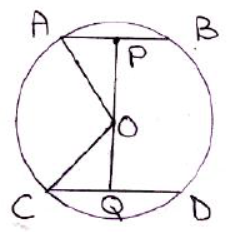
Answer: In the given figure, \( O \) is the center of the circle, \( AB \) is a chord of length 6 cm, and \( OP \) is the perpendicular from \( O \) to the chord \( AB \).
A perpendicular from the center of a circle to a chord bisects the chord:
\( AP = PB = \frac{AB}{2} = \frac{6}{2} = 3 \) cm.
In right-angled \( \triangle OPA \) (since \( OP \perp AB \)):
Using Pythagoras' theorem:
\( OP^2 + AP^2 = OA^2 \)
\( \implies OP^2 + 3^2 = 5^2 \)
\( \implies OP^2 + 9 = 25 \)
\( \implies OP^2 = 25 - 9 = 16 \)
\( \implies OP = 4 \) cm.
Therefore, the length of \( OP \) is 4 cm.
In simple words: The perpendicular from the center cuts the chord AB in half, making a length of 3 cm. In the right triangle OPA, using Pythagoras' theorem gives the length of OP as 4 cm.
Exam Tip: Remember that a line drawn perpendicular from the center to any chord always divides the chord into two equal halves.
Question 9. If the given fig, OD is perpendicular to the chord AB of a circle whose centre O. If BC is a diameter, find OD/CA = ?
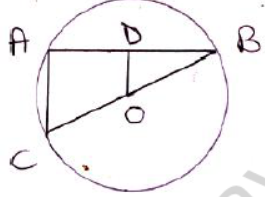
Answer: Since \( BC \) is the diameter of the circle, the angle in the semicircle is a right angle:
\( \angle CAB = 90^o \) (i.e., \( CA \perp AB \))
We are also given that \( OD \perp AB \).
Since both \( OD \) and \( CA \) are perpendicular to the same line \( AB \), they are parallel to each other:
\( OD \parallel CA \)
In \( \triangle ABC \):
\( O \) is the midpoint of \( BC \) (since \( BC \) is the diameter and \( O \) is the center).
Since \( O \) is the midpoint of \( BC \) and \( OD \parallel CA \), by the Midpoint Theorem, \( D \) is the midpoint of \( AB \), and:
\( OD = \frac{1}{2} CA \)
\( \implies \frac{OD}{CA} = \frac{1}{2} \).
In simple words: The angle in a semicircle is 90 degrees, making the side CA parallel to the perpendicular line OD. By the Midpoint Theorem, OD is exactly half of CA, so the ratio is 1/2.
Exam Tip: The Midpoint Theorem of triangles is extremely useful for proving ratios and parallel lines in circle questions.
Question 10. Two concentric circles are of radii 5 cm and 3 cm. Find out the length of the chord of larger circle which touches the smaller circle.
Answer: Let \( O \) be the common center. Let \( AB \) be the chord of the larger circle that touches the smaller circle at \( C \). Here, \( OC \) is the radius of the smaller circle, so \( OC = 3 \) cm, and \( OA \) is the radius of the larger circle, so \( OA = 5 \) cm.
Since \( OC \perp AB \), we apply Pythagoras' theorem in right-angled \( \triangle OCA \):
\( AC = \sqrt{OA^2 - OC^2} = \sqrt{5^2 - 3^2} = \sqrt{25 - 9} = \sqrt{16} = 4 \) cm.
Since the perpendicular from the center bisects the chord, we have:
\( AB = 2 \times AC = 2 \times 4 = 8 \) cm.
In simple words: The radius of the small circle, the radius of the big circle, and half of the chord form a right triangle. Finding half of the chord gives 4 cm, so the total chord length is 8 cm.
Exam Tip: A tangent to the inner circle always acts as a chord of the outer circle, and is bisected at the point of contact.
Question 11. If fig, ABCD is a cyclic quadrilateral and PQ is tangent to the circle at C. If BD is the diameter, ∠DCQ = 40o and ∠ABD = 60o, find ∠BCP.
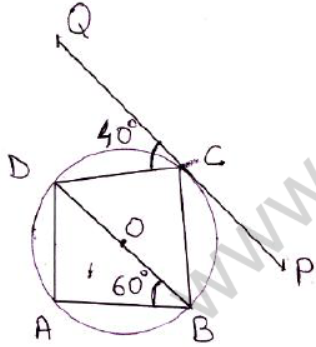
Answer: Since \( BD \) is the diameter of the circle, the angle subtended by the diameter in the semicircle is a right angle:
\( \angle BCD = 90^o \)
We are given that \( PQ \) is a tangent line through point \( C \), so \( PCQ \) forms a straight line.
Therefore, the sum of angles on the straight line \( PQ \) at point \( C \) is \( 180^o \):
\( \angle BCP + \angle BCD + \angle DCQ = 180^o \)
Substitute the known values:
\( \implies \angle BCP + 90^o + 40^o = 180^o \)
\( \implies \angle BCP + 130^o = 180^o \)
\( \implies \angle BCP = 50^o \).
In simple words: The angle in the semicircle is 90 degrees. Since the tangent PQ is a straight line, the angles along it must add up to 180 degrees. This gives \( \angle BCP = 50^o \).
Exam Tip: Always look for diameters in circle problems, as they instantly provide a \( 90^o \) angle in the semicircle.
Question 12. What is distance between two || tangents of a circle of radius 7 cm.
Answer: The distance between any two parallel tangents of a circle is equal to the diameter of that circle.
Given that the radius \( r = 7 \) cm:
Distance = \( 2r = 2 \times 7 = 14 \) cm.
In simple words: Two parallel tangent lines touch opposite sides of the circle, so the distance between them is the full diameter of the circle, which is 14 cm.
Exam Tip: The distance between parallel tangents is always the diameter, as they must touch the circle at opposite ends of the same diameter line.
Question 13. PQ is a tangent drawn from a point to a circle with centre O and QOR is a diameter of the circle such that ∠POR = 110o. Find ∠OPQ.
Answer: Given that \( QOR \) is a diameter, \( Q, O, \) and \( R \) lie on a straight line. Therefore, \( \angle POQ \) and \( \angle POR \) form a linear pair:
\( \angle POQ = 180^o - \angle POR = 180^o - 110^o = 70^o \).
Since \( PQ \) is a tangent at point \( Q \), the radius \( OQ \) is perpendicular to the tangent at \( Q \):
\( \angle OQP = 90^o \).
In \( \triangle OPQ \), using the angle sum property of a triangle:
\( \angle OPQ = 180^o - (\angle OQP + \angle POQ) = 180^o - (90^o + 70^o) = 20^o \).
Therefore, \( \angle OPQ = 20^o \).
In simple words: The angle at the center and the adjacent angle form a straight line, so we get 70 degrees inside the triangle. Subtracting this and the 90-degree tangent corner from 180 degrees leaves 20 degrees for \( \angle OPQ \).
Exam Tip: Write down the reasons for each step (e.g., "Linear Pair" and "Angle Sum Property") to secure full marks in subjective papers.
Question 14. From an external point P, K tangents can be drawn to a circle. Find the value of K.
Answer: By the fundamental theorems of circles, from any given external point, exactly two tangents can be drawn to a circle. Therefore, the value of \( K \) is 2.
In simple words: From any point outside a circle, you can draw exactly two straight lines that touch the circle's edge.
Exam Tip: Remember this fixed coordinate property: 0 tangents can be drawn from inside a circle, exactly 1 from on the circle, and exactly 2 from outside.
Question 15. In the fig, AB, AC, AD are tangents of AB = 5 cm, find AD.
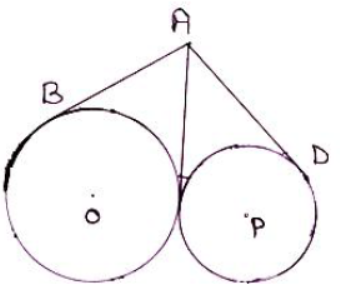
Answer: Since the lengths of tangents drawn from an external point to a circle are equal:
From point \( A \) to the first circle:
\( AC = AB \)
Given that \( AB = 5 \) cm, we have \( AC = 5 \) cm.
From point \( A \) to the second circle:
\( AD = AC \)
Therefore, \( AD = 5 \) cm.
In simple words: The tangents drawn from point A to each circle must be of equal length. Since \( AB = 5 \) cm, the middle tangent \( AC \) is also 5 cm, which in turn makes \( AD = 5 \) cm.
Exam Tip: Tangents from a single external point to a circle are always equal in length. Use this property to step across adjacent circles.
Page 3
Question 16. If PT is tangent to the circle O. Find x + y.
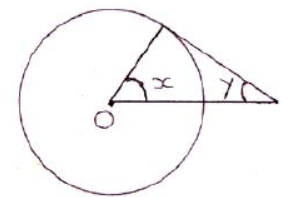
Answer: Since \( OP \) is the radius and \( PT \) is the tangent, the angle between them is a right angle:
\( \angle OPT = 90^o \).
In \( \triangle OPT \), using the angle sum property of a triangle:
\( x + y + \angle OPT = 180^o \)
\( \implies x + y + 90^o = 180^o \)
\( \implies x + y = 90^o \).
In simple words: The radius and tangent meet at 90 degrees. Since the angles in a triangle add up to 180 degrees, the other two angles must add up to 90 degrees.
Exam Tip: The acute angles of a right-angled triangle are always complementary (add up to \( 90^o \)).
Question 17. Find the quadrilateral’s perimeter.
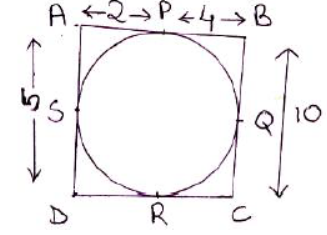
Answer: Let the quadrilateral be \( ABCD \) circumscribing the circle, with tangent points \( P, Q, R, \) and \( S \).
Since lengths of tangents from an external point to a circle are equal:
- From \( A \): \( AS = AP = 2 \) cm
- From \( B \): \( BQ = PB = 4 \) cm
Since \( BC = 10 \) cm, we have:
\( QC = BC - BQ = 10 - 4 = 6 \) cm.
- From \( C \): \( RC = QC = 6 \) cm
Since \( DS = 5 \) cm (as indicated in the diagram):
- From \( D \): \( DR = DS = 5 \) cm.
Now we find the lengths of all sides of the quadrilateral:
- \( AB = AP + PB = 2 + 4 = 6 \) cm
- \( BC = 10 \) cm
- \( CD = CR + RD = 6 + 5 = 11 \) cm
- \( DA = DS + SA = 5 + 2 = 7 \) cm.
The perimeter of quadrilateral \( ABCD \) is the sum of all sides:
Perimeter \( = AB + BC + CD + DA = 6 + 10 + 11 + 7 = 34 \) cm.
In simple words: By matching tangent lengths from each corner of the quadrilateral, we find the lengths of all four outer sides. Adding these sides together gives a total perimeter of 34 cm.
Exam Tip: Label each tangent segment on your diagram first to make the side-summation steps easy to follow and review.
Question 18. Given, PQ = 28 cm, Find the perimeter of ∆PLM.
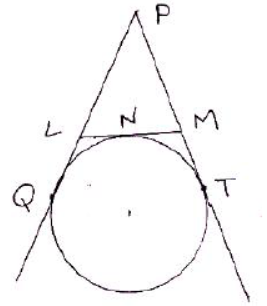
Answer: Let the tangents from point \( P \) be \( PQ \) and \( PR \), so \( PR = PQ = 28 \) cm.
Let the tangent line \( LM \) touch the circle at point \( T \).
The perimeter of \( \triangle PLM \) is:
Perimeter \( = PL + LM + PM = PL + (LT + TM) + PM \)
Since lengths of tangents from an external point are equal:
\( LT = LQ \) (tangents from \( L \))
\( TM = MR \) (tangents from \( M \))
Substituting these into the perimeter equation:
Perimeter \( = PL + LQ + PM + MR = PQ + PR \)
Since \( PQ = PR = 28 \) cm:
Perimeter \( = 28 + 28 = 56 \) cm.
In simple words: The perimeter of the triangle is equal to the sum of the two full tangent lengths drawn from the top point. Since each tangent is 28 cm, the total perimeter is 56 cm.
Exam Tip: This is a classic theorem in circles. The perimeter of such a triangle is always equal to twice the length of the tangent segment from the main external point.
Question 19. Quadrilateral PQRS circumscribes a circle. Find the degree measures of x and y.
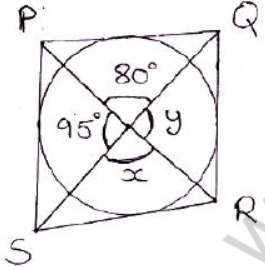
Answer: Since opposite sides of a circumscribing quadrilateral subtend supplementary angles at the center of the circle:
For the opposite sides \( PQ \) and \( RS \) subtending angles at the center:
\( x + 80^o = 180^o \)
\( \implies x = 180^o - 80^o = 100^o \).
Similarly, for opposite sides \( PS \) and \( QR \) subtending angles at the center:
\( y + 95^o = 180^o \)
\( \implies y = 180^o - 95^o = 85^o \).
Therefore, \( x = 100^o \) and \( y = 85^o \).
In simple words: The angles made at the center of the circle by opposite sides of the quadrilateral always add up to 180 degrees. Using this rule, we find \( x = 100^o \) and \( y = 85^o \).
Exam Tip: Remember this supplementary relation for central angles subtended by opposite sides of a circumscribing quadrilateral to solve these questions quickly.
Question 20. In the given fig, if AP = PB, then which two sides of ∆ABC are equal ? Justify your answer.
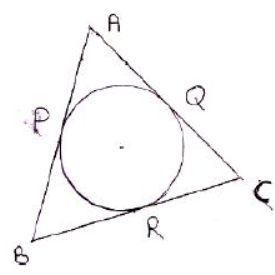
Answer: Let the circle touch the sides \( AB \), \( AC \), and \( BC \) at points \( P \), \( Q \), and \( R \) respectively.
Since lengths of tangents from an external point to a circle are equal:
1. \( AP = AQ \) (tangents from \( A \))
2. \( BP = BR \) (tangents from \( B \))
3. \( CR = CQ \) (tangents from \( C \))
We are given that:
\( AP = PB \)
Since \( AP = AQ \) and \( PB = BR \), we can write:
\( AQ = BR \) - - - (Eq 1)
Now, let us find the lengths of sides \( AC \) and \( BC \):
\( AC = AQ + CQ \)
\( BC = BR + CR \)
Since \( CR = CQ \), we can rewrite \( BC \) as:
\( BC = BR + CQ \)
Using (Eq 1), since \( AQ = BR \):
\( BC = AQ + CQ \)
Therefore, \( AC = BC \).
Thus, the two equal sides of \( \triangle ABC \) are \( AC \) and \( BC \).
In simple words: The equal tangents from each corner combine with the given condition \( AP = PB \) to show that sides \( AC \) and \( BC \) must be equal in length.
Exam Tip: Always make use of the equal tangent segments theorem from each of the vertices to establish relations between the sides of a triangle.
Question 1. In fig, O is the centre of the circle, PQ is tangent to the circle at A. If ∠PAB = 58o, find ∠ABQ and ∠AQB.
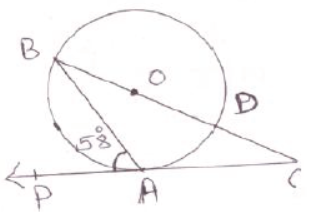
Answer: Since the radius \( OA \) is perpendicular to the tangent line \( PQ \) at the point of contact \( A \), the angle \( \angle OAQ = 90^\circ \).
We are given that the angle \( \angle PAB = 58^\circ \).
We can calculate the angle \( \angle OAB \):
\( \angle OAB = \angle OAQ - \angle PAB = 90^\circ - 58^\circ = 32^\circ \).
In \( \triangle OAB \), since \( OA \) and \( OB \) are both radii of the same circle, the triangle is isosceles, which means the base angles are equal:
\( \angle OBA = \angle OAB = 32^\circ \).
Since point \( B \) lies on the straight line \( OQ \), the angle \( \angle ABQ \) is identical to \( \angle OBA \):
\( \angle ABQ = 32^\circ \).
Now, we apply the exterior angle theorem to \( \triangle ABQ \), where the exterior angle at \( A \) is \( \angle PAB \):
\( \angle PAB = \angle ABQ + \angle AQB \)
\( \implies 58^\circ = 32^\circ + \angle AQB \)
\( \implies \angle AQB = 58^\circ - 32^\circ = 26^\circ \).
Therefore, the required angles are \( \angle ABQ = 32^\circ \) and \( \angle AQB = 26^\circ \).
In simple words: The radius meets the tangent at 90 degrees, leaving 32 degrees for the base angle of the isosceles triangle. Since the outer angle is 58 degrees, subtracting 32 degrees leaves 26 degrees for the angle at point Q.
Exam Tip: Always make use of the fact that the radius of a circle is perpendicular to the tangent at the point of contact to establish your initial 90-degree angle equation.
Question 2. In fig, a circle touches the side BC of ∆ABC at P and touches AB and AC produced at Q and R respectively. If AQ = 5 cm, find the perimeter of ∆ABC.
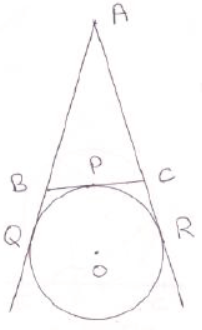
Answer: Since the lengths of tangent segments drawn from an external point to a circle are equal:
1. Tangents from vertex \( A \): \( AQ = AR = 5 \) cm
2. Tangents from vertex \( B \): \( BQ = BP \)
3. Tangents from vertex \( C \): \( CR = CP \)
The perimeter of \( \triangle ABC \) is the sum of its three sides:
Perimeter \( = AB + BC + AC \)
\( \implies \text{Perimeter} = AB + (BP + PC) + AC \)
Substitute \( BP = BQ \) and \( PC = CR \) into the perimeter equation:
\( \implies \text{Perimeter} = AB + BQ + CR + AC \)
Since \( AB + BQ = AQ \) and \( AC + CR = AR \):
\( \implies \text{Perimeter} = AQ + AR \)
Substituting the known value of \( AQ = AR = 5 \) cm:
\( \implies \text{Perimeter} = 5 + 5 = 10 \) cm.
Therefore, the perimeter of \( \triangle ABC \) is 10 cm.
In simple words: The tangents from each corner are equal. Substituting these equal pieces into the perimeter formula shows that the perimeter of the triangle is exactly twice the length of the tangent \( AQ \), which equals 10 cm.
Exam Tip: This is a standard and highly important theorem. Remember that the perimeter of the triangle is always equal to twice the length of the tangent drawn from the opposite main vertex.
Question 3. A tangent PT is drawn 11 to a chord AB as shown in fig. Prove that APB is an isosceles triangle.
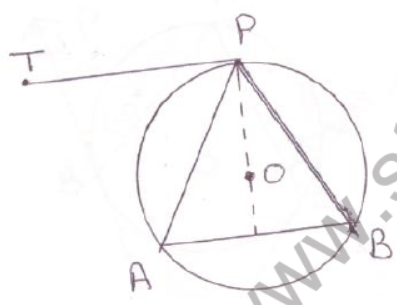
Answer: We are given that the tangent \( PT \) is parallel to the chord \( AB \) (indicated by "11" as a typographical error for "parallel" in the question text).
Since \( PT \parallel AB \) and \( PA \) is a transversal line, the alternate interior angles must be equal:
\( \angle TPA = \angle PAB \) - - - (Eq 1)
According to the Alternate Segment Theorem, the angle between the tangent \( PT \) and the chord \( PA \) is equal to the angle subtended by the chord \( PA \) in the alternate segment:
\( \angle TPA = \angle PBA \) - - - (Eq 2)
Equating (Eq 1) and (Eq 2):
\( \angle PAB = \angle PBA \).
In \( \triangle APB \), since the base angles \( \angle PAB \) and \( \angle PBA \) are equal, the sides opposite to these angles must also be equal:
\( AP = BP \).
Therefore, \( \triangle APB \) is an isosceles triangle.
Hence proved.
In simple words: Because the tangent and the chord are parallel, they make equal alternate angles. Combined with the alternate segment theorem, this shows that the two base angles of the triangle are equal, proving it is isosceles.
Exam Tip: The Alternate Segment Theorem is a powerful tool. Clearly state how the angle between the tangent and chord relates to the angle in the opposite segment to secure full marks.
Question 4. In the fig XP and XQ are two tangents to a circle with centre O from a point X outside the circle. ARB is the tangent to circle at R. Prove that XA + AR = XY + BR.
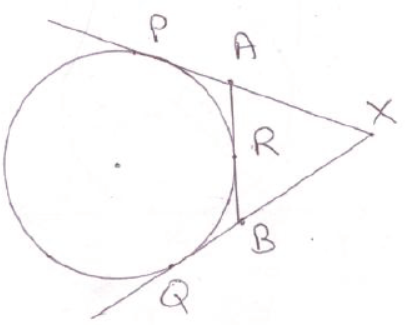
Answer: Since \( XP \) and \( XQ \) are tangents drawn from the same external point \( X \) to the circle, their lengths are equal:
\( XP = XQ \) - - - (Eq 1)
Similarly, \( AP \) and \( AR \) are tangents drawn from the external point \( A \) to the circle, so:
\( AP = AR \) - - - (Eq 2)
From point \( B \) (which is represented as \( Y \) in the question text due to a typographical error), the tangent segments \( BQ \) and \( BR \) are also equal:
\( BQ = BR \) - - - (Eq 3)
We can write the main tangent equality from (Eq 1) as:
\( XA + AP = XB + BQ \)
Substituting the equal tangent values from (Eq 2) and (Eq 3) into this equation:
\( \implies XA + AR = XB + BR \) (which corresponds to \( XA + AR = XY + BR \)).
Hence proved.
In simple words: Since the main tangents from the outside point are equal, we can write them as the sum of their parts. Substituting the smaller equal tangent segments from each corner gives the required proof.
Exam Tip: Keep in mind that tangents drawn from any external point to a circle are always equal. This simple property is key to solving most multi-segment proof questions.
Question 5. Two tangents PA and PB are drawn to a circle with centre O from an external point P. Prove that \( \angle APB = 2 \angle OAB \).
Answer: Let the angle \( \angle APB \) be \( \theta \).
Since the lengths of tangents drawn from an external point to a circle are equal, we have:
\( PA = PB \)
This makes \( \triangle PAB \) an isosceles triangle, which means:
\( \angle PAB = \angle PBA \)
By the angle sum property of a triangle:
\( \angle APB + \angle PAB + \angle PBA = 180^\circ \)
\( \implies \theta + 2\angle PAB = 180^\circ \)
\( \implies 2\angle PAB = 180^\circ - \theta \)
\( \implies \angle PAB = 90^\circ - \frac{\theta}{2} \)
Since the radius is perpendicular to the tangent at the point of contact:
\( \angle OAP = 90^\circ \)
Now, we can find \( \angle OAB \):
\( \angle OAB = \angle OAP - \angle PAB \)
\( \implies \angle OAB = 90^\circ - \left(90^\circ - \frac{\theta}{2}\right) \)
\( \implies \angle OAB = \frac{\theta}{2} \)
\( \implies 2\angle OAB = \theta \)
Substituting \( \theta = \angle APB \), we get:
\( \angle APB = 2\angle OAB \)
Hence proved.
In simple words: Since PA and PB are equal tangents, triangle PAB is isosceles. By calculating its base angles and using the fact that radius OA is perpendicular to tangent PA, we can show that the angle at P is twice the size of angle OAB.
Exam Tip: Remember to state clearly that the radius is perpendicular to the tangent at the point of contact - this is a key marking step in board exams.
Question 6. Prove that parallelogram circumscribing a circle is a rhombus.
Answer: Let ABCD be a parallelogram circumscribing a circle with centre O. Let the sides AB, BC, CD, and DA touch the circle at points P, Q, R, and S respectively.
Since the lengths of tangents drawn from an external point to a circle are equal:
\( AP = AS \)
\( BP = BQ \)
\( CR = CQ \)
\( DR = DS \)
Adding these four equations, we get:
\( (AP + BP) + (CR + DR) = (AS + DS) + (BQ + CQ) \)
\( \implies AB + CD = AD + BC \)
Since ABCD is a parallelogram, its opposite sides are equal:
\( AB = CD \)
\( AD = BC \)
Substituting these values into the equation:
\( AB + AB = AD + AD \)
\( \implies 2AB = 2AD \)
\( \implies AB = AD \)
Since ABCD is a parallelogram with adjacent sides equal, it is a rhombus.
Hence proved.
In simple words: By equating the tangent segments from each corner of the parallelogram, we find that the sum of opposite sides is equal. Since it is a parallelogram, this forces all four sides to be equal, making it a rhombus.
Exam Tip: Be sure to group the tangent segments correctly when adding them up (e.g., AP + PB to form AB) so that you get the proper sides of the quadrilateral.
Question 7. If all sides of a parallelogram touch a circle, show that llgm is a rhombus.
Answer: Let the parallelogram be ABCD, circumscribing a circle. Let the points of contact of the sides AB, BC, CD, and DA with the circle be P, Q, R, and S respectively.
Since tangent segments drawn from an external point to a circle are equal in length:
\( AP = AS \)
\( BP = BQ \)
\( CR = CQ \)
\( DR = DS \)
Summing these four equations:
\( (AP + BP) + (CR + DR) = (AS + DS) + (BQ + CQ) \)
\( \implies AB + CD = AD + BC \)
Since the opposite sides of a parallelogram are equal, we can write \( CD = AB \) and \( BC = AD \):
\( AB + AB = AD + AD \)
\( \implies 2AB = 2AD \)
\( \implies AB = AD \)
Since adjacent sides of this parallelogram are equal, all four sides must be equal. Therefore, the parallelogram is a rhombus.
Hence proved.
In simple words: This proof uses the property that tangent segments from any vertex are equal. Combining this with the fact that opposite sides of a parallelogram are equal shows that all sides are equal, which defines a rhombus.
Exam Tip: Highlighting that a parallelogram with equal adjacent sides is a rhombus is essential for securing full marks in this proof.
Question 8. If fig, there are two concentric circles with centre O and radii 5 cm and 3 cm. From an external point P tangents PA and PB are drawn to these circles. If AP = 12 cm, find the length of BP.
Answer: Let the radius of the outer circle be \( OA = 5\text{ cm} \) and the radius of the inner circle be \( OB = 3\text{ cm} \).
Since PA is a tangent to the outer circle at point A, the radius OA is perpendicular to PA:
\( \angle OAP = 90^\circ \)
In right-angled \( \triangle OAP \), using Pythagoras' theorem:
\( OP^2 = OA^2 + AP^2 \)
\( \implies OP^2 = 5^2 + 12^2 = 25 + 144 = 169 \)
\( \implies OP = 13\text{ cm} \)
Since PB is a tangent to the inner circle at point B, the radius OB is perpendicular to PB:
\( \angle OBP = 90^\circ \)
In right-angled \( \triangle OBP \), using Pythagoras' theorem:
\( OP^2 = OB^2 + BP^2 \)
\( \implies 13^2 = 3^2 + BP^2 \)
\( \implies 169 = 9 + BP^2 \)
\( \implies BP^2 = 160 \)
\( \implies BP = \sqrt{160} = 4\sqrt{10}\text{ cm} \approx 12.65\text{ cm} \)
The length of BP is \( 4\sqrt{10}\text{ cm} \) (or approximately \( 12.65\text{ cm} \)).
In simple words: First, we use the right triangle OAP to find the distance OP. Then, we use this distance OP in the second right triangle OBP to solve for the missing tangent length BP.
Exam Tip: Do not forget to write down the final units (cm) for your calculated lengths to prevent minor mark deductions.
Question 9. In the given fig, TAS is a tangent to a circle, with centre O, at the point A. If ∠OBA = 32°, find the value of x.
Answer: In \( \triangle OAB \), since both OA and OB are radii of the circle:
\( OA = OB \)
This means \( \triangle OAB \) is an isosceles triangle, so:
\( \angle OAB = \angle OBA = 32^\circ \)
Since the tangent TAS is perpendicular to the radius OA at the point of contact A:
\( \angle OAS = 90^\circ \)
From the figure, the angle \( x \) is \( \angle BAS \):
\( x = \angle OAS - \angle OAB \)
\( \implies x = 90^\circ - 32^\circ = 58^\circ \)
The value of \( x \) is \( 58^\circ \).
In simple words: Since OA and OB are equal radii, the two base angles of triangle OAB are both 32 degrees. Knowing that the total angle between the radius and the tangent is 90 degrees, we subtract 32 from 90 to get x = 58 degrees.
Exam Tip: Clearly state that the triangle OAB is isosceles because the sides are radii of the same circle - this justifies why the two base angles are equal.
Question 10. In the given fig, ABC is a right angled ∆. Right angled at A, with AB = 6 cm and AC = 8 cm. A circle with centre O has been inscribed inside the triangle. Calculate the value of r.
Answer: In the right-angled triangle ABC (right-angled at A), using Pythagoras' theorem:
\( BC = \sqrt{AB^2 + AC^2} = \sqrt{6^2 + 8^2} = \sqrt{36 + 64} = 10\text{ cm} \)
Let the inscribed circle touch the sides AB, BC, and CA at points Q, S, and P respectively.
Since the tangent segments from a single external point are equal in length:
\( AQ = AP = r \)
\( BQ = BS \)
\( CP = CS \)
We can write:
\( BQ = AB - AQ = 6 - r \implies BS = 6 - r \)
\( CP = AC - AP = 8 - r \implies CS = 8 - r \)
Since \( BC = BS + CS \):
\( 10 = (6 - r) + (8 - r) \)
\( \implies 10 = 14 - 2r \)
\( \implies 2r = 4 \)
\( \implies r = 2\text{ cm} \)
The value of \( r \) is \( 2\text{ cm} \).
In simple words: First we find the hypotenuse using Pythagoras' theorem. Then, we use the equal tangent lengths from the corners of the triangle to set up an equation for the radius, finding that r = 2 cm.
Exam Tip: You can also use the area formula for an inradius \( r = \frac{\text{Area}}{\text{semi-perimeter}} \) to quickly double-check your answer during the exam.
Question 11. P is the midpoint of are QPR of a circle. Show that the tangent at P is parallel to chord QR.
Answer: Let the tangent drawn at point P be XY.
Since P is the midpoint of arc QPR:
arc QP = arc PR
This implies that the chords corresponding to these arcs are equal:
\( QP = PR \)
In \( \triangle PQR \), since \( QP = PR \), the opposite angles must be equal:
\( \angle PQR = \angle PRQ \)
By the alternate segment theorem, the angle between the tangent XY at P and the chord PQ is equal to the angle subtended by PQ in the alternate segment:
\( \angle QPX = \angle PRQ \)
Since \( \angle PQR = \angle PRQ \), we get:
\( \angle QPX = \angle PQR \)
These two equal angles (\( \angle QPX \) and \( \angle PQR \)) are alternate interior angles.
Therefore, the tangent XY at P is parallel to the chord QR.
Hence proved.
In simple words: Since P is the midpoint of the arc, chords PQ and PR are equal, making the triangle PQR isosceles. This makes the alternate segment angles equal, which proves that the tangent at P is parallel to chord QR.
Exam Tip: The Alternate Segment Theorem is a crucial concept here; explicitly stating its name and how it applies to the angles is key to getting full credit.
Question 12. If ∆ABC is a isosceles with AB = AC, and C(0, r) is incircle of ∆ ABC touching BC at L. Prove that the point L bisects BC.
Answer: Let the incircle with centre O and radius r touch the sides AB, AC, and BC at points M, N, and L respectively.
The lengths of tangents drawn from an external point to a circle are equal:
\( AM = AN \)
\( BM = BL \)
\( CN = CL \)
We are given that \( \triangle ABC \) is an isosceles triangle with \( AB = AC \):
\( AM + BM = AN + CN \)
Since \( AM = AN \), we can subtract this from both sides of the equation:
\( BM = CN \)
Using the tangent equalities \( BM = BL \) and \( CN = CL \):
\( BL = CL \)
This proves that point L is the midpoint of BC, and therefore L bisects BC.
Hence proved.
In simple words: Since the triangle is isosceles and the tangent lengths from each corner are equal, the leftover pieces on the base BC must also be equal. This means the contact point L lies exactly in the middle of BC.
Exam Tip: Clearly list the three pairs of equal tangents first; this structured approach makes the rest of the algebraic proof simple to follow.
Question 13. In the given fig, O is the centre of the circle. Determine ∠AQB and ∠AMB.
Answer: We are given that \( \angle APB = 75^\circ \) and that PA and PB are tangents to the circle from point P.
Since the radius is perpendicular to the tangent at the point of contact:
\( \angle OAP = 90^\circ \)
\( \angle OBP = 90^\circ \)
In quadrilateral AOBP, the sum of all angles is \( 360^\circ \):
\( \angle AOB + \angle OAP + \angle OBP + \angle APB = 360^\circ \)
\( \implies \angle AOB + 90^\circ + 90^\circ + 75^\circ = 360^\circ \)
\( \implies \angle AOB + 255^\circ = 360^\circ \)
\( \implies \angle AOB = 105^\circ \)
The angle subtended by an arc at the centre is double the angle subtended by it at any point on the remaining part of the circle:
\( \angle AQB = \frac{1}{2} \angle AOB = \frac{1}{2} \times 105^\circ = 52.5^\circ \)
Since AQBM is a cyclic quadrilateral, its opposite angles are supplementary:
\( \angle AMB + \angle AQB = 180^\circ \)
\( \implies \angle AMB + 52.5^\circ = 180^\circ \)
\( \implies \angle AMB = 180^\circ - 52.5^\circ = 127.5^\circ \)
Therefore, \( \angle AQB = 52.5^\circ \) and \( \angle AMB = 127.5^\circ \).
In simple words: We find the angle at the center by subtracting the other angles of the quadrilateral from 360 degrees. The angle on the circumference is half of this center angle, and the opposite angle in the cyclic quadrilateral is found by subtracting from 180 degrees.
Exam Tip: Be careful not to confuse the major and minor arc angles. The angle at the circumference is always half of the angle subtended by the same arc at the center.
Question 14. In the given fig, RS as the tangent to the circle at L and MN is a diameter. If ∠NML = 30°, determine ∠RLM.
Answer: Since MN is a diameter of the circle, the angle subtended by it in the semicircle is a right angle:
\( \angle MLN = 90^\circ \)
In \( \triangle MLN \), the sum of angles is \( 180^\circ \):
\( \angle LNM = 180^\circ - \angle MLN - \angle NML \)
\( \implies \angle LNM = 180^\circ - 90^\circ - 30^\circ = 60^\circ \)
By the alternate segment theorem, the angle between the tangent RS and the chord ML at the point of contact L is equal to the angle subtended by the chord ML in the alternate segment:
\( \angle RLM = \angle LNM = 60^\circ \)
Therefore, \( \angle RLM = 60^\circ \).
In simple words: The angle in the semicircle is 90 degrees, so the remaining angle of the triangle is 60 degrees. By the alternate segment theorem, the angle between the tangent and chord is equal to this 60-degree angle.
Exam Tip: State the angle-in-a-semicircle theorem clearly as it helps explain why \( \angle MLN \) is \( 90^\circ \).
Question 15. If the given fig, find x if ∠EBD = 146°.
Answer: Since EBC is a straight tangent line touching the circle at B, the sum of angles on a straight line is \( 180^\circ \):
\( \angle DBC = 180^\circ - \angle EBD \)
\( \implies \angle DBC = 180^\circ - 146^\circ = 34^\circ \)
By the alternate segment theorem, the angle between the tangent line EBC and the chord BD is equal to the angle subtended by the chord in the alternate segment:
\( \angle BAD = \angle DBC \)
Given that \( x = \angle BAD \), we have:
\( x = 34^\circ \)
Therefore, the value of \( x \) is \( 34^\circ \).
In simple words: Subtract 146 from 180 to find the angle DBC, which is 34 degrees. The alternate segment theorem tells us that the angle x is equal to this angle DBC, so x is 34 degrees.
Exam Tip: The alternate segment theorem is often the fastest way to solve angle-chasing problems involving tangents. Remember to quote the theorem name for full marks.
Question 16. In the given fig, TBP and TCQ are tangent to the circle whose centre is O. Also ∠PBA = 60°, ∠ACQ = 70°. Determine ∠BAC and ∠BTC.
Answer: By the alternate segment theorem, the angle between a tangent and a chord is equal to the angle in the alternate segment:
\( \angle ACB = \angle PBA = 60^\circ \)
\( \angle ABC = \angle ACQ = 70^\circ \)
In \( \triangle ABC \), the sum of all interior angles is \( 180^\circ \):
\( \angle BAC + \angle ABC + \angle ACB = 180^\circ \)
\( \implies \angle BAC + 70^\circ + 60^\circ = 180^\circ \)
\( \implies \angle BAC = 50^\circ \)
Now, the angle subtended by arc BC at the centre O is twice the angle at the circumference:
\( \angle BOC = 2\angle BAC = 2 \times 50^\circ = 100^\circ \)
In quadrilateral OBTC, the radii OB and OC are perpendicular to the tangents TB and TC:
\( \angle OBT = 90^\circ \)
\( \angle OCT = 90^\circ \)
The sum of angles in quadrilateral OBTC is \( 360^\circ \):
\( \angle BTC + \angle OBT + \angle OCT + \angle BOC = 360^\circ \)
\( \implies \angle BTC + 90^\circ + 90^\circ + 100^\circ = 360^\circ \)
\( \implies \angle BTC = 180^\circ - 100^\circ = 80^\circ \)
Thus, \( \angle BAC = 50^\circ \) and \( \angle BTC = 80^\circ \).
In simple words: We find the angles in triangle ABC using the alternate segment theorem. Then we calculate the angle BOC at the center, which is twice BAC, and finally use quadrilateral OBTC to find BTC as 80 degrees.
Exam Tip: Be sure to divide the multi-step problem into clear parts for BAC and BTC to show your working logically to the examiner.
Question 17. PQ and PR are tangents segments to a circle with centre O. If ∠QPR = 80°, find ∠QOR.
Answer: Since PQ and PR are tangents to the circle from an external point P, the radii OQ and OR are perpendicular to the tangents:
\( \angle OQP = 90^\circ \)
\( \angle ORP = 90^\circ \)
In quadrilateral OQPR, the sum of all interior angles is \( 360^\circ \):
\( \angle QOR + \angle OQP + \angle ORP + \angle QPR = 360^\circ \)
\( \implies \angle QOR + 90^\circ + 90^\circ + 80^\circ = 360^\circ \)
\( \implies \angle QOR + 260^\circ = 360^\circ \)
\( \implies \angle QOR = 100^\circ \)
Therefore, \( \angle QOR = 100^\circ \).
In simple words: The angles of the quadrilateral OQPR must add up to 360 degrees. Since the two tangent angles are 90 degrees each, the angle at the center and the angle between the tangents must add up to 180 degrees. Thus, 180 minus 80 gives 100 degrees.
Exam Tip: You can directly state that the opposite angles of a tangent-quadrilateral at the center and the external point are supplementary (\( \angle QOR + \angle QPR = 180^\circ \)) to save time.
Question 18. Prove that in two concentric circles, the chord of the larger circle which touches the smaller circle is bisected at the point of contact.
Answer: Let there be two concentric circles with a common centre O.
Let AB be a chord of the larger circle which touches the smaller circle at point C.
Since AB touches the smaller circle, it acts as a tangent to the smaller circle at C.
Therefore, the radius OC of the smaller circle is perpendicular to the tangent AB:
\( OC \perp AB \)
Since AB is a chord of the larger circle and \( OC \perp AB \), we apply the theorem that the perpendicular from the centre of a circle to a chord bisects the chord.
Therefore, C is the midpoint of AB:
\( AC = BC \)
Hence proved.
In simple words: The line from the center is perpendicular to the tangent at the contact point. For the larger circle, this line is a perpendicular bisector of the chord, dividing it into two equal halves.
Exam Tip: This proof relies on two separate circle properties. Make sure to list both (radius-tangent perpendicularity and chord bisector theorem) to earn full credit.
Question 19. In fig AB and CD are two parallel tangents to a circle with centre O. ST is tangent between he two parallel tangents touching the circle at Q. Show that ∠SOT = 90°.
Answer: Let the tangents AB and CD touch the circle at points P and R respectively. Since AB and CD are parallel tangents, PR is a diameter and thus POR is a straight line.
Join OP, OQ, and OR.
In triangles OSP and OSQ:
- \( OP = OQ \) (radii of the same circle)
- \( OS = OS \) (common side)
- \( SP = SQ \) (lengths of tangents from external point S are equal)
By SSS congruence criterion:
\( \triangle OSP \cong \triangle OSQ \)
\( \implies \angle SOP = \angle SOQ \)
Similarly, in triangles OTQ and OTR:
- \( OQ = OR \) (radii of the same circle)
- \( OT = OT \) (common side)
- \( TQ = TR \) (lengths of tangents from external point T are equal)
By SSS congruence criterion:
\( \triangle OTQ \cong \triangle OTR \)
\( \implies \angle TOQ = \angle TOR \)
Since POR is a straight line, the sum of angles along it is \( 180^\circ \):
\( \angle SOP + \angle SOQ + \angle TOQ + \angle TOR = 180^\circ \)
\( \implies 2\angle SOQ + 2\angle TOQ = 180^\circ \)
\( \implies 2(\angle SOQ + \angle TOQ) = 180^\circ \)
\( \implies \angle SOQ + \angle TOQ = 90^\circ \)
\( \implies \angle SOT = 90^\circ \)
Hence proved.
In simple words: By proving the top two triangles are congruent and the bottom two triangles are congruent, we show that the angles at O are bisected. Since all four angles lie on a straight line and sum to 180 degrees, the middle two angles must sum to 90 degrees.
Exam Tip: Showing the SSS congruency of the triangles is the foundation of this proof; write down all three pairs of equal sides explicitly.
Question 20. In the fig, a circle is inscribed in a quadrilateral ABCD in which ∠B = 90°. If AD = 23 cm, AB = 29 cm and DS = 5 cm. Find the radius of the circle.
Answer: Let the circle touch the sides AB, BC, CD, and DA at points Q, P, S, and R respectively.
Since tangent segments drawn from an external point to a circle are equal in length:
\( DR = DS = 5\text{ cm} \)
Since \( AD = 23\text{ cm} \):
\( AR = AD - DR = 23 - 5 = 18\text{ cm} \)
Since tangent segments from A are equal:
\( AQ = AR = 18\text{ cm} \)
Since \( AB = 29\text{ cm} \):
\( QB = AB - AQ = 29 - 18 = 11\text{ cm} \)
In quadrilateral OQBP:
- \( \angle B = 90^\circ \) (given)
- \( \angle OQB = 90^\circ \) (radius is perpendicular to tangent AB)
- \( \angle OPB = 90^\circ \) (radius is perpendicular to tangent BC)
Therefore, the fourth angle is also:
\( \angle POQ = 360^\circ - (90^\circ + 90^\circ + 90^\circ) = 90^\circ \)
This makes OQBP a rectangle. Since its adjacent sides are equal radii (\( OQ = OP = r \)), OQBP is a square.
Therefore:
\( r = QB = 11\text{ cm} \)
The radius of the circle is \( 11\text{ cm} \).
In simple words: By matching tangent lengths, we subtract the known lengths from the sides of the quadrilateral to find the remaining piece. Since the corner of the quadrilateral has a 90-degree angle, it forms a square with the radii, making the radius equal to this remaining piece of 11 cm.
Exam Tip: Be sure to write a line proving that the corner quadrilateral OQBP is a square, as this is necessary to establish \( r = QB \).
Question 21. In fig, OP is equal to diameter of the circle. Prove that ABP is an equilateral ∆.
Answer: Let the radius of the circle be \( r \). Thus, the diameter is \( 2r \).
We are given that \( OP = 2r \).
Let PA and PB be the tangents from point P to the circle.
Since the radius OA is perpendicular to the tangent PA:
\( \angle OAP = 90^\circ \)
In right-angled \( \triangle OAP \):
\( \sin(\angle OPA) = \frac{OA}{OP} = \frac{r}{2r} = \frac{1}{2} \)
\( \implies \angle OPA = 30^\circ \)
Similarly, in right-angled \( \triangle OBP \):
\( \angle OPB = 30^\circ \)
Therefore, the total angle at P is:
\( \angle APB = \angle OPA + \angle OPB = 30^\circ + 30^\circ = 60^\circ \)
Since the tangents from an external point are equal in length, \( PA = PB \). This means \( \triangle ABP \) is an isosceles triangle with:
\( \angle PAB = \angle PBA \)
By the angle sum property of \( \triangle ABP \):
\( \angle APB + \angle PAB + \angle PBA = 180^\circ \)
\( \implies 60^\circ + 2\angle PAB = 180^\circ \)
\( \implies 2\angle PAB = 120^\circ \)
\( \implies \angle PAB = 60^\circ \)
Since \( \angle PAB = \angle PBA = \angle APB = 60^\circ \), \( \triangle ABP \) is an equilateral triangle.
Hence proved.
In simple words: By using trigonometry on the right triangle OAP, we find the half-angle at P is 30 degrees, making the whole angle APB equal to 60 degrees. Since the tangents PA and PB are equal, the base angles are also 60 degrees, which makes it an equilateral triangle.
Exam Tip: Using the sine ratio (\( \sin \theta \)) is the most direct way to solve for the angle in this proof; show the step clearly.
LONG ANSWER TYPE (4 marks)
Question 1. If a hexagon ABCDEF circumscribes a circle, prove that AB + CD + EF = BC + DE + FA.
Answer: Let the sides AB, BC, CD, DE, EF, and FA of the hexagon touch the circle at points P, Q, R, S, T, and U respectively.
Since the lengths of tangent segments drawn from an external point to a circle are equal:
\( AP = AU \)
\( BP = BQ \)
\( CQ = CR \)
\( DR = DS \)
\( ES = ET \)
\( FT = FU \)
Now, let us calculate the sum of alternate sides:
\( AB + CD + EF = (AP + PB) + (CR + RD) + (ET + TF) \)
Substituting the equal tangent values:
\( AB + CD + EF = (AU + BQ) + (CQ + DS) + (ES + FU) \)
Rearranging the terms on the right-hand side:
\( AB + CD + EF = (BQ + CQ) + (DS + ES) + (FU + AU) \)
Since \( BQ + CQ = BC \), \( DS + ES = DE \), and \( FU + AU = FA \), we get:
\( AB + CD + EF = BC + DE + FA \)
Hence proved.
In simple words: Just like the quadrilateral proof, we break each side of the hexagon into its constituent tangent segments. Swapping these equal segments and regrouping them gives the sum of the alternate three sides.
Exam Tip: List all six equations of equal tangent segments at the start of your answer. This makes the proof easy to read and grade.
Question 2. Prove that the tangent at any point of a circle is perpendicular to the radius through the point of contact. Using the above, do the following : O is the centre of two concentric circles. AB is a chord of the larger circle touching the smaller circle at C. Prove that AC = BC.
Answer: Part 1: Tangent-Radius Perpendicularity Theorem
Let there be a circle with centre O and a tangent XY touching the circle at point of contact P.
We need to prove that \( OP \perp XY \).
Take any point Q on the tangent line XY other than P, and join OQ.
Since Q lies on the tangent line, it must lie outside the circle (if it lay inside, the line XY would cut the circle at two points and become a secant).
Therefore, the distance of Q from O is greater than the radius OP:
\( OQ > OP \)
Since this is true for any point Q on the tangent XY other than P, OP is the shortest distance from the centre O to the line XY. We know that the shortest distance from a point to a line is the perpendicular distance.
Therefore, \( OP \perp XY \).
Hence proved.
Part 2: Concentric Circles Chord Proof
Since AB is a chord of the larger circle that touches the smaller circle at point C, AB is a tangent to the smaller circle at C.
Using the theorem proved in Part 1, the radius OC of the smaller circle is perpendicular to the tangent AB:
\( OC \perp AB \)
Now, for the larger circle, AB is a chord and \( OC \perp AB \) is the perpendicular from the centre.
We know that the perpendicular from the centre of a circle to a chord bisects the chord.
Therefore, \( AC = BC \).
Hence proved.
In simple words: First we show that the tangent is perpendicular because any other point on it is further from the center than the radius. Then, applying this to the concentric circles shows that OC is perpendicular to AB, which bisects the chord into two equal parts AC and BC.
Exam Tip: When proving the first part, mention why point Q must lie outside the circle; this is a critical logical step in the proof.
Question 3. O is the centre of a circle. PA and PB are two tangents to a circle from a point P. Prove that (i) PAOB is a cyclic quadrilateral (ii) PO is the bisector of ∠APB (iii) ∠OAB = ∠OPA.
Answer: (i) Since PA and PB are tangents to the circle at A and B, the radii OA and OB are perpendicular to the tangents:
\( \angle OAP = 90^\circ \)
\( \angle OBP = 90^\circ \)
In quadrilateral PAOB, the sum of opposite angles is:
\( \angle OAP + \angle OBP = 90^\circ + 90^\circ = 180^\circ \)
Since the opposite angles of the quadrilateral sum to \( 180^\circ \), PAOB is a cyclic quadrilateral.
(ii) In triangles OAP and OBP:
- \( OA = OB \) (radii of the same circle)
- \( OP = OP \) (common side)
- \( PA = PB \) (tangents from an external point are equal)
By SSS congruence criterion:
\( \triangle OAP \cong \triangle OBP \)
Therefore, \( \angle OPA = \angle OPB \) (by CPCT).
This shows that PO is the angle bisector of \( \angle APB \).
(iii) Let \( \angle OPA = \theta \). Since PO bisects \( \angle APB \), we have \( \angle APB = 2\theta \).
Since \( OA = OB \), \( \triangle OAB \) is an isosceles triangle, so \( \angle OAB = \angle OBA \).
In right-angled \( \triangle OAP \):
\( \angle AOP = 90^\circ - \angle OPA = 90^\circ - \theta \)
Similarly, \( \angle BOP = 90^\circ - \theta \).
Therefore:
\( \angle AOB = \angle AOP + \angle BOP = (90^\circ - \theta) + (90^\circ - \theta) = 180^\circ - 2\theta \)
In \( \triangle OAB \), the sum of angles is \( 180^\circ \):
\( \angle OAB + \angle OBA + \angle AOB = 180^\circ \)
\( \implies 2\angle OAB + (180^\circ - 2\theta) = 180^\circ \)
\( \implies 2\angle OAB = 2\theta \)
\( \implies \angle OAB = \theta \)
Since both \( \angle OAB = \theta \) and \( \angle OPA = \theta \), we have:
\( \angle OAB = \angle OPA \).
Hence proved.
In simple words: The opposite angles of PAOB sum to 180 degrees, which makes it cyclic. Congruency proves that PO is the angle bisector. Using basic angle properties of right triangles and isosceles triangles, we show that angle OAB equals angle OPA.
Exam Tip: Remember to quote "CPCT" (Corresponding Parts of Congruent Triangles) when establishing the angle equality in part (ii).
Question 4. From an external point P, two tangents PA and PB are drawn to a circle with centre O as shown in the fig. Show that OP is perpendicular bisector of AB.
Answer: Let OP intersect the chord AB at point M.
Consider triangles PAM and PBM:
- \( PA = PB \) (lengths of tangents from external point P are equal)
- \( \angle APM = \angle BPM \) (since OP is the bisector of \( \angle APB \))
- \( PM = PM \) (common side)
By SAS congruence criterion:
\( \triangle PAM \cong \triangle PBM \)
Therefore, by CPCT:
- \( AM = BM \)
- \( \angle AMP = \angle BMP \)
Since \( \angle AMP \) and \( \angle BMP \) form a linear pair on the line segment AB:
\( \angle AMP + \angle BMP = 180^\circ \)
\( \implies 2\angle AMP = 180^\circ \)
\( \implies \angle AMP = 90^\circ \)
Since \( AM = BM \) and \( \angle AMP = 90^\circ \), OP is the perpendicular bisector of AB.
Hence proved.
In simple words: By using the SAS congruency rule, we prove that the triangles PAM and PBM are identical. This shows that the line segments AM and BM are equal, and the angles at M are 90 degrees each.
Exam Tip: Showing that the angles at M form a linear pair and sum to 180 degrees is the key mathematical step in proving perpendicularity.
Question 5. In fig O is the centre of circle with radius 5 cm. T is a point such that OT = 13 cm and OT intersects the circle at E, Find the length of AB.
Answer: Let the tangents to the circle from T be TP and TQ, with AB being another tangent touching the circle at E.
In right-angled \( \triangle OPT \) (since radius OP is perpendicular to tangent TP):
\( PT = \sqrt{OT^2 - OP^2} = \sqrt{13^2 - 5^2} = \sqrt{169 - 25} = 12\text{ cm} \)
Since OE is the radius, \( OE = 5\text{ cm} \).
The remaining part of segment OT is:
\( TE = OT - OE = 13 - 5 = 8\text{ cm} \)
Since AB is a tangent at E, the radius OE is perpendicular to AB, so \( \angle AET = 90^\circ \).
Let \( AP = AE = x \) (tangents from A to the circle are equal).
Therefore, \( AT = PT - AP = 12 - x \).
In right-angled \( \triangle AET \):
\( AT^2 = AE^2 + TE^2 \)
\( \implies (12 - x)^2 = x^2 + 8^2 \)
\( \implies 144 - 24x + x^2 = x^2 + 64 \)
\( \implies 24x = 80 \)
\( \implies x = \frac{80}{24} = \frac{10}{3}\text{ cm} \)
By symmetry, \( BE = x = \frac{10}{3}\text{ cm} \).
The total length of AB is:
\( AB = AE + EB = \frac{10}{3} + \frac{10}{3} = \frac{20}{3}\text{ cm} \approx 6.67\text{ cm} \).
In simple words: First, find the tangent PT as 12 cm using Pythagoras. Set up right triangle AET with one leg as the radius piece (8 cm) and another as x. Solving for x gives 10/3 cm, and doubling it gives the total tangent AB as 20/3 cm.
Exam Tip: Setting up the algebraic equation \( (12-x)^2 = x^2 + 8^2 \) is the crucial step. Carefully expand and solve without arithmetic mistakes.
Question 6. QR is a tangent at Q. PR || OQ, where AQ is a chord through A and P is a centre, the end point of diameter AB. Prove that BR is tangent at B.
Answer: Let the circle have center P and diameter AB. We are given that AQ is parallel to PR, and QR is a tangent to the circle at Q.
In \( \triangle APQ \), since AP and PQ are radii of the same circle:
\( AP = PQ \)
This means the base angles of \( \triangle APQ \) are equal:
\( \angle PAQ = \angle PQA \)
Since AQ is parallel to PR:
- \( \angle PAQ = \angle BPR \) (corresponding angles, since A-P-B is a straight line)
- \( \angle PQA = \angle QPR \) (alternate interior angles)
Since \( \angle PAQ = \angle PQA \), we can equate their equivalent angles:
\( \angle QPR = \angle BPR \)
Now, consider triangles PQR and PBR:
- \( PQ = PB \) (radii of the same circle)
- \( \angle QPR = \angle BPR \) (proved above)
- \( PR = PR \) (common side)
By SAS congruence criterion:
\( \triangle PQR \cong \triangle PBR \)
Therefore, by CPCT:
\( \angle PBR = \angle PQR \)
Since QR is tangent at Q, the radius PQ is perpendicular to QR:
\( \angle PQR = 90^\circ \)
Thus:
\( \angle PBR = 90^\circ \)
Since PB is the radius of the circle, the line BR is perpendicular to the radius at its endpoint B.
Therefore, BR is a tangent to the circle at B.
Hence proved.
In simple words: Since AQ is parallel to PR, we use alternate and corresponding angles to show that the angles at the center are equal. By proving the two triangles congruent, the angle at B must equal the 90-degree tangent angle at Q, which proves BR is a tangent.
Exam Tip: Be sure to prove the SAS congruence step clearly as it directly leads to showing that \( \angle PBR = 90^\circ \).
Question 7. If a circle touches the side BC of a triangle ABC at P and extended sides AB and AC at Q and R, prove that AQ = ½(BC + CA + AB).
Answer: Since the lengths of tangents drawn from an external point to a circle are equal:
- Tangents from A: \( AQ = AR \)
- Tangents from B: \( BQ = BP \)
- Tangents from C: \( CR = CP \)
Now, the perimeter of \( \triangle ABC \) is given by:
Perimeter \( = AB + BC + CA \)
\( \implies \text{Perimeter} = AB + (BP + PC) + CA \)
Substituting \( BP = BQ \) and \( PC = CR \):
\( \implies \text{Perimeter} = AB + BQ + CR + CA \)
Since \( AB + BQ = AQ \) and \( AC + CR = AR \):
\( \implies \text{Perimeter} = AQ + AR \)
Since \( AQ = AR \):
\( \implies \text{Perimeter} = AQ + AQ = 2AQ \)
\( \implies 2AQ = AB + BC + CA \)
\( \implies AQ = \frac{1}{2}(BC + CA + AB) \)
Hence proved.
In simple words: We rewrite the perimeter of the triangle by breaking BC into two parts and swapping them with their equal tangent segments. This collapses the entire perimeter down into the two large tangents AQ and AR, which are equal.
Exam Tip: This is a very common exam question. Ensure you write down the three sets of equal tangents at the beginning to establish a solid foundation for the algebraic proof.
Question 8. In fig, from an external point P, a tangent PT and a line segment PAB is drawn to a circle with centre O. ON is perpendicular on the chord AB. Prove that : (i) PA.PB = PN^2 − AN^2 (ii) PN^2 − AN^2 = OP^2 − OT^2 (iii) PA.PB = PT^2.
Answer: (i) Since ON is perpendicular to the chord AB, it bisects AB, so \( AN = BN \).
We can write the segments PA and PB as:
\( PA = PN - AN \)
\( PB = PN + BN = PN + AN \)
Multiplying these two expressions:
\( PA \cdot PB = (PN - AN)(PN + AN) = PN^2 - AN^2 \)
Hence proved.
(ii) In right-angled \( \triangle ONP \):
\( PN^2 = OP^2 - ON^2 \)
In right-angled \( \triangle ONA \):
\( AN^2 = OA^2 - ON^2 \)
Subtracting these two equations:
\( PN^2 - AN^2 = (OP^2 - ON^2) - (OA^2 - ON^2) = OP^2 - OA^2 \)
Since OA and OT are both radii of the same circle, \( OA = OT \):
\( PN^2 - AN^2 = OP^2 - OT^2 \)
Hence proved.
(iii) From parts (i) and (ii), we have:
\( PA \cdot PB = OP^2 - OT^2 \)
In right-angled \( \triangle OTP \) (since radius OT is perpendicular to tangent PT):
\( OP^2 - OT^2 = PT^2 \)
Therefore:
\( PA \cdot PB = PT^2 \)
Hence proved.
In simple words: (i) We use the algebraic identity to multiply the segments. (ii) Applying Pythagoras' theorem to the triangles gives the difference of squares in terms of the hypotenuse. (iii) Combining both steps with Pythagoras on the tangent triangle yields the final proof.
Exam Tip: Make sure to explain that \( AN = BN \) because the perpendicular from the center of a circle to a chord bisects the chord; this is a mandatory step.
Question 9. In fig, the common tangent, AB and CD to equal circles with centres O and O' intersect at E. Prove that O, E, O' are collinear.
Answer: Let the two equal circles have centres O and O'. The tangents AB and CD intersect at E.
Join OE and O'E.
For the circle with centre O, EA and EC are tangents from the external point E.
Since the line joining the centre of a circle to an external point bisects the angle between the tangents, OE is the angle bisector of \( \angle AEC \):
\( \angle OEA = \frac{1}{2}\angle AEC \)
Similarly, for the circle with centre O', EB and ED are tangents from the external point E. Therefore, O'E is the angle bisector of \( \angle BED \):
\( \angle O'EB = \frac{1}{2}\angle BED \)
Since AB and CD are straight lines intersecting at E, \( \angle AEC \) and \( \angle BED \) are vertically opposite angles, which means:
\( \angle AEC = \angle BED \)
Therefore, their half-angles are also equal:
\( \angle OEA = \angle O'EB \)
Since AB is a straight line, \( \angle AEB = 180^\circ \), so:
\( \angle OEA + \angle OEB = 180^\circ \)
\( \implies \angle O'EB + \angle OEB = 180^\circ \)
\( \implies \angle OEO' = 180^\circ \)
Since the angle \( \angle OEO' \) is a straight angle, the points O, E, and O' lie on a straight line, meaning they are collinear.
Hence proved.
In simple words: The lines from the centers to E bisect the vertically opposite angles formed by the intersecting tangents. Because these bisecting angles are equal and lie along the straight line AB, the angle OEO' is exactly 180 degrees, proving they are collinear.
Exam Tip: Pointing out that \( \angle AEC \) and \( \angle BED \) are vertically opposite angles is key to equating the bisected angles.
Question 10. If AB is a chord of a circle with centre O, AOC the diameter and AT is the tangent at A. Prove that ∠BAT = ∠ACB.
Answer: Since AOC is a diameter of the circle, the angle subtended by it in the semicircle is a right angle:
\( \angle ABC = 90^\circ \)
In \( \triangle ABC \), the sum of all interior angles is \( 180^\circ \):
\( \angle ACB + \angle BAC + \angle ABC = 180^\circ \)
\( \implies \angle ACB + \angle BAC + 90^\circ = 180^\circ \)
\( \implies \angle ACB + \angle BAC = 90^\circ \) --- (Equation 1)
Since AT is a tangent at A and OA is the radius (part of diameter AOC), OA is perpendicular to AT:
\( \angle TAC = 90^\circ \)
From the figure:
\( \angle BAT + \angle BAC = 90^\circ \) --- (Equation 2)
Equating Equation 1 and Equation 2:
\( \angle ACB + \angle BAC = \angle BAT + \angle BAC \)
Subtracting \( \angle BAC \) from both sides, we get:
\( \angle BAT = \angle ACB \)
Hence proved.
In simple words: We find that the sum of angles ACB and BAC is 90 degrees due to the right triangle. Since the tangent also makes a 90-degree angle with the diameter, the sum of BAT and BAC is 90 degrees. Comparing both gives the result.
Exam Tip: This is a standard proof of the alternate segment theorem. Memorizing this construction makes it simple to reproduce in exams.
Question 11. AB is a chord of length 24 cm of a circle of radius 13 cm. The tangents A and B intersect at a point C. Find the length of AC.
Answer: Let O be the centre of the circle. The line joining the centre O to the external point C perpendicularly bisects the chord AB at a point M:
\( AM = BM = \frac{24}{2} = 12\text{ cm} \)
In right-angled \( \triangle OMA \), using Pythagoras' theorem:
\( OM = \sqrt{OA^2 - AM^2} = \sqrt{13^2 - 12^2} = \sqrt{169 - 144} = 5\text{ cm} \)
Since the tangent AC is perpendicular to the radius OA, \( \angle OAC = 90^\circ \).
Also, in right-angled \( \triangle OAC \), AM is perpendicular to the hypotenuse OC.
Therefore, the triangles \( \triangle OMA \) and \( \triangle OAC \) are similar (\( \triangle OMA \sim \triangle OAC \)).
Comparing their corresponding sides:
\( \frac{AM}{OM} = \frac{AC}{OA} \)
\( \implies \frac{12}{5} = \frac{AC}{13} \)
\( \implies AC = \frac{12 \times 13}{5} = \frac{156}{5} = 31.2\text{ cm} \)
The length of the tangent AC is \( 31.2\text{ cm} \).
In simple words: We first find the distance OM as 5 cm using Pythagoras. By using similar triangles OMA and OAC, we set up a direct ratio of sides to solve for the tangent length AC.
Exam Tip: Using similar triangles is much faster and less prone to errors than using multiple Pythagorean equations on variables.
CONSTRUCTION
Question 1. To draw a pair of tangents to a circle which are inclined to each other at an angle of 90°, it is required to draw tangents at the end points of those two radii, of the circle, the angle between which is
(a) 60°
(b) 70°
(c) 80°
(d) 90°
Answer: (d) 90°
In simple words: The angle between the two radii and the angle between the tangents must add up to 180 degrees. Thus, 180 minus 90 degrees gives 90 degrees.
Exam Tip: Remember that the quadrilateral formed by the two radii and the two tangents always has opposite angles that are supplementary.
Question 2. The instruments used for performing geometrical construction are
(a) a scale and a protractor
(b) a pair of set squares and a pair of compasses
(c) a pair of compasses and a protractor
(d) a graduated scale and a pair of compasses
Answer: (d) a graduated scale and a pair of compasses
In simple words: Standard Euclidean geometry rules only allow a straight edge (scale) and a compass to perform precise constructions.
Exam Tip: Protractors are only used for measuring or checking, not for classical geometric constructions.
Question 3. The construction of ∆ABC, given that CB = 4.5 cm, ∠C = 60° is possible when difference of AB and AC is equal to
(a) 4.9 cm
(b) 5 cm
(c) 5.2 cm
(d) 4.1 cm
Answer: (d) 4.1 cm
In simple words: In any triangle, the difference between any two sides must always be less than the third side. Since CB is 4.5 cm, the difference between AB and AC must be less than 4.5 cm, which is only satisfied by 4.1 cm.
Exam Tip: The triangle inequality states that \( |AB - AC| < BC \). Always use this rule to check if a triangle is possible.
Question 4. To divide a line segment AB in the ratio 3 : 7, first draw a ray AX, so that ∠BAX is an acute angle and, then mark points on ray AX at equal distance such that minimum number of these points is
(a) 3
(b) 7
(c) 9
(d) 10
Answer: (d) 10
In simple words: To divide a line in the ratio m : n, we must mark a total of m + n points on the ray. Here, 3 + 7 = 10 points.
Exam Tip: For dividing a segment internally, the number of points on the auxiliary ray is always the sum of the ratio parts.
Question 5. To draw a pair of tangents to a circle which are inclined to each other at an angle of 35°, it is required to draw tangents at end points of those two radii of the circle, the angle between which should be
(a) 55°
(b) 70°
(c) 140°
(d) 145°
Answer: (d) 145°
In simple words: Since the angle between the tangents and the radii is supplementary, we subtract 35 degrees from 180 degrees to get 145 degrees.
Exam Tip: Keep this basic supplementary angle relation in mind to quickly answer one-mark questions on tangents.
LONG QUESTION
Question 1. Draw a pair of tangents to a circle of radius 2 cm that are inclined to each other at an angle of 90°.
Answer: Steps of Construction:
1. Draw a circle of radius 2 cm with centre O.
2. Since the tangents are inclined at 90°, the angle between the two radii at the centre is \( 180^\circ - 90^\circ = 90^\circ \).
3. Draw any radius OA.
4. Draw another radius OB such that \( \angle AOB = 90^\circ \) using a compass.
5. Construct a perpendicular (tangent) to the radius OA at point A.
6. Construct a perpendicular (tangent) to the radius OB at point B.
7. Let these two perpendicular lines intersect at point P.
8. PA and PB are the required tangents inclined to each other at an angle of 90°.
In simple words: We draw a circle and two radii at 90 degrees to each other. Building perpendicular lines at the end of these radii gives us the two tangents which will meet at 90 degrees.
Exam Tip: Ensure that your perpendiculars at points A and B are drawn precisely using a compass to show all construction arcs.
Question 2. Construct a tangent to a circle of radius 2 cm from a point on the concentric circle of radius 2.6 cm and measure its length.
Answer: Steps of Construction:
1. Draw two concentric circles with a common centre O and radii 2 cm and 2.6 cm.
2. Choose any point P on the outer circle of radius 2.6 cm.
3. Join OP and find its midpoint M by constructing a perpendicular bisector.
4. With M as centre and radius PM, draw a helper circle.
5. Let this helper circle intersect the inner circle of radius 2 cm at point T.
6. Join PT.
7. PT is the required tangent to the inner circle.
8. Measuring PT with a scale gives approximately 1.66 cm.
In simple words: We draw the two circles and pick a point P on the outer one. By drawing a circle on diameter OP, the intersection with the inner circle gives the exact tangent point.
Exam Tip: You can verify your measurement using Pythagoras' theorem: \( \sqrt{2.6^2 - 2^2} \approx 1.66\text{ cm} \).
Question 3. Draw a triangle ABC in which AB = 4 cm, BC = 6 cm and AC = 9 cm. Construct a triangle similar to ∆ABC with scale factor 3/2. Justify the construction. Are the two triangles congruent? Note that all the three angles and two sides of the two triangles are equal.
Answer: Steps of Construction:
1. Draw a line segment BC = 6 cm.
2. With B as centre and radius 4 cm, draw an arc. With C as centre and radius 9 cm, draw another arc to intersect the first arc at A.
3. Join AB and AC to complete \( \triangle ABC \).
4. Draw a ray BX making an acute angle with BC opposite to vertex A.
5. Mark 3 points \( B_1, B_2, B_3 \) on BX such that \( BB_1 = B_1B_2 = B_2B_3 \).
6. Join \( B_2 \) to C.
7. From \( B_3 \), draw a line parallel to \( B_2C \) to intersect the extended line segment BC at C'.
8. From C', draw a line parallel to CA to intersect the extended line segment BA at A'.
9. \( \triangle A'BC' \) is the required similar triangle.
Justification:
Since \( B_3C' \parallel B_2C \), by Basic Proportionality Theorem:
\( \frac{BC'}{BC} = \frac{3}{2} \)
Since \( A'C' \parallel AC \), \( \triangle A'BC' \sim \triangle ABC \) by AA similarity.
Therefore, the ratio of corresponding sides is:
\( \frac{A'B}{AB} = \frac{BC'}{BC} = \frac{A'C'}{AC} = \frac{3}{2} \).
Congruence:
No, the two triangles are not congruent. Similar triangles are only congruent when the scale factor is 1; here, the scale factor is 3/2, so the sides are in a different ratio.
In simple words: We draw the main triangle first. Then we use a ray with 3 equal divisions to expand the base BC in the ratio 3 : 2. Drawing parallel lines from the new endpoints gives the scaled-up similar triangle.
Exam Tip: When drawing parallel lines, copy the angles at \( B_2 \) and C carefully using a compass to maintain accuracy.
Free study material for Mathematics
Download Class 10 Mathematics Chapter 10 Circles Practice Worksheets
Practice Exercises for Class 10 Mathematics Chapter 10 Circles
Explore reliable practice questions for Chapter 10 Circles tailored for Class 10 Mathematics learners. Use these structured worksheets to evaluate exam preparedness and strengthen problem-solving skills throughout the 2026 academic session.
Step-by-Step Solutions and Practice Guidelines
Built using official NCERT guidelines for Class 10 Mathematics, these practice sheets provide reliable academic support. Cross-reference your completed work with our detailed solutions to learn standard answer-writing formats for CBSE exams.
Enhance Speed with Online Practice
Consistent engagement with these exercises builds familiarity with recurring exam themes. If specific areas within Chapter 10 Circles cause trouble, utilize our dedicated NCERT solutions for Class 10 Mathematics to clear up doubts immediately.
FAQs
You can download the latest chapter-wise printable worksheets for Class 10 Mathematics Chapter 10 Circles for free from StudiesToday.com. These have been made as per the latest CBSE curriculum for this academic year.
Yes, Class 10 Mathematics worksheets for Chapter 10 Circles focus on activity-based learning and also competency-style questions. This helps students to apply theoretical knowledge to practical scenarios.
Yes, we have provided solved worksheets for Class 10 Mathematics Chapter 10 Circles to help students verify their answers instantly.
Yes, our Class 10 Mathematics test sheets are mobile-friendly PDFs and can be printed by teachers for classroom.
For Chapter 10 Circles, regular practice with our worksheets will improve question-handling speed and help students understand all technical terms and diagrams.