

Download Class 10 Mathematics Practice Worksheets
Review targeted academic worksheets with the CBSE Class 10 Mathematics Statistics Worksheet Set 03. Built according to official educational standards for the 2026-27 term, these downloadable Class 10 Mathematics resources support effective daily practice and detailed self-evaluation for Chapter 13 Statistics.
Access Chapter 13 Statistics Practice Papers and Solutions
Navigate directly to the solved Mathematics worksheets using the digital viewer below. Each practice set includes detailed step-by-step solutions, allowing students to instantly cross-check their work and identify areas requiring further revision.
Statistics
Q.- The class marks of a distribution are 82, 88,94, 100, 106, 112 and 118. Determine the class size and the classes.
Sol. The class size is the difference between two consecutive class marks. ∴Class size = 88 – 82 = 6. Now 82 is the class mark of the first class whose width is 6. ∴ Class limits of the first class are 82 – 6/2 and 82 + 6/2

Sol.
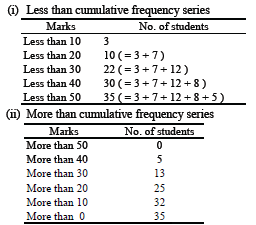

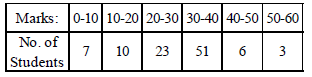
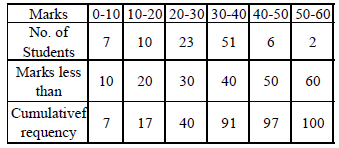
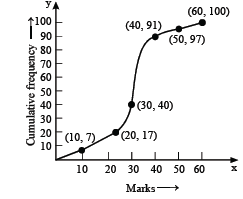

Question 1. The median of the following data is 525.Find the values of x and y, if the total frequency is 100
| C.I | 0 - 100 | 100-200 | 200 - 300 | 300 - 400 | 400-500 | 500-600 | 600-700 | 700-800 | 800-900 | 900-1000 |
|---|---|---|---|---|---|---|---|---|---|---|
| F | 2 | 5 | x | 12 | 17 | 20 | y | 9 | 7 | 4 |
Answer:
To find the missing frequencies \( x \) and \( y \), we first build the cumulative frequency table:
| Class Interval | Frequency (\( f \)) | Cumulative Frequency (\( cf \)) |
|---|---|---|
| 0 - 100 | 2 | 2 |
| 100 - 200 | 5 | 7 |
| 200 - 300 | x | \( 7 + x \) |
| 300 - 400 | 12 | \( 19 + x \) |
| 400 - 500 | 17 | \( 36 + x \) |
| 500 - 600 | 20 | \( 56 + x \) |
| 600 - 700 | y | \( 56 + x + y \) |
| 700 - 800 | 9 | \( 65 + x + y \) |
| 800 - 900 | 7 | \( 72 + x + y \) |
| 900 - 1000 | 4 | \( 76 + x + y \) |
We are given that the total frequency is 100:
\( 76 + x + y = 100 \implies x + y = 24 \) - (i)
The median value is 525, which falls within the interval 500 - 600. Thus, the median class is 500 - 600.
From this class, we get the following values:
Lower limit of median class (\( l \)) = 500
Frequency of median class (\( f \)) = 20
Cumulative frequency of preceding class (\( cf \)) = \( 36 + x \)
Class height (\( h \)) = 100
Total frequency (\( N \)) = 100, which means \( \frac{N}{2} = 50 \)
Using the standard formula for the median:
\( \text{Median} = l + \left( \frac{\frac{N}{2} - cf}{f} \right) \times h \)
\( 525 = 500 + \left( \frac{50 - (36 + x)}{20} \right) \times 100 \)
\( 25 = [50 - 36 - x] \times 5 \)
\( 5 = 14 - x \)
\( x = 9 \)
Now, substitute \( x = 9 \) into equation (i):
\( 9 + y = 24 \implies y = 15 \)
Hence, the calculated values of \( x \) and \( y \) are 9 and 15 respectively.
In simple words: We find the sum of all frequencies to form a linear relation. Because the median of 525 belongs to the 500-600 group, we apply the median formula to calculate the missing values.
Exam Tip: Be careful to apply the negative sign to both terms of the cumulative frequency when substituting \( cf = 36 + x \) into the formula, writing it as \( -36 - x \).
Question 2. The median of the data is 28. Find the values of x and y, if the total frequency is 50
| Marks | 0 - 10 | 10 - 20 | 20 - 30 | 30 - 40 | 40 - 50 |
|---|---|---|---|---|---|
| No of students | 5 | x | 15 | y | 6 |
Answer:
First, we build the cumulative frequency table:
| Marks | Frequency (\( f \)) | Cumulative Frequency (\( cf \)) |
|---|---|---|
| 0 - 10 | 5 | 5 |
| 10 - 20 | x | \( 5 + x \) |
| 20 - 30 | 15 | \( 20 + x \) |
| 30 - 40 | y | \( 20 + x + y \) |
| 40 - 50 | 6 | \( 26 + x + y \) |
The sum of frequencies is given as 50:
\( 26 + x + y = 50 \implies x + y = 24 \) - (i)
Since the median value is 28, the median class is 20 - 30.
Here:
Lower limit (\( l \)) = 20
Frequency (\( f \)) = 15
Cumulative frequency of preceding class (\( cf \)) = \( 5 + x \)
Class size (\( h \)) = 10
\( N = 50 \implies \frac{N}{2} = 25 \)
Using the median formula:
\( \text{Median} = l + \left( \frac{\frac{N}{2} - cf}{f} \right) \times h \)
\( 28 = 20 + \left( \frac{25 - (5 + x)}{15} \right) \times 10 \)
\( 8 = \left( \frac{20 - x}{15} \right) \times 10 \)
\( 8 = \frac{2(20 - x)}{3} \)
\( 24 = 40 - 2x \)
\( 2x = 16 \implies x = 8 \)
Substitute \( x = 8 \) in equation (i):
\( 8 + y = 24 \implies y = 16 \)
Hence, the missing frequencies are \( x = 8 \) and \( y = 16 \).
In simple words: We find the sum of all frequencies and equate it to 50. Since the median is 28, the median class is 20-30, and using its parameters in the formula lets us find the two unknown frequencies.
Exam Tip: Always verify that your final calculated values for \( x \) and \( y \) are positive integers, as frequencies must always represent positive counts.
Question 3. If the mean of the following distribution is 27, find the value of p
| C. I | 0 - 10 | 10 - 20 | 20 - 30 | 30 - 40 | 40 - 50 |
|---|---|---|---|---|---|
| F | 8 | P | 12 | 13 | 10 |
Answer:
To calculate the mean, we construct the table with class marks (\( x_i \)) and frequency products (\( f_i x_i \)):
| Class Interval (C.I) | Frequency (\( f_i \)) | Class Mark (\( x_i \)) | \( f_i x_i \) |
|---|---|---|---|
| 0 - 10 | 8 | 5 | 40 |
| 10 - 20 | p | 15 | \( 15p \) |
| 20 - 30 | 12 | 25 | 300 |
| 30 - 40 | 13 | 35 | 455 |
| 40 - 50 | 10 | 45 | 450 |
| Total | \( \sum f_i = 43 + p \) | - | \( \sum f_i x_i = 1245 + 15p \) |
We are given that the Mean is 27. Using the formula for the mean:
\( \text{Mean} = \frac{\sum f_i x_i}{\sum f_i} \)
\( 27 = \frac{1245 + 15p}{43 + p} \)
\( 27(43 + p) = 1245 + 15p \)
\( 1161 + 27p = 1245 + 15p \)
\( 12p = 84 \)
\( p = 7 \)
Therefore, the value of \( p \) is 7.
In simple words: We find the midpoint for each interval and multiply it by the corresponding frequency. By setting the average expression equal to 27, we solve a basic equation to find p = 7.
Exam Tip: Be precise when summing up the constants in the \( \sum f_i x_i \) column so that you do not add numerical values to the term containing the variable \( p \).
Question 4. Find the missing frequency: mean = 50, Total frequency = 120
| x | 10 | 30 | 50 | 70 | 90 |
|---|---|---|---|---|---|
| f | 17 | F1 | 32 | F2 | 19 |
Answer:
We are given that the sum of the frequencies is 120:
\( 17 + F_1 + 32 + F_2 + 19 = 120 \)
\( F_1 + F_2 + 68 = 120 \)
\( F_1 + F_2 = 52 \) - (i)
Next, we calculate the sum of the products \( f_i x_i \):
\( \sum f_i x_i = (10 \times 17) + (30 \times F_1) + (50 \times 32) + (70 \times F_2) + (90 \times 19) \)
\( \sum f_i x_i = 170 + 30F_1 + 1600 + 70F_2 + 1710 \)
\( \sum f_i x_i = 3480 + 30F_1 + 70F_2 \)
The mean value is 50. Using the formula for the mean:
\( \text{Mean} = \frac{\sum f_i x_i}{\sum f_i} \)
\( 50 = \frac{3480 + 30F_1 + 70F_2}{120} \)
\( 6000 = 3480 + 30F_1 + 70F_2 \)
\( 30F_1 + 70F_2 = 2520 \)
Dividing by 10 gives:
\( 3F_1 + 7F_2 = 252 \) - (ii)
Substitute \( F_1 = 52 - F_2 \) from equation (i) into equation (ii):
\( 3(52 - F_2) + 7F_2 = 252 \)
\( 156 - 3F_2 + 7F_2 = 252 \)
\( 4F_2 = 96 \implies F_2 = 24 \)
Now substitute \( F_2 = 24 \) back into equation (i):
\( F_1 + 24 = 52 \implies F_1 = 28 \)
Hence, the missing frequencies are \( F_1 = 28 \) and \( F_2 = 24 \).
In simple words: The sum of all students' counts is 120, giving us our first linear relationship. Combining the mean formula with the average of 50 gives us the second equation, letting us solve for both unknown groups.
Exam Tip: Simplifying linear equations by dividing common multiples (like dividing by 10 here) helps to keep calculations clean and prevents errors during substitution.
Question 5. The mean of the following frequency distribution is 132 and the sum of the observations is 50. Find the Missing frequencies f1 and f2
| C. I | 0 – 40 | 40 - 80 | 80 - 120 | 120 - 160 | 160 - 200 | 200 - 240 |
|---|---|---|---|---|---|---|
| F | 4 | 7 | F1 | 12 | F2 | 9 |
Answer:
First, we construct the table to find the class marks (\( x_i \)) and products (\( f_i x_i \)):
| Class Interval | Frequency (\( f_i \)) | Class Mark (\( x_i \)) | \( f_i x_i \) |
|---|---|---|---|
| 0 - 40 | 4 | 20 | 80 |
| 40 - 80 | 7 | 60 | 420 |
| 80 - 120 | \( F_1 \) | 100 | \( 100F_1 \) |
| 120 - 160 | 12 | 140 | 1680 |
| 160 - 200 | \( F_2 \) | 180 | \( 180F_2 \) |
| 200 - 240 | 9 | 220 | 1980 |
| Total | \( \sum f_i = 32 + F_1 + F_2 \) | - | \( \sum f_i x_i = 4160 + 100F_1 + 180F_2 \) |
We are given that the sum of the frequencies is 50:
\( 32 + F_1 + F_2 = 50 \implies F_1 + F_2 = 18 \) - (i)
The mean is given as 132. Using the formula for the mean:
\( \text{Mean} = \frac{\sum f_i x_i}{\sum f_i} \)
\( 132 = \frac{4160 + 100F_1 + 180F_2}{50} \)
\( 6600 = 4160 + 100F_1 + 180F_2 \)
\( 100F_1 + 180F_2 = 2440 \)
Dividing by 20 gives:
\( 5F_1 + 9F_2 = 122 \) - (ii)
From equation (i), we can substitute \( F_1 = 18 - F_2 \) into equation (ii):
\( 5(18 - F_2) + 9F_2 = 122 \)
\( 90 - 5F_2 + 9F_2 = 122 \)
\( 4F_2 = 32 \implies F_2 = 8 \)
Substitute \( F_2 = 8 \) back into equation (i):
\( F_1 + 8 = 18 \implies F_1 = 10 \)
Hence, the missing frequencies are \( f_1 = 10 \) and \( f_2 = 8 \).
In simple words: The sum of all frequencies is 50, which gives us our first relation. Combining this with the weighted average equation based on the mean of 132 allows us to solve for both unknown frequencies.
Exam Tip: Be sure to compute midpoints carefully for large class widths like 0-40, 40-80, etc. before carrying out multiplications.
Question 6. Find the mean, median and mode of the following data
| C.I | 0 - 10 | 10 - 20 | 20 – 30 | 30 – 40 | 40 - 50 | 50 - 60 | 60 - 70 |
|---|---|---|---|---|---|---|---|
| F | 6 | 8 | 10 | 15 | 5 | 4 | 2 |
Answer:
Let us construct a combined table to calculate all three statistical measures:
| Class Interval | Frequency (\( f_i \)) | Class Mark (\( x_i \)) | \( f_i x_i \) | Cumulative Frequency (\( cf \)) |
|---|---|---|---|---|
| 0 - 10 | 6 | 5 | 30 | 6 |
| 10 - 20 | 8 | 15 | 120 | 14 |
| 20 - 30 | 10 | 25 | 250 | 24 |
| 30 - 40 | 15 | 35 | 525 | 39 |
| 40 - 50 | 5 | 45 | 225 | 44 |
| 50 - 60 | 4 | 55 | 220 | 48 |
| 60 - 70 | 2 | 65 | 130 | 50 |
| Total | \( \sum f_i = 50 \) | - | \( \sum f_i x_i = 1500 \) | - |
1. Calculation of Mean:
\( \text{Mean} = \frac{\sum f_i x_i}{\sum f_i} = \frac{1500}{50} = 30 \)
2. Calculation of Median:
Total observations \( N = 50 \implies \frac{N}{2} = 25 \).
The cumulative frequency just greater than 25 is 39, which corresponds to the class interval 30 - 40. Thus, 30 - 40 is our median class.
Here:
Lower limit (\( l \)) = 30
Frequency (\( f \)) = 15
Cumulative frequency of preceding class (\( cf \)) = 24
Class size (\( h \)) = 10
\( \text{Median} = l + \left( \frac{\frac{N}{2} - cf}{f} \right) \times h = 30 + \left( \frac{25 - 24}{15} \right) \times 10 = 30 + \frac{10}{15} \approx 30.67 \)
3. Calculation of Mode:
The highest frequency is 15, which corresponds to the class 30 - 40. Thus, 30 - 40 is our modal class.
Here:
Lower limit (\( l \)) = 30
Frequency of modal class (\( f_1 \)) = 15
Frequency of preceding class (\( f_0 \)) = 10
Frequency of succeeding class (\( f_2 \)) = 5
Class size (\( h \)) = 10
\( \text{Mode} = l + \left( \frac{f_1 - f_0}{2f_1 - f_0 - f_2} \right) \times h = 30 + \left( \frac{15 - 10}{2(15) - 10 - 5} \right) \times 10 = 30 + \left( \frac{5}{15} \right) \times 10 = 33.33 \)
Therefore, the Mean is 30, the Median is 30.67, and the Mode is 33.33.
In simple words: We calculate all three statistics using their standard definitions: the average of weighted midpoints (Mean), the point dividing the frequency list in half (Median), and the most frequent group (Mode).
Exam Tip: Be precise with the formulas of all three measures of central tendency, as keeping track of pre-existing and post-existing frequencies for the mode formula is highly critical.
Question 7. The mode of the following frequency distribution is 55. Find the values of x and y
| C.I | 0 - 15 | 15 - 30 | 30 - 45 | 45 - 60 | 60 - 75 | 75 - 90 |
|---|---|---|---|---|---|---|
| F | 6 | 7 | Y | 15 | 10 | X |
Answer:
The mode of the distribution is given as 55, which lies in the class interval 45 - 60. Therefore, 45 - 60 is our modal class.
From this, we get:
Lower limit of modal class (\( l \)) = 45
Frequency of modal class (\( f_1 \)) = 15
Frequency of preceding class (\( f_0 \)) = \( y \)
Frequency of succeeding class (\( f_2 \)) = 10
Class size (\( h \)) = 15
Using the formula for mode:
\( \text{Mode} = l + \left( \frac{f_1 - f_0}{2f_1 - f_0 - f_2} \right) \times h \)
\( 55 = 45 + \left( \frac{15 - y}{30 - y - 10} \right) \times 15 \)
\( 10 = \left( \frac{15 - y}{20 - y} \right) \times 15 \)
\( 2 = 3 \times \frac{15 - y}{20 - y} \)
\( 2(20 - y) = 3(15 - y) \)
\( 40 - 2y = 45 - 3y \implies y = 5 \)
Using the standard textbook assumption that the total frequency for this problem is 50:
\( 6 + 7 + y + 15 + 10 + x = 50 \)
\( 38 + y + x = 50 \)
Substitute \( y = 5 \):
\( 38 + 5 + x = 50 \implies x = 7 \)
Hence, the values of \( x \) and \( y \) are 7 and 5 respectively.
In simple words: Since the mode is 55, we use the 45-60 class to set up our equation. Solving it gives y = 5, and assuming the total frequency is 50 allows us to easily find x = 7.
Exam Tip: If the total frequency is not explicitly printed in the question text, check standard CBSE question banks as these problems almost always assume a total sum like 50.
Question 8. For a given data less than ogive and more than ogive intersect at a point P(x, y). Then what does abscissa of the Point represents
Answer:
When we draw both a "less than" ogive and a "more than" ogive on the same coordinate axes, they intersect at a unique point.
The x-coordinate (abscissa) of this point of intersection represents the **Median** of the given grouped data, while the y-coordinate represents \( \frac{N}{2} \).
Therefore, the abscissa represents the **Median** of the given distribution.
In simple words: The intersection point of both kinds of cumulative frequency curves aligns perfectly with the median value on the horizontal x-axis.
Exam Tip: Memorize this intersection property of ogives, as it is a very common one-mark theory question in board examinations.
Question 9. Write the empirical relationship between the three measures of central tendency
Answer:
The empirical formula relating Mode, Median, and Mean is given as:
\( \text{Mode} = 3 \text{ Median} - 2 \text{ Mean} \)
In simple words: This equation acts as a rule of thumb relating our three main statistical measures together, letting us find any one if we know the other two.
Exam Tip: Write this formula down on your scratch sheet immediately at the start of the exam, as it is highly useful for verifying calculations across different sections.
Question 10. If median = 15 and mean = 16, find mode of the distribution
Answer:
We are given:
\( \text{Median} = 15 \)
\( \text{Mean} = 16 \)
Using the empirical relationship:
\( \text{Mode} = 3 \text{ Median} - 2 \text{ Mean} \)
\( \text{Mode} = 3(15) - 2(16) \)
\( \text{Mode} = 45 - 32 \)
\( \text{Mode} = 13 \)
Therefore, the mode of the distribution is 13.
In simple words: Substituting our known values into the statistical formula lets us find that the Mode is equal to 13.
Exam Tip: Ensure you do not swap the coefficients of Mean and Median, as a very common error is calculating \( 3 \text{ Mean} - 2 \text{ Median} \) instead.
Question 11. Following is the distribution of marks obtained by 60 students: Calculate the arithmetic mean
| Marks | More than 0 | more than 10 | More than 20 | More than 30 | More than 40 | More than 50 |
|---|---|---|---|---|---|---|
| No of students | 60 | 56 | 40 | 20 | 10 | 3 |
Answer:
First, we convert the cumulative "more than" table into a standard grouped frequency distribution:
| Class Interval (C.I) | Frequency (\( f_i \)) | Class Mark (\( x_i \)) | \( f_i x_i \) |
|---|---|---|---|
| 0 - 10 | \( 60 - 56 = 4 \) | 5 | 20 |
| 10 - 20 | \( 56 - 40 = 16 \) | 15 | 240 |
| 20 - 30 | \( 40 - 20 = 20 \) | 25 | 500 |
| 30 - 40 | \( 20 - 10 = 10 \) | 35 | 350 |
| 40 - 50 | \( 10 - 3 = 7 \) | 45 | 315 |
| 50 - 60 | \( 3 - 0 = 3 \) | 55 | 165 |
| Total | \( \sum f_i = 60 \) | - | \( \sum f_i x_i = 1590 \) |
Now, we calculate the arithmetic mean:
\( \text{Mean} = \frac{\sum f_i x_i}{\sum f_i} = \frac{1590}{60} = 26.5 \)
Therefore, the arithmetic mean of the distribution is 26.5.
In simple words: We convert the cumulative "more than" groups into standard class intervals by subtracting adjacent frequency totals, then compute the average of our class midpoints.
Exam Tip: Be meticulous during the conversion of a cumulative distribution to a continuous frequency distribution, as a subtraction mistake in any one interval will throw off the entire mean calculation.
Question 12. From the following data draw the two types of curves and find the median
| C.I | 200 - 220 | 220 - 240 | 240 - 260 | 260 - 280 | 280 - 300 | 300 - 320 |
|---|---|---|---|---|---|---|
| F | 7 | 3 | 6 | 8 | 2 | 4 |
Answer:
First, we construct the cumulative frequency tables for both types of curves:
1. Less than type cumulative frequency table:
| Marks Limit | Cumulative Frequency (cf) |
|---|---|
| Less than 220 | 7 |
| Less than 240 | \( 7 + 3 = 10 \) |
| Less than 260 | \( 10 + 6 = 16 \) |
| Less than 280 | \( 16 + 8 = 24 \) |
| Less than 300 | \( 24 + 2 = 26 \) |
| Less than 320 | \( 26 + 4 = 30 \) |
We plot the points: \( (220, 7), (240, 10), (260, 16), (280, 24), (300, 26), (320, 30) \).
2. More than type cumulative frequency table:
| Marks Limit | Cumulative Frequency (cf) |
|---|---|
| More than or equal to 200 | 30 |
| More than or equal to 220 | \( 30 - 7 = 23 \) |
| More than or equal to 240 | \( 23 - 3 = 20 \) |
| More than or equal to 260 | \( 20 - 6 = 14 \) |
| More than or equal to 280 | \( 14 - 8 = 6 \) |
| More than or equal to 300 | \( 6 - 2 = 4 \) |
We plot the points: \( (200, 30), (220, 23), (240, 20), (260, 14), (280, 6), (300, 4) \).
3. Mathematical Verification of Median:
Here, \( N = 30 \implies \frac{N}{2} = 15 \).
The cumulative frequency just greater than 15 is 16, which corresponds to the class interval 240 - 260. Therefore, 240 - 260 is our median class.
Using the median formula:
- Lower limit (\( l \)) = 240
- Cumulative frequency of preceding class (\( cf \)) = 10
- Frequency (\( f \)) = 6
- Class size (\( h \)) = 20
\( \text{Median} = l + \left( \frac{\frac{N}{2} - cf}{f} \right) \times h = 240 + \left( \frac{15 - 10}{6} \right) \times 20 = 240 + 16.67 = 256.67 \).
Hence, the intersection of the two curves gives the median at \( x = 256.67 \).
In simple words: We generate coordinates for both standard cumulative curves. Plotted on a graph, the intersection point of these curves corresponds to our calculated median value of 256.67 on the horizontal axis.
Exam Tip: When drawing ogive curves, ensure you use a free-hand smooth curve rather than joining the plotted points with straight line segments.
Free study material for Mathematics
Download Class 10 Mathematics Chapter 13 Statistics Practice Worksheets
Mastering Chapter 13 Statistics with Printable Worksheets
Review targeted practice exercises for Class 10 Mathematics Chapter 13 Statistics. Curated to match official CBSE guidelines, these printable problem sets support daily revision and improve overall test readiness.
Verified Solutions and NCERT Alignment
Built using official NCERT guidelines for Class 10 Mathematics, these practice sheets provide reliable academic support. Cross-reference your completed work with our detailed solutions to learn standard answer-writing formats for CBSE exams.
Additional Study Resources for Class 10 Mathematics
Consistent engagement with these exercises builds familiarity with recurring exam themes. If specific areas within Chapter 13 Statistics cause trouble, utilize our dedicated NCERT solutions for Class 10 Mathematics to clear up doubts immediately.
FAQs
You can download the latest chapter-wise printable worksheets for Class 10 Mathematics Chapter 13 Statistics for free from StudiesToday.com. These have been made as per the latest CBSE curriculum for this academic year.
Yes, Class 10 Mathematics worksheets for Chapter 13 Statistics focus on activity-based learning and also competency-style questions. This helps students to apply theoretical knowledge to practical scenarios.
Yes, we have provided solved worksheets for Class 10 Mathematics Chapter 13 Statistics to help students verify their answers instantly.
Yes, our Class 10 Mathematics test sheets are mobile-friendly PDFs and can be printed by teachers for classroom.
For Chapter 13 Statistics, regular practice with our worksheets will improve question-handling speed and help students understand all technical terms and diagrams.