

Official Class 10 Mathematics Worksheets: Chapter 04 Quadratic Equation
Access comprehensive chapter-wise worksheets for Chapter 04 Quadratic Equation using the CBSE Class 10 Mathematics Quadratic Equation Worksheet Set 04. Designed to align with the 2026-27 academic syllabus for Class 10 Mathematics, these printable practice sets help students reinforce key concepts and improve their overall exam readiness.
Solved Practice Worksheets for Mathematics
View or download the dedicated CBSE Class 10 Mathematics Quadratic Equation Worksheet Set 04 resource below. Engaging with these practice papers under focused study conditions ensures continuous academic progress and mastery of the 2026-27 curriculum for Chapter 04 Quadratic Equation.
QUADRATIC EQUATIONS
Sol. (i) Comparing 3x2 – 5x + p = 0
with ax2 + bx + c = 0,
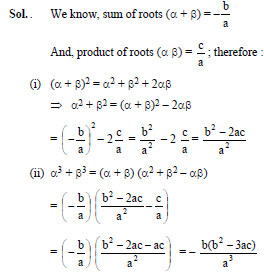
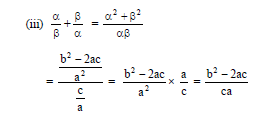
Key Points
1. General Form: The general form of a quadratic equation is \( ax^2 + bx + c = 0 \), where \( a \neq 0 \) and \( a, b, c \) are real numbers.
2. Roots of a Quadratic Equation: A real number \( \alpha \) is called a root of the quadratic equation \( ax^2 + bx + c = 0 \) if \( a\alpha^2 + b\alpha + c = 0 \). The zeroes of the quadratic polynomial \( ax^2 + bx + c \) are identical to the roots of its corresponding equation \( ax^2 + bx + c = 0 \).
3. Discriminant: The value \( b^2 - 4ac \) is defined as the discriminant of the quadratic equation \( ax^2 + bx + c = 0 \) and is denoted by \( D \). Thus, \( D = b^2 - 4ac \).
4. Number of Roots: Every quadratic equation has exactly two roots, which can be real and distinct, real and coincident (equal), or imaginary.
5. Roots Formula: If \( \alpha \) and \( \beta \) are the roots of \( ax^2 + bx + c = 0 \), they are given by:
\[ \alpha = \frac{-b + \sqrt{b^2 - 4ac}}{2a} \quad \text{and} \quad \beta = \frac{-b - \sqrt{b^2 - 4ac}}{2a} \]
6. Relationship between Roots and Coefficients:
- Sum of the roots: \( \alpha + \beta = -\frac{b}{a} \)
- Product of the roots: \( \alpha\beta = \frac{c}{a} \)
7. Formation of Quadratic Equation: A quadratic equation with given roots \( \alpha \) and \( \beta \) is constructed as:
\[ x^2 - (\alpha + \beta)x + \alpha\beta = 0 \]
8. Nature of Roots: For the equation \( ax^2 + bx + c = 0 \):
- (i) If \( D > 0 \), the roots are real and unequal.
- (ii) If \( D = 0 \), the roots are real and equal.
- (iii) If \( D < 0 \), the roots are imaginary (no real roots).
- (iv) If \( D > 0 \) and \( D \) is a perfect square, the roots are rational and unequal.
- (v) If \( D > 0 \) and \( D \) is not a perfect square, the roots are irrational.
9. Conjugate Pairs: Irrational roots always occur in conjugate pairs. If \( 2 + \sqrt{3} \) is a root of a quadratic equation, then its other root must be \( 2 - \sqrt{3} \).
10. Sign Conditions:
- If \( ab > 0 \), then both \( a \) and \( b \) have the same sign (either both positive or both negative).
- If \( ab < 0 \), then \( a \) and \( b \) have opposite signs (one is positive and the other is negative).
LEVEL-I
Question 1. If ½ is a root of the equation x2+kx-5/4=0, then find the value of K.
Answer: Since \( x = \frac{1}{2} \) is a root of the quadratic equation, substituting this value into the equation must satisfy it:
\[ \left(\frac{1}{2}\right)^2 + k\left(\frac{1}{2}\right) - \frac{5}{4} = 0 \]
\[ \implies \frac{1}{4} + \frac{k}{2} - \frac{5}{4} = 0 \]
\[ \implies \frac{k}{2} - 1 = 0 \]
\[ \implies \frac{k}{2} = 1 \implies k = 2 \]
Therefore, the value of \( k \) is 2.
In simple words: We plug \( \frac{1}{2} \) in place of \( x \) and solve the resulting equation to find that \( k \) is equal to 2.
Exam Tip: Substituting a given root directly into the equation is the most reliable way to find an unknown coefficient.
Question 2. If D>0, then write the roots of a quadratic equation ax2+bx+c=0
Answer: For a quadratic equation \( ax^2 + bx + c = 0 \) with a positive discriminant (\( D > 0 \)), the two roots are real and distinct. They are given by the quadratic formula:
\[ x = \frac{-b \pm \sqrt{D}}{2a} \]
where \( D = b^2 - 4ac \).
In simple words: When \( D \) is positive, we get two different real answers using the standard quadratic formula.
Exam Tip: Always state that the roots are real and distinct when the discriminant is strictly greater than zero.
Question 3. Find the Discriminant of x2 +5x+5=0.
Answer: For the quadratic equation \( x^2 + 5x + 5 = 0 \), the coefficients are \( a = 1 \), \( b = 5 \), and \( c = 5 \).
The formula for the discriminant (\( D \)) is:
\[ D = b^2 - 4ac \]
Substitute the coefficients:
\[ D = 5^2 - 4(1)(5) \]
\[ D = 25 - 20 = 5 \]
Therefore, the discriminant of the equation is 5.
In simple words: Using the formula \( b^2 - 4ac \) with our coefficients gives a final value of 5.
Exam Tip: Label \( a, b, \) and \( c \) clearly before evaluating the discriminant to avoid arithmetic errors.
Question 4. Find the the sum of roots of a quadratic equation x²+4x-320=0
Answer: For the quadratic equation \( x^2 + 4x - 320 = 0 \), the coefficients are \( a = 1 \) and \( b = 4 \).
The sum of the roots is given by the formula:
\[ \text{Sum of roots} = -\frac{b}{a} \]
Substitute the values:
\[ \text{Sum of roots} = -\frac{4}{1} = -4 \]
Therefore, the sum of the roots is -4.
In simple words: The sum of the roots is equal to the negative of the second coefficient divided by the first coefficient, which gives -4.
Exam Tip: Make sure not to lose the negative sign in the formula \( -\frac{b}{a} \).
Question 5. Find the product of roots of a quadratic equation 2x²+7x-4=0.
Answer: For the quadratic equation \( 2x^2 + 7x - 4 = 0 \), the coefficients are \( a = 2 \) and \( c = -4 \).
The product of the roots is given by the formula:
\[ \text{Product of roots} = \frac{c}{a} \]
Substitute the values:
\[ \text{Product of roots} = \frac{-4}{2} = -2 \]
Therefore, the product of the roots is -2.
In simple words: Dividing the constant term by the coefficient of the squared term gives us a product of -2.
Exam Tip: Always pay attention to the sign of the constant term \( c \) when calculating the product of the roots.
Question 6. Find the values of K for which the equation 9 x2+2kx + 1=0 has real roots.
Answer: For the quadratic equation \( 9x^2 + 2kx + 1 = 0 \), the coefficients are \( a = 9 \), \( b = 2k \), and \( c = 1 \).
For the roots to be real, the discriminant (\( D \)) must be greater than or equal to zero:
\[ D = b^2 - 4ac \geq 0 \]
\[ (2k)^2 - 4(9)(1) \geq 0 \]
\[ 4k^2 - 36 \geq 0 \]
\[ 4k^2 \geq 36 \implies k^2 \geq 9 \]
Taking the square root on both sides:
\[ k \geq 3 \quad \text{or} \quad k \leq -3 \]
Therefore, the equation has real roots when \( k \geq 3 \) or \( k \leq -3 \).
In simple words: Setting the discriminant \( b^2 - 4ac \geq 0 \) gives \( k^2 \geq 9 \), which means \( k \) must be either at least 3 or less than or equal to -3.
Exam Tip: Remember that "real roots" includes both equal and distinct roots, so use the \( \geq \) inequality rather than strictly \( > \).
Question 7. Find the Value of K if the equation x2- 2(k + 1) x +k2 = 0 has equal roots.
Answer: For the quadratic equation \( x^2 - 2(k + 1)x + k^2 = 0 \), the coefficients are \( a = 1 \), \( b = -2(k + 1) \), and \( c = k^2 \).
For the roots to be equal, the discriminant (\( D \)) must be zero:
\[ D = b^2 - 4ac = 0 \]
\[ [-2(k + 1)]^2 - 4(1)(k^2) = 0 \]
\[ 4(k^2 + 2k + 1) - 4k^2 = 0 \]
\[ 4k^2 + 8k + 4 - 4k^2 = 0 \]
\[ 8k + 4 = 0 \implies k = -\frac{4}{8} = -\frac{1}{2} \]
Therefore, the value of \( k \) is \( -\frac{1}{2} \).
In simple words: Setting the discriminant to zero and expanding the squared term allows us to cancel \( k^2 \), leaving \( 8k + 4 = 0 \), which solves to \( -0.5 \).
Exam Tip: Group terms carefully before expanding to avoid sign errors when dealing with negative coefficients.
Question 8. For what value of k, x=a is a solution of equation x2- (a+ b ) x +k =0 ?
Answer: Since \( x = a \) is a solution, substituting \( x = a \) into the equation must satisfy it:
\[ a^2 - (a + b)a + k = 0 \]
\[ a^2 - a^2 - ab + k = 0 \]
\[ -ab + k = 0 \implies k = ab \]
Therefore, the value of \( k \) is \( ab \).
In simple words: Replacing \( x \) with \( a \) simplifies the equation, leaving \( -ab + k = 0 \), which directly gives \( k = ab \).
Exam Tip: Substituting the given value of \( x \) is a very quick and standard way to evaluate the constant term.
Question 9. Represent the situation in the form of Quadratic equation: The Product of Rahman’s age (in years) 5 years ago with his age 9 years later is 15.
Answer: Let the present age of Rahman be \( x \) years.
- His age 5 years ago was \( (x - 5) \) years.
- His age 9 years from now will be \( (x + 9) \) years.
According to the problem, the product of these two ages is 15:
\[ (x - 5)(x + 9) = 15 \]
\[ x^2 + 9x - 5x - 45 = 15 \]
\[ x^2 + 4x - 45 - 15 = 0 \]
\[ x^2 + 4x - 60 = 0 \]
Therefore, the required quadratic equation is \( x^2 + 4x - 60 = 0 \).
In simple words: Let Rahman's age be x. Multiplying his past age \( (x - 5) \) and future age \( (x + 9) \) and setting it to 15 simplifies to the quadratic equation \( x^2 + 4x - 60 = 0 \).
Exam Tip: Always define your variable clearly at the start (e.g., "Let present age be \( x \)") before writing the age expressions.
Question 10. Find the roots of x2-3x-10 = 0
Answer: To find the roots of the quadratic equation \( x^2 - 3x - 10 = 0 \), we factorize by splitting the middle term:
\[ x^2 - 5x + 2x - 10 = 0 \]
\[ x(x - 5) + 2(x - 5) = 0 \]
\[ (x - 5)(x + 2) = 0 \]
This gives:
- \( x - 5 = 0 \implies x = 5 \)
- \( x + 2 = 0 \implies x = -2 \)
Therefore, the roots of the equation are 5 and -2.
In simple words: We split the middle term to factor the equation into \( (x - 5)(x + 2) = 0 \), which gives us the roots as 5 and -2.
Exam Tip: Splitting the middle term is usually the fastest method; if factors are hard to find, fall back on the quadratic formula.
Question 11. The product of two consecutive odd numbers is 483. Find the numbers.
Answer: Let the two consecutive odd numbers be \( x \) and \( x + 2 \).
According to the problem, their product is 483:
\[ x(x + 2) = 483 \]
\[ x^2 + 2x - 483 = 0 \]
Factorize by splitting the middle term:
\[ x^2 + 23x - 21x - 483 = 0 \]
\[ x(x + 23) - 21(x + 23) = 0 \]
\[ (x + 23)(x - 21) = 0 \]
This gives:
- \( x = 21 \implies \) the numbers are 21 and 23.
- \( x = -23 \implies \) the numbers are -23 and -21.
Therefore, the consecutive odd numbers are 21, 23 (or -23, -21).
In simple words: Let the odd numbers be x and x+2. Solving the quadratic equation \( x^2 + 2x - 483 = 0 \) gives the numbers as 21 and 23.
Exam Tip: consecutive odd or even numbers are always represented as \( x \) and \( x + 2 \) because they differ by 2.
LEVEL - II
Question 1. If x = 2 and x = 3 are roots of the equation 3x2 – 2kx + 2m = 0 find the value of k and m.
Answer: Since both \( x = 2 \) and \( x = 3 \) are roots, they must satisfy the equation:
1. **Substitute \( x = 2 \) into the equation:**
\[ 3(2)^2 - 2k(2) + 2m = 0 \]
\[ 12 - 4k + 2m = 0 \implies 2k - m = 6 \tag{Equation 1} \]
2. **Substitute \( x = 3 \) into the equation:**
\[ 3(3)^2 - 2k(3) + 2m = 0 \]
\[ 27 - 6k + 2m = 0 \implies 6k - 2m = 27 \tag{Equation 2} \]
Now, solve the system of linear equations:
Multiply Equation 1 by 2:
\[ 4k - 2m = 12 \tag{Equation 3} \]
Subtract Equation 3 from Equation 2:
\[ (6k - 2m) - (4k - 2m) = 27 - 12 \]
\[ 2k = 15 \implies k = \frac{15}{2} \]
Substitute \( k = \frac{15}{2} \) into Equation 1:
\[ 2\left(\frac{15}{2}\right) - m = 6 \implies 15 - m = 6 \implies m = 9 \]
Therefore, \( k = \frac{15}{2} \) and \( m = 9 \).
In simple words: Substituting both roots into the equation gives us two linear equations. Solving this system yields \( k = 7.5 \) and \( m = 9 \).
Exam Tip: You can also use the relations \( \text{Sum of roots} = \frac{2k}{3} \) and \( \text{Product of roots} = \frac{2m}{3} \) to solve this much faster.
Question 2. Solve the equation: \( \frac{x}{x+1} + \frac{x+1}{x} = \frac{34}{15} \), \( x \neq 0, x \neq -1 \)
Answer: Let \( \frac{x}{x+1} = y \). Then, \( \frac{x+1}{x} = \frac{1}{y} \).
The equation becomes:
\[ y + \frac{1}{y} = \frac{34}{15} \]
\[ \frac{y^2 + 1}{y} = \frac{34}{15} \implies 15y^2 + 15 = 34y \]
\[ 15y^2 - 34y + 15 = 0 \]
Factorize by splitting the middle term:
\[ 15y^2 - 25y - 9y + 15 = 0 \]
\[ 5y(3y - 5) - 3(3y - 5) = 0 \]
\[ (5y - 3)(3y - 5) = 0 \]
This gives:
- \( y = \frac{3}{5} \), or
- \( y = \frac{5}{3} \)
Now, substitute back \( y = \frac{x}{x+1} \):
1. **If \( y = \frac{3}{5} \):**
\[ \frac{x}{x+1} = \frac{3}{5} \implies 5x = 3x + 3 \implies 2x = 3 \implies x = \frac{3}{2} \]
2. **If \( y = \frac{5}{3} \):**
\[ \frac{x}{x+1} = \frac{5}{3} \implies 3x = 5x + 5 \implies -2x = 5 \implies x = -\frac{5}{2} \]
Therefore, the solutions are \( x = \frac{3}{2} \) and \( x = -\frac{5}{2} \).
In simple words: We substitute \( y \) for the fraction to get a quadratic equation in terms of \( y \). Solving this gives \( y = 3/5 \) or \( 5/3 \), which then simplifies to \( x = 1.5 \) or \( -2.5 \).
Exam Tip: Substituting a temporary variable like \( y \) for reciprocal terms is a highly efficient way to simplify fractional algebraic equations.
Question 3. Solve the equation 2x2 – 5x + 3 = 0 by the method of completing square.
Answer: The given equation is \( 2x^2 - 5x + 3 = 0 \).
Divide the entire equation by the leading coefficient 2:
\[ x^2 - \frac{5}{2}x + \frac{3}{2} = 0 \]
\[ x^2 - \frac{5}{2}x = -\frac{3}{2} \]
Add the square of half the coefficient of \( x \), which is \( \left(\frac{5}{4}\right)^2 = \frac{25}{16} \), to both sides:
\[ x^2 - \frac{5}{2}x + \frac{25}{16} = -\frac{3}{2} + \frac{25}{16} \]
\[ \left(x - \frac{5}{4}\right)^2 = \frac{-24 + 25}{16} \]
\[ \left(x - \frac{5}{4}\right)^2 = \frac{1}{16} \]
Taking the square root on both sides:
\[ x - \frac{5}{4} = \pm \frac{1}{4} \]
This gives:
- \( x = \frac{5}{4} + \frac{1}{4} = \frac{6}{4} = \frac{3}{2} \)
- \( x = \frac{5}{4} - \frac{1}{4} = \frac{4}{4} = 1 \)
Therefore, the roots are \( \frac{3}{2} \) and 1.
In simple words: We divide the equation by 2, rearrange the terms, and add the completing square term \( \frac{25}{16} \) to both sides. Taking the square root gives us \( x = 1.5 \) and \( x = 1 \).
Exam Tip: Ensure that you show the step where you add \( (\frac{b}{2a})^2 \) to both sides, as this is the core of the completing the square method.
Question 4. Using quadratic formula, solve the equation: p2x2 + (p2 – q2)x – q2 = 0.
Answer: The given equation is \( p^2x^2 + (p^2 - q^2)x - q^2 = 0 \).
Comparing with the standard form \( Ax^2 + Bx + C = 0 \):
- \( A = p^2 \), \( B = p^2 - q^2 \), \( C = -q^2 \)
Calculate the discriminant (\( D \)):
\[ D = B^2 - 4AC \]
\[ D = (p^2 - q^2)^2 - 4(p^2)(-q^2) \]
\[ D = (p^2 - q^2)^2 + 4p^2q^2 \]
Using the identity \( (X - Y)^2 + 4XY = (X + Y)^2 \):
\[ D = (p^2 + q^2)^2 \]
Now, apply the quadratic formula:
\[ x = \frac{-B \pm \sqrt{D}}{2A} \]
\[ x = \frac{-(p^2 - q^2) \pm (p^2 + q^2)}{2p^2} \]
This gives:
- \( x = \frac{-p^2 + q^2 + p^2 + q^2}{2p^2} = \frac{2q^2}{2p^2} = \frac{q^2}{p^2} \)
- \( x = \frac{-p^2 + q^2 - p^2 - q^2}{2p^2} = \frac{-2p^2}{2p^2} = -1 \)
Therefore, the roots of the equation are \( \frac{q^2}{p^2} \) and -1.
In simple words: The discriminant simplifies beautifully to a perfect square \( (p^2+q^2)^2 \). Using this in our quadratic formula yields the roots as \( \frac{q^2}{p^2} \) and -1.
Exam Tip: Recognizing the algebraic identity to simplify the discriminant is the key step to solving literal coefficient problems.
Question 5. 300 apples are distributed equally among a certain number of student’s .Had there been 10 more students, each would have received one apple less. Find the number of students.
Answer: Let the initial number of students be \( x \).
- Original share of each student = \( \frac{300}{x} \) apples.
If there are 10 more students, the total number becomes \( (x + 10) \):
- New share of each student = \( \frac{300}{x + 10} \) apples.
According to the problem, the new share is 1 apple less than the original share:
\[ \frac{300}{x} - \frac{300}{x + 10} = 1 \]
\[ 300\left(\frac{(x + 10) - x}{x(x + 10)}\right) = 1 \]
\[ 300\left(\frac{10}{x^2 + 10x}\right) = 1 \]
\[ 3000 = x^2 + 10x \]
\[ x^2 + 10x - 3000 = 0 \]
Factorize by splitting the middle term:
\[ (x + 60)(x - 50) = 0 \]
This gives:
- \( x = 50 \)
- \( x = -60 \) (rejected, as the count of students must be positive)
Therefore, the initial number of students is 50.
In simple words: Let the students be x. Setting up the difference in share values as 1 apple gives us the quadratic equation \( x^2 + 10x - 3000 = 0 \). Solving this gives 50 students.
Exam Tip: For word problems, always explicitly state why you rejected the negative solution (e.g., "number of students cannot be negative").
Question 6. Find the roots of Quadratic equation 16x2 – 24x -1 = 0 by using the quadratic formula.
Answer: For the quadratic equation \( 16x^2 - 24x - 1 = 0 \), the coefficients are \( a = 16 \), \( b = -24 \), and \( c = -1 \).
First, calculate the discriminant (\( D \)):
\[ D = b^2 - 4ac \]
\[ D = (-24)^2 - 4(16)(-1) \]
\[ D = 576 + 64 = 640 \]
Now, apply the quadratic formula:
\[ x = \frac{-b \pm \sqrt{D}}{2a} \]
\[ x = \frac{-(-24) \pm \sqrt{640}}{2 \times 16} \]
Simplify the radical \( \sqrt{640} = \sqrt{64 \times 10} = 8\sqrt{10} \):
\[ x = \frac{24 \pm 8\sqrt{10}}{32} \]
Divide the numerator and denominator by 8:
\[ x = \frac{3 \pm \sqrt{10}}{4} \]
Therefore, the roots of the equation are \( \frac{3 + \sqrt{10}}{4} \) and \( \frac{3 - \sqrt{10}}{4} \).
In simple words: Calculating the discriminant gives 640. Using this in the quadratic formula and simplifying the root term yields the final answers as \( \frac{3 \pm \sqrt{10}}{4} \).
Exam Tip: Be sure to simplify the square root of 640 completely to ensure your final fraction is in its simplest form.
Question 7. Find the discriminant of the Quadratic equation 2x2-4x+3 = 0 and hence find the nature of its roots.
Answer: For the quadratic equation \( 2x^2 - 4x + 3 = 0 \), the coefficients are \( a = 2 \), \( b = -4 \), and \( c = 3 \).
The formula for the discriminant (\( D \)) is:
\[ D = b^2 - 4ac \]
Substitute the values:
\[ D = (-4)^2 - 4(2)(3) \]
\[ D = 16 - 24 = -8 \]
Since the discriminant \( D = -8 < 0 \), the quadratic equation has no real roots (the roots are imaginary).
In simple words: The discriminant calculates to a negative value of -8, which means the equation has no real solutions.
Exam Tip: State both the numerical value of the discriminant and the corresponding nature of the roots clearly to secure full marks.
LEVEL – III
Question 1. In a class test, the sum of Shefali‘s marks in math’s and English is 30. Had she got 2 marks more in math’s and 3 marks less in English, the product of their marks would have been 210. Find her marks in two subjects.
Answer: Let Shefali's marks in Mathematics be \( x \).
Therefore, her marks in English are \( 30 - x \).
According to the new conditions:
- New Mathematics marks = \( x + 2 \)
- New English marks = \( (30 - x) - 3 = 27 - x \)
The product of these new marks is 210:
\[ (x + 2)(27 - x) = 210 \]
\[ 27x - x^2 + 54 - 2x = 210 \]
\[ -x^2 + 25x + 54 = 210 \]
\[ x^2 - 25x + 156 = 0 \]
Factorize by splitting the middle term:
\[ x^2 - 12x - 13x + 156 = 0 \]
\[ x(x - 12) - 13(x - 12) = 0 \]
\[ (x - 12)(x - 13) = 0 \]
This gives two cases:
- **Case 1:** If \( x = 12 \) (Maths marks = 12), then English marks = \( 30 - 12 = 18 \).
- **Case 2:** If \( x = 13 \) (Maths marks = 13), then English marks = \( 30 - 13 = 17 \).
Therefore, Shefali's marks are either 12 in Mathematics and 18 in English, or 13 in Mathematics and 17 in English.
In simple words: Let her math score be x. Setting the product of her adjusted scores to 210 gives a quadratic equation with roots 12 and 13, yielding two possible pairs of scores.
Exam Tip: Always list both valid combinations of marks in your final answer; writing only one pair is incomplete.
Question 2. A two digit number is such that the product of its digit is 35. When 18 is added to the number, the digits interchange the places. Find the number.
Answer: Let the tens digit of the number be \( x \) and the units digit be \( y \).
The number is represented as \( 10x + y \).
We are given:
- Product of digits: \( xy = 35 \tag{Equation 1} \)
When 18 is added, the digits are reversed:
\[ 10x + y + 18 = 10y + x \]
\[ 9y - 9x = 18 \]
\[ y - x = 2 \implies y = x + 2 \tag{Equation 2} \]
Substitute Equation 2 into Equation 1:
\[ x(x + 2) = 35 \]
\[ x^2 + 2x - 35 = 0 \]
Factorize by splitting the middle term:
\[ (x + 7)(x - 5) = 0 \]
This gives:
- \( x = 5 \)
- \( x = -7 \) (rejected, as digits must be positive integers)
Using \( x = 5 \), find \( y \):
\[ y = 5 + 2 = 7 \]
Therefore, the two-digit number is \( 10(5) + 7 = 57 \).
In simple words: Let the digits be x and y. The condition that adding 18 reverses the digits tells us that \( y = x + 2 \). Solving the product equation \( x(x+2) = 35 \) gives the number as 57.
Exam Tip: Remember that the digits of a number can only be positive integers from 1 to 9, so always reject any negative or fractional values.
Question 3. Solve 3x2 -23x-110=0
Answer: To solve the quadratic equation \( 3x^2 - 23x - 110 = 0 \), we factorize by splitting the middle term.
We need two factors of \( 3 \times (-110) = -330 \) that add up to -23. These factors are -33 and 10:
\[ 3x^2 - 33x + 10x - 110 = 0 \]
\[ 3x(x - 11) + 10(x - 11) = 0 \]
\[ (3x + 10)(x - 11) = 0 \]
This gives:
- \( 3x + 10 = 0 \implies x = -\frac{10}{3} \)
- \( x - 11 = 0 \implies x = 11 \)
Therefore, the roots of the equation are \( -\frac{10}{3} \) and 11.
In simple words: Splitting the middle term of the equation into -33 and 10 allows us to factorize it as \( (3x + 10)(x - 11) = 0 \), which gives the roots as -10/3 and 11.
Exam Tip: When factorizing large products like -330, list the factors systematically starting from small numbers to find the correct pair.
Question 4. Solve the following equation for ‘x’ , - 9(a+b)x + ( +5ab+ ) = 0
Answer: The complete equation is \( 9x^2 - 9(a + b)x + (2a^2 + 5ab + 2b^2) = 0 \).
First, factorize the constant quadratic term:
\[ 2a^2 + 5ab + 2b^2 = 2a^2 + 4ab + ab + 2b^2 = 2a(a + 2b) + b(a + 2b) = (2a + b)(a + 2b) \]
Substitute this back into our original equation:
\[ 9x^2 - 9(a + b)x + (2a + b)(a + 2b) = 0 \]
We split the middle term \( -9(a+b) \) using the factors \( 3(2a+b) \) and \( 3(a+2b) \):
\[ 9x^2 - 3(2a + b)x - 3(a + 2b)x + (2a + b)(a + 2b) = 0 \]
\[ 3x[3x - (2a + b)] - (a + 2b)[3x - (2a + b)] = 0 \]
\[ [3x - (2a + b)][3x - (a + 2b)] = 0 \]
This gives:
- \( 3x - (2a + b) = 0 \implies x = \frac{2a + b}{3} \)
- \( 3x - (a + 2b) = 0 \implies x = \frac{a + 2b}{3} \)
Therefore, the solutions are \( \frac{2a + b}{3} \) and \( \frac{a + 2b}{3} \).
In simple words: We factorize the last term first, then use those parts to split the middle term of our equation. This yields the roots \( \frac{2a + b}{3} \) and \( \frac{a + 2b}{3} \).
Exam Tip: Factoring the algebraic constant term at the start is the key to solving complex quadratic equations with algebraic coefficients.
Question 5. If the roots of the equation (a-b) + (b-c)x + (c-a) = 0 are equal , prove that 2a = b+c.
Answer: Let's compare the equation with \( Ax^2 + Bx + C = 0 \), where the missing squared variable is understood:
- \( A = a - b \)
- \( B = b - c \)
- \( C = c - a \)
Notice that the sum of the coefficients is:
\[ A + B + C = (a - b) + (b - c) + (c - a) = 0 \]
This means \( x = 1 \) is a root of the equation.
Since the roots are equal, both roots of the equation must be equal to 1.
The product of the roots is:
\[ \text{Product of roots} = 1 \times 1 = \frac{C}{A} \]
\[ \implies 1 = \frac{c - a}{a - b} \]
\[ \implies a - b = c - a \implies 2a = b + c \]
Hence, proven.
In simple words: Since the sum of the coefficients is zero, 1 is a root of the equation. Since the roots are equal, both roots must be 1. Equating their product \( \frac{c-a}{a-b} \) to 1 proves \( 2a = b+c \).
Exam Tip: The "sum of coefficients is zero" trick is a beautiful and elegant shortcut that saves you from doing highly complex discriminant expansions.
Self-Evaluation
Question 1. Find the value of p so that the equation has equal roots. Also find the roots.
Answer: The complete equation is \( 3x^2 - 5x + 2p = 0 \).
For equal roots, the discriminant (\( D \)) must be equal to zero:
\[ D = b^2 - 4ac = 0 \]
Substitute \( a = 3 \), \( b = -5 \), and \( c = 2p \):
\[ (-5)^2 - 4(3)(2p) = 0 \]
\[ 25 - 24p = 0 \implies p = \frac{25}{24} \]
Now, find the roots of the equation. Since the roots are equal (\( D = 0 \)), they are given by:
\[ x = -\frac{b}{2a} = -\frac{-5}{2(3)} = \frac{5}{6} \]
Therefore, \( p = \frac{25}{24} \) and the equal roots are \( \frac{5}{6} \).
In simple words: We set the discriminant of \( 3x^2 - 5x + 2p = 0 \) to zero to find \( p = 25/24 \). Since the roots are equal, their value is \( -b / 2a = 5/6 \).
Exam Tip: When \( D = 0 \), you can skip the full quadratic formula and use \( x = -\frac{b}{2a} \) to find the roots directly.
Question 2. The sum of two numbers is 15. If the sum of their reciprocals is 3/10, find the two numbers.
Answer: Let the two numbers be \( x \) and \( y \).
We are given:
\[ x + y = 15 \tag{Equation 1} \]
And the sum of their reciprocals is \( \frac{3}{10} \):
\[ \frac{1}{x} + \frac{1}{y} = \frac{3}{10} \]
\[ \frac{x + y}{xy} = \frac{3}{10} \]
Substitute \( x + y = 15 \) from Equation 1:
\[ \frac{15}{xy} = \frac{3}{10} \implies 3xy = 150 \implies xy = 50 \tag{Equation 2} \]
From Equation 1, \( y = 15 - x \). Substitute this into Equation 2:
\[ x(15 - x) = 50 \]
\[ 15x - x^2 = 50 \implies x^2 - 15x + 50 = 0 \]
Factorize the quadratic equation:
\[ (x - 10)(x - 5) = 0 \implies x = 10 \text{ or } x = 5 \]
If \( x = 10 \), then \( y = 5 \), and if \( x = 5 \), then \( y = 10 \).
Therefore, the two numbers are 5 and 10.
In simple words: Substituting the sum of the numbers into the reciprocal formula shows that their product must be 50. Solving the resulting quadratic equation gives the numbers as 5 and 10.
Exam Tip: Substituting the sum \( x+y \) directly into the numerator of the reciprocal sum fraction is the fastest algebraic shortcut for this problem.
Question 3. Find the quadratic equation whose roots are 2 + √3 and 2 - √3.
Answer: Let the roots be \( \alpha = 2 + \sqrt{3} \) and \( \beta = 2 - \sqrt{3} \).
First, find the sum of the roots (\( S \)):
\[ S = \alpha + \beta = (2 + \sqrt{3}) + (2 - \sqrt{3}) = 4 \]
Next, find the product of the roots (\( P \)):
\[ P = \alpha\beta = (2 + \sqrt{3})(2 - \sqrt{3}) = 2^2 - (\sqrt{3})^2 = 4 - 3 = 1 \]
The quadratic equation is given by:
\[ x^2 - Sx + P = 0 \]
\[ x^2 - 4x + 1 = 0 \]
Therefore, the quadratic equation is \( x^2 - 4x + 1 = 0 \).
In simple words: The sum of the given roots is 4 and their product is 1. Plugging these into the standard form \( x^2 - Sx + P = 0 \) gives \( x^2 - 4x + 1 = 0 \).
Exam Tip: Remember to use the difference of squares identity \( (a+b)(a-b) = a^2 - b^2 \) to multiply conjugate roots cleanly.
Question 4. A person on tour has Rs. 360 for his daily expenses. If he exceeds his tour Programme by four days, he must cut down his daily expenses by Rs 3 per day. Find the number of days of his tour Programme.
Answer: Let the original duration of the tour be \( x \) days.
- Original daily expense = Rs. \( \frac{360}{x} \)
If the tour is extended by 4 days, the new duration is \( (x + 4) \) days:
- New daily expense = Rs. \( \frac{360}{x + 4} \)
According to the problem, the daily expense is reduced by Rs. 3:
\[ \frac{360}{x} - \frac{360}{x + 4} = 3 \]
Divide the entire equation by 3:
\[ \frac{120}{x} - \frac{120}{x + 4} = 1 \]
\[ 120 \left( \frac{(x + 4) - x}{x(x + 4)} \right) = 1 \]
\[ 120 \left( \frac{4}{x^2 + 4x} \right) = 1 \]
\[ 480 = x^2 + 4x \implies x^2 + 4x - 480 = 0 \]
Factorize by splitting the middle term:
\[ (x + 24)(x - 20) = 0 \]
This gives:
- \( x = 20 \)
- \( x = -24 \) (rejected, as the number of days must be positive)
Therefore, the duration of the tour is 20 days.
In simple words: Let the tour last x days. Setting the difference between his original and new daily expenses to Rs. 3 gives a quadratic equation that yields the answer of 20 days.
Exam Tip: Dividing the equation by 3 early on keeps the numbers small and makes factoring the quadratic much easier.
Question 5. Divide 29 into two parts so that the sum of squares of the parts is 425.
Answer: Let the first part be \( x \). Therefore, the second part is \( 29 - x \).
According to the problem, the sum of their squares is 425:
\[ x^2 + (29 - x)^2 = 425 \]
\[ x^2 + (841 - 58x + x^2) = 425 \]
\[ 2x^2 - 58x + 841 - 425 = 0 \]
\[ 2x^2 - 58x + 416 = 0 \]
Divide the entire equation by 2:
\[ x^2 - 29x + 208 = 0 \]
Factorize by splitting the middle term:
\[ (x - 13)(x - 16) = 0 \]
This gives:
- \( x = 13 \implies \) the parts are 13 and 16.
- \( x = 16 \implies \) the parts are 16 and 13.
Therefore, the two parts are 13 and 16.
In simple words: Let the parts be x and 29-x. Solving the equation \( x^2 + (29-x)^2 = 425 \) yields the parts as 13 and 16.
Exam Tip: Be careful when expanding \( (29-x)^2 \); remember to include the middle term \( -58x \).
Question 6. Solve for x:
Answer: The complete equation is \( 9x^2 - 6ax + (a^2 - b^2) = 0 \).
We can rewrite this equation by grouping the perfect square terms:
\[ (3x)^2 - 2(3x)(a) + a^2 - b^2 = 0 \]
\[ \implies (3x - a)^2 - b^2 = 0 \]
Using the difference of squares identity \( A^2 - B^2 = (A - B)(A + B) \):
\[ (3x - a - b)(3x - a + b) = 0 \]
This gives:
- \( 3x - a - b = 0 \implies 3x = a + b \implies x = \frac{a + b}{3} \)
- \( 3x - a + b = 0 \implies 3x = a - b \implies x = \frac{a - b}{3} \)
Therefore, the solutions are \( \frac{a+b}{3} \) and \( \frac{a-b}{3} \).
In simple words: We rewrite the equation to identify the perfect square \( (3x-a)^2 - b^2 = 0 \). Applying the difference of squares formula yields the roots directly as \( \frac{a+b}{3} \) and \( \frac{a-b}{3} \).
Exam Tip: Grouping terms to find a perfect square is a highly efficient alternative to using the quadratic formula for algebraic coefficients.
Question 7. If the equation show that
Answer: The complete question is: "If the equation \( (1 + m^2)x^2 + 2mcx + c^2 - a^2 = 0 \) has equal roots, show that \( c^2 = a^2(1 + m^2) \)."
Since the roots are equal, the discriminant (\( D \)) of the quadratic equation must be equal to zero.
Here, \( A = 1+m^2 \), \( B = 2mc \), and \( C = c^2 - a^2 \).
\[ D = B^2 - 4AC = 0 \]
\[ (2mc)^2 - 4(1+m^2)(c^2 - a^2) = 0 \]
\[ 4m^2c^2 - 4(c^2 - a^2 + m^2c^2 - m^2a^2) = 0 \]
Divide both sides by 4:
\[ m^2c^2 - c^2 + a^2 - m^2c^2 + m^2a^2 = 0 \]
The \( m^2c^2 \) terms cancel out:
\[ -c^2 + a^2 + m^2a^2 = 0 \]
\[ a^2(1 + m^2) = c^2 \implies c^2 = a^2(1 + m^2) \]
Hence, proven.
In simple words: For equal roots, we set the discriminant to zero. Expanding the terms and cancelling \( m^2c^2 \) simplifies the equation directly to \( c^2 = a^2(1 + m^2) \).
Exam Tip: Dividing by 4 early in the discriminant step keeps the algebra clean and reduces potential errors.
VALUE Based Questions
Question Q1. If the price of petrol is increased by Rs. 2 per liter, a person had to buy 1 liter less petrol for Rs. 1740. Find the original price of the petrol at that time.
(a) Why do you think the price of petrol is increasing day by day?
(b) What should we do to save petrol?
Answer: Let the original price of petrol be Rs. \( x \) per liter.
- Original quantity of petrol bought for Rs. 1740 = \( \frac{1740}{x} \) liters.
When the price increases by Rs. 2, the new price is Rs. \( (x + 2) \) per liter:
- New quantity bought = \( \frac{1740}{x + 2} \) liters.
Since the person buys 1 liter less petrol:
\[ \frac{1740}{x} - \frac{1740}{x + 2} = 1 \]
\[ 1740 \left( \frac{(x + 2) - x}{x(x + 2)} \right) = 1 \]
\[ 1740 \left( \frac{2}{x^2 + 2x} \right) = 1 \]
\[ 3480 = x^2 + 2x \implies x^2 + 2x - 3480 = 0 \]
Factorize by splitting the middle term:
\[ (x + 60)(x - 58) = 0 \]
This gives:
- \( x = 58 \)
- \( x = -60 \) (rejected, as price cannot be negative)
Thus, the original price of petrol was Rs. 58 per liter.
(a) The price of petrol is increasing daily due to rising global demand, depletion of crude oil reserves, inflation, and increasing taxes.
(b) To save petrol, we should use public transportation, practice carpooling, walk or cycle for short distances, and keep our vehicles well-maintained.
In simple words: Let the original price be x. Solving the difference in quantity equation gives \( x = 58 \) as the original price of petrol.
Exam Tip: Be sure to write clear, socially conscious, and brief answers for the conceptual sub-parts (a) and (b) to secure full marks.
Question 2. Ramesh wants to design a rectangular park of perimeter 80 m and area 400 m2 forjogging and morning walk for the people of his colony. Is it possible to design the park? If so find the length and breadth of the park. Which value of Ramesh is depicted here?
Answer: Let the length of the rectangular park be \( l \) and the breadth be \( b \).
- Perimeter = \( 2(l + b) = 80 \implies l + b = 40 \implies b = 40 - l \)
Using the area formula:
\[ \text{Area} = l \times b = 400 \]
\[ l(40 - l) = 400 \]
\[ 40l - l^2 = 400 \implies l^2 - 40l + 400 = 0 \]
This is a perfect square equation:
\[ (l - 20)^2 = 0 \implies l = 20\text{ m} \]
Since we get a real value for the length, it is possible to design the park.
- Breadth \( b = 40 - 20 = 20\text{ m} \)
Since length equals breadth, the park is a square of side 20 m.
The value depicted by Ramesh is a sense of social responsibility, care for the health and well-being of his community, and environmental consciousness.
In simple words: Yes, it is possible. Setting up the perimeter and area equations yields \( l = 20 \) m and \( b = 20 \) m, meaning the park is a square. Ramesh's actions show his care for his neighbors' health.
Exam Tip: To show whether a design is possible, you can check if the discriminant of the resulting quadratic equation is non-negative (\( D \geq 0 \)).
Free study material for Mathematics
Free CBSE Practice Worksheets: Class 10 Mathematics Chapter 04 Quadratic Equation
Daily Practice Questions for Class 10 Mathematics
Review targeted practice exercises for Class 10 Mathematics Chapter 04 Quadratic Equation. Curated to match official CBSE guidelines, these printable problem sets support daily revision and improve overall test readiness.
Detailed Answers for Class 10 Mathematics Chapter 04 Quadratic Equation
Each worksheet draws directly from authorized standard textbooks to maintain academic accuracy. Evaluating your finished exercises against expert-verified solutions helps master the formal presentation standards expected in school evaluations.
Complete Your Chapter Revision
Follow up your worksheet practice by attempting the interactive online MCQ tests for Chapter 04 Quadratic Equation to evaluate your execution speed. All printable assignments and revision sheets on our platform are updated for the 2026 session and available free of charge.
FAQs
You can download the latest chapter-wise printable worksheets for Class 10 Mathematics Chapter 04 Quadratic Equation for free from StudiesToday.com. These have been made as per the latest CBSE curriculum for this academic year.
Yes, Class 10 Mathematics worksheets for Chapter 04 Quadratic Equation focus on activity-based learning and also competency-style questions. This helps students to apply theoretical knowledge to practical scenarios.
Yes, we have provided solved worksheets for Class 10 Mathematics Chapter 04 Quadratic Equation to help students verify their answers instantly.
Yes, our Class 10 Mathematics test sheets are mobile-friendly PDFs and can be printed by teachers for classroom.
For Chapter 04 Quadratic Equation, regular practice with our worksheets will improve question-handling speed and help students understand all technical terms and diagrams.