

Download Class 10 Mathematics Practice Worksheets
Access comprehensive chapter-wise worksheets for Chapter 06 Triangles using the CBSE Class 10 Mathematics Triangles Worksheet Set 06. Designed to align with the 2026-27 academic syllabus for Class 10 Mathematics, these printable practice sets help students reinforce key concepts and improve their overall exam readiness.
Access Chapter 06 Triangles Practice Papers and Solutions
Access the complete worksheet PDF for Class 10 Mathematics below. Regular practice with these targeted academic tasks builds familiarity with standard question patterns and helps secure higher marks in final school examinations.
Triangles
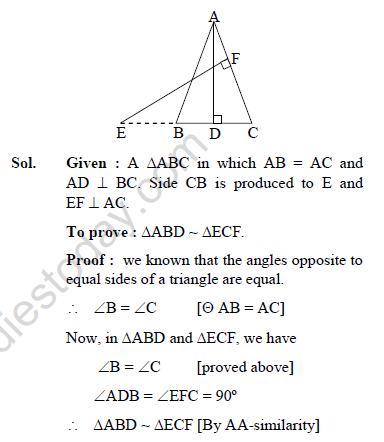
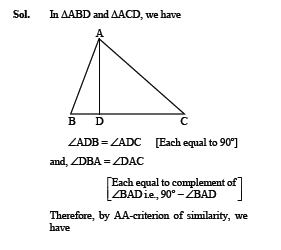
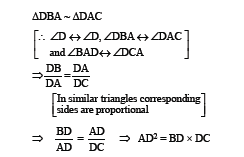
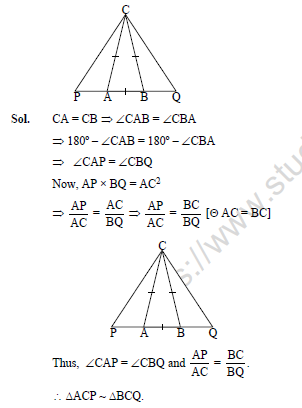
Q.- In the figure, E is a point on side CB produced of an isosceles ΔABC with AB = AC. If AD ⊥ BC and EF ⊥ AC, prove that ΔABD ~ ΔECF.

More question-
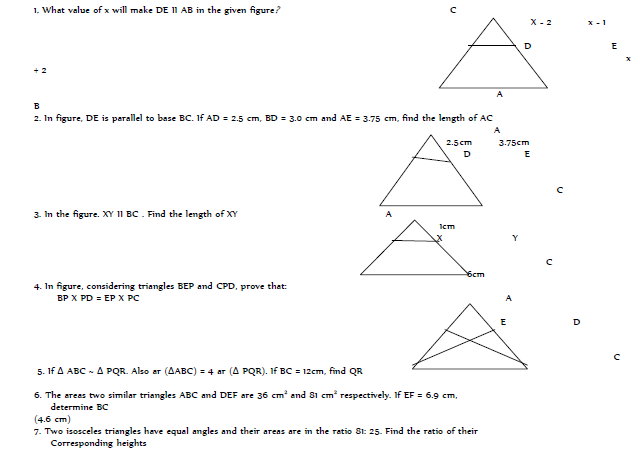
Question 1. What value of x will make DE II AB in the given figure?
Answer: x = 4
For the line segment \( DE \) to be parallel to \( AB \) in \( \Delta CAB \), the Basic Proportionality Theorem (Thales's Theorem) must be satisfied. This means the ratios of the segments on both sides must be equal: \[ \frac{CD}{DA} = \frac{CE}{EB} \] From the given figure, we substitute the values: \[ \frac{x - 2}{x} = \frac{x - 1}{x + 2} \] Cross-multiplying both sides: \[ (x - 2)(x + 2) = x(x - 1) \] \[ x^2 - 4 = x^2 - x \] Subtracting \( x^2 \) from both sides: \[ -4 = -x \implies x = 4 \] In simple words: When a line is parallel to the base of a triangle, it divides the other two sides in the same proportion. We use this proportional relation to set up our equation and solve for x.
Exam Tip: Always make sure to write down the theorem name (Basic Proportionality Theorem) before setting up your ratios to secure full steps marks.
Question 2. In figure, DE is parallel to base BC. If AD = 2.5 cm, BD = 3.0 cm and AE = 3.75 cm, find the length of AC
Answer: 8.25 cm
Since the line \( DE \) is parallel to the base \( BC \), we apply Thales's Theorem in \( \Delta ABC \): \[ \frac{AD}{BD} = \frac{AE}{EC} \] Substitute the given numerical values into the proportion: \[ \frac{2.5}{3.0} = \frac{3.75}{EC} \] Cross-multiplying to find \( EC \): \[ 2.5 \times EC = 3.0 \times 3.75 \] \[ EC = \frac{11.25}{2.5} = 4.5\text{ cm} \] The total length of the side \( AC \) is the sum of \( AE \) and \( EC \): \[ AC = AE + EC = 3.75\text{ cm} + 4.5\text{ cm} = 8.25\text{ cm} \] In simple words: Since the inner line is parallel to the bottom, the ratio of the left segments equals the ratio of the right segments. Finding the bottom-right segment allows us to calculate the full right side length.
Exam Tip: Always double-check if the question asks for the remaining segment \( EC \) or the full side length \( AC \) to avoid losing minor marks.
Question 3. In the figure. XY II BC . Find the length of XY
Answer: 2 cm
Since \( XY \parallel BC \) in \( \Delta ABC \), the corresponding angles are equal, meaning \( \Delta AXY \sim \Delta ABC \) by AA similarity. Because the triangles are similar, their corresponding side lengths are proportional: \[ \frac{XY}{BC} = \frac{AX}{AB} \] Given that \( AX = 1\text{ cm} \) and \( XB = 2\text{ cm} \), the total length of \( AB \) is: \[ AB = AX + XB = 1 + 2 = 3\text{ cm} \] Now, substitute the values to find \( XY \): \[ \frac{XY}{6} = \frac{1}{3} \] \[ XY = \frac{6}{3} = 2\text{ cm} \] In simple words: The small top triangle is a scaled-down version of the large triangle. Since the total left side of the large triangle is 3 times longer than the small one's left side, the bottom side of the large triangle must also be 3 times longer than the small one's bottom side.
Exam Tip: A very common mistake is using \( XB \) in the denominator instead of the full side length \( AB \). Remember that similarity ratios compare the full sides of both triangles.
Question 4. In figure, considering triangles BEP and CPD, prove that: BP X PD = EP X PC
Answer:
In the given figure, \( BD \perp AC \) and \( CE \perp AB \), intersecting at \( P \). Let us consider \( \Delta BEP \) and \( \Delta CPD \):
1. \( \angle BEP = \angle CPD = 90^\circ \) (as \( CE \perp AB \) and \( BD \perp AC \))
2. \( \angle BPE = \angle CPD \) (Vertically opposite angles) By AA (Angle-Angle) similarity, the two triangles are similar: \[ \Delta BEP \sim \Delta CDP \] Since similar triangles have proportional corresponding sides: \[ \frac{BP}{CP} = \frac{EP}{DP} \] Cross-multiplying both sides yields: \[ BP \times DP = EP \times CP \] Which can be written as: \[ BP \times PD = EP \times PC \] Hence proved. In simple words: The two small triangles facing each other share matching right angles and equal opposite angles at the center point. Because they are similar, their sides have proportional lengths that cross-multiply to prove the statement.
Exam Tip: Vertically opposite angles are a very useful tool to identify similar triangles in intersecting figures.
Question 5. If Δ ABC ~ Δ PQR. Also ar (ΔABC) = 4 ar (Δ PQR). If BC = 12cm, find QR
Answer: 6 cm
For similar triangles, the ratio of their areas is equal to the square of the ratio of their corresponding sides: \[ \frac{\text{ar}(\Delta ABC)}{\text{ar}(\Delta PQR)} = \left(\frac{BC}{QR}\right)^2 \] Given that \( \text{ar}(\Delta ABC) = 4 \times \text{ar}(\Delta PQR) \): \[ \frac{4 \times \text{ar}(\Delta PQR)}{\text{ar}(\Delta PQR)} = \left(\frac{12}{QR}\right)^2 \] \[ 4 = \left(\frac{12}{QR}\right)^2 \] Taking the square root on both sides: \[ 2 = \frac{12}{QR} \] \[ 2 \times QR = 12 \implies QR = 6\text{ cm} \]
In simple words: When the area of one triangle is 4 times larger than another similar one, its sides must be exactly 2 times longer (since side length scales with the square root of area). This means the smaller side is half of the larger one.
Exam Tip: Be sure to write out the basic theorem relating similar triangle areas to their sides before substituting the values.
Question 6. The areas two similar triangles ABC and DEF are 36 cm2 and 81 cm2 respectively. If EF = 6.9 cm, determine BC
Answer: 4.6 cm
Since \( \Delta ABC \sim \Delta DEF \), we use the area similarity theorem: \[ \frac{\text{ar}(\Delta ABC)}{\text{ar}(\Delta DEF)} = \left(\frac{BC}{EF}\right)^2 \] Substitute the given values: \[ \frac{36}{81} = \left(\frac{BC}{6.9}\right)^2 \] Taking the square root of both sides: \[ \frac{6}{9} = \frac{BC}{6.9} \] Reduce the fraction: \[ \frac{2}{3} = \frac{BC}{6.9} \] \[ 3 \times BC = 2 \times 6.9 \] \[ 3 \times BC = 13.8 \implies BC = \frac{13.8}{3} = 4.6\text{ cm} \]
In simple words: The ratio of the areas of two similar triangles is equal to the squared ratio of their side lengths. We take the square root of both sides to easily solve for the unknown side.
Exam Tip: Always simplify fractions like \( \frac{36}{81} \) to \( \frac{4}{9} \) or take their square root directly to make calculations much simpler.
Question 7. Two isosceles triangles have equal angles and their areas are in the ratio 81: 25. Find the ratio of their Corresponding heights
Answer: 9 : 5
Since the two isosceles triangles have equal angles, they are similar by AA similarity. The ratio of the areas of two similar triangles is equal to the square of the ratio of their corresponding heights: \[ \frac{\text{Area}_1}{\text{Area}_2} = \left(\frac{h_1}{h_2}\right)^2 \] Given the area ratio: \[ \frac{81}{25} = \left(\frac{h_1}{h_2}\right)^2 \] Taking the square root on both sides: \[ \frac{h_1}{h_2} = \sqrt{\frac{81}{25}} = \frac{9}{5} \] Therefore, the ratio of their corresponding heights is \( 9 : 5 \).
In simple words: For any similar shapes, linear measurements like heights scale directly with the square root of their area ratios.
Exam Tip: Clearly mention that equal angles in isosceles triangles guarantee similarity before applying the area-height relationship.
Question 8. D, E and F are respectively the mid points of the sides BC, CA and AB of ΔABC. Find the ratio of the areas of Δ DEF and Δ ABC
Answer: 1 : 4
Let \( D, E, \) and \( F \) be the midpoints of the sides of \( \Delta ABC \). According to the midpoint theorem, the segments \( DE, EF, \) and \( FD \) are parallel to and exactly half the length of the sides of the original triangle \( \Delta ABC \). This dividing action splits \( \Delta ABC \) into four congruent triangles of equal area: \[ \Delta AFE \cong \Delta FBD \cong \Delta EDC \cong \Delta DEF \] The area of \( \Delta DEF \) is therefore one-fourth of the total area of \( \Delta ABC \): \[ \frac{\text{ar}(\Delta DEF)}{\text{ar}(\Delta ABC)} = \frac{1}{4} \] Therefore, the ratio is \( 1 : 4 \).
In simple words: Connecting the midpoints of a triangle splits it into four smaller triangles of equal area. Thus, the inner triangle's area is exactly a quarter of the outer one.
Exam Tip: Be sure to write the ratio in the exact order requested in the question: \( \text{Area}(DEF) : \text{Area}(ABC) \).
Question 9. The perimeters of two similar triangles are 36cm and 48cm respectively. If one side of the first triangle is 9cm, what is the corresponding side of the other triangle
Answer: 12 cm
For similar triangles, the ratio of their perimeters is equal to the ratio of their corresponding side lengths: \[ \frac{\text{Perimeter}_1}{\text{Perimeter}_2} = \frac{\text{Side}_1}{\text{Side}_2} \] Substitute the given values: \[ \frac{36}{48} = \frac{9}{\text{Side}_2} \] Simplify the perimeter ratio: \[ \frac{3}{4} = \frac{9}{\text{Side}_2} \] \[ 3 \times \text{Side}_2 = 36 \implies \text{Side}_2 = 12\text{ cm} \]
In simple words: The boundary lines of similar shapes scale in the exact same proportion as their sides. Since the boundary of the first shape is three-fourths of the second, its sides are also three-fourths of the second.
Exam Tip: Remember that perimeter ratios do not require squaring, unlike area ratios.
Question 10. In triangle ABC, AB= √3a, AC = a and BC = 2a. Prove that ∟A = 90˚
Answer:
Let us calculate the sum of the squares of the two shorter sides: \[ AB^2 + AC^2 = (\sqrt{3}a)^2 + a^2 \] \[ AB^2 + AC^2 = 3a^2 + a^2 = 4a^2 \] Now, calculate the square of the longest side: \[ BC^2 = (2a)^2 = 4a^2 \] Since the values are equal: \[ AB^2 + AC^2 = BC^2 \] By the converse of Pythagoras' Theorem, the triangle must be right-angled at the vertex opposite to the hypotenuse \( BC \). Therefore, \( \angle A = 90^\circ \). Hence proved.
In simple words: Squaring the sides and adding them shows they fit the Pythagoras equation perfectly. By this rule, the angle opposite the longest side must be a right angle.
Exam Tip: When proving a right angle, always state the "Converse of Pythagoras' Theorem" clearly as your reason.
Question 11. In triangle ABC, ∟BAC = 90˚ and AD ┴ BC. If BD = 8cm, DC= 18 cm, find AD
Answer: 12 cm
In a right-angled triangle \( \Delta ABC \), the altitude \( AD \) drawn to the hypotenuse \( BC \) creates two smaller triangles that are similar to each other: \[ \Delta ABD \sim \Delta CAD \] Thus, the ratios of their corresponding sides are equal: \[ \frac{BD}{AD} = \frac{AD}{CD} \] \[ AD^2 = BD \times CD \] Substitute the given segment values: \[ AD^2 = 8 \times 18 \] \[ AD^2 = 144 \implies AD = \sqrt{144} = 12\text{ cm} \]
In simple words: The altitude squared is equal to the product of the two segments it divides the base into. Multiplying the segments and taking the square root gives us the height.
Exam Tip: The relation \( AD^2 = BD \times CD \) is a standard right-triangle identity that should be written directly to save time.
Question 12. Two poles of height 8m and 13m stand on a plane ground. If the distance between their tips is 13m, find the distance between their feet
Answer: 12 m
Let the two poles be \( AB = 8\text{ m} \) and \( CD = 13\text{ m} \). Let the horizontal distance between their feet be \( BD = x \). Draw a perpendicular line segment \( AE \) from \( A \) to \( CD \). Then \( AE = BD = x \) and \( DE = AB = 8\text{ m} \). Find the height difference \( CE \): \[ CE = CD - DE = 13\text{ m} - 8\text{ m} = 5\text{ m} \] In right-angled triangle \( \Delta AEC \) (where \( \angle AEC = 90^\circ \)): \[ AC^2 = AE^2 + CE^2 \] Since the distance between their tips \( AC = 13\text{ m} \): \[ 13^2 = x^2 + 5^2 \] \[ 169 = x^2 + 25 \] \[ x^2 = 144 \implies x = 12\text{ m} \] The distance between their feet is 12 m.
In simple words: Drawing a horizontal helper line forms a right-angled triangle between the tops of the poles. Using Pythagoras' theorem on this triangle lets us find the horizontal distance.
Exam Tip: Always draft a small sketch to visually confirm how the horizontal helper line creates the right-angled triangle.
Question 13. The perpendicular from A on side BC of a triangle ABC intersects BC at D such that BD = 3CD. Prove that 2 AB2 – 2 AC2 = BC2
Answer:
In right-angled triangle \( \Delta ABD \) (where \( \angle ADB = 90^\circ \)): \[ AB^2 = AD^2 + BD^2 \] -- (1) In right-angled triangle \( \Delta ACD \): \[ AC^2 = AD^2 + CD^2 \] -- (2) Subtracting equation (2) from (1): \[ AB^2 - AC^2 = BD^2 - CD^2 \] Given that \( BD = 3CD \): \[ AB^2 - AC^2 = (3CD)^2 - CD^2 \] \[ AB^2 - AC^2 = 9CD^2 - CD^2 = 8CD^2 \] We also know that the full side \( BC = BD + CD \): \[ BC = 3CD + CD = 4CD \implies CD = \frac{BC}{4} \] Substitute this expression back into the equation: \[ AB^2 - AC^2 = 8 \times \left(\frac{BC}{4}\right)^2 \] \[ AB^2 - AC^2 = 8 \times \frac{BC^2}{16} = \frac{BC^2}{2} \] Multiplying both sides by 2: \[ 2AB^2 - 2AC^2 = BC^2 \] Hence proved.
In simple words: We apply Pythagoras' theorem to the two right triangles to eliminate the height. Then, we substitute the relationship between the base segments to obtain the final equation.
Exam Tip: Eliminating the shared perpendicular height is a very common technique when proving side relationships in triangles.
Question 14. In an isosceles triangle ABC with AB = AC, BD is a perpendicular from B to the side AC. Prove that BD2 - CD2 = 2CD . AD
Answer:
In right-angled triangle \( \Delta ABD \) (where \( \angle ADB = 90^\circ \)): \[ BD^2 = AB^2 - AD^2 \] Subtracting \( CD^2 \) from both sides: \[ BD^2 - CD^2 = AB^2 - AD^2 - CD^2 \] Since \( \Delta ABC \) is an isosceles triangle with \( AB = AC \) and \( AC = AD + CD \): \[ AB^2 = AC^2 = (AD + CD)^2 \] Expand the squared binomial: \[ AB^2 = AD^2 + CD^2 + 2CD \cdot AD \] Now substitute this expanded term back into our expression: \[ BD^2 - CD^2 = (AD^2 + CD^2 + 2CD \cdot AD) - AD^2 - CD^2 \] Simplifying by canceling like terms: \[ BD^2 - CD^2 = 2CD \cdot AD \] Hence proved.
In simple words: Using Pythagoras' theorem on the upper right triangle gives a value for the perpendicular. Substituting the side length relation \( AB = AC \) and expanding algebraically simplifies to the desired proof.
Exam Tip: Substituting the sum of segments for the equal sides of an isosceles triangle is a simple way to resolve complex algebraic proofs.
Question 15. P and Q are points on the sides CA and CB respectively of a ΔABC right angled at C. Prove that AQ2 + BP2 = AB2 + PQ2
Answer:
In right-angled triangle \( \Delta ACQ \) (where \( \angle C = 90^\circ \)): \[ AQ^2 = AC^2 + CQ^2 \] -- (1) In right-angled triangle \( \Delta BCP \): \[ BP^2 = BC^2 + CP^2 \] -- (2) Adding equations (1) and (2): \[ AQ^2 + BP^2 = (AC^2 + BC^2) + (CP^2 + CQ^2) \] In right-angled triangle \( \Delta ACB \), we have: \[ AC^2 + BC^2 = AB^2 \] In right-angled triangle \( \Delta PCQ \), we have: \[ CP^2 + CQ^2 = PQ^2 \] Substituting these values back into the sum: \[ AQ^2 + BP^2 = AB^2 + PQ^2 \] Hence proved.
In simple words: Apply Pythagoras' theorem to the two crossed right triangles. Adding their equations and regrouping the terms lets us substitute the hypotenuses of the main and inner triangles to complete the proof.
Exam Tip: Grouping terms according to their respective right-angled triangles makes this multi-triangle proof very simple.
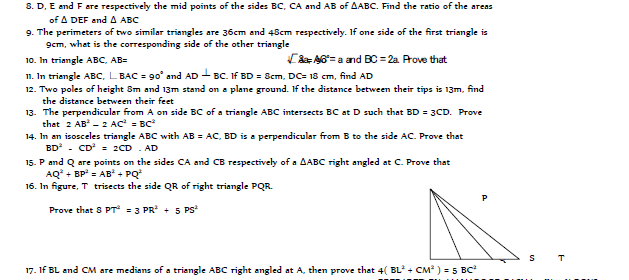
Question 16. In figure, T trisects the side QR of right triangle PQR. Prove that 8 PT2 = 3 PR2 + 5 PS2
Answer:
Since \( S \) and \( T \) trisect the side \( QR \) of the right-angled triangle \( \Delta PQR \), they divide it into three equal parts: \[ QS = ST = TR = x \] This means the segment lengths from the vertex \( Q \) are: \[ QS = x \] \[ QT = 2x \] \[ QR = 3x \] Applying Pythagoras' theorem in the right-angled triangles with vertex \( Q \):
1. In \( \Delta PQS \): \( PS^2 = PQ^2 + QS^2 = PQ^2 + x^2 \implies PQ^2 = PS^2 - x^2 \) -- (1)
2. In \( \Delta PQT \): \( PT^2 = PQ^2 + QT^2 = PQ^2 + (2x)^2 = PQ^2 + 4x^2 \) -- (2)
3. In \( \Delta PQR \): \( PR^2 = PQ^2 + QR^2 = PQ^2 + (3x)^2 = PQ^2 + 9x^2 \) -- (3) Now consider the right-hand side of the required proof: \[ \text{RHS} = 3PR^2 + 5PS^2 \] Substitute equations (1) and (3) into this expression: \[ = 3(PQ^2 + 9x^2) + 5(PQ^2 + x^2) \] \[ = 3PQ^2 + 27x^2 + 5PQ^2 + 5x^2 \] \[ = 8PQ^2 + 32x^2 \] Factor out the common multiplier of 8: \[ = 8(PQ^2 + 4x^2) \] Using equation (2), substitute back \( PT^2 \): \[ = 8PT^2 = \text{LHS} \] Hence proved. In simple words: Representing the three trisected base segments with a single variable allows us to write Pythagoras equations for all three segments. Simplifying the algebraic combination of the outer triangles shows it matches the middle one.
Exam Tip: Using a single variable \( x \) for trisected segments is an effective way to simplify complex-looking geometry proofs.
Question 17. If BL and CM are medians of a triangle ABC right angled at A, then prove that 4( BL2 + CM2 ) = 5 BC2
Answer:
In right-angled triangle \( \Delta ABC \) (where \( \angle A = 90^\circ \)): \[ BC^2 = AB^2 + AC^2 \] -- (1) Since \( BL \) is a median, \( L \) is the midpoint of \( AC \), so \( AL = \frac{AC}{2} \). In right-angled triangle \( \Delta BAL \): \[ BL^2 = AB^2 + AL^2 = AB^2 + \left(\frac{AC}{2}\right)^2 = AB^2 + \frac{AC^2}{4} \] -- (2) Since \( CM \) is a median, \( M \) is the midpoint of \( AB \), so \( AM = \frac{AB}{2} \). In right-angled triangle \( \Delta CAM \): \[ CM^2 = AC^2 + AM^2 = AC^2 + \left(\frac{AB}{2}\right)^2 = AC^2 + \frac{AB^2}{4} \] -- (3) Add equations (2) and (3): \[ BL^2 + CM^2 = \left(AB^2 + \frac{AC^2}{4}\right) + \left(AC^2 + \frac{AB^2}{4}\right) \] \[ BL^2 + CM^2 = \frac{5}{4} AB^2 + \frac{5}{4} AC^2 \] \[ BL^2 + CM^2 = \frac{5}{4} (AB^2 + AC^2) \] Using equation (1), substitute the hypotenuse \( BC^2 \) into the expression: \[ BL^2 + CM^2 = \frac{5}{4} BC^2 \] Multiplying both sides by 4: \[ 4(BL^2 + CM^2) = 5BC^2 \] Hence proved.
In simple words: Find Pythagoras' relations for both median triangles. Summing them up creates fractions that combine to equal five-fourths of the main hypotenuse, completing the proof.
Exam Tip: This median theorem is one of the most frequently asked questions in Class 10 trigonometry and geometry exams; make sure you practice it thoroughly.
Free study material for Mathematics
Free CBSE Practice Worksheets: Class 10 Mathematics Chapter 06 Triangles
Daily Practice Questions for Class 10 Mathematics
Review targeted practice exercises for Class 10 Mathematics Chapter 06 Triangles. Curated to match official CBSE guidelines, these printable problem sets support daily revision and improve overall test readiness.
Detailed Answers for Class 10 Mathematics Chapter 06 Triangles
Designed around the official curriculum for Class 10 Mathematics, these practice sheets guarantee standard compliance. Reviewing step-by-step solutions after completion sharpens your accuracy and clarifies complex sub-topics within Chapter 06 Triangles.
Complete Your Chapter Revision
Consistent engagement with these exercises builds familiarity with recurring exam themes. If specific areas within Chapter 06 Triangles cause trouble, utilize our dedicated NCERT solutions for Class 10 Mathematics to clear up doubts immediately.
FAQs
You can download the latest chapter-wise printable worksheets for Class 10 Mathematics Chapter 06 Triangles for free from StudiesToday.com. These have been made as per the latest CBSE curriculum for this academic year.
Yes, Class 10 Mathematics worksheets for Chapter 06 Triangles focus on activity-based learning and also competency-style questions. This helps students to apply theoretical knowledge to practical scenarios.
Yes, we have provided solved worksheets for Class 10 Mathematics Chapter 06 Triangles to help students verify their answers instantly.
Yes, our Class 10 Mathematics test sheets are mobile-friendly PDFs and can be printed by teachers for classroom.
For Chapter 06 Triangles, regular practice with our worksheets will improve question-handling speed and help students understand all technical terms and diagrams.