

Class 10 Mathematics Practice Sheet: CBSE Class 10 Mathematics Triangles Worksheet Set 07
Explore structured practice materials through the CBSE Class 10 Mathematics Triangles Worksheet Set 07. Tailored for Class 10 learners, utilizing these Mathematics worksheets ensures thorough preparation and strengthens problem-solving accuracy before final school evaluations.
Download Chapter 06 Triangles Worksheet PDF with Answers
Access the complete worksheet PDF for Class 10 Mathematics below. Regular practice with these targeted academic tasks builds familiarity with standard question patterns and helps secure higher marks in final school examinations.
Triangles
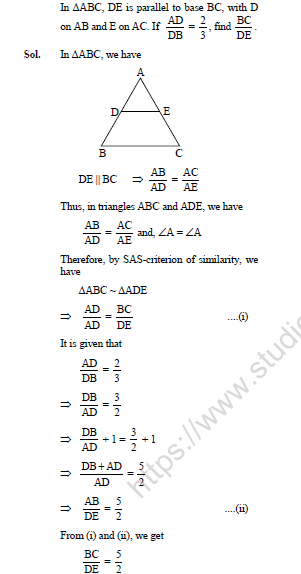
Q.- A vertical stick 20 cm long casts a shadow 6 cm long on the ground. At the same time, a tower casts a shadow 15 m long on the ground. Find the height of the tower.




1.In ABC right angled at C, AD is median. Then AB2 =
(A) AC2 - AD2
(B) AD2 - AC2
(C) 3AC2 - 4AD2
(D) 4AD2 - 3AC2
2.Which of the following statement is true?
(A) Any two right triangles are similar
(B) Any two squares are similar
(C) Any two rectangles are similar
(D) Both b and c
3.In the given fig. AB || MN, If PA = x - 2, PM = x ; PB = x - 1 and PN = x + 2, find the value of 'x'.
(A) 2
(B) 3
(C) 4
(D) none
4.If three or more parallel lines are intersected by transversals, the intercepts made by them on the transversals are
(A)
(B)
(C)
(D)
5.If ABC is an equilateral triangle with side 12 cm, then the area of triangle formed by joined its mid points is :
(A)
(B)
(C) 64 sq cm
(D) none of these
6.The areas of two similar triangles are 121 cm2and 64 cm2 respectively. If the median of the first triangle is 12.1 cm. find the corresponding median of the other.
(A) 8 cm
Please click the below link to access CBSE Class 10 Mathematics Triangles Worksheet Set G
Triangles
Question 1. In ABC right angled at C, AD is median. Then AB2 =
(A) AC2 - AD2
(B) AD2 - AC2
(C) 3AC2 - 4AD2
(D) 4AD2 - 3AC2
Answer: (D) 4AD2 - 3AC2
In right-angled triangle \( \Delta ABC \) (right-angled at \( C \)): \[ AB^2 = AC^2 + BC^2 \] Since \( AD \) is the median to \( BC \), \( D \) is the midpoint of \( BC \). Thus: \[ CD = \frac{BC}{2} \implies BC = 2CD \] Squaring both sides gives: \[ BC^2 = 4CD^2 \] In right-angled triangle \( \Delta ACD \): \[ AD^2 = AC^2 + CD^2 \implies CD^2 = AD^2 - AC^2 \] Substitute the expression for \( CD^2 \) into the equation for \( BC^2 \): \[ BC^2 = 4(AD^2 - AC^2) \] Substitute this back into the first equation for \( AB^2 \): \[ AB^2 = AC^2 + 4(AD^2 - AC^2) \] \[ AB^2 = AC^2 + 4AD^2 - 4AC^2 \] \[ AB^2 = 4AD^2 - 3AC^2 \]
In simple words: By using the Pythagorean theorem on both the small and large right triangles, we can substitute the length of the median to express the hypotenuse in terms of the other sides.
Exam Tip: Remember to relate the median segment to the full side before substituting it into Pythagoras' formula.
Question 2. Which of the following statement is true?
(A) Any two right triangles are similar
(B) Any two squares are similar
(C) Any two rectangles are similar
(D) Both b and c
Answer: (B) Any two squares are similar
Two polygons are similar if their corresponding angles are equal and their corresponding sides are in the same ratio. For any two squares, all angles are always \( 90^\circ \) and the ratio of their sides is always equal. Right triangles and rectangles can have different side ratios, so they are not always similar.
In simple words: All squares have the exact same shape (all angles are 90 degrees and all sides are equal), so any square is just a scaled-up or scaled-down version of another.
Exam Tip: Regular polygons with the same number of sides (like equilateral triangles or squares) are always similar to each other.
Question 3. In the given fig. AB || MN, If PA = x - 2, PM = x ; PB = x - 1 and PN = x + 2, find the value of 'x'.
(A) 2
(B) 3
(C) 4
(D) none
Answer: (C) 4
Since \( AB \parallel MN \), we can apply Thales's Theorem (Basic Proportionality Theorem) in triangle \( \Delta PMN \): \[ \frac{PA}{PM} = \frac{PB}{PN} \] Substitute the given algebraic values: \[ \frac{x - 2}{x} = \frac{x - 1}{x + 2} \] Cross-multiplying: \[ (x - 2)(x + 2) = x(x - 1) \] \[ x^2 - 4 = x^2 - x \] \[ -4 = -x \implies x = 4 \] In simple words: Since the inner line is parallel to the base, it cuts the sides of the triangle in the same ratio. Setting up this ratio allows us to solve for x.
Exam Tip: Be careful to identify whether the ratio is given for the parts of the side (like \( AM \)) or the entire side (like \( PM \)).
Question 4. If three or more parallel lines are intersected by transversals, the intercepts made by them on the transversals are
(A) \( \frac{AD}{BE} = \frac{BE}{CF} \)
(B) \( \frac{AE}{BD} = \frac{BF}{CE} \)
(C) \( \frac{AC}{BC} = \frac{DF}{DE} \)
(D) \( \frac{AB}{BC} = \frac{DE}{EF} \)
Answer: (D) \( \frac{AB}{BC} = \frac{DE}{EF} \)
According to the intercept theorem (Three Parallel Lines Theorem), if three parallel lines are cut by two transversals, then the intercepts made by them on the transversals are proportional: \[ \frac{AB}{BC} = \frac{DE}{EF} \] In simple words: When parallel lines cut across two lines, the segments created on one line will have the exact same ratio as the corresponding segments on the other line.
Exam Tip: This theorem is an extension of the basic proportionality theorem and is extremely useful for solving multi-line parallel geometry problems.
Question 5. If ABC is an equilateral triangle with side 12 cm, then the area of triangle formed by joined its mid points is :
(A) \( 9\sqrt{3}\text{ sq cm} \)
(B) \( 2\sqrt{2}\text{ sq cm} \)
(C) 64 sq cm
(D) none of these
Answer: (A) \( 9\sqrt{3}\text{ sq cm} \)
The area of the main equilateral triangle \( \Delta ABC \) with side \( s = 12\text{ cm} \) is: \[ \text{Area}(ABC) = \frac{\sqrt{3}}{4} \times s^2 = \frac{\sqrt{3}}{4} \times 144 = 36\sqrt{3}\text{ cm}^2 \] Joining the midpoints of the sides of a triangle divides it into 4 congruent triangles of equal area. Therefore, the area of the central triangle formed by joining the midpoints is: \[ \text{Area} = \frac{1}{4} \times \text{Area}(ABC) = \frac{1}{4} \times 36\sqrt{3} = 9\sqrt{3}\text{ cm}^2 \]
In simple words: Joining the midpoints divides the triangle into four smaller, equal-sized triangles. The area of one of these small triangles is just one-fourth of the big triangle's area.
Exam Tip: Keep in mind that the small triangle formed by the midpoints of an equilateral triangle is also equilateral, with exactly half the side length of the original.
Question 6. The areas of two similar triangles are 121 cm2and 64 cm2respectively. If the median of the first triangle is 12.1 cm. find the corresponding median of the other.
(A) 8 cm
(B) 8.5 cm
(C) 8.9 cm
(D) 8.8 cm
Answer: (D) 8.8 cm
For two similar triangles, the ratio of their areas is equal to the square of the ratio of their corresponding medians: \[ \frac{\text{Area}_1}{\text{Area}_2} = \left(\frac{m_1}{m_2}\right)^2 \] Substitute the given values: \[ \frac{121}{64} = \left(\frac{12.1}{m_2}\right)^2 \] Taking the square root on both sides: \[ \frac{11}{8} = \frac{12.1}{m_2} \] \[ 11 \times m_2 = 12.1 \times 8 \] \[ 11 \times m_2 = 96.8 \implies m_2 = 8.8\text{ cm} \]
In simple words: The ratio of the areas of similar triangles is equal to the squared ratio of any corresponding lengths, such as medians or altitudes.
Exam Tip: Make sure you take the square root of the area ratio before setting up the equation to solve for the median length.
Question 7. A girl of height 120 cm is walking from the base of a lamp-post at a speed to 1.2 m/s. If the lamp is 3.6 m above the ground, find the length of her shadow after 4 seconds.
(A) 1.6 m
(B) 2.2 m
(C) 2.4 m
(D) 2.6 m
Answer: (C) 2.4 m
Height of the girl \( = 120\text{ cm} = 1.2\text{ m} \). Distance walked by the girl in 4 seconds: \[ \text{Distance} = \text{Speed} \times \text{Time} = 1.2\text{ m/s} \times 4\text{ s} = 4.8\text{ m} \] Let \( x \) be the length of her shadow. Since the triangles formed by the lamp-post and the girl are similar: \[ \frac{\text{Height of lamp-post}}{\text{Height of girl}} = \frac{\text{Total distance from post}}{\text{Length of shadow}} \] \[ \frac{3.6}{1.2} = \frac{4.8 + x}{x} \] \[ 3 = \frac{4.8 + x}{x} \] \[ 3x = 4.8 + x \] \[ 2x = 4.8 \implies x = 2.4\text{ m} \] In simple words: The girl and the lamp-post form two similar right-angled triangles with the ground. By using the ratio of their heights, we can find the unknown length of the shadow.
Exam Tip: Convert all measurements to the same unit (meters or centimeters) before starting any calculations.
Question 8. The line segment joining the midpoints of any two sides of a triangle is parallel to
(A) right angle
(B) isosceles triangle
(C) second side
(D) Third side
Answer: (D) Third side
By the Midpoint Theorem, the line segment joining the midpoints of any two sides of a triangle is parallel to the third side and is equal to half of it.
In simple words: If you mark the exact middle of two sides of a triangle and connect them, that new line will run perfectly parallel to the bottom (third) side.
Exam Tip: Be prepared to use both conclusions of this theorem: the parallel relationship and the half-length relationship.
Question 9. If D, E, F are the midpoints of sides BC, CA, AB of ABC. Then the DEF and ABC are_____
(A) congruent
(B) similar
(C) both A & B
(D) none of these
Answer: (B) similar
By the Midpoint Theorem, each side of \( \Delta DEF \) is exactly half the length of the corresponding parallel side of \( \Delta ABC \). Since their corresponding sides are proportional, the two triangles are similar by SSS similarity criterion.
In simple words: The smaller triangle inside has sides that are exactly half the size of the larger triangle's sides, so they share the exact same shape and are similar.
Exam Tip: Remember that while the four small triangles are congruent to each other, they are only similar (not congruent) to the original large triangle.
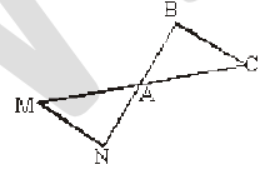
Question 10. Given MN || BC, ABC and ANM are _________ .
(A) similar
(B) congruent
(C) neither similar nor congruent
(D) none of these
Answer: (A) similar
Since \( MN \parallel BC \), we can identify alternate interior angles: \[ \angle ANM = \angle ABC \] \[ \angle AMN = \angle ACB \] Also, vertically opposite angles are equal: \[ \angle MAN = \angle CAB \] Therefore, by AA similarity, \( \Delta ABC \sim \Delta ANM \).
In simple words: The parallel lines create equal alternate interior angles, making the two triangles share all the same angle values, which means they are similar.
Exam Tip: When writing similarity statements, ensure you list the matching vertices in the correct corresponding order.
Question 11. If ABC ~ PQR and then find R.
(A) 20°
(B) 30°
(C) 35°
(D) 37°
Answer: (B) 30°
Since \( \Delta ABC \sim \Delta PQR \), the corresponding angles must be equal: \[ \angle R = \angle C \] In \( \Delta ABC \), the sum of all interior angles is \( 180^\circ \): \[ \angle A + \angle B + \angle C = 180^\circ \] \[ 80^\circ + 70^\circ + \angle C = 180^\circ \] \[ 150^\circ + \angle C = 180^\circ \implies \angle C = 30^\circ \] Therefore, \( \angle R = 30^\circ \).
In simple words: Similar triangles have the exact same angles. We find the third angle of the first triangle, which is 30 degrees, so the corresponding angle in the other triangle is also 30 degrees.
Exam Tip: Always sum the given angles and subtract from 180 degrees to find the remaining angle in any triangle.
Question 12. In ABC, AB > AC and AD ⊥ BC. Then AB2 - AC2
(A) BD2 + AD2
(B) BD2 + CD2
(C) BD2 + AC2
(D) BD2 - CD2
Answer: (D) BD2 - CD2
In right-angled triangle \( \Delta ABD \): \[ AB^2 = AD^2 + BD^2 \] In right-angled triangle \( \Delta ACD \): \[ AC^2 = AD^2 + CD^2 \] Subtracting these two equations: \[ AB^2 - AC^2 = (AD^2 + BD^2) - (AD^2 + CD^2) \] \[ AB^2 - AC^2 = BD^2 - CD^2 \]
In simple words: Applying Pythagoras' theorem to both right-angled triangles formed by the altitude allows the common height squared terms to cancel out when subtracted.
Exam Tip: Subtracting Pythagoras equations is a common technique when dealing with multiple triangles sharing a common perpendicular side.
Question 13. If the corresponding sides of two triangles are proportional then they are
(A) congruent
(B) similar
(C) proportional
(D) none of these
Answer: (B) similar
By the SSS similarity criterion, if the corresponding sides of two triangles are proportional, then their corresponding angles are equal, making the two triangles similar.
In simple words: When sides are scaled up or down in the same proportion, the shape stays identical, making them similar triangles.
Exam Tip: Proportionality of sides guarantees similarity, but only equal lengths (1:1 ratio) can guarantee congruence.
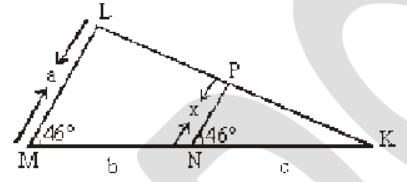
Question 14. From given fig. express 'x' in terms of a, b, c.
(A) \( \frac{-ac}{b+c} \)
(B) \( \frac{ac}{b-c} \)
(C) \( \frac{ac}{b+c} \)
(D) None
Answer: (C) \( \frac{ac}{b+c} \)
In the given figure, \( \angle LMK = 46^\circ \) and \( \angle PNK = 46^\circ \). Since the corresponding angles are equal, the lines \( LM \) and \( PN \) are parallel (\( LM \parallel PN \)). Thus, \( \Delta LMK \sim \Delta PNK \) by AA similarity. Therefore, the ratios of their corresponding sides are equal: \[ \frac{PN}{LM} = \frac{NK}{MK} \] Substitute the given values where \( MK = MN + NK = b + c \): \[ \frac{x}{a} = \frac{c}{b + c} \implies x = \frac{ac}{b + c} \]
In simple words: Equal angles show that the inner lines are parallel. This means the smaller triangle is similar to the larger one, letting us set up a ratio to express x.
Exam Tip: Be sure to write the full base segment \( MK \) as \( b + c \) instead of just using one part of it.
Question 15. The areas of two similar triangles are 64 cm2, 49 cm2. Altitude of first one is 6 cm. Then altitude of second in cm is.
(A) 5.25cm
(B) 3.5
(C) 27.56
Answer: (A) 5.25cm
The ratio of the areas of two similar triangles is equal to the square of the ratio of their corresponding altitudes: \[ \frac{\text{Area}_1}{\text{Area}_2} = \left(\frac{h_1}{h_2}\right)^2 \] Substitute the given values: \[ \frac{64}{49} = \left(\frac{6}{h_2}\right)^2 \] Taking the square root on both sides: \[ \frac{8}{7} = \frac{6}{h_2} \] \[ 8h_2 = 42 \implies h_2 = 5.25\text{ cm} \]
In simple words: Just like with medians, the ratio of the areas is the squared ratio of their heights. Taking the square root lets us solve for the missing height.
Exam Tip: Ensure that you align the correct area with its corresponding altitude in the ratio equation.
Question 16. ABC and DEF are similar, in which BC = 3.5 cm, EF = 2.5 cm and area of ABC = 7 sq cm. Then area of DEF in sq cm is
(A) 4.59
(B) 5.49
(C) 9.54
(D) 3.57
Answer: (D) 3.57
The ratio of the areas of similar triangles is equal to the ratio of the squares of their corresponding sides: \[ \frac{\text{Area}(ABC)}{\text{Area}(DEF)} = \left(\frac{BC}{EF}\right)^2 \] Substitute the given values: \[ \frac{7}{\text{Area}(DEF)} = \left(\frac{3.5}{2.5}\right)^2 = \left(\frac{7}{5}\right)^2 = \frac{49}{25} \] \[ \text{Area}(DEF) = \frac{7 \times 25}{49} = \frac{175}{49} \approx 3.57\text{ cm}^2 \]
In simple words: Setting up the ratio of the areas as the square of the ratio of their side lengths gives the area of the smaller triangle.
Exam Tip: Simplifying the decimals \( \frac{3.5}{2.5} \) to the fraction \( \frac{7}{5} \) makes the calculation much easier to perform without a calculator.
Question 17. If the ratios of areas of two similar triangles are 81 : 49 the ratios of their corresponding angle-bisector segments is:
(A) 5 : 4
(B) 9 : 7
(C) 4 : 5
(D) 625 : 256
Answer: (B) 9 : 7
For similar triangles, the ratio of their areas is equal to the square of the ratio of their corresponding angle-bisector segments: \[ \frac{\text{Area}_1}{\text{Area}_2} = \left(\frac{t_1}{t_2}\right)^2 \] \[ \frac{81}{49} = \left(\frac{t_1}{t_2}\right)^2 \] Taking the square root: \[ \frac{t_1}{t_2} = \frac{9}{7} \implies 9 : 7 \]
In simple words: The ratio of any linear measurements (like angle bisectors) is simply the square root of the ratio of their areas.
Exam Tip: Remember that medians, altitudes, angle bisectors, and side lengths all scale in the exact same ratio for similar triangles.
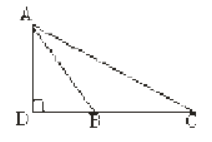
Question 18. In the figure ABC is obtuse. Then AC2 =
(A) AB2 + BC2 - 2BC. BD
(B) AB2 + BC2
(C) AB2 + BC2 + 2BC. BD
(D) AD2 + BD2
Answer: (C) AB2 + BC2 + 2BC. BD
In right-angled triangle \( \Delta ACD \) (right-angled at \( D \)): \[ AC^2 = AD^2 + CD^2 \] Since \( CD = BC + BD \): \[ AC^2 = AD^2 + (BC + BD)^2 \] \[ AC^2 = AD^2 + BC^2 + BD^2 + 2BC \cdot BD \] In right-angled triangle \( \Delta ABD \), \( AD^2 + BD^2 = AB^2 \). Substituting this in: \[ AC^2 = AB^2 + BC^2 + 2BC \cdot BD \]
In simple words: This is the obtuse-angle extension of the Pythagorean theorem. It adds a positive correction term to account for the angle being wider than 90 degrees.
Exam Tip: Pay attention to the sign: obtuse triangles have a \( +2BC \cdot BD \) term, while acute triangles have a \( -2BC \cdot BD \) term.
Question 19. In the figure, CD ⊥ AB, CD = p. Then \(\frac{c}{a}\) =
(A) \( \frac{c}{b} \)
(B) \( - \frac{p}{b} \)
(C) \( \frac{b}{p} \)
(D) None of these
Answer: (C) \(\frac{b}{p}\)
In a right-angled triangle \( \Delta ABC \) with hypotenuse \( c \) and legs \( a, b \), if \( CD \perp AB \), we can find the area in two ways: \[ \text{Area} = \frac{1}{2} a b \quad \text{and} \quad \text{Area} = \frac{1}{2} c p \] Equating these two equations: \[ a b = c p \implies \frac{c}{a} = \frac{b}{p} \]
In simple words: Expressing the triangle's area using two different bases and heights shows that the product of the legs equals the hypotenuse times the altitude. Rearranging this gives the ratio.
Exam Tip: The relation \( ab = cp \) is extremely useful for solving right-angled triangle questions involving perpendiculars from the right angle to the hypotenuse.
Question 20. In rhombus ABCD, AB2 + BC2 + CD2 + DA2 =
(A) OA2 + OB2
(B) OB2 + OC2
(C) OC2 + OD2
(D) AC2 + BD2
Answer: (D) AC2 + BD2
In a rhombus, the diagonals bisect each other at right angles (\( 90^\circ \)). In right-angled triangle \( \Delta AOB \): \[ AB^2 = OA^2 + OB^2 \] Since the diagonals bisect each other: \[ OA = \frac{AC}{2} \quad \text{and} \quad OB = \frac{BD}{2} \] \[ AB^2 = \left(\frac{AC}{2}\right)^2 + \left(\frac{BD}{2}\right)^2 = \frac{AC^2 + BD^2}{4} \] Since all sides of a rhombus are equal (\( AB = BC = CD = DA \)): \[ AB^2 + BC^2 + CD^2 + DA^2 = 4AB^2 = AC^2 + BD^2 \]
In simple words: The sum of the squares of the sides of a rhombus is always equal to the sum of the squares of its diagonals.
Exam Tip: Remember this geometric property as it often appears as a direct proof or numerical question in exams.
Question 21. A ladder is placed against a wall such that its foot is at a distance of 5.5m from the wall and its top reaches a window 9 m above the ground. Find the length of the ladder.
(A) 10.52 m
(B) 10.54 m
(C) 11 m
(D) 10.9 m
Answer: (B) 10.54 m
The ladder, the wall, and the ground form a right-angled triangle. By Pythagoras' Theorem: \[ \text{Hypotenuse}^2 = \text{Base}^2 + \text{Height}^2 \] \[ \text{Length}^2 = 5.5^2 + 9^2 = 30.25 + 81 = 111.25 \] \[ \text{Length} = \sqrt{111.25} \approx 10.547\text{ m} \]
In simple words: The ladder acts as the hypotenuse of a right-angled triangle. Squaring the two distances and adding them gives the square of the ladder's length.
Exam Tip: Be precise when taking square roots of decimals; round off correctly to match the given options.
Question 22. In a right angle triangle, one of the angles is 60 degree, the side opposite to this angle is .
(A) \( \frac{1}{2} \times \text{hypotenuse} \)
(B) \( \frac{1}{\sqrt{2}} \times \text{hypotenuse} \)
(C) \( \frac{2}{3} \times \text{hypotenuse} \)
(D) \( \frac{\sqrt{3}}{2} \times \text{hypotenuse} \)
Answer: (D) \( \frac{\sqrt{3}}{2} \times \text{hypotenuse} \)
By trigonometric definitions in a right-angled triangle: \[ \sin(60^\circ) = \frac{\text{Opposite side}}{\text{Hypotenuse}} \] Since \( \sin(60^\circ) = \frac{\sqrt{3}}{2} \): \[ \text{Opposite side} = \frac{\sqrt{3}}{2} \times \text{Hypotenuse} \]
In simple words: The sine of a 60-degree angle is always radical 3 over 2. This defines the ratio of the opposite side to the hypotenuse.
Exam Tip: Memorizing standard trigonometric ratios like \( \sin(60^\circ) \) and \( \sin(30^\circ) \) helps solve right-triangle geometry problems quickly.
Question 23. In equilateral triangle ABC, if AD ⊥ BC, then:
(A) \( 2AB^2 = 3AD^2 \)
(B) \( 4AB^2 = 3AD^2 \)
(C) \( 3AB^2 = 4AD^2 \)
(D) \( 3AB^2 = 2AD^2 \)
Answer: (C) \( 3AB^2 = 4AD^2 \)
In an equilateral triangle \( \Delta ABC \), the altitude \( AD \) bisects the base \( BC \). Thus, \( BD = \frac{BC}{2} = \frac{AB}{2} \). In right-angled triangle \( \Delta ABD \): \[ AB^2 = AD^2 + BD^2 \] \[ AB^2 = AD^2 + \left(\frac{AB}{2}\right)^2 \] \[ AB^2 = AD^2 + \frac{AB^2}{4} \] \[ AB^2 - \frac{AB^2}{4} = AD^2 \] \[ \frac{3AB^2}{4} = AD^2 \implies 3AB^2 = 4AD^2 \]
In simple words: Using Pythagoras' theorem on half of the equilateral triangle gives a direct relationship between its side length and its altitude.
Exam Tip: This specific ratio is a fundamental property of equilateral triangles and is highly likely to be tested.
Question 24. On joining the mid points of the sides of a triangle along with any of the vertices as the fourth point make a .
(A) parallelogram
(B) Rhombus
(C) rectangle
(D) Square.
Answer: (A) parallelogram
Let \( D, E, F \) be the midpoints of the sides of \( \Delta ABC \). By the Midpoint Theorem: \[ DE \parallel AB \quad \text{and} \quad DE = \frac{1}{2} AB = AF \] Since one pair of opposite sides is both equal and parallel, the quadrilateral \( ADEF \) is a parallelogram.
In simple words: The lines connecting the midpoints of a triangle run parallel to the outer sides, creating a perfect four-sided parallelogram when paired with any vertex.
Exam Tip: Be sure to cite the Midpoint Theorem to justify why the segments are parallel and equal in length.
Question 25. The triangle with measurements a = (2p - 1), b = 2\sqrt{2p}, c = (2p + 1) is
(A) equilateral
(B) right angled
(C) isosceles
(D) none of these
Answer: (B) right angled
Let us check if the side lengths satisfy Pythagoras' theorem: \[ a^2 + b^2 = (2p - 1)^2 + (2\sqrt{2p})^2 \] \[ a^2 + b^2 = 4p^2 - 4p + 1 + 8p \] \[ a^2 + b^2 = 4p^2 + 4p + 1 \] This can be factored as: \[ a^2 + b^2 = (2p + 1)^2 = c^2 \] Since the square of the longest side equals the sum of squares of the other two sides, the triangle is right-angled.
In simple words: Squaring the side lengths and adding them shows they perfectly fit the Pythagoras formula, meaning it must be a right-angled triangle.
Exam Tip: Don't get intimidated by variables in side lengths; expand the algebraic squares carefully to check for Pythagorean triplets.
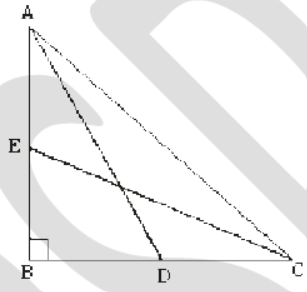
Question 26. In the fig. ABC is a rt. triangle, rt. angled at B. AD and CE are the two medians drawn from A and C respectively. If AC = 5 cm. and AD = \(\frac{3\sqrt{5}}{2}\) cm. Then CE =
(A) \( \sqrt{5}\text{ cm} \)
(B) \( \sqrt{7}\text{ cm} \)
(C) \( 2\sqrt{5}\text{ cm} \)
(D) none of these
Answer: (C) \( 2\sqrt{5}\text{ cm} \)
For any right-angled triangle with medians drawn to its legs: \[ 4(AD^2 + CE^2) = 5AC^2 \] Substitute the given values: \[ 4\left(\left(\frac{3\sqrt{5}}{2}\right)^2 + CE^2\right) = 5(5^2) \] \[ 4\left(\frac{45}{4} + CE^2\right) = 125 \] \[ 45 + 4CE^2 = 125 \] \[ 4CE^2 = 80 \] \[ CE^2 = 20 \implies CE = 2\sqrt{5}\text{ cm} \]
In simple words: There is a special rule connecting the medians of a right triangle to its hypotenuse. We plug in the known values to find the length of the other median.
Exam Tip: Memorizing the median identity \( 4(AD^2 + CE^2) = 5AC^2 \) is extremely useful for saving time in multiple-choice questions.
Question 27. The perimeters of two similar triangles are 36 cm and 48 cm respectively. If one side of the first triangles is 9 cm, what is the corresponding side of the other triangle?
Answer:
For similar triangles, the ratio of their perimeters is equal to the ratio of their corresponding sides: \[ \frac{\text{Perimeter}_1}{\text{Perimeter}_2} = \frac{\text{Side}_1}{\text{Side}_2} \] Substitute the given values: \[ \frac{36}{48} = \frac{9}{\text{Side}_2} \] Simplify the fraction: \[ \frac{3}{4} = \frac{9}{\text{Side}_2} \] \[ 3 \times \text{Side}_2 = 36 \implies \text{Side}_2 = 12\text{ cm} \]
In simple words: The outer boundaries of similar shapes scale in the exact same way as their individual sides.
Exam Tip: Do not square the perimeter ratios; only area ratios require squaring.
Question 28. ABC is a right triangle right-angled at B. Let D and E be any points on AB and BC respectively. Prove that \( AE^2 + CD^2 = AC^2 + DE^2 \)
Answer:
In right-angled triangle \( \Delta ABE \) (right-angled at \( B \)): \[ AE^2 = AB^2 + BE^2 \] -- (1) In right-angled triangle \( \Delta DBC \): \[ CD^2 = BD^2 + BC^2 \] -- (2) Adding equations (1) and (2): \[ AE^2 + CD^2 = (AB^2 + BE^2) + (BD^2 + BC^2) \] Rearranging the terms: \[ AE^2 + CD^2 = (AB^2 + BC^2) + (BE^2 + BD^2) \] In right-angled triangle \( \Delta ABC \), we know \( AB^2 + BC^2 = AC^2 \). In right-angled triangle \( \Delta DBE \), we know \( BE^2 + BD^2 = DE^2 \). Substituting these values: \[ AE^2 + CD^2 = AC^2 + DE^2 \] Hence proved.
In simple words: Apply Pythagoras' theorem to the triangles formed by the segments on the legs, regroup the terms, and substitute the main hypotenuse values.
Exam Tip: Draw the diagram first and identify the four right-angled triangles that exist in this figure.
Question 29. Any point X inside the \( \Delta DEF \) is joined to its vertices. From a point P in DX, PQ is drawn parallel to DE meeting XE at Q and QR is drawn parallel to EF meeting XF in R. Prove that \( PR \parallel DF \)
Answer:
In triangle \( \Delta XDE \), we are given \( PQ \parallel DE \). By the Basic Proportionality Theorem (BPT): \[ \frac{XP}{PD} = \frac{XQ}{QE} \] -- (1) In triangle \( \Delta XEF \), we are given \( QR \parallel EF \). By the Basic Proportionality Theorem (BPT): \[ \frac{XQ}{QE} = \frac{XR}{RF} \] -- (2) From equations (1) and (2), we equate the ratios: \[ \frac{XP}{PD} = \frac{XR}{RF} \] Now, in triangle \( \Delta XDF \), since the line segment \( PR \) divides the sides \( XD \) and \( XF \) in the same ratio, we can apply the converse of the Basic Proportionality Theorem: \[ PR \parallel DF \] Hence proved.
In simple words: Using Thales's theorem on the two internal triangles shows they share a common ratio, which proves the outer lines must also be parallel.
Exam Tip: Be sure to state both "Basic Proportionality Theorem" and "Converse of Basic Proportionality Theorem" at the appropriate steps.
Question 30. A girl of height 90 cm is walking away from the base of a lamp-post at a speed of 1.2 m/s. If the lamp is 3.6 m above the ground, find the length of her shadow after 4 seconds.
Answer:
Height of the girl \( = 90\text{ cm} = 0.9\text{ m} \). Distance covered by the girl in 4 seconds: \[ \text{Distance} = 1.2\text{ m/s} \times 4\text{ s} = 4.8\text{ m} \] Let \( x \) be the length of her shadow. Since the triangles formed by the lamp-post and the girl are similar: \[ \frac{\text{Height of lamp-post}}{\text{Height of girl}} = \frac{\text{Total distance}}{\text{Shadow length}} \] \[ \frac{3.6}{0.9} = \frac{4.8 + x}{x} \] \[ 4 = \frac{4.8 + x}{x} \] \[ 4x = 4.8 + x \] \[ 3x = 4.8 \implies x = 1.6\text{ m} \] The length of her shadow after 4 seconds is 1.6 m.
In simple words: Set up a ratio using similar triangles. The taller lamp-post and the shorter girl create proportional triangles, letting us find the shadow length.
Exam Tip: Do not confuse the height of the girl with the height of the lamp-post when setting up your ratios.
Question 31. A Point O in the interior of a rectangle ABCD is joined with each of the vertices A,B, C and D prove that \( OB^2 + OD^2 = OC^2 + OA^2 \)
Answer:
Through \( O \), draw a line \( PQ \parallel AD \) such that \( P \) lies on \( AB \) and \( Q \) lies on \( CD \). Since \( PQ \parallel AD \parallel BC \), \( PQ \) is perpendicular to both \( AB \) and \( CD \) because the angles of a rectangle are \( 90^\circ \). Thus, \( APQD \) and \( PBCQ \) are rectangles, which means: \[ AP = DQ \quad \text{and} \quad PB = QC \] Using Pythagoras' theorem in the right-angled triangles: \[ OB^2 = OP^2 + PB^2 \] \[ OD^2 = OQ^2 + QD^2 \] Adding these equations: \[ OB^2 + OD^2 = OP^2 + PB^2 + OQ^2 + QD^2 \] Substitute \( PB = QC \) and \( QD = AP \): \[ OB^2 + OD^2 = OP^2 + QC^2 + OQ^2 + AP^2 \] Rearranging the terms: \[ OB^2 + OD^2 = (OQ^2 + QC^2) + (OP^2 + AP^2) \] Using Pythagoras' theorem on the right-angled triangles \( \Delta OQC \) and \( \Delta OPA \): \[ OC^2 = OQ^2 + QC^2 \] \[ OA^2 = OP^2 + AP^2 \] Therefore: \[ OB^2 + OD^2 = OC^2 + OA^2 \] Hence proved.
In simple words: Draw a parallel line through the interior point to form several right triangles, substitute equal side segments of the smaller rectangles, and regroup terms.
Exam Tip: Drawing the helper line \( PQ \) is the key construction step; make sure to state that it is parallel to the outer sides.
Question 32. In a trapezium ABCD, AB || DC and DC = 2 AB; FE drawn parallel to AB Cuts AD in F and BC in E, such that BE/EC = 3/4 Diagonal DB intersects FE at G. Prove that 7 FE = 10 AB
Answer:
In \( \Delta BCD \), \( GE \parallel DC \). Thus, \( \Delta BGE \sim \Delta BDC \): \[ \frac{GE}{DC} = \frac{BE}{BC} \] Given \( \frac{BE}{EC} = \frac{3}{4} \implies \frac{BE}{BC} = \frac{3}{7} \). \[ GE = \frac{3}{7} DC \] Substitute \( DC = 2AB \): \[ GE = \frac{6}{7} AB \] -- (1) In \( \Delta ABD \), \( FG \parallel AB \). Thus, \( \Delta DFG \sim \Delta DAB \): \[ \frac{FG}{AB} = \frac{DF}{AD} \] Since \( FE \parallel DC \), by BPT we have \( \frac{DF}{FA} = \frac{CE}{EB} = \frac{4}{3} \implies \frac{DF}{AD} = \frac{4}{7} \). \[ FG = \frac{4}{7} AB \] -- (2) Since \( FE = FG + GE \), add equations (1) and (2): \[ FE = \frac{4}{7} AB + \frac{6}{7} AB \] \[ FE = \frac{10}{7} AB \implies 7FE = 10AB \] Hence proved.
In simple words: The diagonal splits the parallel line into two parts. Calculate each part using similar triangles in terms of the base, and add them together.
Exam Tip: Be sure to write ratios relative to the entire side of the triangle (like \( AD \) or \( BC \)) when applying similarity properties.
Question 33. ABC is a triangle in which AB=AC and D is any point in BC. Prove that \( AB^2 - AD^2 = BD \cdot CD \)
Answer:
Draw \( AE \perp BC \). Since \( \Delta ABC \) is isosceles with \( AB = AC \), the altitude \( AE \) bisects the base \( BC \): \[ BE = EC \] In right-angled triangle \( \Delta ABE \): \[ AB^2 = AE^2 + BE^2 \] -- (1) In right-angled triangle \( \Delta ADE \): \[ AD^2 = AE^2 + DE^2 \] -- (2) Subtracting equation (2) from (1): \[ AB^2 - AD^2 = BE^2 - DE^2 \] Using the difference of squares identity: \[ AB^2 - AD^2 = (BE - DE)(BE + DE) \] Since \( BE = EC \): \[ BE - DE = BD \quad \text{and} \quad BE + DE = EC + DE = CD \] Substituting these values: \[ AB^2 - AD^2 = BD \cdot CD \] Hence proved.
In simple words: Draw a perpendicular line to bisect the base. Subtracting the Pythagorean equations for both triangles and using algebraic factoring completes the proof.
Exam Tip: Remember that in an isosceles triangle, the perpendicular to the base always bisects it.
Question 34. D, E and F are respectively mid-points of the sides of BC, CA and AB of ABC. Find the ratio of the areas of DEF and ABC
Answer:
Let \( D, E, F \) be the midpoints of the sides \( BC, CA, AB \) of \( \Delta ABC \). By the Midpoint Theorem, the segments \( DE, EF, FD \) are parallel to and half the length of the sides of \( \Delta ABC \). This divides \( \Delta ABC \) into four congruent triangles: \[ \Delta AFE \cong \Delta FBD \cong \Delta EDC \cong \Delta DEF \] Since congruent triangles have equal areas: \[ \text{Area}(DEF) = \frac{1}{4} \text{Area}(ABC) \] Therefore, the ratio of the areas is: \[ \text{Area}(DEF) : \text{Area}(ABC) = 1 : 4 \]
In simple words: Joining the midpoints of any triangle creates four equal smaller triangles. The area of the middle one is exactly one-fourth of the total area.
Exam Tip: Clearly state that the four smaller triangles are congruent to justify why their areas are identical.
Question 35. In figure ABC is a right triangle, right angled at B. Medians AD and CE are of respective lengths 5 cm and \(2\sqrt{5}\) cm. Find the length of AC
Answer:
We use the standard relation for medians to the legs of a right-angled triangle: \[ 4(AD^2 + CE^2) = 5AC^2 \] Substitute the given lengths \( AD = 5\text{ cm} \) and \( CE = 2\sqrt{5}\text{ cm} \): \[ 4\left(5^2 + (2\sqrt{5})^2\right) = 5AC^2 \] \[ 4(25 + 20) = 5AC^2 \] \[ 4(45) = 5AC^2 \] \[ 180 = 5AC^2 \] \[ AC^2 = 36 \implies AC = 6\text{ cm} \]
In simple words: Plug the two median lengths into the right-triangle median formula to easily calculate the hypotenuse.
Exam Tip: This formula can be derived by applying Pythagoras' theorem to three different right triangles in the figure.
Question 36. ABC is a right triangle right-angled at C. Let BC = a, CA = b, AB = c and let p be the length of perpendicular form C on AB prove that (i) cp = ab (ii) 1/p2 = 1/a2 + 1/b2
Answer:
(i) We can find the area of right triangle \( \Delta ABC \) in two ways: \[ \text{Area} = \frac{1}{2} \times \text{base} \times \text{height} = \frac{1}{2} a b \] Taking hypotenuse \( c \) as base and \( p \) as height: \[ \text{Area} = \frac{1}{2} c p \] Equating these two equations: \[ \frac{1}{2} a b = \frac{1}{2} c p \implies c p = a b \] Hence proved.
(ii) From the first part, we have: \[ p = \frac{a b}{c} \implies \frac{1}{p} = \frac{c}{a b} \] Squaring both sides: \[ \frac{1}{p^2} = \frac{c^2}{a^2 b^2} \] In right-angled triangle \( \Delta ABC \), \( c^2 = a^2 + b^2 \). Substitute this in: \[ \frac{1}{p^2} = \frac{a^2 + b^2}{a^2 b^2} \] \[ \frac{1}{p^2} = \frac{a^2}{a^2 b^2} + \frac{b^2}{a^2 b^2} = \frac{1}{b^2} + \frac{1}{a^2} = \frac{1}{a^2} + \frac{1}{b^2} \] Hence proved.
In simple words: Equating area formulas proves the first part. Squaring that result and substituting Pythagoras' formula for the hypotenuse completes the second proof.
Exam Tip: This is a classic Board exam question; practicing both parts together ensures you won't lose easy marks.
Question 37. In Figure if AD ⊥ BC prove that \( AB^2 + CD^2 = BD^2 + AC^2 \)
Answer:
In right-angled triangle \( \Delta ABD \): \[ AB^2 = AD^2 + BD^2 \] -- (1) In right-angled triangle \( \Delta ACD \): \[ AC^2 = AD^2 + CD^2 \implies AD^2 = AC^2 - CD^2 \] -- (2) Substitute the value of \( AD^2 \) from equation (2) into (1): \[ AB^2 = (AC^2 - CD^2) + BD^2 \] Rearranging terms: \[ AB^2 + CD^2 = BD^2 + AC^2 \] Hence proved.
In simple words: Express the height squared from one right triangle and substitute it into the other to eliminate the height term and link the remaining sides.
Exam Tip: This simple rearrangement of Pythagoras' theorem is often used as a sub-step in more complex proofs.
Question 38. Prove that the ratio of the areas of two similar triangles is equal to the ratio of squares of their corresponding sides.
Answer:
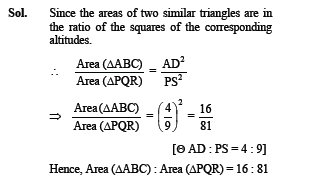
Let \( \Delta ABC \sim \Delta PQR \). Draw altitudes \( AM \perp BC \) and \( PN \perp QR \). \[ \frac{\text{Area}(ABC)}{\text{Area}(PQR)} = \frac{\frac{1}{2} \times BC \times AM}{\frac{1}{2} \times QR \times PN} = \frac{BC}{QR} \times \frac{AM}{PN} \] -- (1) In \( \Delta ABM \) and \( \Delta PQN \): \[ \angle B = \angle Q \quad (\text{since } \Delta ABC \sim \Delta PQR) \] \[ \angle AMB = \angle PNQ = 90^\circ \] By AA similarity, \( \Delta ABM \sim \Delta PQN \). Therefore: \[ \frac{AM}{PN} = \frac{AB}{PQ} \] -- (2) Since the main triangles are similar: \[ \frac{AB}{PQ} = \frac{BC}{QR} \] -- (3) From (2) and (3), we get: \[ \frac{AM}{PN} = \frac{BC}{QR} \] Substitute this back into (1): \[ \frac{\text{Area}(ABC)}{\text{Area}(PQR)} = \frac{BC}{QR} \times \frac{BC}{QR} = \frac{BC^2}{QR^2} \] Similarly, we can prove it for the other sides. Hence proved.
In simple words: Write out the area formulas using heights. Prove the smaller triangles are similar to show that the height ratio equals the side ratio, then substitute.
Exam Tip: Clearly write down the similarity criterion (AA) for the smaller altitude triangles during the proof.
Question 39. Prove that in a right triangle, the square of the hypotenuse is equal to the sum of the squares of the other two sides
Use the above theorem in the figure to prove that \( PR^2 = PQ^2 + QR^2 - 2QM \cdot QR \)
Answer:
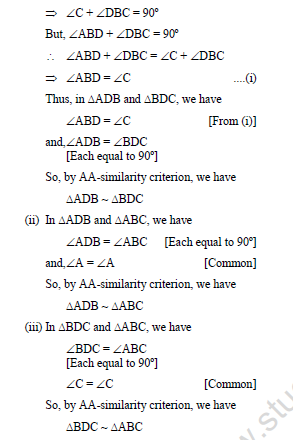
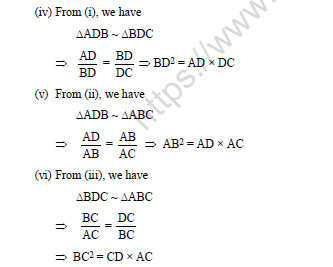
Part 1 (Pythagoras Theorem): Let \( \Delta ABC \) be right-angled at \( B \). Draw \( BD \perp AC \). In \( \Delta ADB \) and \( \Delta ABC \), \( \angle A = \angle A \) and \( \angle ADB = \angle ABC = 90^\circ \). Thus \( \Delta ADB \sim \Delta ABC \): \[ \frac{AD}{AB} = \frac{AB}{AC} \implies AB^2 = AD \cdot AC \] -- (1) Similarly, \( \Delta BDC \sim \Delta ABC \implies \frac{CD}{BC} = \frac{BC}{AC} \implies BC^2 = CD \cdot AC \) -- (2) Adding (1) and (2): \[ AB^2 + BC^2 = AC(AD + CD) = AC \cdot AC = AC^2 \] This proves Pythagoras' Theorem.
Part 2 (Application): In the given acute triangle with \( PM \perp QR \): In right-angled triangle \( \Delta PMR \): \[ PR^2 = PM^2 + MR^2 \] Since \( MR = QR - QM \): \[ PR^2 = PM^2 + (QR - QM)^2 \] \[ PR^2 = PM^2 + QR^2 + QM^2 - 2QM \cdot QR \] In right-angled triangle \( \Delta PMQ \), we know \( PM^2 + QM^2 = PQ^2 \). Substituting this in: \[ PR^2 = PQ^2 + QR^2 - 2QM \cdot QR \] Hence proved.
In simple words: Prove Pythagoras' theorem using similar triangles. Then, apply it to the acute triangle by splitting the base and expanding the algebraic square.
Exam Tip: This multi-part proof is a standard 6-mark question; write both parts cleanly and label your equations clearly.
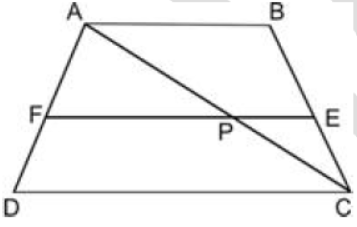
Question 40. If a line is drawn parallel to one side of a triangle intersecting the other two sides, then the other sides are divided in the same ratio. Prove this theorem Using above theorem, prove that in the figure if ABCD is a trapezium in which AB || CD
Answer:
Part 1 (Basic Proportionality Theorem): Given a triangle \( \Delta ABC \) with \( DE \parallel BC \) cutting \( AB \) at \( D \) and \( AC \) at \( E \). Join \( BE \) and \( CD \). Draw altitudes \( EL \perp AB \) and \( DM \perp AC \). \[ \frac{\text{Area}(ADE)}{\text{Area}(BDE)} = \frac{\frac{1}{2} \times AD \times EL}{\frac{1}{2} \times DB \times EL} = \frac{AD}{DB} \] -- (1) \[ \frac{\text{Area}(ADE)}{\text{Area}(CDE)} = \frac{\frac{1}{2} \times AE \times DM}{\frac{1}{2} \times EC \times DM} = \frac{AE}{EC} \] -- (2) Since \( \Delta BDE \) and \( \Delta CDE \) lie on the same base \( DE \) and between the same parallel lines \( DE \) and \( BC \): \[ \text{Area}(BDE) = \text{Area}(CDE) \] -- (3) From (1), (2), and (3): \[ \frac{AD}{DB} = \frac{AE}{EC} \] This proves BPT.
Part 2 (Application to Trapezium): Let diagonal \( AC \) intersect \( FE \) at point \( P \). In triangle \( \Delta ADC \), since \( FP \parallel CD \), apply BPT: \[ \frac{AF}{FD} = \frac{AP}{PC} \] -- (1) In triangle \( \Delta CAB \), since \( PE \parallel AB \), apply BPT: \[ \frac{AP}{PC} = \frac{BE}{EC} \] -- (2) From equations (1) and (2): \[ \frac{AF}{FD} = \frac{BE}{EC} \] Hence proved.
In simple words: First prove Thales's theorem using triangle areas. Then, apply it to the trapezium by drawing a diagonal to create two triangles that share a common ratio.
Exam Tip: Drawing the diagonal is the essential construction step for the trapezium application; clearly show how it creates two separate triangles for BPT.
Free study material for Mathematics
Download Class 10 Mathematics Chapter 06 Triangles Practice Worksheets
Daily Practice Questions for Class 10 Mathematics
Access structured practice worksheets for Chapter 06 Triangles aligned with the 2026 CBSE curriculum. These downloadable exercises for Class 10 Mathematics help students build accuracy and reinforce core concepts for upcoming school tests.
Detailed Answers for Class 10 Mathematics Chapter 06 Triangles
Each worksheet draws directly from authorized standard textbooks to maintain academic accuracy. Evaluating your finished exercises against expert-verified solutions helps master the formal presentation standards expected in school evaluations.
Complete Your Chapter Revision
Wrap up your chapter revision by testing your knowledge against standard objective question formats. Explore our full library of free, up-to-date printable assignments to maximize your academic results in upcoming CBSE evaluations.
FAQs
You can download the latest chapter-wise printable worksheets for Class 10 Mathematics Chapter 06 Triangles for free from StudiesToday.com. These have been made as per the latest CBSE curriculum for this academic year.
Yes, Class 10 Mathematics worksheets for Chapter 06 Triangles focus on activity-based learning and also competency-style questions. This helps students to apply theoretical knowledge to practical scenarios.
Yes, we have provided solved worksheets for Class 10 Mathematics Chapter 06 Triangles to help students verify their answers instantly.
Yes, our Class 10 Mathematics test sheets are mobile-friendly PDFs and can be printed by teachers for classroom.
For Chapter 06 Triangles, regular practice with our worksheets will improve question-handling speed and help students understand all technical terms and diagrams.