

Class 10 Mathematics Practice Sheet: CBSE Class 10 Mathematics Probability Worksheet Set 01
Explore structured practice materials through the CBSE Class 10 Mathematics Probability Worksheet Set 01. Tailored for Class 10 learners, utilizing these Mathematics worksheets ensures thorough preparation and strengthens problem-solving accuracy before final school evaluations.
Download Chapter 14 Probability Worksheet PDF with Answers
Access the complete worksheet PDF for Class 10 Mathematics below. Regular practice with these targeted academic tasks builds familiarity with standard question patterns and helps secure higher marks in final school examinations.
Question. A letter is chosen at random from the word ‘ASSASSINATION’. The probability that it is a vowel is
Answer : Consider the set of ordered pairs
=8/36=2/9
Answer : Proabibilty of the event = Number of favourable outcomes / Total Number of possible outcomes
Total number of balls = 5 + 7 + 3 = 15
i. Number of red balls = 7
P(drawing a red ball) = 7/15
ii. Number of black or white balls = 5 + 3 = 8
P(drawing a black or white ball) = 8/15
iii. Number of balls which are not black = 15 - 5=10
P(drawing a ball that is not black) = 10/15 = 2/5
Hence, the probability of getting a red ball, a black or white ball and a not black
ball are 7/15. 8/15 and 2/3 respectively.
Question. Why is tossing a coin considered as the way of deciding which team should get the ball at the beginning of a football match?
Answer : Proabibilty of the event = Number of favourable outcomes / Total Number of possible outcomes
Probability of head= P(H) = 1/2
Probability of tail = P(T) = 1/2
i.e. P (H) = 1/2 = P (T) = 1/2
Probability of getting head and tail both are same.
Tossing a coin considered to be fairway.
Question. Two dice are thrown simultaneously. Find the probability of getting a multiple of 2 on one dice and a multiple of 3 on the other.
Answer : Two dice are thrown simultaneously. We have to find the probability of getting a multiple of 2 on one dice and a multiple of 3 on the other.
Let A be the event of getting a multiple of 2 on one die and a multiple of 3 on the other.
Then, the elementary events favourable to A are:
(2, 3), (2, 6), (4, 3), (4, 6), (6, 3), (6, 6), (3, 2), (3, 4),
(3, 6), (6, 2), (6, 4). Favourable number of elementary events =11
Hence, required probability = 11/36
Question. In a simultaneous throw of a pair of dice, find the probability of getting a number other than 5 on any dice.
Answer : Favourable outcomes of a number other than 5 on any dice =
{(1,1)(1,2)(1,3)(1,4)(1,6)
(2,1)(2,2)(2,3)(2,4)(2,6)
(3,1)(3,2)(3,3)(3,4)(3,6)
(4,1)(4,2)(4,3)(4,4)(4,6)
(6,1)(6,2)(6,3)(6,4)(6,6)}
Therefore, favourable number of cases to the event = 25
∴ Probability of a number other than 5 on any dice = Number of favourable outcomes / Number of total outcomes = 25/36
Question. Two coins are tossed together. Find the probability of getting both heads or both tails.
Answer : Two coins are tossed together.
Possibilities are HH, HT, TH, TT
Total outcomes = 4
Both heads or both tails = HH, TT
Number of favourable outcome = 2
Probability = Number of favourable outcomes / Total Number of outcomes
P(HH or TT) = 2/4 = 1/2
Question. Cards numbered 11 to 60 are kept in a box. If a card is drawn at random from the box, find the probability that the number on the drawn card is (i) an odd number, (ii) a perfect square number, (iii) divisible by 5, (iv) a prime number less than 20.
Answer : According to the question,
All possible outcomes are 11. 12. 13,....... 60
Total number of possible outcomes = (60 - 10) = 50
i. Suppose, E1 be the event that the number on the drawn card is an odd number.
⇒ the favourable outcomes are 11. 13. 15,....... 59
Clearly, these numbers form an AP with a = 11 and d = 2.
Tn = 59 ⇒ 11 + (n - 1) x 2 = 59 ⇒ (n - 1) x 2 = 48 ⇒ n - 1 = 24 ⇒ n = 25
So, the number of favourable outcomes = 25
∴ P(getting an odd number) = P (E1) = 25/50 = 1/2 .
ii. Suppose, E2 be the event that the number on the drawn card is a perfect square number.
⇒ the favourable outcomes are . 16. 25. 36. 49..
The number of favourable outcomes = 4.
∴ P(getting a perfect square number) P (E2) = 4/50 = 2/25 ..
iii. Suppose, E3 be the event that the number on the drawn card is divisible by 5.
⇒ the favourable outcomes are 15, 20. 25..........60
Clearly, these numbers form an AP with a = 15 and d=5.
Tm = 60 ⇒ 15 + (m - 1) x 5 = 60 ⇒ (m - 1) x 5 = 45 ⇒ m - 1 = 19 ⇒ m = 10
So, the number of favourable outcomes = 10
∴ P(getting a number divisible by 5) = P (E3) = 10/50 = 1/5
iv. Suppose, E4 be the event that the number on the drawn card is a prime number less than 20.
⇒ the favourable outcomes are 11, 13, 17, 19
So, the number of favourable outcomes = 4
∴ P(getting a prime number less than 20) = P (E4) = 4/50 = 2/25
Question. A bag contains, white, black and red balls only. A ball is drawn at random from the bag. If the probability of getting a white ball is 3/10 and that of a black ball is , 2/5 then find the probability of getting a red ball. If the bag contains 20 black balls, then find the total number of balls in the bag.
Answer : P (White ball) = 3/10
P(Black ball) = 2/5
P(E) = 1 - P( not E)
Probability of not getting white and black ball is equals to probability of getting red balls.
P(Red ball) = 1 - (3/10 + 2/5) = 3/10
2/5 x Total no of balls = 20 (red balls)
Hence, Total numbers of balls = 20x5/2 = 50
Question. The probability of selecting a red ball at random from a jar that contains only red, blue and orange balls is . The probability of selecting a blue ball at random from the same jar is . If the jar contains 10 orange balls, find the total number of ball in the jar.
Answer : P(red ball) = 1/4, P(blue ball) = 1/3
P(orange ball) = 1 - 1/4 - 1/3 = 5/12
Suppose total no. of balls = x
Then 10/x = 5/12
Hence x = 24
Question. All red face cards are removed from a pack of playing cards. The remaining cards are well-shuffled and then a card is drawn at random from them. Find the probability that the drawn card is
i. a red card,
ii. a face card,
iii. a card of clubs.
Answer : There are 6 red face cards. These are removed.
Thus, remaining number of card = 52 – 6 = 46.
i. Number of red cards now = 26 – 6 = 20.
Therefore, P(getting a red card) = Number of favourable outcomes / Number of all possible outcomes = 20/46 = 10/23
Thus, the probability that the drawn card is a red card is 10/23.
ii. Number of face cards now = 12 – 6 = 6.
Therefore, P(getting a face card) = Number of favourable outcomes / Number of all possible outcomes = 6/46 = 3/23
Thus, the probability that the drawn card is a face card is 3/23.
iii. The number of card of clubs = 12.
Therefore, P(getting a card of clubs) = Number of favourable outcomes / Number of all possible outcomes = 12/46 = 6/23
Thus, the probability that the drawn card is a card of clubs is 6/23
Question. A box contains cards bearing numbers 6 to 70. If one cards is drawn at random from the box, find the probability that it bears
i. a one digit number.
ii. a number divisible by 5,
iii. an odd number less than 30,
Answer : i. Let E be the event of getting a one digit number.
Number of possible outcomes = 70 - 6 + 1 = 65
The outcomes favourable to E are 6,7,8 and 9
Number of favourable outcomes = 4
P(E)=P(Getting a one digit number) = 4/65
ii. Let F be the event of getting a number divisible by 5.
Number of possible outcomes =65
The outcomes favourable to the event F are 10,15,20,...., 65,70.
Number of outcomes favourable to F = 13
P(F)=P(Getting a number divisible by 5) = 13/65 = 1/5
iii. Let G be the event of getting an odd number less than 30.
Number of possible outcomes =65
The outcomes favourable to the event G are 7,9,11,13,....., 29.
Number of favourable outcome =12
P(G)=P(Getting an odd number less than 30) = 12/65
Question. A box contains 90 discs which are numbered 1 to 90. If one disc is drawn at random from the box, find the probability that it bears
i. a two digit number,
ii. number divisible by 5.
Answer : 20. No. of all possible outcomes = 90
i. Discs with two digit number are 10 to 90
No. of discs with two digits numbers = 90 - 10 +1 = 81
∴ No of favourable outcomes = 81
P(a disc with two digit number) = No of favourable outcome / No of all possible outcome = 81/90 = 9/10
ii. The numbers having 0 or 5 at its once place are divisible by 5 = 5,10,15.....90
Total no. of favourable outcomes = 18
P(a disc with a number divisible by 5) = 18/90 = 1/5
Question. A card is drawn at random from a well shuffled deck of 52 cards. The probability that it will be a spade or a king is
Question. Cards marked with numbers 1, 2, 3, ……….., 25 are placed in a box and mixed thoroughly and one card is drawn at random from the box. The probability that the number on the card is a multiple of 3 and 5 is
a. 12/25
b. 4/25
c. 1/25
d. 8/25
Answer : C
Explanation: Multiples of 3 = 3 6 9 12 15 18 21 24
Multiples of 5 = 5 10 15 20 25
Number of possible outcomes (multiple of 3 and 5) = {15} = 1
Number of Total outcomes = 25
∴ Required Probability =1/25
Question. A game of chance consists of spinning an arrow which comes to rest pointing at one of the numbers 1, 2, 3, 4, 5, 6, 7, 8, 9, 10 and these values are equally likely outcomes. The probability that it will point at a number greater than 5 is
a. 1/2
b.1/4
c.1/5
d.1/3
Answer : A
Explanation: Number of possible outcomes = {6, 7, 8, 9, 10} = 5
Number of total outcomes = 10
∴ Required Probability = 5/10 =1/2
Question. The probability of selecting a rotten apple randomly from a heap of 900 apples is 0.18. What is the number of rotten apples in the heap.
Answer : 162
Question. A bag contains cards which are numbered from 2 to 90. A card is drawn at random from the bag. Find the probability that it bears a two digit number
Answer : 𝟖𝟏/𝟖𝟗
Question. The Probability of guessing the right answer to a certain question in a test is 𝑥/12 . If the probability of not guessing the correct answer to this question is 2/3 , then find value of x
Answer : 4
Question. A card is drawn from a pack of 52 cards. Find the probability of getting a king of red colour
Answer : 𝟏/𝟐𝟔
Question. Two coins are tossed simultaneously. Find the probability of getting at most one head
Answer : 𝟑/𝟒
Question. A bag contains 40 balls out of which some are red, some are blue and remaining are black. If the probability of drawing a red ball is 11/20 and that of blue ball is 1/5 , then what is the no. of black balls?
Answer : 10
Question. A card is drawn from a pack of 52 cards. Find the probability that the card drawn is not a face card
Answer : 𝟏𝟎/𝟏𝟑
Question. A card is drawn from a well shuffled deck of cards. What is the probability that the card drawn is neither a king nor a queen?
Answer : 11/13
Question. A die is thrown twice. Find the probability of getting a sum less than 8
Answer : 𝟕/𝟏𝟐
Question. A box contains cards numbered 6 to 50. A card is drawn at random from the box. Find the probability that the card drawn has a number which is a perfect square
Answer : 𝟏/𝟗
Question. A bag contains cards numbered from 1 to 49. After mixing the cards thoroughly a card is drawn from the bag at random, Find the probability that the number on the drawn card is an odd number
Answer : 25/49
Question. A month is selected at random in a year. Find the probability that it is March or October.
Answer : 1/6
Question. A number is selected from first 50 natural numbers. What is the probability that it is a multiple of 3 or 5?
Answer : 𝟐𝟑/𝟓𝟎
Question. Two dice are thrown together. Find the probability that the product of the numbers on the top of the dice is
a) 6
b) 12
c) 7
Answer : (1/9, 1/9, 0)
Question. Two different dice are thrown at the same time. Find the probability that the sum of the two numbers appearing On the top of the dice is 7
Answer : (1/6)
3. A pair of dice is tossed once, find the probability of getting
a) a total of 2
b) a total of 5
c) an even number as the sum
d) same number on each dice
Answer : (1/36)
(1/9)
(1/2)
(1/6)
4. A die is thrown once. Find the probability of getting the following:
a) a prime number
b) a number lying between 2 and 5
Answer : (1/2)
(1/3)
Question. A card is drawn at random from a well shuffled pack of playing cards. Find the probability of getting a red face card
Answer : (3/26)
Question. One card is drwn from a well shuffled deck of 52 playing cards. Find the number of probability of getting
a) A face card
b) A black queen or a red king
c) a king of red colour
d) the jack of hearts
e) a spade.
f) either a king or a queen
g) neither a king nor a queen
Answer : (3/13)
(1/13)
(1/26)
(1/52)
(1/4)
(2/13)
(11/13)
Question. From a pack of 52 playing cards, Jacks, Queens, Kings and Aces of red colour are removed. From the remaining,
A card is drawn at random. Find the probability that the card drawn is
a) A black queen
b) A non – face card
c) A black jack
d) a Black King or a Red Queen
Answer : (1/21)
(10/13)
(1/22)
(1/13)
Question. A bag contains 5 red balls and some blue balls. If the probability of drawing a blue ball from the bag is thrice that of red ball, find the number of blue balls in the bag
Answer : (15)
Question. A bag contains 6 red, 3 black and 6white balls. A ball is selected at random from the bag. Find the probability that the selected ball is
a )Red or black b) not black
Answer : (3/5, 4/5)
Question. Cards marked with numbers 5,6,7,………………………..74 are placed in a bag and mixed thoroughly. One card is Drawn at random from the bag. Find the probability that the number on the card is a perfect square
Answer : (3/35)
Question. Cards numbered 2,3, 4, 5, 6, -------,49 are put in a box and mixed thoroughly. If one card is drawn at random Find the probability that the number on the card is
a) Even number
b) prime number
c) Divisible by 6
d) A perfect square
Answer : (1/2)
(5/16)
(1/6)
(1/8)
Question. Two unbiased coins are tossed. Calculate the probability of getting
a) Exactly two heads
b) At least two tails
c) At most two tails
Answer : (1/4)
(1/4)
(3/4)
Question. A letter is chosen at random from the English alphabet. Find the probability that the letter chosen
a) Is a vowel
b) Is a consonant
c) Follow r
Answer : (5/26)
(21/26)
(8/26)
Question. Find the probability of 53 Sundays in the year 2012
Answer : (2/7)
Question. Which of the following cannot be the probability of an event?
a) 1/5
b) 0.3
c) 4%
d) 5/4
Question. A card is drawn from a pack of 52 playing cards. The probability of getting a face card is
a) 3/13
b) 4/13
c) ½
d) 2/3
Question. The probability of drawing a red queen from a well shuffled deck of 52 cards is
a) 1/13
b) 2/13
c) 1/26
d) 1/52
Question. A die is thrown, the probability of getting a number less than 3 and greater than 2 is
a) 0
b) 1
c) 1/3
d) 2/3
Question. A card is drawn from a well – shuffled deck of 52 playing cards. The probability that it is not a face card is
a) 12/52
b) 16/52
c) 10/13
d) 9/13
Question. If an event cannot occur then its probability of occurring is
a) 1
b) 2/3
c) ½
d) 0
Question. The probability of getting a perfect square number from the numbers 1 to 10 is
a) 3/10
b) ½
c) 2/5
d) 1/5
Question. The probability of throwing a number less than 6 with a fair die is
a) 5/6
b) 1
c) 1/6
d) 2/3
Q.- What is the probability that a leap year,selected at random will contain 53 Sundays ?
More question-
PROBABILITY
1. A card is drawn from a pack of cards numbered 1 to 52. The probability that the number on the card is a perfect square is
(a) 1/31
(b) 2/13
(c) 7/52
(d) 5/52
2. A die is thrown once, then the probability of getting a number greater than 3 is
(a) 1/2
(b) 2/3
(b) 6
(d) 0
3. When a die is thrown, the probability of getting an odd number less than 3 is
(a) 1/6
(b) 1/3
(c) 1/2
(d) 0
4. A card is drawn from a deck of 52 cards. The event ‘E’ is that card which is not ace of hearts. The number of outcomes favourable to E is
(a) 4
(b) 13
(c) 48
(d) 51
5. One ticket is drawn at random from a bag containing tickets numbered 1 to 40. The probability that the selected ticket has a number which is a multiple of 5 is
(a) 1/5
(b) 3/5
(c) 4/5
(d) 1/3
6. The probability of getting a bad egg in a lot of 400 is 0.035. The number of bad eggs in the lot is
(a) 7
(b) 14
(c) 21
(d) 28
7. The probability that a card drawn out of a packet of 52 is of diamond is
(a) 0
(b) 1/52
(c) 1/13
(d) 1/4
8. In simultaneous tossing of two coins, the probability of getting 2 tails is
(a) 0
(b) 1
(c) 1/2
(d) 1/4
9. Which of the following can not be the probability of an event ?
(a) 3/2
(b) 4%
(c) 0.9
(d) 3/7
10. An event is very unlikely to happen. Its probability is closest to
(a) 0.01
(b) 0.0001
(c) 0.1
11. The probability of sure event ‘is
(a) 0
(b) 1/2
(c) 1/4
(d) 1
12. If P(A) denotes the probability of an event A, then
(a) P(A) < 0
(b) P(A) > 1
(c) 0 ≤ P(A) ≤ 1
(d) −1 ≤ P(A) ≤ 1
13. If for any event E, P(E) = 0.3 then P(not E) is equal to
(a) 0.3
(b) −0.3
(c) 0.7
(d) −0.7
14. The probability expressed as a percentage of a particular occurrence can never be
(a) less than 100
(b) less than 0
(c) greater than 1
(d) number other than a whole number
15. The probability of getting two tails when three coins are tossed simultaneously is
(a) 1/8
(b) 1/2
(c) 3/8
(d) 5/8
16. A card accidently dropped from a pack of 52 cards. The probability of its being a card of diamond is
(a) 1/2
(b) 1/4
(c) 1/13
(d) 1/20
17. A letter of English alphabet is chosen at random. The probability that it is a letter of the word “MATHEMATICS” is
(a) 11/26
(b) 5/13
(c) 9/26
(d) 4/13
18. In a single throw of a pair of dice, the probability of getting the sum 12 is
(a) 5/36
(b) 1/9
(c) 1/18
(d) 1/36
19. In a single throw of a dice, the probability of getting a prime number is
(a) 2/3
(b) 1/6
(c) 1/3
(d) 1/2
20. Three coins are tossed. What is the probability of getting neither 3 heads nor 3 tails ?
(a) 1/2
(b) 1/3
(c) 2/3
(d) 3/4
21. The probability that a leap year should have exactly 52 Tuesday is
(a) 2/7
(b) 3/7
(c) 1
(d) 5/7
22. Among 52 cards, there are 12 face cards. Probability that a card drawn at random is not a face card is
(a) 3/13
(b) 9/13
(c) 10/13
(d) 3/4
23. If an event cannot occur, then its probability is
(a) 1
(b) 3/4
(c) 1/2
(d) 0
24. Which of the following cannot be the probability of an event ?
(a) 1/3
(b) 0.1
(c) 3%
(d) 17/16
25. An event is very unlikely to happen. Its probability is closes to
(a) 0.0001
(b) 0.001
(c) 0.01
(d) 0.1
26. The probability expressed as a percentage of a particular occurrence can never be
(a) Less than 100
(b) less than 0
(c) greater than 1
(d) anything but a whole number
27. A fair dice is rolled. The probability of getting a number more than six is
(a) 1 < 0
(b) ≥ 1
(c) 0
(d) Can not be determined
28. In tossing a fair die, the probability of getting an odd number or a number less than 4 is
(a) 2
(b) 1/2
(c) 2/3
(d) 3/4
29. The probability of getting 9 with two dice is
(a) 1/36
(b) 9/1
(c) 1/27
(d) 2/9
30. A card is drawn from well shuffled deck of playing cards. The probability of a face card is
(a) 1/13
(b) 3/13
(c) 4/13
(d) 2/13
31. In a single throw of a pair of dice, the probability of getting the sum a perfect square is
(a) 1/18
(b) 7/36
(c) 1/6
(d) 2/9
32. If P(E) = 0.05 the P(not E) i.e. P(E) = _______ ?
(a) 0.05
(b) 0.5
(c) 0.9
(d) 0.95
Short Questions
1. Box A contains 25 slips of which 19 are marked Rs.1 and other are marked Rs.5 each. Box B contains 50 slips of which 45 are marked Rs.1 each and others are marked Rs.13 each. Slips of both the boxes are poured into a third box and reshuffled. A slip is drawn at random. What is the probability that it is marked other than Rs.1 ?
2. A child’s game has 8 triangles of which 3 are blue and rest are red, and 10 squares of which 6 are blue and rest are red. One piece is lost at random. Find the probability that it is a : (i) triangle (ii) square (iii) square of blue colour (iv) triangle of red colour.
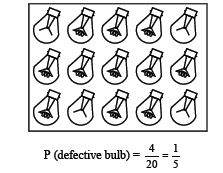
3. A carton of 24 blubs contain 6 defective bulbs. One bulb is drawn at random. What is the probability that the bulb is not defective ? If the bulb selected is defective and it is not replaced and a second bulb is selected at random from the rest, what is the probability that the second bulb is defective ?
4. A lot consists of 48 mobile phones of which 42 are good, 3 have only minor defects and 3 have major defect Varnika will buy a phone if it is good but the trader will only buy a mobile if it has no major defect. One phone is selected at random from the lot. What is the probability that it is (i) acceptable to varnika ? (ii) acceptable to the trader ?
5. In a game, the entry fee is Rs.5. The game consists of tossing a coin 3 times. If one or two heads show, Sweta gets her entry fee back. If she shows 3 heads, the receives double the entry fees. Otherwise, she will lose. After tossing a coin three times, find the probabilities that she (i) loses the entry fee (ii) gets double entry fee (iii) just gets her entry fee
6. A lot of 60 bulbs contain 12 defective ones. One bulbs drawn at random from the lot. What is the probability that this bulb is defective ? Suppose the bulb draw in first attempt is defective and is not replaced. Now, one bulb is drawn at random from the rest. What is the probability that this bulb is not defective ?
7. A bag contains 5 black, 7 red & 3 white balls. A ball is drawn from the bag at random. Find the probability that the ball drawn is (i) red (ii) black or white (iii) not black.
8. Find the probability of getting 53 Fridays (i) in a leap year (ii) in a non-leap year.
9. Out of 400 bulbs in a box. 15 bulbs are defective. One bulb is taken out at random from the box. Find the probability that the drawn bulb is not defective.
10. A card is drawn at random from a pack of 52 playing cards. Find the probability that the card drawn is neither an ace nor a jack.
11. The king, queen and jack of diamond are removed from a deck of 52 playing cards and then well shuffled. Now, one card is drawn at random from the remaining cards. Determine the probability that the card is (i) a jack (ii) a heart (iii) a red queen
12. Cards bearing numbers 1, 3, 5 ….. 35 are kept in a bag. A card is drawn at random from the bag. Find the probability of getting a card bearing (i) a prime no. less than 15 (ii) a no. divisible by 3 and 5.
13. An integer is chosen between 0 and 100. What is the probability that it is (i) divisible by 9 ? (ii) not divisible by 9 ?
14. A bag contains cards which are numbered from 2 to 90. A card is drawn at random from the bag. Find the probability that it bears (i) a two digit number (ii) a number which is a perfect square.
15. A card is drawn at random from a pack of 52 playing cards. Find the probability that the card drawn is neither a black card not a king.
16. Two dice are thrown together and the product of numbers appearing on them is noted. Find the probability that the product is less than 12.
17. A die is thrown twice. What is the probability that (i) 3 will not come up either time ? (ii) 3 will come up atleast once ?
18. A die has its six faces marked 0, 1, 1,1, 6, 6. Two such dices are thrown together and the total score is recorded. (i) How many different scores are possible ? (ii) What is the probability of getting a total of 7 ?
19. A bag contains white, black and red balls only. A ball is drawn at random from the bag. The probability of getting a white ball is 3/10 and that of a black ball is 2/5. Find the probability of getting a red ball if the bag contains 20 black balls, then find the total no. of balls in the bag.
20. A bag contains 7 green, 10 blue and 5 red balls. A ball is drawn at random. Find the probability of this ball being a (i) blue ball (ii) red ball or green ball (iii) not a green ball.
21. A bag contains 24 balls of which x are red, 2x are white and 3x are blue. A ball is selected at random. What is the probability that the drawn ball is (i) not white ? (ii) blue ?
LONG TYPES QUESTIONS
1. A bag contains 6 red, 5 black and 4 white balls. A ball is drawn from the bag at random. Find the probability that the ball drawn is (i) white (ii) red (iii) not black (iv) red or white.
2. 18 cards, numbered 1, 2, 3, …… 18 are put in a box and mixed thoroughly. A card is drawn at random from the box. Find the probability that the card drawn bears (i) an even numbers (ii) a number divisible by 2 or 3.
3. A card is drawn at random from a well shuffled deck of playing cards. Find the probability that the card drawn is (i) a card of spade or an ace (ii) a red king (iii) neither a king nor a queen (iv) either a king or a queen.
4. Cards marked with numbers 3, 4, 5……….. 50 are placed in a box and mixed thoroughly one card is drawn at random from the box. Find the probability that number on the drawn card is (i) divisible by 7 (ii) a number which is a perfect square ?
5. The probability of gussing the correct answer to a certain test is P/12. If the probability of not guessing the correct answer to this question is 1/3. Find the value of ‘P’.
6. A number is selected at random from the number 3, 5, 5, 7, 7, 7, 9, 9, 9, 9. Find the probability that the selected number is their average.
7. If a number x is chosen from the number 1, 2, 3 and a number y is selected from the numbers 1, 4, 9. Find the probability that xy = 10.
8. A number ‘x’ is chosen from the numbers −4, −3, −2, −1, 0, 1, 2, 3, 4. Find the probability that |x| < 3.
9. A die has six faces marked 0, 1, 1, 1, 6, 6. Two such dice are thrown together and the total is recorded. (i) How many different scores are possible ? (ii) What is the probability of getting a total of 7 ?
10. A bag contains 5 red balls & some blue balls. If the probability of drawing a blue ball is double that of a red ball, find the number of blue balls in the bag.
Value Based Questions
1. In a survey, it was found that 40% people use petrol, 35% use diesel and remaining use CNG for their vehicles. Find the probability that a person chosen at random use CNG.
a) Which fuel out of the above three is appropriate for the welfare of the society?
2. In a survey, it was found that 30% of the population is using non – biodegradable products. While the remaing is using biodegradableproducts.What is the probability that a person chosen at random uses non – biodegradable products?
i) Which type of products should be used in a society for its proper development – biodegradable or non – biodegradable? Justify your answer.
3. A school gives awards to the students of each class – 5 for bravery, 3 for punctuality, 3 for full attendance, 4 for social service and 5 for self confidence. An awarded student is selected at random. What is the probability that he is being awarded for (i) punctuality (ii) Self Confidence.
a) Which value out of the above five is most important for the development of society? Justify your answer.
4. Arushi, mahi and Saina were fighting to get first chance in a game. Arushi says, “Let us toss two coins. If both head appear, Mahi will take first chance, if both tail appear, Saina will get it and if one head and one tail appears, I will get the chance.”
i) What is the probability of Arushi getting the 1st chance?
ii) Is her decision fair?
iii) What quality of her character is being depicted here?
5. In a town, 75% population uses biodegradable material and the remaining uses non – biodegradable material. A person is chosen at random from the town.
i) What is the probability that he uses non – biodegradable material?
ii) Which type of material should we use and why?
6. A survey was conducted in a residential society in which it was discovered that 45 households believe in hard work, 28 believe in self confidence and 12 believe in punctuality for attaining success in life. What is the probability that a person chosen at random believes in self confidence?
Which value, according to you, contributes the most in attaining success in life?
7. Ina food survey, 80% of the food samples were found to be adulterated while the remaining samples were pure. If the sample is selected at random, what is the probability that the food is adulterated?
i) What does the result of the survey show?
ii) How does food adulteration affect our health?
8. In a self assessment survey, 45% claimed that they are patriotic, 42% claimed to be non – violent and the remaining claimed to be optimistic. What is the probability of a person chosen at random to be claiming himself (A) patriotic (b) optimistic?
Which value do you claim for yourself out of the given three and why?
9. In a society, certain number of people worked for three campaigns. Some worked for “ Say no to plastic”. Some for “Say no to crackers” and the remaining for “Say no to child labour”. A person is selected at random from the society. The probability of getting a person from first campaign is 3/10 and that of 2nd campaign is 2/5. Find the probability of getting a person who worked for the third campaign. If the number of persons in 2nd campaign was 20, find the total number of persons involved in the three campaigns. Are such campaigns helpful in spreading awareness among the people? Give your views.
Question. A card is drawn from a well-shuffled deck of playing cards. Find the probability of drawing
(i) a face card (ii) a red face card.
More question-
Question. Two dice are thrown together. Find the probability that the product of the numbers on the top of the dice is a) 6 b) 12 c) 7
Answer : (1/9, 1/9, 0)
Question. Two different dice are thrown at the same time. Find the probability that the sum of the two numbers appearing On the top of the dice is 7
Answer : (1/6)
Question. A pair of dice is tossed once, find the probability of getting
a) a total of 2
b) a total of 5
c) an even number as the sum
d) same number on each dice
Answer : (1/36)
(1/9)
(1/2)
(1/6)
Question. A die is thrown once. Find the probability of getting the following:
a) a prime number
b) a number lying between 2 and 5
Answer : (1/2)
(1/3)
Question. A card is drawn at random from a well shuffled pack of playing cards. Find the probability of getting a red face card
Answer : (3/26)
Question. One card is drwn from a well shuffled deck of 52 playing cards. Find the number of probability of getting
a) A face card
b) A black queen or a red king
c) a king of red colour
d) the jack of hearts
e) a spade.
f) either a king or a queen
g) neither a king nor a queen
Answer : (3/13)
(1/13)
(1/26)
(1/52)
(1/4)
(2/1)
(11/13)
Question. From a pack of 52 playing cards, Jacks, Queens, Kings and Aces of red colour are removed. From the remaining,
A card is drawn at random. Find the probability that the card drawn is
a) A black queen
b) A non – face card
c) A black jack
d) a Black King or a Red Queen
Answer : (1/21)
(10/13)
(1/22)
(1/13)
Question. A bag contains 5 red balls and some blue balls. If the probability of drawing a blue ball from the bag is thrice that of red ball, find the number of blue balls in the bag
Answer : (15)
Question. A bag contains 6 red, 3 black and 6white balls. A ball is selected at random from the bag. Find the probability that the selected ball is
a) Red or black b) not black
Answer : (3/5, 4/5)
Question. Cards marked with numbers 5,6,7,………………………..74 are placed in a bag and mixed thoroughly. One card is Drawn at random from the bag. Find the probability that the number on the card is a perfect square
Answer : (3/35)
Question. Cards numbered 2,3, 4, 5, 6, -------,49 are put in a box and mixed thoroughly. If one card is drawn at random Find the probability that the number on the card is
a) Even number
b) rime number
c) Divisible by 6
d) A perfect square
Answer : (1/2)
(5/16)
(1/6)
(1/8)
Question. Two unbiased coins are tossed. Calculate the probability of getting
a) Exactly two heads
b) At least two tails
c) At most two tails
Answer : (1/4)
(1/4)
(3/4)
Question. A letter is chosen at random from the English alphabet. Find the probability that the letter chosen
a) Is a vowel
b) Is a consonant
c) Follow r
Answer : (5/26)
(21/26)
(8/26)
Question. Find the probability of 53 Sundays in the year 2012
Answer : (2/7)
Question. Which of the following cannot be the probability of an event?
a) 1/5
b) 0.3
c) 4%
d) 5/4
Question. A card is drawn from a pack of 52 playing cards. The probability of getting a face card is
a) 3/13
b) 4/13
c) ½
d) 2/3
Question. The probability of drawing a red queen from a well shuffled deck of 52 cards is
a) 1/13
b) 2/13
c) 1/26
d) 1/52
Question. A die is thrown, the probability of getting a number less than 3 and greater than 2 is
a) 0
b) 1
c) 1/3
d) 2/3
Question. A card is drawn from a well – shuffled deck of 52 playing cards. The probability that it is not a face card is
a) 12/52
b) 16/52
c) 10/13
d) 9/13
Question. If an event cannot occur then its probability of occurring is
a) 1
b) 2/3
c) ½
d) 0
Question. The probability of getting a perfect square number from the numbers 1 to 10 is
a) 3/10
b) ½
c) 2/5
d) 1/5
Question. The probability of throwing a number less than 6 with a fair die is
a) 5/6
b) 1
c) 1/6
d) 2/3
Q.- A bag contains 6 red, 8 white, 4 green and 7 black balls. One ball is drawn at random.The probability that the ball drawn is neither green nor white is
Ans- Let boys be B1 B2, B3 (3 Boys)
CASE STUDY
1. A lottery involves the drawing of numbers at random for a prize. It is a form of gambling. Some governments have banned Lottery in their countries while some governments endorse it in their countries. there are many formats of the Lottery. In one format, the prize can be a fixed amount of cash or goods while in another format, the prize will be 50 per cent of the revenue.

In a Lottery system, a box contains cards numbers between 11 to 122. A card is drawn at random from the box.
Based on the above information, answer the following questions.
(a) The probability that the number on the drawn card is a square number, is:
Answer : 4/55
(b) The probability that the number on the drawn card is a multiple of 7, is:
Answer : 8 /55
(c) The probability that the number on the drawn card is divisible by 3, is:
Answer : 5/9
(d) The probability that the number on the drawn card is a multiple of 11, is:
Answer : 37/110
2. During the admission procedure in a school, the number of students seeking admission is more than that of the seats available in the class so that school administration decides to organize a draw so that each student has equal possibility of getting admission in the school. The following category of students applied for admission.

Question 1. If all the admission forms are shuffled and one form is drawn randomly, what is the probability that an OBC student belonging to either of the categories 1,2,3 or 4 will get admission?
Answer : 13/22
Question 2: If General, SC, OBC and ST category’s admission forms are shuffled and one form is drawn randomly, what is the probability that a student of EWS category will get admission?
Answer : 0
Question 3: . If EWS, SC and ST category’s admission forms are shuffled and one form is drawn randomly, what is the probability that student either SC or EWS student from category-3 will get admission?
Answer : 41/49
Question4 : If SC and ST category’s admission forms are shuffled and one form is drawn randomly, what is the probability that student from service category 1 either SC or ST will get admission?
Answer : 52/ 205
3. FREE TICKETS FOR WORLD CUP
Geeta wanted to watch football world cup final match. She saw an advertisement that a radio station has 25 free tickets to football world cup final match to give away. Radio announced that one participant can send only one SMS for free ticket. SMS`s are received from 20000 listeners out of which 12000 are female. SMS`s are then selected at random one at a time until all free tickets are given away.

Q1. The first 24 tickets have been given away to the participants and Gita’s SMS`s has yet not been selected. What is Geeta’s chance of winning the last ticket, based on above said information.
(a) 1/25
(b) 1/20000
(c) 1/19976
(d) none of these
Answer : B
Q2. Out of first 24 tickets 14 males have already won the ticket and remaining are won by females. Chances that last ticket is won by Geeta is.
( a) 24/25
(b) 11990/20000
(c) 1/19976
(d) 11990/19976
Answer : C
Q3. How many more males should have sent SMS`s so that the chances of winning a ticket is equal for both male/female
(a) 4000
(b) 2000
(c) 12000
(d) cannot be determined
Answer : A
Q4. In the same condition, the number of winner tickets is doubled and one ticket is left for male while rest are won by female. Find the probability of winning last ticket by any male.
(a) 1/19951
(b) 1/8000
(c) 8000/19951
(d) cannot be determined
Answer : C
KEY POINTS
1. Probability: - The theoretical probability of an event E, written as P (E) is defined as.
P (E) = Number of outcomes Favorable to E/Number of all possible outcomes of the experiment
Where we assume that the outcomes of the experiment are equally likely.
2. The probability of a sure event (or certain event) is 1.
3. The probability of an impossible event is 0.
4. The probability of an Event E is number P (E) such that 0≤P (E) ≤1.
5. Elementary events: - An event having only one outcome is called an elementary event. The sum of the probabilities of all the elementary events of an experiment is 1.
6. For any event E, P (E) + P (E¯) =1, where
stands for not E, E and E¯ are called complementary event.
7. Performing experiments:-
a. Tossing a coin.
b. Throwing a die.
c. Drawing a card from deck of 52 cards.
8. Sample space:-The set of all possible outcomes in an experiment is called sample space.
9. An event is a subset of a sample space.
10. Equally likely events - If one event cannot be expected in preference to other event then they are said to be equally likely.
LEVEL-I
Question. The probability of getting bad egg in a lot of 400 is 0.035.Then find the no. of bad eggs in the lot.
Answer : 14
Question. Write the probability of a sure event.
Answer : 1
Question. What is the probability of an impossible event?
Answer : 0
Question. When a dice is thrown, then find the probability of getting an odd number less than 3.
Answer : 1/6
Question. A girl calculates that the probability of her winning the third prize in a lottery is 0.08.If 6000 tickets are sold, how many ticket has she bought.
Answer : 480
Question. What is probability that a non-leap year selected at random will contain 53 Sundays.
Answer : 1/7
Question. A bag contains 40 balls out of which some are red, some are blue and remaining are black. If the probability of drawing a red ball is 11/20 and that of blue ball is 1/5, then what is the no. of black ball?
Answer : 10
Question. Two coins are tossed simultaneously. Find the probability of getting exactly one head.
Answer : 1/2
Question. A card is drawn from a well shuffled deck of 52 cards. Find the probability of getting an ace.
Answer : 1/13
Question. In a lottery, there are 10 prizes and 25 blanks. Find the probability of getting a prize.
Answer : 2/7
LEVEL-II
Question. Find the probability that a no. selected at random from the number 3, 4, 5, 6...25 is prime.
Answer : 8/23
Question. A bag contains 5 red, 4 blue and 3 green balls. A ball is taken out of the bag at random. Find the probability that the selected ball is (a) of red colour (b) not of green colour.
Answer : A. 5/12 B. ¾
Question. A card is drawn at random from a well-shuffled deck of playing cards. Find the probability of drawing
(a) A face card (b) card which is neither a king nor a red card
Answer : A. 3/13 B. 6/13
Question. A dice is thrown once. What is the probability of getting a number greater than 4?
Answer : 1/3
Question. Two dice are thrown at the same time. Find the probability that the sum of two numbers appearing on the top of the dice is more than 9.
Answer : 1/6
Question. Two dice are thrown at the same time. Find the probability of getting different numbers on both dice.
Answer : 5/6
Question. A coin is tossed two times. Find the probability of getting almost one head.
Answer : 3/4
Question. Cards with numbers 2 to 101 are placed in a box. A card selected at random from the box. Find the probability that the card which is selected has a number which is a perfect square.
Answer : 9/100
Question. Find the probability of getting the letter M in the word “MATHEMATICS”.
Answer : 2/11
LEVEL-III
Question. Cards bearing numbers 3, 5… 35 are kept in a bag. A card is drawn at random from the bag. Find the probability of getting a card bearing (a) a prime number less than 15 (b) a number divisible by 3 and 5.
Answer : A. 5/17 B. 1/17
Question. Two dice are thrown at the same time. Find the probability of getting (a) same no. on the both side (b) different no. on both dices.
Answer : A. 1/6 B. 5/6
Question. A child game has 8 triangles of which three are blue and rest are red and ten squares of which six are blue and rest are red. One piece is lost at random. Find the probability of that is (a) A square (b) A triangle of red colour.
Answer : A. 5/9 B. 5/18
Question. Two dice are thrown simultaneously. What is the probability that:
(a) 5 will not come up either of them? (b) 5 will come up on at least one? (c) 5 will come at both dice?
Answer : A. 25/36 B. 11/36 C. 1/36
Question. The king, queen and jack of clubs are removed from a deck of 52 playing cards and remaining cards are shuffled. A card is drawn from the remaining cards. Find the probability of getting a card of (a) heart (b) queen (c) clubs
Answer : A. 13/49 B. 3/49, C 10/49
Question. A game consist of tossing a one-rupee coin 3 times and noting its outcome each time. Hanif wins if all the tosses give the same result, i.e., 3 heads or three tails and loses otherwise. Calculate the probability that Hanif will lose the game.
Answer : 3/4
Question. Cards bearing numbers 1, 3, 5… 37 are kept in a bag. A card is drawn at random from the bag. Find the probability of getting a card bearing
(a) A prime number less than 15
(b) a number divisible by 3 and 5.
Answer : A. 5/19 B. 1/19
Question. A dice has its six faces marked 0, 1, 1, 1, 6, 6.Two such dice are thrown together and total score is recorded.(a)how many different scores are possible? (b) What is the probability of getting a total of seven?
Answer : A. 6 scores B. 1/3
Self-Evaluation/HOTS
Question. Two dice are thrown simultaneously .Find the probability of getting an even number as the sum.
Answer : 1/2
Question. Cards marked with the number 2 to 101 are placed in a box and mixed thoroughly. One card is drawn from the box. Find the probability that the number on the card is:
(i) An even number
(ii) A number less than 14
(iii) A number is perfect square
(iv) A prime number less than 20
Answer : A. 1/2 B 3/25 C 9/100, D. 2/25
Question. Out of the families having three children, a family is chosen random. Find the probability that the family has
(i) Exactly one girl
(ii) At least one girl
(iii) At most one girl
Answer : A. 1/5, B. (i) ¼ (ii) 0
Value based Question
Question. In a survey, it was found that 40 % people use petrol, 35 % uses diesel and remaining uses CNG for their vehicles. Find the probability that a person uses CNG at random.
(a) Which fuel out of above 3 is appropriate for the welfare of the society?
Board questions of previous years
Answer : Probability = 0.25
CNG
Level -I
Question. A die is thrown once. What is probability of getting a number greater than 4?
Answer : 1/3
Question. A bag contains 4 red and 6 black balls. A ball is taken out of the bag at random. Find the probability of getting a black ball?
Answer : 3/5
Question. A die is thrown once. Find the probability of getting.
a) prime number
b) A number divisible by 2.
Answer : 1/2, 1/2
Level -II
Question. A bag contains card which are numbered from 2 to 90. A card is drawn at random from the bag. Find the probability that it bears.
a.) A Two digit number
b.) A number which is perfect square.
Answer : 81/89, 8/89
Question. Two dice are rolled once. Find the probability of getting such numbers on the two dice whose product is 12.
Answer : 1/9
Level – III
Question. Red queens and black jacks are removed from a pack of 52 playing card. A card is drawn at random from the remaining card, after reshuffling them. find the probability that the drawn card is:
i) King
ii) of red colour
iii) a face card
iv) queen
Answer : 1/12, 11/48, 1/6, 1/24
Question. All the red face cards are removed from a pack of 52 playing cards. A card is drawn at random from the remaining cards after reshuffling them. Find the probability that the card drawn is
i) Of red colour
ii) a queen
iii) an ace
iv) a face card.
Answer : 10/23,1/23,2/23,3/23
Question. In a family of 3 children, find the probability of having a least 1 boy.
Answer : 7/8
Question. Three unbiased coins are thrown simultaneously. Find the probability of getting.
i. Exactly two heads.
ii. At least two heads.
iii. At most two heads.
Answer : 3/8,1/2,7/8
Question 1. A die is thrown once. List the sample space (write all the possible outcomes). Find the probability of getting i) an odd number ii) an even number iii) a prime iv) a composite no. v) a number that is neither prime nor composite vi) a factor of 6 vii) a proper factor of 6 viii) a no. < 5
Answer: When a single six-sided die is rolled once, the sample space consists of all integers from 1 to 6.
\( S = \{1, 2, 3, 4, 5, 6\} \)
Therefore, the total count of possible outcomes, \( n(S) \), is 6.
(i) Let \( E_1 \) be the event of rolling an odd number.
Favorable outcomes: \( \{1, 3, 5\} \)
\( n(E_1) = 3 \)
\( P(E_1) = \frac{n(E_1)}{n(S)} = \frac{3}{6} = \frac{1}{2} \)
(ii) Let \( E_2 \) be the event of rolling an even number.
Favorable outcomes: \( \{2, 4, 6\} \)
\( n(E_2) = 3 \)
\( P(E_2) = \frac{n(E_2)}{n(S)} = \frac{3}{6} = \frac{1}{2} \)
(iii) Let \( E_3 \) be the event of rolling a prime number.
Favorable outcomes: \( \{2, 3, 5\} \) (Note that 1 is neither prime nor composite)
\( n(E_3) = 3 \)
\( P(E_3) = \frac{n(E_3)}{n(S)} = \frac{3}{6} = \frac{1}{2} \)
(iv) Let \( E_4 \) be the event of rolling a composite number.
Favorable outcomes: \( \{4, 6\} \)
\( n(E_4) = 2 \)
\( P(E_4) = \frac{n(E_4)}{n(S)} = \frac{2}{6} = \frac{1}{3} \)
(v) Let \( E_5 \) be the event of rolling a number that is neither prime nor composite.
The only such number is 1.
Favorable outcomes: \( \{1\} \)
\( n(E_5) = 1 \)
\( P(E_5) = \frac{n(E_5)}{n(S)} = \frac{1}{6} \)
(vi) Let \( E_6 \) be the event of rolling a factor of 6.
Favorable outcomes: \( \{1, 2, 3, 6\} \)
\( n(E_6) = 4 \)
\( P(E_6) = \frac{n(E_6)}{n(S)} = \frac{4}{6} = \frac{2}{3} \)
(vii) Let \( E_7 \) be the event of rolling a proper factor of 6. Proper factors of 6 are all its factors except the number itself.
Favorable outcomes: \( \{1, 2, 3\} \)
\( n(E_7) = 3 \)
\( P(E_7) = \frac{n(E_7)}{n(S)} = \frac{3}{6} = \frac{1}{2} \)
(viii) Let \( E_8 \) be the event of rolling a number less than 5.
Favorable outcomes: \( \{1, 2, 3, 4\} \)
\( n(E_8) = 4 \)
\( P(E_8) = \frac{n(E_8)}{n(S)} = \frac{4}{6} = \frac{2}{3} \)
In simple words: The sample space of a die contains the numbers 1, 2, 3, 4, 5, and 6. To find the probability of any event, write down the list of favorable numbers, count them, and divide that count by the total of 6 options.
Exam Tip: Remember that 1 is neither prime nor composite, which is a very common trick question on exams.
Question 2. Two dice are thrown simultaneously. List the sample space for the experiment (List all the possible outcomes).
Answer: When two dice are thrown together, each die has 6 possible outcomes. The total number of combined outcomes is \( 6 \times 6 = 36 \).
The complete sample space \( S \) can be written as:
\( S = \{ (1, 1), (1, 2), (1, 3), (1, 4), (1, 5), (1, 6), \)
\( \phantom{S = \{} (2, 1), (2, 2), (2, 3), (2, 4), (2, 5), (2, 6), \)
\( \phantom{S = \{} (3, 1), (3, 2), (3, 3), (3, 4), (3, 5), (3, 6), \)
\( \phantom{S = \{} (4, 1), (4, 2), (4, 3), (4, 4), (4, 5), (4, 6), \)
\( \phantom{S = \{} (5, 1), (5, 2), (5, 3), (5, 4), (5, 5), (5, 6), \)
\( \phantom{S = \{} (6, 1), (6, 2), (6, 3), (6, 4), (6, 5), (6, 6) \} \)
In simple words: List every possible pair of numbers you can get when you roll two dice. There are 36 different pairs in total.
Exam Tip: Always write the sample space in an organized grid format to ensure you do not miss any pairs.
Question 3. In a single throw of two dice, find the probability of getting i) a total of 7. ii) a total of 11. iii) Doublets iv) Six as a product
Answer: The total number of possible outcomes when two dice are rolled is 36.
(i) Let \( E_1 \) be the event of getting a total of 7.
Favorable outcomes: \( \{(1, 6), (2, 5), (3, 4), (4, 3), (5, 2), (6, 1)\} \)
Number of favorable outcomes \( = 6 \)
\( P(E_1) = \frac{6}{36} = \frac{1}{6} \)
(ii) Let \( E_2 \) be the event of getting a total of 11.
Favorable outcomes: \( \{(5, 6), (6, 5)\} \)
Number of favorable outcomes \( = 2 \)
\( P(E_2) = \frac{2}{36} = \frac{1}{18} \)
(iii) Let \( E_3 \) be the event of getting doublets (same number on both dice).
Favorable outcomes: \( \{(1, 1), (2, 2), (3, 3), (4, 4), (5, 5), (6, 6)\} \)
Number of favorable outcomes \( = 6 \)
\( P(E_3) = \frac{6}{36} = \frac{1}{6} \)
(iv) Let \( E_4 \) be the event of getting a product of 6.
Favorable outcomes: \( \{(1, 6), (2, 3), (3, 2), (6, 1)\} \)
Number of favorable outcomes \( = 4 \)
\( P(E_4) = \frac{4}{36} = \frac{1}{9} \)
In simple words: Out of the 36 possible rolls, find the pairs that match each condition, count them, and divide that count by 36.
Exam Tip: "Doublets" means both dice show the same number. Always remember there are exactly 6 doublets in the sample space of two dice.
Question 4. If a single coin is tossed, what are the possible outcomes
Answer: When we toss a single coin, it can land on either Head or Tail.
Thus, the possible outcomes are Head (\( H \)) and Tail (\( T \)).
The sample space \( S = \{H, T\} \).
In simple words: Tossing one coin can only result in two possible things: a head or a tail.
Exam Tip: Clearly state the sample space using curly braces to show proper mathematical presentation.
Question 5. Two unbiased coins are tossed once. List all the possible outcomes (Write the sample space)
Answer: When two coins are tossed, the outcomes on the first and second coin can be combined.
The complete sample space \( S \) is:
\( S = \{HH, HT, TH, TT\} \)
Here, \( H \) stands for Head and \( T \) stands for Tail. The total number of outcomes is 4.
In simple words: With two coins, you can get two heads, head-tail, tail-head, or two tails. This gives 4 possible outcomes.
Exam Tip: Remember that \( HT \) and \( TH \) are two distinct outcomes because the coins are separate.
Question 6. If three coins are tossed simultaneously, what are all the possible outcomes?
Answer: When three coins are tossed, each coin has 2 possible outcomes. The total number of outcomes is \( 2 \times 2 \times 2 = 8 \).
The sample space \( S \) containing all possible outcomes is:
\( S = \{HHH, HHT, HTH, HTT, THH, THT, TTH, TTT\} \)
In simple words: Tossing three coins results in 8 different combinations of heads and tails.
Exam Tip: You can write this systematically by listing outcomes with 3 heads, then 2 heads, then 1 head, and finally 0 heads.
Question 7. Two unbiased coins are tossed simultaneously. what is the probability of getting i) exactly one head ii) at least one head iii) no head iv) at the most one head v) neither head nor tail
Answer: The sample space for tossing two coins simultaneously is \( S = \{HH, HT, TH, TT\} \), so the total count of outcomes is 4.
(i) Let \( E_1 \) be the event of getting exactly one head.
Favorable outcomes: \( \{HT, TH\} \)
\( n(E_1) = 2 \)
\( P(E_1) = \frac{2}{4} = \frac{1}{2} \)
(ii) Let \( E_2 \) be the event of getting at least one head (one or more heads).
Favorable outcomes: \( \{HH, HT, TH\} \)
\( n(E_2) = 3 \)
\( P(E_2) = \frac{3}{4} \)
(iii) Let \( E_3 \) be the event of getting no head.
Favorable outcomes: \( \{TT\} \)
\( n(E_3) = 1 \)
\( P(E_3) = \frac{1}{4} \)
(iv) Let \( E_4 \) be the event of getting at most one head (zero or one head).
Favorable outcomes: \( \{HT, TH, TT\} \)
\( n(E_4) = 3 \)
\( P(E_4) = \frac{3}{4} \)
(v) Let \( E_5 \) be the event of getting neither head nor tail.
Every outcome in the sample space contains either a head, a tail, or both. Therefore, it is impossible to get neither.
Number of favorable outcomes \( = 0 \)
\( P(E_5) = \frac{0}{4} = 0 \)
In simple words: Match the conditions against the 4 possible coin pairs to calculate each probability. Neither head nor tail is impossible, so its probability is 0.
Exam Tip: Be careful with "at least" and "at most". "At least one" includes 1 or 2 heads, while "at most one" includes 0 or 1 head.
Question 8. Three coins are tossed simultaneously. write the sample space and answer the following. What is the probability of getting i) Two Heads ii) at least one head iii) at least two heads iv) Three Heads
Answer: The sample space for tossing three coins simultaneously is \( S = \{HHH, HHT, HTH, HTT, THH, THT, TTH, TTT\} \). The total count of outcomes is 8.
(i) Let \( E_1 \) be the event of getting exactly two heads.
Favorable outcomes: \( \{HHT, HTH, THH\} \)
\( n(E_1) = 3 \)
\( P(E_1) = \frac{3}{8} \)
(ii) Let \( E_2 \) be the event of getting at least one head (one, two, or three heads).
Favorable outcomes: All outcomes except \( TTT \)
\( n(E_2) = 7 \)
\( P(E_2) = \frac{7}{8} \)
(iii) Let \( E_3 \) be the event of getting at least two heads (two or three heads).
Favorable outcomes: \( \{HHH, HHT, HTH, THH\} \)
\( n(E_3) = 4 \)
\( P(E_3) = \frac{4}{8} = \frac{1}{2} \)
(iv) Let \( E_4 \) be the event of getting exactly three heads.
Favorable outcomes: \( \{HHH\} \)
\( n(E_4) = 1 \)
\( P(E_4) = \frac{1}{8} \)
In simple words: Check the 8 possible outcomes to find which ones fit. Then write the probability as the count of matching outcomes divided by 8.
Exam Tip: For "at least one head", using the complement rule \( 1 - P(\text{no heads}) = 1 - P(TTT) = 1 - \frac{1}{8} = \frac{7}{8} \) is a very fast and accurate method.
Question 9. A bag contains 5 red marbles, 8 white marbles, 4 green marbles and 7 black marbles. If one marble is drawn (taken) at random, find the probability that it is i) red ii) white iii) green iv) black. Verify that the sum of the probabilities of all these elementary events of the experiment is 1
Answer: First, calculate the total number of marbles in the bag:
Total marbles \( = 5 \text{ (red)} + 8 \text{ (white)} + 4 \text{ (green)} + 7 \text{ (black)} = 24 \)
(i) Probability of drawing a red marble:
\( P(\text{Red}) = \frac{\text{Number of red marbles}}{\text{Total marbles}} = \frac{5}{24} \)
(ii) Probability of drawing a white marble:
\( P(\text{White}) = \frac{\text{Number of white marbles}}{\text{Total marbles}} = \frac{8}{24} = \frac{1}{3} \)
(iii) Probability of drawing a green marble:
\( P(\text{Green}) = \frac{\text{Number of green marbles}}{\text{Total marbles}} = \frac{4}{24} = \frac{1}{6} \)
(iv) Probability of drawing a black marble:
\( P(\text{Black}) = \frac{\text{Number of black marbles}}{\text{Total marbles}} = \frac{7}{24} \)
Verification:
The sum of the probabilities of all elementary events is:
\( \text{Sum} = P(\text{Red}) + P(\text{White}) + P(\text{Green}) + P(\text{Black}) \)
\( \implies \text{Sum} = \frac{5}{24} + \frac{8}{24} + \frac{4}{24} + \frac{7}{24} \)
\( \implies \text{Sum} = \frac{5 + 8 + 4 + 7}{24} = \frac{24}{24} = 1 \)
Since the sum is 1, the statement is verified.
In simple words: Find the fraction of marbles of each color. Adding all these fractions together gives exactly 1, because it covers every possible option.
Exam Tip: When simplifying fractions in subparts, always use the unsimplified versions with the same denominator to perform the final verification step easily.
Question 10. the Probability that it will rain tomorrow is 0.75. what is the probability that it will not rain tomorrow?
Answer: Let the event of rain tomorrow be \( R \).
We are given \( P(R) = 0.75 \).
The event of no rain tomorrow is the complement event, denoted as \( P(\bar{R}) \).
Using the complement rule:
\( P(\bar{R}) = 1 - P(R) \)
\( \implies P(\bar{R}) = 1 - 0.75 = 0.25 \)
Thus, the probability that it will not rain tomorrow is 0.25.
In simple words: The total probability of something happening or not happening is always 1. Subtract the chance of rain (0.75) from 1 to find the chance of no rain (0.25).
Exam Tip: Remember the basic rule \( P(E) + P(\text{not } E) = 1 \), which is useful for any complementary events.
Question 11. one card is drawn from a well shuffled deck of 52 playing cards, at random. Find the probability that the card is i) Red ii) a King iii) a Queen iv) a King or a Queen v) An face card vi) 10 of a black suit
Answer: A standard playing deck consists of 52 cards in total.
(i) Probability of getting a red card:
There are 26 red cards (Hearts and Diamonds) in a deck.
\( P(\text{Red}) = \frac{26}{52} = \frac{1}{2} \)
(ii) Probability of getting a King:
There are 4 Kings in a deck.
\( P(\text{King}) = \frac{4}{52} = \frac{1}{13} \)
(iii) Probability of getting a Queen:
There are 4 Queens in a deck.
\( P(\text{Queen}) = \frac{4}{52} = \frac{1}{13} \)
(iv) Probability of getting a King or a Queen:
Since these events are mutually exclusive, the total count of favorable cards is \( 4 \text{ Kings} + 4 \text{ Queens} = 8 \).
\( P(\text{King or Queen}) = \frac{8}{52} = \frac{2}{13} \)
(v) Probability of getting a face card:
Face cards are Kings, Queens, and Jacks. There are 12 face cards in total (3 in each of the 4 suits).
\( P(\text{Face Card}) = \frac{12}{52} = \frac{3}{13} \)
(vi) Probability of getting a 10 of a black suit:
There are two black suits (Spades and Clubs), and each suit contains one 10. Thus, there are 2 such cards.
\( P(10 \text{ of black suit}) = \frac{2}{52} = \frac{1}{26} \)
In simple words: Find the number of cards in a 52-card deck that meet each description, then divide that count by 52 and simplify the fraction.
Exam Tip: Learn the structure of a standard deck of cards well (suits, colors, face cards) because card questions are extremely common in probability exams.
Question 12. A card is drawn at random from a well shuffled deck of playing cards. Find the probability that the card is i) a king or a Jack ii) not an ace iii) neither a king nor a queen iv) a face card
Answer: The total number of cards is 52.
(i) Probability of drawing a King or a Jack:
There are 4 Kings and 4 Jacks in a deck, making a total of 8 favorable cards.
\( P(\text{King or Jack}) = \frac{8}{52} = \frac{2}{13} \)
(ii) Probability of drawing a card that is not an Ace:
There are 4 Aces, so the number of cards that are not Aces is \( 52 - 4 = 48 \).
\( P(\text{not an Ace}) = \frac{48}{52} = \frac{12}{13} \)
(iii) Probability of drawing a card that is neither a King nor a Queen:
There are 4 Kings and 4 Queens (8 cards in total). The cards that are neither are \( 52 - 8 = 44 \).
\( P(\text{neither King nor Queen}) = \frac{44}{52} = \frac{11}{13} \)
(iv) Probability of drawing a face card:
There are 12 face cards (Jacks, Queens, and Kings) in a deck.
\( P(\text{Face Card}) = \frac{12}{52} = \frac{3}{13} \)
In simple words: Work out the count of favorable cards for each condition, and divide it by the total count of 52.
Exam Tip: For "neither A nor B" questions, it is often easiest to find the total of A and B, subtract that from 52, and write the remaining count over 52.
Question 13. A card is drawn from a well-shuffled deck of playing cards. What is the probability that the card is i) a black jack ii) a red King iii) not a face card iv) 8 of a Heart
Answer: The total number of cards is 52.
(i) Probability of drawing a black Jack:
There are 2 black Jacks in a deck (Jack of Spades and Jack of Clubs).
\( P(\text{black Jack}) = \frac{2}{52} = \frac{1}{26} \)
(ii) Probability of drawing a red King:
There are 2 red Kings in a deck (King of Hearts and King of Diamonds).
\( P(\text{red King}) = \frac{2}{52} = \frac{1}{26} \)
(iii) Probability of drawing a card that is not a face card:
There are 12 face cards. The number of non-face cards is \( 52 - 12 = 40 \).
\( P(\text{not a face card}) = \frac{40}{52} = \frac{10}{13} \)
(iv) Probability of drawing the 8 of Hearts:
There is only one 8 of Hearts in a standard deck.
\( P(8 \text{ of Hearts}) = \frac{1}{52} \)
In simple words: Count how many cards in the deck match the specific target. Put that count over 52 and simplify.
Exam Tip: Keep in mind that "black Jack" or "red King" halves the count of that specific rank, because there are exactly two suits of each color.
Question 14. From a deck of 52 playing cards, King, Queen, Jack and Ace of Hearts are removed. The remaining cards are thoroughly shuffled. If a card is drawn, what is the Probability that it is i) a king ii) a Heart iii) Red Card iv) either a king or a queen?
Answer: Originally there are 52 cards. Since 4 cards (King, Queen, Jack, and Ace of Hearts) are removed, the total number of remaining cards in the deck is:
Total cards \( = 52 - 4 = 48 \)
(i) Probability of getting a King:
A standard deck has 4 Kings. Since the King of Hearts was removed, the number of remaining Kings is \( 4 - 1 = 3 \).
\( P(\text{King}) = \frac{3}{48} = \frac{1}{16} \)
(ii) Probability of getting a Heart:
A standard deck has 13 Hearts. Since 4 Hearts (King, Queen, Jack, and Ace of Hearts) were removed, the number of remaining Hearts is \( 13 - 4 = 9 \).
\( P(\text{Heart}) = \frac{9}{48} = \frac{3}{16} \)
(iii) Probability of getting a Red Card:
A standard deck has 26 red cards. Since 4 red cards (Hearts are red) were removed, the number of remaining red cards is \( 26 - 4 = 22 \).
\( P(\text{Red Card}) = \frac{22}{48} = \frac{11}{24} \)
(iv) Probability of getting either a King or a Queen:
There were 4 Kings and 4 Queens. Since 1 King and 1 Queen of Hearts were removed, 3 Kings and 3 Queens remain. The total count of favorable cards is \( 3 + 3 = 6 \).
\( P(\text{King or Queen}) = \frac{6}{48} = \frac{1}{8} \)
In simple words: Start with 48 total cards instead of 52. For each question, subtract the removed Heart cards from your usual card counts before calculating the probability.
Exam Tip: Whenever cards are removed from the deck, always calculate the new total number of cards first, as this will be your new denominator.
Free study material for Mathematics
Chapter 14 Probability Printable Worksheets and Exercises for Class 10 Mathematics
Practice Exercises for Class 10 Mathematics Chapter 14 Probability
Access structured practice worksheets for Chapter 14 Probability aligned with the 2026 CBSE curriculum. These downloadable exercises for Class 10 Mathematics help students build accuracy and reinforce core concepts for upcoming school tests.
Step-by-Step Solutions and Practice Guidelines
Designed around the official curriculum for Class 10 Mathematics, these practice sheets guarantee standard compliance. Reviewing step-by-step solutions after completion sharpens your accuracy and clarifies complex sub-topics within Chapter 14 Probability.
Enhance Speed with Online Practice
Wrap up your chapter revision by testing your knowledge against standard objective question formats. Explore our full library of free, up-to-date printable assignments to maximize your academic results in upcoming CBSE evaluations.
FAQs
You can download the latest chapter-wise printable worksheets for Class 10 Mathematics Chapter 14 Probability for free from StudiesToday.com. These have been made as per the latest CBSE curriculum for this academic year.
Yes, Class 10 Mathematics worksheets for Chapter 14 Probability focus on activity-based learning and also competency-style questions. This helps students to apply theoretical knowledge to practical scenarios.
Yes, we have provided solved worksheets for Class 10 Mathematics Chapter 14 Probability to help students verify their answers instantly.
Yes, our Class 10 Mathematics test sheets are mobile-friendly PDFs and can be printed by teachers for classroom.
For Chapter 14 Probability, regular practice with our worksheets will improve question-handling speed and help students understand all technical terms and diagrams.