

Class 10 Mathematics Practice Sheet: CBSE Class 10 Mathematics Some Applications of Trigonometry Worksheet Set 06
Access comprehensive chapter-wise worksheets for Chapter 09 Some Applications of Trigonometry using the CBSE Class 10 Mathematics Some Applications of Trigonometry Worksheet Set 06. Designed to align with the 2026-27 academic syllabus for Class 10 Mathematics, these printable practice sets help students reinforce key concepts and improve their overall exam readiness.
Download Chapter 09 Some Applications of Trigonometry Worksheet PDF with Answers
View or download the dedicated CBSE Class 10 Mathematics Some Applications of Trigonometry Worksheet Set 06 resource below. Engaging with these practice papers under focused study conditions ensures continuous academic progress and mastery of the 2026-27 curriculum for Chapter 09 Some Applications of Trigonometry.
Applications Of Trigonometry
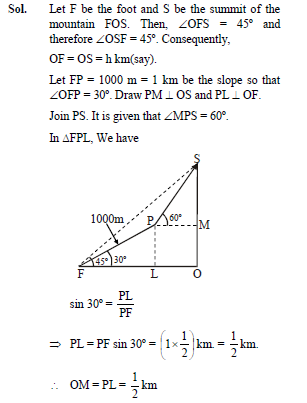
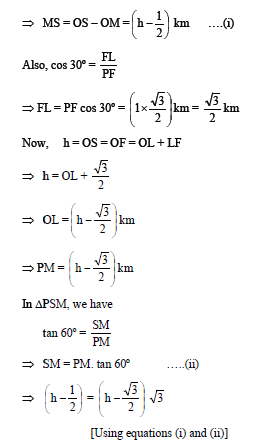
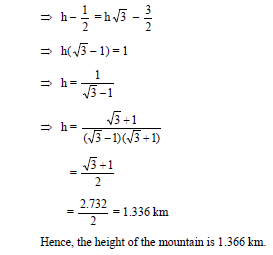
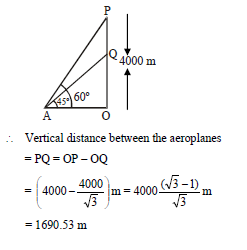
Q.- At the foot of a mountain the elevation of its summit is 45º; after ascending 1000 m towards the mountain up a slope of 30º inclination is found to be 60º. Find the height of the mountain.

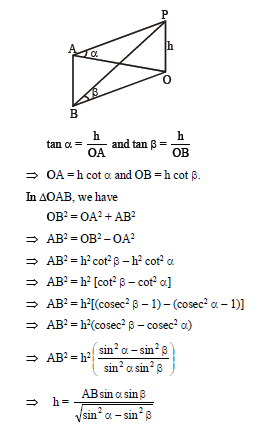

Question 1. If tan A = √2 – 1 , show that sinA cos A = \( \frac{\sqrt{2}}{4} \)
Answer:
We are given:
\[ \tan A = \sqrt{2} - 1 \]
Using the trigonometric identity \( \sec^2 A = 1 + \tan^2 A \):
\[ \sec^2 A = 1 + (\sqrt{2} - 1)^2 \]
\[ \sec^2 A = 1 + (2 + 1 - 2\sqrt{2}) \]
\[ \sec^2 A = 4 - 2\sqrt{2} \delta \]
Since \( \cos^2 A = \frac{1}{\sec^2 A} \), we have:
\[ \cos^2 A = \frac{1}{4 - 2\sqrt{2}} \]
Now, we can express \( \sin A \cos A \) in terms of \( \tan A \) and \( \cos^2 A \):
\[ \sin A \cos A = \frac{\sin A}{\cos A} \cdot \cos^2 A = \tan A \cos^2 A \]
Substituting the values of \( \tan A \) and \( \cos^2 A \):
\[ \sin A \cos A = (\sqrt{2} - 1) \cdot \frac{1}{4 - 2\sqrt{2}} \]
Factor out \( 2\sqrt{2} \) from the denominator:
\[ 4 - 2\sqrt{2} = 2\sqrt{2}(\sqrt{2} - 1) \]
So the expression becomes:
\[ \sin A \cos A = \frac{\sqrt{2} - 1}{2\sqrt{2}(\sqrt{2} - 1)} \]
Canceling the common factor \( \sqrt{2} - 1 \):
\[ \sin A \cos A = \frac{1}{2\sqrt{2}} \]
Rationalize the denominator by multiplying the numerator and denominator by \( \sqrt{2} \):
\[ \sin A \cos A = \frac{\sqrt{2}}{2\sqrt{2} \cdot \sqrt{2}} = \frac{\sqrt{2}}{4} \]
Hence proved.
In simple words: First find the value of cosine squared by using the standard identity that connects tangent and secant. Then rewrite the product of sine and cosine as tangent multiplied by cosine squared to solve it easily.
Exam Tip: Whenever you need to calculate \( \sin A \cos A \) and are given \( \tan A \delta \), using the substitution \( \sin A \cos A = \tan A \cos^2 A \) is often much faster than finding the individual values of sine and cosine.
Question 2. Evaluate 1 - sin² 30° cos² 45° + 4 tan² 30° + 1/2 sin² 90° - 2 cos² 90° + 1/24 cos² 0°
Answer:
We know the standard values of the trigonometric ratios:
- \( \sin 30^\circ = \frac{1}{2} \)
- \( \cos 45^\circ = \frac{1}{\sqrt{2}} \)
- \( \tan 30^\circ = \frac{1}{\sqrt{3}} \)
- \( \sin 90^\circ = 1 \)
- \( \cos 90^\circ = 0 \)
- \( \cos 0^\circ = 1 \)
Substituting these values into the given expression:
\[ E = 1 - \left(\frac{1}{2}\right)^2 \left(\frac{1}{\sqrt{2}}\right)^2 + 4 \left(\frac{1}{\sqrt{3}}\right)^2 + \frac{1}{2} (1)^2 - 2 (0)^2 + \frac{1}{24} (1)^2 \]
Evaluate each term step-by-step:
\[ E = 1 - \left(\frac{1}{4}\right) \left(\frac{1}{2}\right) + 4 \left(\frac{1}{3}\right) + \frac{1}{2} - 0 + \frac{1}{24} \]
\[ E = 1 - \frac{1}{8} + \frac{4}{3} + \frac{1}{2} + \frac{1}{24} \]
To add these fractions, find a common denominator, which is 24:
\[ E = \frac{24}{24} - \frac{3}{24} + \frac{32}{24} + \frac{12}{24} + \frac{1}{24} \]
\[ E = \frac{24 - 3 + 32 + 12 + 1}{24} \]
\[ E = \frac{66}{24} \]
Simplify the fraction by dividing the numerator and denominator by 6:
\[ E = \frac{11}{4} \]
The final value of the expression is \( \frac{11}{4} \).
In simple words: Replace each trigonometric term with its standard numerical value, perform the multiplications, and find a common denominator to add the fractions together.
Exam Tip: Double check your arithmetic when finding common denominators, as this is the most common place where students lose marks in evaluation questions.
Question 3. P.T \( \frac{\cos(90 - \theta)\sec(90 - \theta)\tan\theta}{\csc(90 - \theta)\sin(90 - \theta)\cot(90 - \theta)} + \frac{\tan(90 - \theta)}{\cot\theta} = 2 \)
Answer:
We use standard complementary angle trigonometric formulas:
- \( \cos(90^\circ - \theta) = \sin\theta \)
- \( \sec(90^\circ - \theta) = \csc\theta \)
- \( \csc(90^\circ - \theta) = \sec\theta \)
- \( \sin(90^\circ - \theta) = \cos\theta \)
- \( \cot(90^\circ - \theta) = \tan\theta \)
- \( \tan(90^\circ - \theta) = \cot\theta \)
Now, let us substitute these formulas into the Left-Hand Side (LHS):
\[ \text{LHS} = \frac{\sin\theta \cdot \csc\theta \cdot \tan\theta}{\sec\theta \cdot \cos\theta \cdot \tan\theta} + \frac{\cot\theta}{\cot\theta} \]
We know that \( \sin\theta \cdot \csc\theta = 1 \) and \( \sec\theta \cdot \cos\theta = 1 \). Substituting these reciprocal identities:
\[ \text{LHS} = \frac{1 \cdot \tan\theta}{1 \cdot \tan\theta} + 1 \]
\[ \text{LHS} = \frac{\tan\theta}{\tan\theta} + 1 \]
\[ \text{LHS} = 1 + 1 = 2 \]
Since \( \text{LHS} = 2 \), which is equal to the Right-Hand Side (RHS), the identity is proved.
In simple words: Simplify the terms with 90 minus theta by converting them to their complementary functions. This reduces both parts of the expression to 1, giving a total of 2.
Exam Tip: Memorize complementary angle formulas as they are crucial for solving complex-looking fractions in trigonometry.
Question 4. sec⁴\(\theta\) - sec²\(\theta\) = tan⁴\(\theta\) + tan²\(\theta\)
Answer:
Let us start with the Left-Hand Side (LHS):
\[ \text{LHS} = \sec^4\theta - \sec^2\theta \]
Factor out \( \sec^2\theta \) from the expression:
\[ \text{LHS} = \sec^2\theta (\sec^2\theta - 1) \]
We know the basic trigonometric identity:
\[ \sec^2\theta - 1 = \tan^2\theta \]
And we also have:
\[ \sec^2\theta = 1 + \tan^2\theta \]
Substitute these identities into our factored expression:
\[ \text{LHS} = (1 + \tan^2\theta) \cdot \tan^2\theta \]
Multiply the terms inside the parentheses:
\[ \text{LHS} = \tan^2\theta + \tan^4\theta \]
Rearranging the terms:
\[ \text{LHS} = \tan^4\theta + \tan^2\theta = \text{RHS} \]
Hence proved.
In simple words: Take out secant squared as a common factor, and then replace secant squared with one plus tangent squared using standard identities to get the answer.
Exam Tip: Factoring out common powers is a highly effective first step when working with higher-degree trigonometric identities.
Question 5. \(\sqrt{\sec^2\theta + \csc^2\theta} = \tan\theta + \cot\theta\)
Answer:
Let us simplify the expression inside the square root on the Left-Hand Side (LHS):
\[ \text{LHS} = \sqrt{\sec^2\theta + \csc^2\theta} \]
Express secant and cosecant in terms of sine and cosine:
\[ \text{LHS} = \sqrt{\frac{1}{\cos^2\theta} + \frac{1}{\sin^2\theta}} \]
Take a common denominator to add the fractions:
\[ \text{LHS} = \sqrt{\frac{\sin^2\theta + \cos^2\theta}{\sin^2\theta \cdot \cos^2\theta}} \]
Using the standard identity \( \sin^2\theta + \cos^2\theta = 1 \):
\[ \text{LHS} = \sqrt{\frac{1}{\sin^2\theta \cdot \cos^2\theta}} \]
Taking the square root:
\[ \text{LHS} = \frac{1}{\sin\theta\cos\theta} \]
Now, let us simplify the Right-Hand Side (RHS):
\[ \text{RHS} = \tan\theta + \cot\theta \]
Express tangent and cotangent in terms of sine and cosine:
\[ \text{RHS} = \frac{\sin\theta}{\cos\theta} + \frac{\cos\theta}{\sin\theta} \]
Take a common denominator to combine these fractions:
\[ \text{RHS} = \frac{\sin^2\theta + \cos^2\theta}{\sin\theta\cos\theta} \]
\[ \text{RHS} = \frac{1}{\sin\theta\cos\theta} \]
Since \( \text{LHS} = \text{RHS} \), the identity is proved.
In simple words: Convert the terms on both sides into sines and cosines. Simplifying both sides leads to the same fraction, which completes the proof.
Exam Tip: When proving identities with a square root, simplifying the terms inside the root into a single fraction is often the easiest path to eliminate the radical sign.
Question 6. Through the midpoint m of the side CD of a parallelogram ABCD , the line BM is drawn intersecting AC in L and AD produced in E . Prove that EL = 2BL.
Answer:
Let \( ABCD \) be a parallelogram, where \( AD \parallel BC \) and \( AB \parallel CD \).
\( M \) is the midpoint of side \( CD \), which means \( DM = MC \).
The line \( BM \) is extended to intersect \( AC \) at \( L \) and \( AD \) produced at \( E \).
First, let us compare \( \Delta EMD \) and \( \Delta BMC \):
1. \( \angle EDM = \angle BCM \) (alternate interior angles, as \( AE \parallel BC \))
2. \( DM = MC \) (given that \( M \) is the midpoint of \( CD \))
3. \( \angle EMD = \angle BMC \) (vertically opposite angles)
By ASA congruence criteria:
\[ \Delta EMD \cong \Delta BMC \]
Since the triangles are congruent, their corresponding parts are equal (CPCT):
\[ ED = BC \]
We know \( AD = BC \) because opposite sides of a parallelogram are equal.
Therefore, the total length of side \( AE \) is:
\[ AE = AD + ED = BC + BC = 2BC \]
Now, let us compare \( \Delta EAL \) and \( \Delta CBL \):
1. \( \angle EAL = \angle LCB \) (alternate interior angles, as \( AE \parallel BC \))
2. \( \angle AEL = \angle LBC \) (alternate interior angles)
By AA similarity criteria:
\[ \Delta EAL \sim \Delta CBL \]
Since the triangles are similar, the ratio of their corresponding sides must be equal:
\[ \frac{EL}{BL} = \frac{AE}{BC} \]
Substituting \( AE = 2BC \) into this ratio:
\[ \frac{EL}{BL} = \frac{2BC}{BC} = 2 \]
\[ EL = 2BL \]
Hence proved.
In simple words: First show that the small triangles at the corner are congruent to find that the extended side of the parallelogram is twice the bottom side. Then use similar triangles on the diagonals to find the required ratio.
Exam Tip: Clearly state the geometric reasons (like alternate interior angles or opposite sides of a parallelogram) for each step to secure maximum marks.
Question 7. If two triangles are equiangular , prove that the ratio of the corresponding side is same as the ratio of corresponding altitudes .
Answer:
Let \( \Delta ABC \) and \( \Delta PQR \) be two equiangular triangles, which means:
\[ \Delta ABC \sim \Delta PQR \quad \text{(by AAA similarity)} \]
Since the triangles are similar, their corresponding sides are in the same ratio:
\[ \frac{AB}{PQ} = \frac{BC}{QR} = \frac{AC}{PR} \]
Let \( AD \) be the altitude from vertex \( A \) to side \( BC \) in \( \Delta ABC \), so \( \angle ADB = 90^\circ \).
Let \( PS \) be the altitude from vertex \( P \) to side \( QR \) in \( \Delta PQR \), so \( \angle PSQ = 90^\circ \).
Now, let us compare the smaller triangles \( \Delta ABD \) and \( \Delta PQS \):
1. \( \angle B = \angle Q \) (since \( \Delta ABC \sim \Delta PQR \))
2. \( \angle ADB = \angle PSQ = 90^\circ \) (altitudes are perpendicular)
By AA similarity criteria:
\[ \Delta ABD \sim \Delta PQS \]
Since these smaller triangles are similar, the ratio of their corresponding sides must be equal:
\[ \frac{AB}{PQ} = \frac{AD}{PS} \]
Thus, the ratio of the corresponding sides of the similar triangles is equal to the ratio of their corresponding altitudes.
Hence proved.
In simple words: Use the similarity of the main triangles to show that the smaller triangles formed by drawing the altitudes are also similar. This proves that the ratio of their sides matches the ratio of the heights.
Exam Tip: Remember that in similar triangles, the ratio of any corresponding linear segments (altitudes, medians, or angle-bisectors) is always equal to the ratio of the corresponding sides.
Question 8. ABC is a right \Delta at C . let BC = a , CA = b and AB = c , and let ‘P’ be the perpendicular from C and AB . Prove that (i) pc = ab (ii) \frac{1}{p^2} = \frac{1}{a^2} + \frac{1}{b^2}
Answer:
Let \( ABC \) be a right-angled triangle with \( \angle C = 90^\circ \).
We are given \( BC = a \), \( CA = b \), and \( AB = c \).
Let \( p \) be the length of the perpendicular altitude from \( C \) to the hypotenuse \( AB \).
(i) To prove \( pc = ab \):
We can find the area of \( \Delta ABC \) in two different ways:
1. Taking side \( BC = a \) as the base and side \( CA = b \) as the height:
\[ \text{Area} = \frac{1}{2} \times \text{base} \times \text{height} = \frac{1}{2} ab \]
2. Taking the hypotenuse \( AB = c \) as the base and the perpendicular \( p \) as the height:
\[ \text{Area} = \frac{1}{2} \times \text{base} \times \text{height} = \frac{1}{2} cp \]
Since the area of the triangle remains the same in both cases, we equate them:
\[ \frac{1}{2} ab = \frac{1}{2} cp \]
\[ ab = pc \]
This proves part (i).
(ii) To prove \( \frac{1}{p^2} = \frac{1}{a^2} + \frac{1}{b^2} \):
From part (i), we can express \( p \) as:
\[ p = \frac{ab}{c} \ scraps \]
Taking the reciprocal on both sides:
\[ \frac{1}{p} = \frac{c}{ab} \]
Squaring both sides:
\[ \frac{1}{p^2} = \frac{c^2}{a^2 b^2} \]
Since \( \Delta ABC \) is right-angled at \( C \), by Pythagoras theorem:
\[ c^2 = a^2 + b^2 \]
Substitute this value of \( c^2 \) into our equation:
\[ \frac{1}{p^2} = \frac{a^2 + b^2}{a^2 b^2} \]
Split the fraction on the right-hand side:
\[ \frac{1}{p^2} = \frac{a^2}{a^2 b^2} + \frac{b^2}{a^2 b^2} \]
Simplify the terms:
\[ \frac{1}{p^2} = \frac{1}{b^2} + \frac{1}{a^2} \]
\[ \frac{1}{p^2} = \frac{1}{a^2} + \frac{1}{b^2} \]
This proves part (ii).
In simple words: First find the area of the triangle using the base and height in two different ways to prove the product relation. Then use Pythagoras theorem to rewrite the hypotenuse term to get the reciprocal formula.
Exam Tip: Expressing the area of a right triangle in two different ways is a very useful technique for proving relations involving altitudes to the hypotenuse.
Question 9. In an equilateral \Delta with side ‘a’ prove that a) Altitude = \frac{\sqrt{3}}{2}a b) Area = \frac{\sqrt{3}}{4} a^2
Answer:
Let \( ABC \) be an equilateral triangle with side length \( a \), so \( AB = BC = CA = a \).
Let \( AD \) be the altitude drawn from vertex \( A \) to side \( BC \), so \( AD \perp BC \).
a) To prove \( \text{Altitude} = \frac{\sqrt{3}}{2}a \):
In an equilateral triangle, the altitude bisects the base. Therefore, \( D \) is the midpoint of \( BC \):
\[ BD = DC = \frac{a}{2} \]
In the right-angled triangle \( \Delta ABD \), using Pythagoras theorem:
\[ AB^2 = AD^2 + BD^2 \]
\[ a^2 = AD^2 + \left(\frac{a}{2}\right)^2 \]
\[ a^2 = AD^2 + \frac{a^2}{4} \]
Isolate \( AD^2 \):
\[ AD^2 = a^2 - \frac{a^2}{4} \]
\[ AD^2 = \frac{3a^2}{4} \]
Taking the square root on both sides:
\[ AD = \frac{\sqrt{3}}{2}a \]
Thus, the altitude of the equilateral triangle is \( \frac{\sqrt{3}}{2}a \). This proves part (a).
b) To prove \( \text{Area} = \frac{\sqrt{3}}{4} a^2 \):
The area of a triangle is given by the formula:
\[ \text{Area} = \frac{1}{2} \times \text{base} \times \text{height} \]
Here, the base is \( BC = a \), and the height is the altitude \( AD = \frac{\sqrt{3}}{2}a \).
\[ \text{Area} = \frac{1}{2} \times a \times \frac{\sqrt{3}}{2}a \]
\[ \text{Area} = \frac{\sqrt{3}}{4} a^2 \]
This proves part (b).
In simple words: Use the property that the altitude bisects the base to find the sides of the right-angled triangle. Applying Pythagoras theorem gives the altitude, which is then used to find the area of the triangle.
Exam Tip: Memorize the standard formulas for the altitude and area of an equilateral triangle as they are frequently used in both direct derivations and complex mensuration problems.
Question 10. A man goes 15m due west and 8m due north . How far is he from the starting point .
Answer:
Let \( O \) be the starting point of the man.
The man travels \( 15\text{ m} \) due west to reach point \( A \), so \( OA = 15\text{ m} \).
From point \( A \), he travels \( 8\text{ m} \) due north to reach point \( B \), so \( AB = 8\text{ m} \).
Since the west and north directions are perpendicular to each other, the path forms a right-angled triangle \( OAB \) with the right angle at \( A \).
We need to find the distance of the man from his starting point, which is the length of the hypotenuse \( OB \).
By Pythagoras theorem:
\[ OB^2 = OA^2 + AB^2 \]
\[ OB^2 = 15^2 + 8^2 \]
\[ OB^2 = 225 + 64 \]
\[ OB^2 = 289 \]
Taking the square root on both sides:
\[ OB = \sqrt{289} = 17\text{ m} \]
Therefore, the man is \( 17\text{ m} \) away from the starting point.
In simple words: The directions of west and north make a right angle, so we can use Pythagoras theorem with sides of 15m and 8m to find the straight-line distance, which is 17m.
Exam Tip: Draw a small direction diagram showing North, South, East, and West to visualize the right angle correctly before applying the Pythagorean theorem.
Free study material for Mathematics
Free CBSE Practice Worksheets: Class 10 Mathematics Chapter 09 Some Applications of Trigonometry
Daily Practice Questions for Class 10 Mathematics
Access structured practice worksheets for Chapter 09 Some Applications of Trigonometry aligned with the 2026 CBSE curriculum. These downloadable exercises for Class 10 Mathematics help students build accuracy and reinforce core concepts for upcoming school tests.
Detailed Answers for Class 10 Mathematics Chapter 09 Some Applications of Trigonometry
Each worksheet draws directly from authorized standard textbooks to maintain academic accuracy. Evaluating your finished exercises against expert-verified solutions helps master the formal presentation standards expected in school evaluations.
Complete Your Chapter Revision
Follow up your worksheet practice by attempting the interactive online MCQ tests for Chapter 09 Some Applications of Trigonometry to evaluate your execution speed. All printable assignments and revision sheets on our platform are updated for the 2026 session and available free of charge.
FAQs
You can download the latest chapter-wise printable worksheets for Class 10 Mathematics Chapter 09 Some Applications of Trigonometry for free from StudiesToday.com. These have been made as per the latest CBSE curriculum for this academic year.
Yes, Class 10 Mathematics worksheets for Chapter 09 Some Applications of Trigonometry focus on activity-based learning and also competency-style questions. This helps students to apply theoretical knowledge to practical scenarios.
Yes, we have provided solved worksheets for Class 10 Mathematics Chapter 09 Some Applications of Trigonometry to help students verify their answers instantly.
Yes, our Class 10 Mathematics test sheets are mobile-friendly PDFs and can be printed by teachers for classroom.
For Chapter 09 Some Applications of Trigonometry, regular practice with our worksheets will improve question-handling speed and help students understand all technical terms and diagrams.