

Class 10 Mathematics Practice Sheet: CBSE Class 10 Mathematics Coordinate Geometry Worksheet Set 08
Access comprehensive chapter-wise worksheets for Chapter 07 Coordinate Geometry using the CBSE Class 10 Mathematics Coordinate Geometry Worksheet Set 08. Designed to align with the 2026-27 academic syllabus for Class 10 Mathematics, these printable practice sets help students reinforce key concepts and improve their overall exam readiness.
Download Chapter 07 Coordinate Geometry Worksheet PDF with Answers
Access the complete worksheet PDF for Class 10 Mathematics below. Regular practice with these targeted academic tasks builds familiarity with standard question patterns and helps secure higher marks in final school examinations.
Question. The point on the x-axis which is equidistant from (– 4, 0) and (10, 0) is:
(a) (7, 0)
(b) (5, 0)
(c) (0, 0)
(d) (3, 0)
Answer : D
Question. The centre of a circle whose end points of a diameter are (– 6, 3) and (6, 4) are:
(a) (8, – 1)
(b) (4, 7)
(c) (0, 2/7)
(d) (4, 2/7)
Answer : C
Question. The distance between the points (m, – n) and (– m, n) is:
(a) √m2 +n2
(b) m + n
(c) 2 √m2 + n2
(d) √2m2 + 2n2
Answer : C
Question. The point which divides the line segment joining the points (7, –6) and (3, 4) in the ratio 1:2 internally, lies in the:
(a) I quadrant
(b) II quadrant
(c) III quadrant
(d) IV quadrant
Answer : D
Question. The distance between the points (a cos θ + b sin θ, 0) and (0, a sin θ – b cos θ), is
(a) a2 + b2
(b) a2 – b2
(c) √a2 + b2
(d) √a2 – b2
Answer : C
Question. The point which lies on the perpendicular bisector of the line segment joining point A (–2, –5) and B (2, 5) is:
(a) (0, 0)
(b) (0, –1)
(c) (–1, 0)
(d) (1, 0)
Answer : A
Question. The fourth vertex D of a parallelogram ABCD whose three vertices are A (–2, 3), B (6, 7) and C (8, 3) is:
(a) (0, 1)
(b) (0, –1)
(c) (–1, 0)
(d) (1, 0)
Answer : B
Question. If the point P(k, 0) divides the line segment joining the points A(2, –2) and B(–7, 4) in the ratio 1 : 2, then the value of k is
(a) 1
(b) 2
(c) –2
(d) –1
Answer : D
Question. The distance of the point p(-3, -4) from the x-axis (in units) is:
(a) 3
(b) –3
(c) 4
(d) 5
Answer : C
Question. If the point P(2, 1) lies on the line segment joining points A(4, 2) and B(8, 4), then:
(a) AP = 1/3 AB
(b) AP = PB
(c) PB = 1/3 AB
(d) AP = 1/2 AB
Answer : D
Question. If A , (m/3, 5) is the mid-point of the line segment joining the points Q(–6, 7) and R(–2, 3), then the value of m is:
(a) -12
(b) -4
(c) 12
(d) -6
Answer : A
Question. The perimeter of a triangle ABC with vertices A (0, 4), B (0, 0) and C (3, 0) is:
(a) 5 units
(b) 11 units
(c) 12 units
(d) (7 + 5) units
Answer : C
Question. If P (a/3, 4) is the midpoint of the line segment joining the points Q(–6, 5) and R(–2, 3), then the value of a is:
(a) –4
(b) –12
(c) 12
(d) –6
Answer : B
Question. The perpendicular bisector of the line segment joining the points A(1, 5) and B(4, 6) cuts the y-axis at:
(a) (0, 13)
(b) (0, –13)
(c) (0, 12)
(d) (13, 0)
Answer : A
Question. The coordinates of the point which is equidistant from the three vertices of the ΔAOB as shown in the figure is:
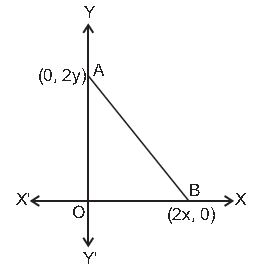
(a) (x, y)
(b) (y, x)
(c) (x/2, y/2)
(d) (y/2, x/2)
Answer : A
Question. A circle drawn with origin as the centre passes through (13/2, 0) The point which does not lie in the interior of the circle is:
(a) (-3/4, 1)
(b) (2, 7/3)
(c) (5, 1/2)
(d) (-6, 5/2)
Answer : D
Fill in the Blanks
Fill in the blanks/tables with suitable information:
Question. AOBC is a rectangle whose three vertices are A(0, –3), O(0, 0) and B(4, 0). The length of its diagonal is .............................. .
Answer : 5
Question. The centroid of the triangle whose vertices are (4, – 8), (– 9, 7) and (8, 13) is .............................. .
Answer : (1, 4)
Question. The ratio in which x-axis divides the line segment joining the point (2, 3) and (4, – 8) is .............................. .
Answer : 3.8
Question. The mid-point of the line segment AB is (4, 0).
If the co-ordinates of point A is (3,–2), then coordinates of point B is .............................. .
Answer : B (3, 2)
Question. Distance of a point (–24, 7) from the origin (in units) is .............................. .
Answer : 25 units
Question. If P(–1, 1) is the mid-point of the line segment joining the points A(–3, b) and B(1, b + 4) then b = ...............................
Answer : –1
Write True or False
Question. ΔABC with vertices A(–2, 0), B(2, 0) and C(0, 2) is similar to DDEF with vertices D(–4, 0), E(4, 0) and F(0, 4).
Answer : True.
Question. Point P (–4, 2) lies on the line segment joining the points A (–4, 6) and B (–4, –6).
Answer : True.
Question. Points A(4, 3), B(6, 4), C(5, –6) and D(–3, 5) are the vertices of a parallelogram.
Answer : False.
Question. Point P(5, –3) is one of the two points of trisection of the line segment joining points A(7, –2) and B(1, –5).
Answer : True.
Question. Point P(–2, 4) lies on a circle of radius 6 and centre C(3, 5). [CBSE 2014, 13]
Answer : False.
Question. The points A (–1, –2), B (4, 3), C (2, 5) and D (–3, 0) in that order from a rectangle.
Answer : True.
Question. Find the area of the triangle formed by the points O (0,0), A(a,0) and B(0,h).
Answer : ab/2
Question. Find the area of ∆ABC where A (2,3), B (-2,1) and C (3,-2)
Answer : 11sq. units
Question. Find the distance between the prints A(10 Cosθ) and B(0,10 Sinθ)
Answer : 10
Question. If the centroid of the triangle formed by the points (a,b), (b,c) and (c,a) at the origin, then find the value of a3 + b3 + c3
Answer : 3abc
Question. Find the distance of the point (3,-4) from y-axis If A(3,2) , B(-2,1) are two vertices of ∆ABC whose centroid G has the co-ordinates (5/3, 1/3). Find the co-ordinates of the third vertex C.
Answer : 3 units
Question. AB is the diameter of a circle whose centre is (2,-3). If the co-ordinates of A.B are (1,4), then find the co-ordinates of A.
Answer : (3,-10)
Question. Find the ratio in which the line-segment joining the points (-3,-4) and (1,-2) is divided by y-axis
Answer : 3:1
Question. If the area of a triangle formed by (x, 2x), (-2, 6) and (3,1) is 5 square units, then find the value of x.
Answer : x = 2
Question. Find the co-ordinates of the point which divides the line-segment joining the point (1,3) and (2,7) in the ratio 3:4
Answer : 10/7, 33/7
Basic Concepts
1. Distance Formula
This formula determines the length of the line segment connecting two coordinates, \( A(x_1, y_1) \) and \( B(x_2, y_2) \). It is written as:
\[ d = \sqrt{(x_2 - x_1)^2 + (y_2 - y_1)^2} \]
Corollary:
As a direct consequence, the distance from the origin \( O(0,0) \) to any point \( P(x,y) \) simplifies to:
\[ OP = \sqrt{x^2 + y^2} \]
2. Section Formula
When a point \( P(x, y) \) splits the line segment between \( A(x_1, y_1) \) and \( B(x_2, y_2) \) on the inside in a ratio of \( m:n \), its coordinates are found using:
\[ x = \frac{mx_2 + nx_1}{m+n}, \quad y = \frac{my_2 + ny_1}{m+n} \]
3. Midpoint Formula
In the case where \( R \) is the exact middle point, the ratio divides equally. The coordinates for \( R \) are calculated as:
\[ R\left(\frac{x_1 + x_2}{2}, \frac{y_1 + y_2}{2}\right) \ ]
4. Coordinates of the Centroid of Triangle
For a triangle with corners at \( P(x_1, y_1) \), \( Q(x_2, y_2) \), and \( R(x_3, y_3) \), the center of gravity (centroid) is located at:
\[ \left(\frac{x_1 + x_2 + x_3}{3}, \frac{y_1 + y_2 + y_3}{3}\right) \]
5. Area of a Triangle
The total space enclosed by a triangle with vertices at \( P(x_1, y_1) \), \( Q(x_2, y_2) \), and \( R(x_3, y_3) \) is represented by the positive value of the following formula:
\[ \text{ar}(\Delta PQR) = \frac{1}{2} |x_1(y_2 - y_3) + x_2(y_3 - y_1) + x_3(y_1 - y_2)| \]
Level-I
Question 1. Find the distance between the points P (7, 5) and Q (2, 5).
Answer: Apply the distance formula to compute the length between \( P(7,5) \) and \( Q(2,5) \):
\( d = \sqrt{(x_2 - x_1)^2 + (y_2 - y_1)^2} \)
Substituting the values:
\( d = \sqrt{(2 - 7)^2 + (5 - 5)^2} \)
\( \implies d = \sqrt{(-5)^2 + (0)^2} \)
\( \implies d = \sqrt{25} \)
\( \implies d = 5 \) units.
In simple words: The gap between these two points is 5 units. Since their vertical coordinates are the same, we can also find this by simply subtracting their horizontal coordinates.
Exam Tip: Always write the units after finding the distance, as marks can be deducted for missing units.
Question 2. IfP(a/3, 4)is the midpoint of the line segment joining the points Q(-6, 5) and R (-2,3), then find the value of a.
Answer: We use the midpoint coordinates formula to find the value of \( a \):
\( x = \frac{x_1 + x_2}{2} \)
For coordinates \( Q(-6, 5) \) and \( R(-2, 3) \), the midpoint's x-coordinate is:
\( x = \frac{-6 + (-2)}{2} \)
\( \implies x = \frac{-8}{2} \)
\( \implies x = -4 \)
We are given that the x-coordinate of \( P \) is \( \frac{a}{3} \). Equating these two values:
\( \frac{a}{3} = -4 \)
\( \implies a = -12 \)
Thus, the value of \( a \) is \( -12 \).
In simple words: Find the middle point's x-value by averaging the x-values of the two ends. Then set this equal to the given fraction to solve for the missing letter.
Exam Tip: Be careful with signs when substituting negative values into formulas to avoid arithmetic errors.
Question 3. A line intersects y -axis and x-axis at the points P and Q respectively. If (2,-5)is the mid point of PQ, then find the coordinates of P and Q respectively.
Answer: Since point \( P \) lies on the y-axis, we can write its coordinates as \( (0, y) \). Similarly, since \( Q \) lies on the x-axis, its coordinates can be written as \( (x, 0) \).
We are given that the midpoint of segment \( PQ \) is \( (2, -5) \).
Applying the midpoint formula:
\( \frac{0 + x}{2} = 2 \) and \( \frac{y + 0}{2} = -5 \)
Solving these individually:
\( \implies x = 4 \)
\( \implies y = -10 \)
Therefore, the coordinates are \( P(0, -10) \) and \( Q(4, 0) \).
In simple words: Points on the axes always have one zero coordinate. Using the midpoint formula allows us to solve for the missing values easily.
Exam Tip: Remember that any point on the x-axis has a y-coordinate of 0, and any point on the y-axis has an x-coordinate of 0.
Question 4. If the distance between the points(4, p) & (1, 0)is 5, then find the value of p
Answer: Using the distance formula, set up the equation with the given distance:
\( \sqrt{(1 - 4)^2 + (0 - p)^2} = 5 \)
Squaring both sides of the equation:
\( (1 - 4)^2 + (0 - p)^2 = 25 \)
\( \implies (-3)^2 + (-p)^2 = 25 \)
\( \implies 9 + p^2 = 25 \)
\( \implies p^2 = 25 - 9 \)
\( \implies p^2 = 16 \)
\( \implies p = \pm 4 \)
Thus, the value of \( p \) is \( \pm 4 \).
In simple words: Solve the distance equation for the variable by squaring both sides, which gives two possible values - positive and negative 4.
Exam Tip: When solving a quadratic equation for distance, do not forget the negative solution unless the question specifies a positive coordinate.
Question 5. If the point A (1, 2),B (0, 0) and C (a,b) are collinear, then find there relation between a and b.
Answer: For three coordinates \( A(1, 2) \), \( B(0, 0) \), and \( C(a, b) \) to be collinear, the area of the triangle they form must be exactly zero:
\( x_1(y_2 - y_3) + x_2(y_3 - y_1) + x_3(y_1 - y_2) = 0 \)
Substituting the values:
\( 1(0 - b) + 0(b - 2) + a(2 - 0) = 0 \)
\( \implies -b + 2a = 0 \)
\( \implies 2a = b \)
Thus, the relation is \( 2a = b \).
In simple words: When three points lie on the same straight line, they cannot form a triangle, so their area is zero. This gives us the equation relating the variables.
Exam Tip: For collinearity proofs, setting the area of the triangle to zero is the most reliable and direct method.
Question 6. Find the rational number which the y-axis divides the segment joining(-3, 6)and(12,-3).
Answer: Let the y-axis divide the segment joining \( A(-3, 6) \) and \( B(12, -3) \) in the ratio \( k:1 \).
Since any point on the y-axis has an x-coordinate of 0, we can use the section formula for the x-coordinate:
\( x = \frac{m_1 x_2 + m_2 x_1}{m_1 + m_2} \)
\( \implies 0 = \frac{k(12) + 1(-3)}{k + 1} \)
Multiplying both sides by \( k+1 \):
\( \implies 12k - 3 = 0 \)
\( \implies 12k = 3 \)
\( \implies k = \frac{3}{12} = \frac{1}{4} \)
Thus, the required rational number representing the ratio is \( \frac{1}{4} \).
In simple words: Since the y-axis has an x-coordinate of zero, we set up a ratio equation using the x-values and find that it divides the line in a 1 to 4 ratio.
Exam Tip: If the question asks for how the y-axis divides a segment, always substitute x = 0 in the section formula first.
Question 7. Find the coordinates of a point A, where AB is diameter of a circle whose Centre is(2,-3) and B is (1,4)
Answer: The center of a circle is the exact midpoint of its diameter \( AB \). Let the coordinates of point \( A \) be \( (x, y) \).
Using the midpoint formula with the given center \( (2, -3) \) and point \( B(1, 4) \):
\( \frac{x + 1}{2} = 2 \) and \( \frac{y + 4}{2} = -3 \)
Solving these equations individually:
\( \implies x + 1 = 4 \implies x = 3 \)
\( \implies y + 4 = -6 \implies y = -10 \)
Hence, the coordinates of point \( A \) are \( (3, -10) \).
In simple words: The center is halfway between the two ends of the diameter. We can find the missing endpoint by working backwards from this midpoint.
Exam Tip: Since the center is the midpoint of the diameter, this problem is solved quickly using the midpoint formula.
Question 8. Find the centroid of triangle whose vertices are(3, -7),(-8,6)and (5, 10).
Answer: The coordinates of a triangle's centroid are calculated using the centroid formula:
\( G(x, y) = \left(\frac{x_1 + x_2 + x_3}{3}, \frac{y_1 + y_2 + y_3}{3}\right) \)
Given the vertices \( (3, -7) \), \( (-8, 6) \), and \( (5, 10) \):
\( x = \frac{3 - 8 + 5}{3} = \frac{0}{3} = 0 \)
\( y = \frac{-7 + 6 + 10}{3} = \frac{9}{3} = 3 \)
Thus, the centroid coordinates are \( (0, 3) \).
In simple words: Add the three x-values together and divide by 3, then do the same for the three y-values to find the center of the triangle.
Exam Tip: Double-check your division by 3 when calculating the centroid to ensure accuracy.
Level-II
Question 1. If A (-2, 4), B (0,0),C(4,2)are the vertices of a ∆ABC, then find the length of median through the vertex A.
Answer: The median starting from vertex \( A \) bisects the opposite side \( BC \) at its midpoint, which we will call \( D \).
First, find the coordinates of \( D \) using the midpoint formula on \( B(0,0) \) and \( C(4,2) \):
\( D = \left(\frac{0 + 4}{2}, \frac{0 + 2}{2}\right) = (2, 1) \)
Now, calculate the length of the median \( AD \) using the distance formula between \( A(-2, 4) \) and \( D(2, 1) \):
\( AD = \sqrt{(2 - (-2))^2 + (1 - 4)^2} \)
\( \implies AD = \sqrt{(4)^2 + (-3)^2} \)
\( \implies AD = \sqrt{16 + 9} = \sqrt{25} \)
\( \implies AD = 5 \) units.
In simple words: Find the middle point of the side opposite to vertex A, then calculate the straight-line distance from A to this middle point.
Exam Tip: Identify the correct opposite side to find the midpoint before using the distance formula for the median.
Question 2. Find the value of x for which the distance between the points P (4,-5) and Q(12, x) is 10units.
Answer: Using the distance formula, set up the distance between \( P(4, -5) \) and \( Q(12, x) \):
\( \sqrt{(12 - 4)^2 + (x - (-5))^2} = 10 \)
Square both sides of the equation:
\( (8)^2 + (x + 5)^2 = 100 \)
\( \implies 64 + (x + 5)^2 = 100 \)
\( \implies (x + 5)^2 = 36 \)
Taking the square root of both sides:
\( \implies x + 5 = \pm 6 \)
This yields two scenarios:
\( x + 5 = 6 \implies x = 1 \)
\( x + 5 = -6 \implies x = -11 \)
The possible values for \( x \) are \( 1 \) and \( -11 \).
In simple words: Use the distance formula to find an equation for the variable. Solving the quadratic equation gives two valid answers.
Exam Tip: Remember to check both positive and negative roots when squaring coordinates, as both represent valid geometric distances.
Question 3. If the points A(4, 3) and B(x, 5)are on the circle with Centre O (2, 3) then find the value of x.
Answer: Because points \( A \) and \( B \) are on the boundary of the circle, they are at an equal distance (the radius) from the center \( O \):
\( OA = OB \)
First, find the distance \( OA \):
\( OA = \sqrt{(4 - 2)^2 + (3 - 3)^2} = \sqrt{(2)^2 + 0} = 2 \)
Now, express the distance \( OB \):
\( OB = \sqrt{(x - 2)^2 + (5 - 3)^2} = \sqrt{(x - 2)^2 + 4} \)
Equating the two distances:
\( \sqrt{(x - 2)^2 + 4} = 2 \)
Square both sides to solve for \( x \):
\( (x - 2)^2 + 4 = 4 \)
\( \implies (x - 2)^2 = 0 \)
\( \implies x - 2 = 0 \)
\( \implies x = 2 \)
Thus, the value of \( x \) is \( 2 \).
In simple words: Since both points lie on the circle, they must be the same distance from the center. Setting their distances equal helps us find that the variable must be 2.
Exam Tip: Set distances equal to the radius. Simplifying before squaring can help avoid high-degree polynomials.
Question 4. What is the distance between the point A (c, 0)and B(0,-c)?
Answer: Using the distance formula, determine the length between \( A(c, 0) \) and \( B(0, -c) \):
\( d = \sqrt{(0 - c)^2 + (-c - 0)^2} \)
\( \implies d = \sqrt{(-c)^2 + (-c)^2} \)
\( \implies d = \sqrt{c^2 + c^2} \)
\( \implies d = \sqrt{2c^2} \)
\( \implies d = \sqrt{2}c \) units.
In simple words: Use the coordinates to find the length of the line segment. The resulting value simplifies to the square root of 2 times the value of c.
Exam Tip: Keep terms with variables under the square root carefully and simplify the radical completely.
Question 5. For what value of p, are the points (-3, 9),(2,p) and(4,-5) collinear?
Answer: These three points are collinear if the area of the triangle they form is zero:
\( x_1(y_2 - y_3) + x_2(y_3 - y_1) + x_3(y_1 - y_2) = 0 \)
Substitute the given coordinates \( (-3, 9) \), \( (2, p) \), and \( (4, -5) \):
\( -3(p - (-5)) + 2(-5 - 9) + 4(9 - p) = 0 \)
\( \implies -3(p + 5) + 2(-14) + 36 - 4p = 0 \)
\( \implies -3p - 15 - 28 + 36 - 4p = 0 \)
Combine the terms:
\( \implies -7p - 7 = 0 \)
\( \implies -7p = 7 \)
\( \implies p = -1 \)
Thus, the value of \( p \) is \( -1 \).
In simple words: Set the triangle area equation to zero and solve for the unknown value. This ensures all three coordinates lie along a single straight line.
Exam Tip: Always expand brackets carefully when working with minus signs in the collinearity formula.
Question 6. Show that the points (3,2),(0,5), (-3, 2) and(0,-1)are the vertices of a square.
Answer: Let the given points be \( A(3, 2) \), \( B(0, 5) \), \( C(-3, 2) \), and \( D(0, -1) \).
First, we calculate the lengths of all four sides using the distance formula:
\( AB = \sqrt{(0 - 3)^2 + (5 - 2)^2} = \sqrt{(-3)^2 + (3)^2} = \sqrt{9 + 9} = \sqrt{18} \)
\( BC = \sqrt{(-3 - 0)^2 + (2 - 5)^2} = \sqrt{(-3)^2 + (-3)^2} = \sqrt{9 + 9} = \sqrt{18} \)
\( CD = \sqrt{(0 - (-3))^2 + (-1 - 2)^2} = \sqrt{(3)^2 + (-3)^2} = \sqrt{9 + 9} = \sqrt{18} \)
\( DA = \sqrt{(3 - 0)^2 + (2 - (-1))^2} = \sqrt{(3)^2 + (3)^2} = \sqrt{9 + 9} = \sqrt{18} \)
Since \( AB = BC = CD = DA = \sqrt{18} \), all four sides are equal.
Next, we calculate the lengths of the diagonals \( AC \) and \( BD \):
\( AC = \sqrt{(-3 - 3)^2 + (2 - 2)^2} = \sqrt{(-6)^2 + 0} = 6 \)
\( BD = \sqrt{(0 - 0)^2 + (-1 - 5)^2} = \sqrt{0 + (-6)^2} = 6 \)
Since the diagonals are equal (\( AC = BD = 6 \)) and all four sides are equal, \( ABCD \) is indeed a square.
In simple words: We show that all four sides are equal in length, and both diagonal lines across the shape are equal too. This proves it is a perfect square.
Exam Tip: To prove a shape is a square, you must show both that all four sides are equal and that both diagonals are equal.
Question 7. Point P divides the line segment joining the points A (2, 1) and B (5,-8) such that AP: AB=1:3 If P lies on the line 2x-y+k=0, then find the value of k.
Answer: Given that \( \frac{AP}{AB} = \frac{1}{3} \), this means that \( P \) splits the line segment \( AB \) internally.
The ratio of \( AP \) to \( PB \) is:
\( AP : PB = AP : (AB - AP) = 1 : (3 - 1) = 1 : 2 \)
Applying the section formula with ratio \( m:n = 1:2 \) on points \( A(2, 1) \) and \( B(5, -8) \):
\( x = \frac{1(5) + 2(2)}{1 + 2} = \frac{9}{3} = 3 \)
\( y = \frac{1(-8) + 2(1)}{1 + 2} = \frac{-6}{3} = -2 \)
Thus, the coordinates of \( P \) are \( (3, -2) \).
Since \( P(3, -2) \) lies on the line \( 2x - y + k = 0 \), we substitute these coordinates into the line's equation:
\( 2(3) - (-2) + k = 0 \)
\( \implies 6 + 2 + k = 0 \)
\( \implies 8 + k = 0 \)
\( \implies k = -8 \)
Thus, the value of \( k \) is \( -8 \).
In simple words: Use the given ratio to find the coordinates of point P on the line segment, then plug those coordinates into the line equation to find the value of k.
Exam Tip: Notice that the given ratio AP:AB = 1:3 must be converted to the division ratio AP:PB = 1:2 before using the section formula.
Question 8. Find the relation between x and y if the points (2,1), (x,y) and (7, 5) are collinear
Answer: For the points \( (2, 1) \), \( (x, y) \), and \( (7, 5) \) to lie on a single straight line, the area of the triangle formed by them must be 0:
\( x_1(y_2 - y_3) + x_2(y_3 - y_1) + x_3(y_1 - y_2) = 0 \)
Substitute the given coordinates:
\( 2(y - 5) + x(5 - 1) + 7(1 - y) = 0 \)
\( \implies 2y - 10 + 4x + 7 - 7y = 0 \)
Group the terms together:
\( \implies 4x - 5y - 3 = 0 \)
Thus, the relation is \( 4x - 5y - 3 = 0 \).
In simple words: Setting the area of the triangle formed by these three points to zero gives us the linear relation between x and y.
Exam Tip: Keep the linear equation in the standard form Ax + By + C = 0 as it is the preferred presentation.
Level-III
Question 1. Find the ratio in which the line 2x+3y=10 divides the line segment joining the points (1, 2) and (2, 3).
Answer: Let the line \( 2x + 3y = 10 \) divide the segment joining \( A(1, 2) \) and \( B(2, 3) \) in the ratio \( k:1 \).
Using the section formula, the coordinates of the intersection point \( P(x, y) \) are:
\( x = \frac{k(2) + 1(1)}{k + 1} = \frac{2k + 1}{k + 1} \)
\( y = \frac{k(3) + 1(2)}{k + 1} = \frac{3k + 2}{k + 1} \)
Since \( P \) lies on the given line \( 2x + 3y = 10 \), we substitute these coordinates into the line equation:
\( 2\left(\frac{2k + 1}{k + 1}\right) + 3\left(\frac{3k + 2}{k + 1}\right) = 10 \)
Multiply the entire equation by \( k + 1 \):
\( 2(2k + 1) + 3(3k + 2) = 10(k + 1) \)
\( \implies 4k + 2 + 9k + 6 = 10k + 10 \)
\( \implies 13k + 8 = 10k + 10 \)
\( \implies 3k = 2 \)
\( \implies k = \frac{2}{3} \)
Therefore, the line divides the segment in the ratio \( 2:3 \).
In simple words: Use the section formula to represent the point of intersection using a ratio k. Placing this point into the line's equation lets us solve for the ratio.
Exam Tip: Keep the ratio as k:1 to solve with a single variable, making the algebra much simpler to handle.
Question 2. Prove that (4,-1),(6,0),(7,2) & (5,1) are the vertices of a rhombus is it a square?
Answer: Let the given points be \( A(4, -1) \), \( B(6, 0) \), \( C(7, 2) \), and \( D(5, 1) \).
First, find the lengths of all four sides:
\( AB = \sqrt{(6 - 4)^2 + (0 - (-1))^2} = \sqrt{(2)^2 + (1)^2} = \sqrt{5} \)
\( BC = \sqrt{(7 - 6)^2 + (2 - 0)^2} = \sqrt{(1)^2 + (2)^2} = \sqrt{5} \)
\( CD = \sqrt{(5 - 7)^2 + (1 - 2)^2} = \sqrt{(-2)^2 + (-1)^2} = \sqrt{5} \)
\( DA = \sqrt{(4 - 5)^2 + (-1 - 1)^2} = \sqrt{(-1)^2 + (-2)^2} = \sqrt{5} \)
Since \( AB = BC = CD = DA = \sqrt{5} \), all sides are equal, showing that \( ABCD \) is a rhombus.
Now, let's calculate the lengths of the diagonals:
\( AC = \sqrt{(7 - 4)^2 + (2 - (-1))^2} = \sqrt{3^2 + 3^2} = \sqrt{18} \)
\( BD = \sqrt{(5 - 6)^2 + (1 - 0)^2} = \sqrt{(-1)^2 + 1^2} = \sqrt{2} \)
Because the diagonals are unequal (\( AC \neq BD \)), this rhombus is not a square.
In simple words: All four sides are equal, which proves it is a rhombus. Since the diagonals are of different lengths, it cannot be a square.
Exam Tip: Showing equal sides is not enough to prove a square - you must also show equal diagonals, otherwise it remains a rhombus.
Question 3. Find the area of the triangle formed by joining the midpoints of the sides of the triangle whose vertices are (0,-1), (2, 1) and (0, 3).Find the ratio of this area to the area of the given triangle.
Answer: Let the given triangle have vertices \( A(0, -1) \), \( B(2, 1) \), and \( C(0, 3) \).
First, find the area of \( \Delta ABC \):
\( \text{Area}(\Delta ABC) = \frac{1}{2} |x_1(y_2 - y_3) + x_2(y_3 - y_1) + x_3(y_1 - y_2)| \)
\( \text{Area}(\Delta ABC) = \frac{1}{2} |0(1 - 3) + 2(3 - (-1)) + 0(-1 - 1)| \)
\( \text{Area}(\Delta ABC) = \frac{1}{2} |0 + 8 + 0| = 4 \) sq units.
Next, let the midpoints of sides \( AB \), \( BC \), and \( CA \) be \( D \), \( E \), and \( F \) respectively:
\( D = \left(\frac{0+2}{2}, \frac{-1+1}{2}\right) = (1, 0) \)
\( E = \left(\frac{2+0}{2}, \frac{1+3}{2}\right) = (1, 2) \)
\( F = \left(\frac{0+0}{2}, \frac{3-1}{2}\right) = (0, 1) \)
Now, calculate the area of the midpoint triangle \( \Delta DEF \):
\( \text{Area}(\Delta DEF) = \frac{1}{2} |1(2 - 1) + 1(1 - 0) + 0(0 - 2)| \)
\( \text{Area}(\Delta DEF) = \frac{1}{2} |1(1) + 1(1) + 0| = \frac{1}{2} (2) = 1 \) sq unit.
The ratio of the area of the midpoint triangle to the given triangle is:
\( \text{Ratio} = \frac{\text{Area}(\Delta DEF)}{\text{Area}(\Delta ABC)} = \frac{1}{4} = 1:4 \).
In simple words: The area of the larger triangle is 4, and the smaller triangle formed by connecting its midpoints has an area of 1. This creates a ratio of 1 to 4.
Exam Tip: The area of the triangle formed by joining midpoints is always 1/4 the area of the original triangle.
Question 4. Determine the ratio in which the point P (a,-2) divides the line joining of points (-4, 3) and B (2, -4).Also find the value of a.
Answer: Let the point \( P(a, -2) \) divide the line segment joining \( A(-4, 3) \) and \( B(2, -4) \) in the ratio \( k:1 \).
We use the y-coordinate of \( P \) since it is known:
\( y = \frac{k y_2 + y_1}{k + 1} \)
\( \implies -2 = \frac{k(-4) + 1(3)}{k + 1} \)
\( \implies -2(k + 1) = -4k + 3 \)
\( \implies -2k - 2 = -4k + 3 \)
\( \implies 2k = 5 \)
\( \implies k = \frac{5}{2} \)
So, the division ratio is \( 5:2 \).
Now, we calculate \( a \) using the x-coordinate section formula:
\( a = \frac{k x_2 + x_1}{k + 1} \)
\( \implies a = \frac{\frac{5}{2}(2) + 1(-4)}{\frac{5}{2} + 1} \)
\( \implies a = \frac{5 - 4}{\frac{7}{2}} = \frac{1}{\frac{7}{2}} \)
\( \implies a = \frac{2}{7} \)
Thus, the ratio is \( 5:2 \) and the value of \( a \) is \( \frac{2}{7} \).
In simple words: Use the known y-coordinate to set up a ratio equation. Once we find the ratio is 5:2, we plug this ratio into the x-coordinate formula to find the value of a.
Exam Tip: Use the coordinate that contains no unknown variables to find the ratio first, then use that ratio to find the unknown coordinate.
Question 5. If the point C (-1, 2) divides internally the line segment joining A (2, 5) and in the ratio 3:4. Find the Co-ordinates of B.
Answer: Let the coordinates of point \( B \) be \( (x, y) \). Point \( C(-1, 2) \) divides \( AB \) internally in the ratio \( 3:4 \).
Using the section formula for internal division:
\( x_C = \frac{m_1 x_B + m_2 x_A}{m_1 + m_2} \) and \( y_C = \frac{m_1 y_B + m_2 y_A}{m_1 + m_2} \)
Substitute the values:
\( -1 = \frac{3(x) + 4(2)}{3 + 4} \implies -1 = \frac{3x + 8}{7} \)
\( \implies 3x + 8 = -7 \implies 3x = -15 \implies x = -5 \)
Now for the y-coordinate:
\( 2 = \frac{3(y) + 4(5)}{3 + 4} \implies 2 = \frac{3y + 20}{7} \)
\( \implies 3y + 20 = 14 \implies 3y = -6 \implies y = -2 \)
Therefore, the coordinates of \( B \) are \( (-5, -2) \).
In simple words: Use the section formula with the known midpoint and one endpoint. This lets us solve two simple equations to find the coordinates of the other endpoint.
Exam Tip: Take special care with the order of points when using the internal section formula.
Question 6. Show that points (1,1),(4,4),(4,8)and (1,5) are the vertices of a parallelogram.
Answer: Let the given points be \( A(1, 1) \), \( B(4, 4) \), \( C(4, 8) \), and \( D(1, 5) \).
In a parallelogram, the diagonals bisect each other, meaning they share the same midpoint. Let's find the midpoints of diagonals \( AC \) and \( BD \):
Midpoint of diagonal \( AC \):
\( M_{AC} = \left(\frac{1 + 4}{2}, \frac{1 + 8}{2}\right) = (2.5, 4.5) \)
Midpoint of diagonal \( BD \):
\( M_{BD} = \left(\frac{4 + 1}{2}, \frac{4 + 5}{2}\right) = (2.5, 4.5) \)
Since the midpoints of both diagonals are the same, \( ABCD \) is a parallelogram.
In simple words: We can prove a shape is a parallelogram by showing that its diagonals cross exactly at their midpoints. Since both midpoints match, the shape is a parallelogram.
Exam Tip: Showing that the diagonals share a midpoint is the fastest way to prove a quadrilateral is a parallelogram.
Question 7. Find the value of p, for which the points (-1, 3), (2, p) & (5,-1) are collinear
Answer: For these three coordinates to be collinear, the area of the triangle formed by them must be zero:
\( x_1(y_2 - y_3) + x_2(y_3 - y_1) + x_3(y_1 - y_2) = 0 \)
Substitute the values:
\( -1(p - (-1)) + 2(-1 - 3) + 5(3 - p) = 0 \)
\( \implies -1(p + 1) + 2(-4) + 15 - 5p = 0 \)
\( \implies -p - 1 - 8 + 15 - 5p = 0 \)
\( \implies -6p + 6 = 0 \)
\( \implies 6p = 6 \)
\( \implies p = 1 \)
Thus, the value of \( p \) is \( 1 \).
In simple words: When the area of the triangle is set to zero, it means the three points are perfectly lined up. Solving the equation gives us \( p = 1 \).
Exam Tip: Collinearity questions are excellent scoring opportunities - ensure your arithmetic is clean and step-by-step.
Question 8. If the points (-1, 3), (1,-1) and (5, 1) are the vertices of a triangle. Find the length of the median through the first vertex.
Answer: Let the vertices be \( A(-1, 3) \), \( B(1, -1) \), and \( C(5, 1) \). The median from the first vertex \( A \) meets the side \( BC \) at its midpoint \( D \).
Calculate the coordinates of midpoint \( D \):
\( D = \left(\frac{1 + 5}{2}, \frac{-1 + 1}{2}\right) = (3, 0) \)
Now, find the length of the median \( AD \) by applying the distance formula:
\( AD = \sqrt{(3 - (-1))^2 + (0 - 3)^2} \)
\( \implies AD = \sqrt{(4)^2 + (-3)^2} \)
\( \implies AD = \sqrt{16 + 9} = \sqrt{25} \)
\( \implies AD = 5 \) units.
In simple words: Locate the middle of the opposite side first. Then, calculate the distance from the first vertex to that middle point.
Exam Tip: Always verify which vertex the median passes through so you find the midpoint of the correct opposite side.
Self Evaluation
Question 1. Find the Centre of a circle passing through the points (6,-6), (3, 7) and (3, 3).
Answer: Let the center of the circle be \( O(x, y) \). Since \( O \) is equidistant from the three points \( A(6, -6) \), \( B(3, 7) \), and \( C(3, 3) \) on the circle:
\( OA^2 = OB^2 = OC^2 \)
First, equate \( OB^2 \) and \( OC^2 \):
\( (x - 3)^2 + (y - 7)^2 = (x - 3)^2 + (y - 3)^2 \)
Since \( (x-3)^2 \) is on both sides, we can cancel it out:
\( (y - 7)^2 = (y - 3)^2 \)
\( \implies y^2 - 14y + 49 = y^2 - 6y + 9 \)
\( \implies -8y = -40 \implies y = 5 \)
Now, equate \( OA^2 \) and \( OC^2 \), substituting \( y = 5 \):
\( (x - 6)^2 + (5 - (-6))^2 = (x - 3)^2 + (5 - 3)^2 \)
\( \implies (x - 6)^2 + (11)^2 = (x - 3)^2 + (2)^2 \)
\( \implies x^2 - 12x + 36 + 121 = x^2 - 6x + 9 + 4 \)
\( \implies -12x + 157 = -6x + 13 \)
\( \implies -6x = -144 \)
\( \implies x = 24 \)
So, the coordinates of the center are \( (24, 5) \).
In simple words: The center is the same distance from all three points. Setting these distances equal lets us solve for the center's coordinates.
Exam Tip: Cancel the quadratic x and y terms early when setting distances equal to simplify your work.
Question 2. If the distance between the points (3, 0) and (0, y) is 5unitsand y is positive, what is the value of y?
Answer: Using the distance formula:
\( \sqrt{(0 - 3)^2 + (y - 0)^2} = 5 \)
Squaring both sides of the equation:
\( (-3)^2 + y^2 = 25 \)
\( \implies 9 + y^2 = 25 \)
\( \implies y^2 = 16 \)
\( \implies y = \pm 4 \)
Since we are given that \( y \) must be positive, we select \( y = 4 \).
In simple words: Set up the distance equation, square both sides to find \( y^2 = 16 \), and choose the positive value since we are told y is positive.
Exam Tip: Always read the constraints carefully - since y is positive, discard the negative root.
Question 3. If the points(x, y), (-5,-2) and (3,-5) are collinear, then prove that 3x+8y+31=0.
Answer: Since the points \( (x, y) \), \( (-5, -2) \), and \( (3, -5) \) are collinear, the area of the triangle formed by them must equal zero:
\( x_1(y_2 - y_3) + x_2(y_3 - y_1) + x_3(y_1 - y_2) = 0 \)
Substitute the points into this equation:
\( x(-2 - (-5)) + (-5)(-5 - y) + 3(y - (-2)) = 0 \)
\( \implies x(3) - 5(-5 - y) + 3(y + 2) = 0 \)
\( \implies 3x + 25 + 5y + 3y + 6 = 0 \)
Combining the like terms together:
\( \implies 3x + 8y + 31 = 0 \)
This proves the required relation.
In simple words: Setting the area equation for these three points to zero and simplifying terms results directly in the desired algebraic relationship.
Exam Tip: To prove an equation, systematically group terms to match the required format exactly.
Question 4. Find the ratio in which the Y-axis divides the line segment joining the points (5, -6) and (-1,-4). Also find the coordinates of the point of division.
Answer: Let the Y-axis divide the segment joining \( (5, -6) \) and \( (-1, -4) \) in the ratio \( k:1 \).
Since any point on the Y-axis has an x-coordinate of 0, we use the section formula for x:
\( x = \frac{k x_2 + x_1}{k + 1} \)
\( \implies 0 = \frac{k(-1) + 1(5)}{k + 1} \)
\( \implies -k + 5 = 0 \)
\( \implies k = 5 \)
So, the Y-axis divides the segment in the ratio \( 5:1 \).
Now, we calculate the y-coordinate of the dividing point:
\( y = \frac{k y_2 + y_1}{k + 1} \)
\( \implies y = \frac{5(-4) + 1(-6)}{5 + 1} \)
\( \implies y = \frac{-20 - 6}{6} = \frac{-26}{6} = -\frac{13}{3} \)
Thus, the point of division is \( (0, -\frac{13}{3}) \).
In simple words: Since the Y-axis has an x-coordinate of 0, we can easily find that the division ratio is 5 to 1. Using this ratio gives the y-coordinate as \( -\frac{13}{3} \).
Exam Tip: Remember that the point of division on the Y-axis has an x-coordinate of 0.
Question 5. By distance formula, show that the points (1,-1), (5, 2) and (9, 5) are collinear.
Answer: Let the given points be \( A(1, -1) \), \( B(5, 2) \), and \( C(9, 5) \). We find the distance between each pair of points:
\( AB = \sqrt{(5 - 1)^2 + (2 - (-1))^2} = \sqrt{(4)^2 + (3)^2} = \sqrt{16 + 9} = 5 \)
\( BC = \sqrt{(9 - 5)^2 + (5 - 2)^2} = \sqrt{(4)^2 + (3)^2} = \sqrt{16 + 9} = 5 \)
\( AC = \sqrt{(9 - 1)^2 + (5 - (-1))^2} = \sqrt{(8)^2 + (6)^2} = \sqrt{64 + 36} = \sqrt{100} = 10 \)
We observe that:
\( AB + BC = 5 + 5 = 10 = AC \)
Since the sum of the two shorter segments equals the longest segment, the points lie on the same straight line, proving collinearity.
In simple words: Find the distances between all three points. Since the sum of the first two distances equals the total distance between the end points, they must lie on a single line.
Exam Tip: When proving collinearity with the distance formula, show that the sum of two smaller segments equals the largest.
Question 6. Show that the three points (a, a), (-a, -a) & (-a√3, a√3) are the vertices of an equilateral triangle.
Answer: Let the points be \( A(a, a) \), \( B(-a, -a) \), and \( C(-a\sqrt{3}, a\sqrt{3}) \).
We calculate the lengths of all three sides of the triangle:
\( AB = \sqrt{(-a - a)^2 + (-a - a)^2} = \sqrt{(-2a)^2 + (-2a)^2} = \sqrt{4a^2 + 4a^2} = \sqrt{8a^2} \)
\( BC = \sqrt{(-a\sqrt{3} - (-a))^2 + (a\sqrt{3} - (-a))^2} = \sqrt{(a - a\sqrt{3})^2 + (a + a\sqrt{3})^2} \)
Expanding the terms:
\( BC = \sqrt{(a^2 - 2a^2\sqrt{3} + 3a^2) + (a^2 + 2a^2\sqrt{3} + 3a^2)} = \sqrt{8a^2} \)
\( AC = \sqrt{(-a\sqrt{3} - a)^2 + (a\sqrt{3} - a)^2} = \sqrt{(-a(\sqrt{3} + 1))^2 + (a(\sqrt{3} - 1))^2} \)
\( AC = \sqrt{a^2(3 + 2\sqrt{3} + 1) + a^2(3 - 2\sqrt{3} + 1)} = \sqrt{8a^2} \)
Since all three side lengths are equal (\( AB = BC = AC = \sqrt{8a^2} \)), the given coordinates are vertices of an equilateral triangle.
In simple words: Use the distance formula to find the lengths of the three sides. Because all three lengths simplify to the same value, it is an equilateral triangle.
Exam Tip: Use the identity (a+b)^2 + (a-b)^2 = 2(a^2 + b^2) to simplify the algebra for the triangle sides.
Board Questions
Question 1. Find the value of k, if the point P (2, 4) is equidistant from the points (5, k) and (k, 7). (CBSE: 2012)
Answer: Let the points be \( A(5, k) \) and \( B(k, 7) \). Since point \( P(2, 4) \) is equidistant from \( A \) and \( B \):
\( PA^2 = PB^2 \)
Using the squared distance formula:
\( (5 - 2)^2 + (k - 4)^2 = (k - 2)^2 + (7 - 4)^2 \)
\( \implies 9 + (k - 4)^2 = (k - 2)^2 + 9 \)
Subtracting 9 from both sides:
\( (k - 4)^2 = (k - 2)^2 \)
\( \implies k^2 - 8k + 16 = k^2 - 4k + 4 \)
\( \implies -4k = -12 \)
\( \implies k = 3 \)
Thus, the value of \( k \) is \( 3 \).
In simple words: Set the distances from point P to both points equal to each other. Simplify the equations to find that k must be 3.
Exam Tip: In equidistant problems, squaring both sides right away avoids working with square roots.
Question 2. If the point A(0,2)is equidistant from the points B(3,p) and C(p,5),find p. Also find the length of AB. (CBSE: 2014)
Answer: Since \( A(0, 2) \) is at equal distance from \( B(3, p) \) and \( C(p, 5) \):
\( AB^2 = AC^2 \)
Using the distance formula:
\( (3 - 0)^2 + (p - 2)^2 = (p - 0)^2 + (5 - 2)^2 \)
\( \implies 9 + (p - 2)^2 = p^2 + 9 \)
Cancel 9 on both sides:
\( (p - 2)^2 = p^2 \)
\( \implies p^2 - 4p + 4 = p^2 \)
\( \implies -4p = -4 \)
\( \implies p = 1 \)
Now, find the length of \( AB \) by substituting \( p = 1 \):
\( AB = \sqrt{(3 - 0)^2 + (1 - 2)^2} = \sqrt{9 + (-1)^2} = \sqrt{10} \) units.
In simple words: Set up the distance equation to find that p is 1. Substituting this back into the distance formula gives the length of AB as \( \sqrt{10} \).
Exam Tip: Substitute the calculated value of p back into the original distance expression to verify your final length.
Question 3. Find the ratio in which the point P(x, 2) divides the line- segments joining the points A (12, 5) and B (4,-3).Also, find the value of x. (CBSE: 2014)
Answer: Let the point \( P(x, 2) \) divide the line segment \( AB \) joining \( A(12, 5) \) and \( B(4, -3) \) in the ratio \( k:1 \).
Using the y-coordinate of \( P \) to determine \( k \):
\( y_P = \frac{k y_2 + y_1}{k + 1} \)
\( \implies 2 = \frac{k(-3) + 1(5)}{k + 1} \)
\( \implies 2(k + 1) = -3k + 5 \)
\( \implies 2k + 2 = -3k + 5 \)
\( \implies 5k = 3 \implies k = \frac{3}{5} \)
So, the division ratio is \( 3:5 \).
Now, we find the value of \( x \) using the x-coordinate formula:
\( x = \frac{k x_2 + x_1}{k + 1} \)
\( \implies x = \frac{\frac{3}{5}(4) + 12}{\frac{3}{5} + 1} = \frac{\frac{12 + 60}{5}}{\frac{8}{5}} = \frac{72}{8} = 9 \).
In simple words: Use the y-coordinate to calculate the division ratio of 3:5. We then use this ratio to solve for the x-coordinate, which equals 9.
Exam Tip: Double-check your division ratio - writing it as a ratio of integers like 3:5 is expected.
Question 4. If the points A (-2, 1),B (a,b) and C(4,-1) are collinear and a-b=1.Find the value of a and b. (CBSE: 2014)
Answer: Because points \( A(-2, 1) \), \( B(a, b) \), and \( C(4, -1) \) lie on a straight line, their triangle's area must be 0:
\( x_1(y_2 - y_3) + x_2(y_3 - y_1) + x_3(y_1 - y_2) = 0 \)
Substituting the coordinates:
\( -2(b - (-1)) + a(-1 - 1) + 4(1 - b) = 0 \)
\( \implies -2b - 2 - 2a + 4 - 4b = 0 \)
\( \implies -2a - 6b + 2 = 0 \)
Divide the equation by -2:
\( a + 3b = 1 \)
We are also given the relation:
\( a - b = 1 \implies a = b + 1 \)
Substitute this into the first equation:
\( (b + 1) + 3b = 1 \)
\( \implies 4b = 0 \implies b = 0 \)
Using \( b = 0 \), we find \( a \):
\( a = 0 + 1 = 1 \)
Thus, \( a = 1 \) and \( b = 0 \).
In simple words: Use the collinearity condition to find one linear equation. Combining it with the given relation lets us solve for a = 1 and b = 0.
Exam Tip: Solve the linear equations simultaneously to find both coordinates systematically.
Question 5. In what ratio does the point (-4, 6) divides the line segment joining the points A (-6, 10) &B (3,-8) (CBSE: 2012)
Answer: Let the point \( (-4, 6) \) divide the line segment \( AB \) in the ratio \( k:1 \).
Applying the section formula on the x-coordinates:
\( x = \frac{k x_2 + x_1}{k + 1} \)
\( \implies -4 = \frac{k(3) + 1(-6)}{k + 1} \)
\( \implies -4(k + 1) = 3k - 6 \)
\( \implies -4k - 4 = 3k - 6 \)
\( \implies 7k = 2 \)
\( \implies k = \frac{2}{7} \)
Thus, the point divides the line segment in the ratio \( 2:7 \).
In simple words: Using the x-coordinate from the section formula, we solve for the ratio k, which gives us 2 to 7.
Exam Tip: Keep your ratio in the form k:1 for quick algebraic solving.
Asked Questions
Question 1. Mr. Gopal aged 70 lives in his house at (4, 5).he goes to shop which is located at (5, 2) and then to a park located at (3, 6) .Find the distance travelled by Mr. Gopal. In what way will you take your grandfather to the park? What are the values you exhibit when you accompany your grandfather?
Answer: Let the house be \( H(4, 5) \), the shop be \( S(5, 2) \), and the park be \( P(3, 6) \).
We calculate the distance from the house to the shop:
\( HS = \sqrt{(5 - 4)^2 + (2 - 5)^2} = \sqrt{1^2 + (-3)^2} = \sqrt{1 + 9} = \sqrt{10} \approx 3.16 \) units.
Now, calculate the distance from the shop to the park:
\( SP = \sqrt{(3 - 5)^2 + (6 - 2)^2} = \sqrt{(-2)^2 + 4^2} = \sqrt{4 + 16} = \sqrt{20} = 2\sqrt{5} \approx 4.47 \) units.
The total distance traveled by Mr. Gopal is:
\( \text{Total Distance} = \sqrt{10} + \sqrt{20} \) units.
For the value-based questions:
We should accompany our grandfather safely and comfortably, assisting him with care and walking at a gentle pace.
The values shown here are respect and care for senior citizens, a sense of responsibility, and good time management.
In simple words: Find the two distances using the distance formula and add them together. We also show kindness and care when helping elder family members.
Exam Tip: For real-world value-based questions, mention the mathematical distance first, followed by clear, positive values like empathy and care.
Question 2. The coordinates of houses of Sonu and Monu are(7, 3)and (4, 3)respectively. Coordinate of their school is(2, 2).If both leave their houses at the same time in the morning and also reach school in the same time. (i) Then who travel faster, and (ii) Which value is depicted in the question?
Answer: Let Sonu's house be \( S(7, 3) \), Monu's house be \( M(4, 3) \), and their school be \( Sc(2, 2) \).
First, find the distance Sonu travels to school:
\( \text{Distance}_{Sonu} = \sqrt{(2 - 7)^2 + (2 - 3)^2} = \sqrt{(-5)^2 + (-1)^2} = \sqrt{25 + 1} = \sqrt{26} \approx 5.10 \) units.
Next, find the distance Monu travels to school:
\( \text{Distance}_{Monu} = \sqrt{(2 - 4)^2 + (2 - 3)^2} = \sqrt{(-2)^2 + (-1)^2} = \sqrt{4 + 1} = \sqrt{5} \approx 2.24 \) units.
(i) Since both leave at the same time and reach at the same time, the duration of their journey is identical. Because Sonu covers a larger distance (\( \sqrt{26} > \sqrt{5} \)) in that same duration, Sonu must travel at a higher speed.
(ii) The key values highlighted in this question are punctuality, discipline, and commitment to reaching school on time.
In simple words: Sonu lives further away but arrives at the same time, meaning Sonu must travel faster. This shows punctuality and good discipline.
Exam Tip: Explain why the person covering a greater distance in the same time travels faster by referencing the speed-distance relationship.
Free study material for Mathematics
CBSE Class 10 Mathematics Worksheets for Chapter 07 Coordinate Geometry
Download Chapter Worksheets: Class 10 Mathematics
Explore reliable practice questions for Chapter 07 Coordinate Geometry tailored for Class 10 Mathematics learners. Use these structured worksheets to evaluate exam preparedness and strengthen problem-solving skills throughout the 2026 academic session.
Concept Clarification for Chapter 07 Coordinate Geometry
Built using official NCERT guidelines for Class 10 Mathematics, these practice sheets provide reliable academic support. Cross-reference your completed work with our detailed solutions to learn standard answer-writing formats for CBSE exams.
Effective Revision Strategies for School Exams
Consistent engagement with these exercises builds familiarity with recurring exam themes. If specific areas within Chapter 07 Coordinate Geometry cause trouble, utilize our dedicated NCERT solutions for Class 10 Mathematics to clear up doubts immediately.
FAQs
You can download the latest chapter-wise printable worksheets for Class 10 Mathematics Chapter 07 Coordinate Geometry for free from StudiesToday.com. These have been made as per the latest CBSE curriculum for this academic year.
Yes, Class 10 Mathematics worksheets for Chapter 07 Coordinate Geometry focus on activity-based learning and also competency-style questions. This helps students to apply theoretical knowledge to practical scenarios.
Yes, we have provided solved worksheets for Class 10 Mathematics Chapter 07 Coordinate Geometry to help students verify their answers instantly.
Yes, our Class 10 Mathematics test sheets are mobile-friendly PDFs and can be printed by teachers for classroom.
For Chapter 07 Coordinate Geometry, regular practice with our worksheets will improve question-handling speed and help students understand all technical terms and diagrams.