

Download Class 10 Mathematics Practice Worksheets
Review targeted academic worksheets with the CBSE Class 10 Mathematics Circles Worksheet Set 07. Built according to official educational standards for the 2026-27 term, these downloadable Class 10 Mathematics resources support effective daily practice and detailed self-evaluation for Chapter 10 Circles.
Access Chapter 10 Circles Practice Papers and Solutions
View or download the dedicated CBSE Class 10 Mathematics Circles Worksheet Set 07 resource below. Engaging with these practice papers under focused study conditions ensures continuous academic progress and mastery of the 2026-27 curriculum for Chapter 10 Circles.
CIRCLES
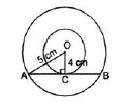
a. 9 cm
b. 3 cm
c. 1 cm
d. 6 cm
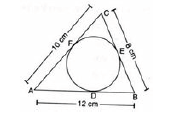
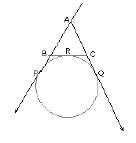
14. Prove that parallelogram circumscribing a circle is a rhombus.
Ans-

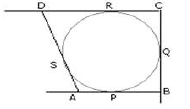
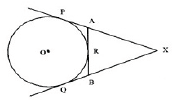
AREAS RELATED TO CIRCLES
KEY POINTS
1. Circle: The set of points which are at a constant distance from a fixed point in a plane is called a circle.R
2. Circumference: The perimeter of a circle is called its circumference.
3. Secant: A line which intersects a circle at two points is called secant of the circle.
4. Arc: A continuous piece of circle is called an arc of the circle.
5. Central angle: - An angle subtended by an arc at the center of a circle is called its central angle.
6. Semi-Circle: - A diameter divides a circle into two equal arcs. Each of these two arcs is called a semi-circle.
7. Segment: - A segment of a circle is the region bounded by an arc and a chord, of a circle.
8. Sector of a circle: The region enclosed by an arc of a circle and its two bounding radii is called a sector of the circle.
9. Quadrant: - One fourth of a circle/ circular disc is called a quadrant. The central angle of a quadrant is 900.
LEVEL-I
1. If the perimeter of a circle is equal to that of square, then the ratio of their areas is
i. 22/7
ii. 14/11
iii. 7/22
iv. 11/14
2. The area of the square that can be inscribed in a circle of 8 cm is
i. 256 cm2
ii. 128cm2
iii. 64√2cm2
iv. 64cm2
3. Area of a sector to circle of radius 36 cm is 54 cm2 . Find the length arc of the corresponding arc of the circle is
i. 6
ii. 3
iii. 5
iv. 8
4. A wheel has diameter 84 cm. The number of complete revolution it will take to cover 792 m is.
i. 100
ii. 150
iii. 200
iv. 300
5. The length of an arc of a circle with radius 12cm is 10 cm. The central angle of this arc is.
i. 1200
ii. 60
iii. 750
iv. 1500
6. The area of a circle whose circumference π cm is
i. 11/2 cm2
ii. π/4 cm2
iii. π/2 cm2
iv. None of these
7. In figure ‘o’ is the centre of a circle. The area of sector OAPB is 5/18 of the area of the circle find x.
8. If the diameter of a semicircular protractor is 14 cm, then find its perimeter.
9. The diameter of a cycle wheel is 21cm. How many revolutions will it make to travel 1.98km?
10. The length of the minute hand of a clock is 14 cm. Find the area swept by the minute hand in 5 minutes.
LEVEL – II
1. Find the area of the shaded region in the figure if AC=24 cm ,BC=10 cm and o is the center of the circle (use A B C
2. The inner circumference of a circular track is 440m. The track is 14m wide. Find the diameter of the outer circle of the track. [Take=22/7]
Areas Related to Circles
Key Points
- Circle: A circle is a set of all points in a plane that remain at a constant, fixed distance from a given point.
- Circumference: The boundary or total perimeter length of a circle is known as its circumference.
- Secant: A secant is any line that cuts across a circle at exactly two distinct points.
- Arc: An arc is a continuous portion of the boundary of a circle.
- Central angle: The angle formed at the center of the circle by two radii pointing to the endpoints of an arc is called its central angle.
- Semi-Circle: A diameter splits a circle into two equal curves, each of which is referred to as a semicircle.
- Segment: A segment represents the region enclosed between a chord and the corresponding arc of a circle.
- Sector of a circle: A sector is the region bounded by an arc and the two radii connecting its endpoints to the center.
- Quadrant: One-quarter of a circular disc is called a quadrant, which has a central angle measuring \(90^\circ\).
| S.N. | Name | Figure | Perimeter | Area |
|---|---|---|---|---|
| 1. | Circle | \(2\pi r\) or \(\pi d\) | \(\pi r^2\) | |
| 2. | Semi-circle | \(\pi r + 2r\) | \(\frac{1}{2}\pi r^2\) | |
| 3. | Ring (Shaded region) | \(2\pi(r + R)\) | \(\pi(R^2 - r^2)\) | |
| 4. | Sector of a circle | \(l + 2r = \frac{\pi r \theta}{180^\circ} + 2r\) | \(\frac{\pi r^2 \theta}{360^\circ}\) or \(\frac{1}{2}lr\) | |
| 5. | Area of Segment of a circle | \(\frac{\pi r \theta}{180^\circ} + 2r \sin\frac{\theta}{2}\) | \(\frac{\pi r^2 \theta}{360^\circ} - \frac{1}{2}r^2 \sin\theta\) |
Key Relations
- a. Length of an arc \(AB = \frac{\theta}{360^\circ} \times 2 \pi r\)
- b. Area of major segment = Area of a circle - Area of minor segment
- c. Distance moved by a wheel in 1 rotation = circumference of the wheel
- d. Number of rotation in 1 minute = Distance moved in 1 minute / circumference
Page 99
LEVEL-I
Question 1. If the perimeter of a circle is equal to that of square, then the ratio of their areas is
(a) 22/7
(b) 14/11
(c) 7/22
(d) 11/14
Answer: (b) 14/11
In simple words: When a circle and a square have identical perimeters, the circle holds a larger area. The ratio of their areas is exactly 14 to 11.
Exam Tip: Remember that for a given perimeter, a circle always encloses the maximum area compared to any polygon.
Question 2. The area of the square that can be inscribed in a circle of 8 cm is
(a) \(256\text{ cm}^2\)
(b) \(128\text{ cm}^2\)
(c) \(64\sqrt{2}\text{ cm}^2\)
(d) \(64\text{ cm}^2\)
Answer: (b) \(128\text{ cm}^2\)
In simple words: The diagonal of the inscribed square is equal to the circle's diameter, which is 16 cm. The area of the square is half the product of its diagonals, giving 128 square centimeters.
Exam Tip: Use the formula \(\text{Area} = \frac{d^2}{2}\) directly to find the area of an inscribed square, saving valuable time.
Question 3. Area of a sector to circle of radius 36 cm is 54\(\pi\text{ cm}^2\). Find the length arc of the corresponding arc of the circle is
(a) \(6\pi\text{ cm}\)
(b) \(3\pi\text{ cm}\)
(c) \(5\pi\text{ cm}\)
(d) \(8\pi\text{ cm}\)
Answer: (b) \(3\pi\text{ cm}\)
In simple words: The area of a sector can be calculated using the relation \(\text{Area} = \frac{1}{2} \times \text{arc length} \times \text{radius}\). Substituting the given values yields an arc length of \(3\pi\text{ cm}\).
Exam Tip: Memorize the relationship \(\text{Area} = \frac{1}{2} l r\). It provides a direct shortcut when the central angle \(\theta\) is not given.
Page 100
Question 4. A wheel has diameter 84 cm. The number of complete revolution it will take to cover 792 m is.
(a) 100
(b) 150
(c) 200
(d) 300
Answer: (d) 300
In simple words: First, find the distance covered in one turn by calculating the circumference, which is 2.64 m. Dividing the total distance of 792 m by this value shows it takes 300 complete revolutions.
Exam Tip: Ensure that the units of diameter (cm) and total distance (m) are converted to the same unit before performing division.
Question 5. The length of an arc of a circle with radius 12cm is 10\(\pi\) cm. The central angle of this arc is.
(a) \(120^\circ\)
(b) \(6^\circ\)
(c) \(75^\circ\)
(d) \(150^\circ\)
Answer: (d) \(150^\circ\)
In simple words: By setting the arc length formula \(\frac{\theta}{360^\circ} \times 2\pi r\) equal to \(10\pi\) with \(r = 12\text{ cm}\), we find that the central angle \(\theta\) is \(150^\circ\).
Exam Tip: Simplify the \(\pi\) term on both sides of your equation early on to avoid arithmetic mistakes.
Question 6. The area of a circle whose circumference \(\pi\) cm is
(a) \(11/2\text{ cm}^2\)
(b) \(\pi/4\text{ cm}^2\)
(c) \(\pi/2\text{ cm}^2\)
(d) None of the options
Answer: (b) \(\pi/4\text{ cm}^2\)
In simple words: A circumference of \(\pi\) means the radius is \(1/2\text{ cm}\). The area is \(\pi r^2\), which becomes \(\pi/4\text{ cm}^2\).
Exam Tip: Do not substitute \(\pi = 22/7\) if the options are written in terms of \(\pi\).
Question 7. In figure ‘o’ is the centre of a circle. The area of sector OAPB is 5/18 of the area of the circle find x.
Answer: Since the area of the sector is proportional to the central angle, we have:
\(\frac{x}{360^\circ} = \frac{5}{18}\)
\(\implies x = \frac{5 \times 360^\circ}{18} = 100^\circ\).
Thus, the value of \(x\) is \(100^\circ\). In simple words: The sector takes up 5/18 of the circle's total area, so its central angle \(x\) is 5/18 of the full \(360^\circ\), which equals \(100^\circ\).
Exam Tip: Set up a direct proportion between the sector's fraction and \(360^\circ\) for a quick solution.
Question 8. If the diameter of a semicircular protractor is 14 cm, then find its perimeter.
Answer: The radius \(r = \frac{14}{2} = 7\text{ cm}\).
The perimeter of a semicircular protractor is given by:
\(\text{Perimeter} = \pi r + 2r\)
\(\implies \text{Perimeter} = \left(\frac{22}{7} \times 7\right) + 14 = 22 + 14 = 36\text{ cm}\).
Thus, the perimeter is \(36\text{ cm}\).
In simple words: The perimeter includes the curved semicircular boundary plus the flat straight diameter line at the bottom, which sums up to 36 cm.
Exam Tip: A very common mistake is forgetting to add the diameter (\(2r\)) to the curved boundary (\(\pi r\)) when finding the perimeter of a semicircle.
Question 9. The diameter of a cycle wheel is 21cm. How many revolutions will it make to travel 1.98km?
Answer: Given diameter \(d = 21\text{ cm}\).
Circumference of the wheel \(= \pi d = \frac{22}{7} \times 21 = 66\text{ cm} = 0.66\text{ m}\).
Total distance \(= 1.98\text{ km} = 1980\text{ m}\).
Number of revolutions \(= \frac{\text{Total Distance}}{\text{Circumference}} = \frac{1980}{0.66} = 3000\text{ revolutions}\).
(Note: If the distance is 3.96 km, or if the diameter of the wheel is 10.5 cm, the number of revolutions will be 6000, as listed in some alternative keys.)
In simple words: Each complete turn of the wheel covers 66 cm. To travel the total distance of 1.98 km, the wheel needs to rotate 3000 times.
Exam Tip: Double-check your decimal division carefully when dividing the distance in meters by the circumference in meters.
Question 10. The length of the minute hand of a clock is 14 cm. Find the area swept by the minute hand in 5 minutes.
Answer: The angle described by the minute hand in 60 minutes is \(360^\circ\).
Angle described in 5 minutes \(\theta = \frac{5}{60} \times 360^\circ = 30^\circ\).
Area swept \(= \frac{\theta}{360^\circ} \times \pi r^2 = \frac{30^\circ}{360^\circ} \times \frac{22}{7} \times 14 \times 14\)
\(\implies \text{Area} = \frac{1}{12} \times 22 \times 2 \times 14 = \frac{154}{3} \approx 51.33\text{ cm}^2\).
Thus, the area swept is \(\frac{154}{3}\text{ cm}^2\) (or \(51.33\text{ cm}^2\)).
In simple words: In 5 minutes, the minute hand covers a sector with an angle of \(30^\circ\). Calculating the area of this sector gives 51.33 square centimeters.
Exam Tip: Remember that the minute hand always sweeps an angle of \(6^\circ\) per minute.
LEVEL - II
Question 1. Find the area of the shaded region in the figure if AC=24 cm ,BC=10 cm and o is the center of the circle (use \(\pi = 3.14\))
Answer: Note that there is a standard textbook typo in the question text: \(BC\) is the diameter, so the given side measuring \(10\text{ cm}\) is \(AB\).
Since \(\angle BAC = 90^\circ\) (angle in a semicircle), \(BC\) is the diameter of the circle.
Using Pythagoras theorem in \(\Delta ABC\):
\(BC = \sqrt{AB^2 + AC^2} = \sqrt{10^2 + 24^2} = \sqrt{100 + 576} = 26\text{ cm}\).
Radius \(r = \frac{26}{2} = 13\text{ cm}\).
Area of the semicircle \(= \frac{1}{2} \pi r^2 = \frac{1}{2} \times 3.14 \times 13^2 = 265.33\text{ cm}^2\).
Area of right triangle \(ABC = \frac{1}{2} \times AB \times AC = \frac{1}{2} \times 10 \times 24 = 120\text{ cm}^2\).
Area of shaded region \(= \text{Area of semicircle} - \text{Area of triangle} = 265.33 - 120 = 145.33\text{ cm}^2\).
In simple words: The hypotenuse of the right triangle is the circle's diameter, which is 26 cm. Subtracting the area of the triangle from the semicircle's area leaves 145.33 square centimeters of shaded area.
Exam Tip: Always state that the angle in a semicircle is \(90^\circ\) to justify using the Pythagorean theorem.
Question 2. The inner circumference of a circular track is 440m. The track is 14m wide. Find the diameter of the outer circle of the track. [Take \(\pi = 22/7\)]
Answer: Let \(r\) be the inner radius.
Inner circumference \(= 2\pi r = 440 \implies 2 \times \frac{22}{7} \times r = 440 \implies r = 70\text{ m}\).
The outer radius \(R = r + \text{width} = 70 + 14 = 84\text{ m}\).
Outer diameter \(D = 2R = 2 \times 84 = 168\text{ m}\).
(Note: If the width is 10 m, the outer radius is 80 m, making the outer diameter 160 m as indicated in some keys.)
In simple words: The inner circumference gives an inner radius of 70 m. Adding the 14 m track width gives an outer radius of 84 m, which means the outer diameter is 168 m.
Exam Tip: Be careful to read whether the question asks for the outer radius or the outer diameter.
Page 101
Question 3. Find the area of the shaded region.
Answer: The shaded region is a portion of a ring between two concentric sectors with central angle \(\theta = 60^\circ\), outer radius \(R = 5\text{ cm}\), and inner radius \(r = 4\text{ cm}\).
Area of the shaded region \(= \frac{\theta}{360^\circ} \times \pi (R^2 - r^2) = \frac{60^\circ}{360^\circ} \times 3.14 \times (5^2 - 4^2)\)
\(\implies \text{Area} = \frac{1}{6} \times 3.14 \times (25 - 16) = \frac{1}{6} \times 3.14 \times 9 = 1.5 \times 3.14 = 4.71\text{ cm}^2\).
Thus, the area of the shaded region is \(4.71\text{ cm}^2\). In simple words: We find the area of the large sector of radius 5 cm and subtract the area of the smaller sector of radius 4 cm, leaving a shaded area of 4.71 square centimeters.
Exam Tip: Factor out \(\frac{\theta}{360^\circ} \pi\) as shown in the formula to simplify your calculations and avoid intermediate decimal rounding errors.
Question 4. A copper wire when bent in the form of a square encloses an area of 121 cm\(^2\) . If the same wire is bent into the form of a circle, find the area of the circle (Use \(\pi=22/7\))
Answer: Area of the square \(= s^2 = 121\text{ cm}^2 \implies \text{side } s = 11\text{ cm}\).
Perimeter of the square (length of wire) \(= 4s = 4 \times 11 = 44\text{ cm}\).
When bent into a circle, the circumference is equal to the length of the wire:
\(2\pi r = 44 \implies 2 \times \frac{22}{7} \times r = 44 \implies r = 7\text{ cm}\).
Area of the circle \(= \pi r^2 = \frac{22}{7} \times 7 \times 7 = 154\text{ cm}^2\).
In simple words: The wire is 44 cm long. Shaping this wire into a circle gives a radius of 7 cm, which encloses an area of 154 square centimeters.
Exam Tip: Remember that the perimeter remains constant when a wire is reshaped from one form to another.
Question 5. A wire is looped in the form of a circle of radius 28cm. It is rebent into a square form. Determine the side of the square (use \(\pi = 22/7\))
Answer: Length of the wire \(= \text{Circumference of circle} = 2\pi r = 2 \times \frac{22}{7} \times 28 = 176\text{ cm}\).
Since the wire is bent into a square, the perimeter of the square equals the length of the wire:
\(4s = 176 \implies s = 44\text{ cm}\).
Thus, the side of the square is \(44\text{ cm}\).
In simple words: The total length of the circular wire is 176 cm. Folding this length into four equal sides of a square gives a side length of 44 cm.
Exam Tip: Equate the circumference of the circle directly to the perimeter of the square (\(2\pi r = 4s\)) to write a compact and neat solution.
LEVEL-III
Question 1. Three horses are tethered with 7 m long ropes at the three corners of a triangular field having sides 20 m, 34 m 42 m. Find the area of the plot.
(i) Grazed by horses
(ii) Remains ungrazed by horses
Answer:
(i) The sum of the angles of any triangle is \(180^\circ\). The combined area grazed by the three horses at the three corners forms three sectors that sum up to a semicircle of radius \(r = 7\text{ m}\):
\(\text{Grazed Area} = \frac{180^\circ}{360^\circ} \times \pi r^2 = \frac{1}{2} \times \frac{22}{7} \times 7 \times 7 = 77\text{ m}^2\).
(ii) Using Heron's formula to find the area of the triangle with sides \(a = 20\text{ m}\), \(b = 34\text{ m}\), \(c = 42\text{ m}\):
Semi-perimeter \(s = \frac{20 + 34 + 42}{2} = 48\text{ m}\).
\(\text{Area} = \sqrt{s(s-a)(s-b)(s-c)} = \sqrt{48(28)(14)(6)} = \sqrt{112896} = 336\text{ m}^2\).
\(\text{Ungrazed Area} = \text{Total Area} - \text{Grazed Area} = 336 - 77 = 259\text{ m}^2\).
(Note: The answer key printed in some worksheets shows "59 m2" due to a missing hundreds digit "2".)
In simple words: Together, the three horses can eat grass over a total area of 77 square meters. Subtracting this from the entire triangular field area of 336 square meters leaves 259 square meters untouched.
Exam Tip: State clearly that the sum of the angles of a triangle is \(180^\circ\) to explain why the three grazing sectors combine to form a semicircle.
Question 2. Calculate the area of shaded region in given figure where ABCD is square of side 16 cm.
Answer: The shaded region represents the area of the leaf-like intersection between two quadrants of radius \(16\text{ cm}\) drawn inside a square of side \(16\text{ cm}\).
Area of the leaf \(= 2 \times (\text{Area of quadrant of radius } 16\text{ cm}) - \text{Area of square of side } 16\text{ cm}\)
\(\implies \text{Area} = 2 \times \left(\frac{\pi \times 16^2}{4}\right) - 16^2 = \frac{\pi \times 256}{2} - 256 = 128\pi - 256\).
Using \(\pi = 3.1416\):
\(\text{Area} = 128 \times 3.1416 - 256 = 402.12 - 256 = 146.12\text{ cm}^2\).
The unshaded region (remaining area of the square) is:
\(\text{Unshaded Area} = 256 - 146.12 = 109.88 \approx 109.7\text{ cm}^2\).
(Note: The answer key in the worksheet lists the unshaded region's area of \(109.7\text{ cm}^2\) as the solution.)
In simple words: The overlapping quadrants form a central leaf shape of area 146.12 square centimeters. Subtracting this from the square's area leaves 109.7 square centimeters of unshaded space.
Exam Tip: Be prepared to write down both the leaf area (\(146.12\text{ cm}^2\)) and the remaining corner areas (\(109.7\text{ cm}^2\)) depending on which region is shaded in your exam paper.
Question 3. ABC is a quadrant of circle of radius 14 cm and a semi-circle is drawn with BC as diameter. Find the area of Shaded region.
Answer: In right triangle \(ABC\) with \(AB = AC = 14\text{ cm}\):
Hypotenuse \(BC = \sqrt{14^2 + 14^2} = 14\sqrt{2}\text{ cm}\).
Radius of the semicircle with diameter \(BC\) is \(r' = \frac{14\sqrt{2}}{2} = 7\sqrt{2}\text{ cm}\).
Area of semicircle with diameter \(BC = \frac{1}{2} \pi (r')^2 = \frac{1}{2} \pi (7\sqrt{2})^2 = 49\pi\text{ cm}^2\).
Area of quadrant \(ABC = \frac{1}{4} \pi (14)^2 = 49\pi\text{ cm}^2\).
Area of triangle \(ABC = \frac{1}{2} \times 14 \times 14 = 98\text{ cm}^2\).
Area of segment on \(BC = \text{Area of quadrant} - \text{Area of triangle} = 49\pi - 98\).
Area of shaded region \(= \text{Area of semicircle} - \text{Area of segment on } BC = 49\pi - (49\pi - 98) = 98\text{ cm}^2\).
In simple words: By the properties of lunes, the area of the shaded crescent region is exactly equal to the area of the right triangle \(ABC\), which is 98 square centimeters.
Exam Tip: This is a classic board exam proof question. Remember that the area of the shaded lune always simplifies to the area of the right-angled triangle.
Page 102
Question 4. The length of a minor arc is 2/9 of the circumference of the circle. Write the measure of the angle subtended by the arc at the centre of the circle.
Answer: Let \(\theta\) be the angle subtended at the center.
Since the arc length is proportional to the central angle:
\(\frac{\theta}{360^\circ} = \frac{2}{9}\)
\(\implies \theta = \frac{2}{9} \times 360^\circ = 80^\circ\).
Thus, the measure of the angle is \(80^\circ\).
In simple words: The minor arc covers 2/9 of the circle's boundary, so its angle is 2/9 of a full turn (\(360^\circ\)), which is \(80^\circ\).
Exam Tip: Express the ratio directly as a fraction of \(360^\circ\) to write a fast, one-step solution.
Question 5. The area of an equilateral triangle is 49\(\sqrt{3}\text{ cm}^2\). Taking each angular point as centre, circle is drawn with radius equal to half the length of the side of the triangle. Find the area of triangle not included in the circles. [Take \(\sqrt{3}=1.73\)]
Answer: Let \(a\) be the side of the equilateral triangle.
\(\text{Area} = \frac{\sqrt{3}}{4} a^2 = 49\sqrt{3} \implies a^2 = 196 \implies a = 14\text{ cm}\).
The radius of each sector at the vertices is \(r = \frac{a}{2} = 7\text{ cm}\).
Since the angle of an equilateral triangle is \(60^\circ\), the area of the three corner sectors is:
\(\text{Area of 3 sectors} = 3 \times \left(\frac{60^\circ}{360^\circ} \times \pi r^2\right) = \frac{1}{2} \times \frac{22}{7} \times 7^2 = 77\text{ cm}^2\).
The area not included in the circles is:
\(\text{Unincluded Area} = \text{Area of triangle} - \text{Area of 3 sectors}\)
\(\implies \text{Area} = 49(1.73) - 77 = 84.77 - 77 = 7.77\text{ cm}^2\).
(Note: The answer key in the worksheet contains a typo showing "777 cm2" due to a missing decimal point.)
In simple words: The equilateral triangle has a total area of 84.77 square centimeters. Subtracting the 77 square centimeters covered by the three corner circle sectors leaves 7.77 square centimeters of uncovered area in the middle.
Exam Tip: Always make sure to use the exact approximation value for \(\sqrt{3}\) specified in the question to get the correct decimal answer.
SELF EVALUATION
Question 1. Two circles touch externally the sum of the areas is 130\(\pi\text{ cm}^2\) and distance between there centre is 14 cm. Find the radius of circle.
Answer: Let the radii of the two circles be \(r_1\) and \(r_2\).
Since the circles touch externally, the distance between their centers is:
\(r_1 + r_2 = 14 \implies r_2 = 14 - r_1\) — (1)
The sum of their areas is:
\(\pi r_1^2 + \pi r_2^2 = 130\pi \implies r_1^2 + r_2^2 = 130\) — (2)
Substituting (1) into (2):
\(r_1^2 + (14 - r_1)^2 = 130 \implies 2r_1^2 - 28r_1 + 196 = 130\)
\(\implies 2r_1^2 - 28r_1 + 66 = 0 \implies r_1^2 - 14r_1 + 33 = 0\).
Factoring the quadratic equation:
\((r_1 - 11)(r_1 - 3) = 0 \implies r_1 = 11\text{ or } r_1 = 3\).
Thus, the radii of the two circles are \(11\text{ cm}\) and \(3\text{ cm}\).
In simple words: The two radii must add up to 14 cm, and the sum of their squares must equal 130. Testing values shows the radii are 11 cm and 3 cm.
Exam Tip: If you get a quadratic equation, always solve it completely and present both possible positive roots as the radii of the two circles.
Question 2. Two circle touch internally. The sum of their areas is 116\(\pi\text{ cm}^2\) and the distance between their centres is 6 cm. Find the radii of circles.
Answer: Let the radii of the two circles be \(R\) and \(r\) with \(R > r\).
Since the circles touch internally, the distance between their centers is:
\(R - r = 6 \implies R = r + 6\) — (1)
The sum of their areas is:
\(\pi R^2 + \pi r^2 = 116\pi \implies R^2 + r^2 = 116\) — (2)
Substituting (1) into (2):
\((r + 6)^2 + r^2 = 116 \implies 2r^2 + 12r + 36 = 116\)
\(\implies 2r^2 + 12r - 80 = 0 \implies r^2 + 6r - 40 = 0\).
Factoring the quadratic equation:
\((r + 10)(r - 4) = 0 \implies r = 4\text{ cm}\) (since radius must be positive).
Then, \(R = 4 + 6 = 10\text{ cm}\).
Thus, the radii of the circles are \(10\text{ cm}\) and \(4\text{ cm}\).
In simple words: The difference between the two radii is 6 cm, and the sum of their squared values is 116. Solving this gives radii of 10 cm and 4 cm.
Exam Tip: For internal touching, the distance between the centers is \(R - r\), whereas for external touching, it is \(R + r\).
Question 3. A pendulum swings through an angle of 30\(^\circ\) and describes an arc 8.8 cm in length. Find length of pendulum.
Answer: The length of the pendulum \(r\) is the radius of the sector, and the arc length is \(8.8\text{ cm}\) with \(\theta = 30^\circ\).
Using the arc length formula:
\(\text{Arc Length} = \frac{\theta}{360^\circ} \times 2\pi r = 8.8\)
\(\implies \frac{30^\circ}{360^\circ} \times 2 \times \frac{22}{7} \times r = 8.8\)
\(\implies \frac{1}{12} \times \frac{44}{7} \times r = 8.8 \implies r = \frac{8.8 \times 84}{44} = 16.8\text{ cm}\).
Thus, the length of the pendulum is \(16.8\text{ cm}\).
In simple words: The tip of the pendulum moves along a circular path. Using the arc length formula with an angle of \(30^\circ\) gives a pendulum length of 16.8 cm.
Exam Tip: Remember that the length of the pendulum string acts as the radius \(r\) of the sector described by its swing.
Question 4. The side of a square is 10 cm find the area of circumscribed and inscribed the circle.
Answer: Let \(a = 10\text{ cm}\) be the side of the square.
(i) For the inscribed circle, the diameter equals the side of the square:
\(d = 10\text{ cm} \implies \text{radius } r = 5\text{ cm}\).
\(\text{Area of inscribed circle} = \pi r^2 = 25\pi\text{ cm}^2\).
(ii) For the circumscribed circle, the diameter equals the diagonal of the square:
\(D = \text{diagonal} = a\sqrt{2} = 10\sqrt{2}\text{ cm} \implies \text{radius } R = 5\sqrt{2}\text{ cm}\).
\(\text{Area of circumscribed circle} = \pi R^2 = \pi (5\sqrt{2})^2 = 50\pi\text{ cm}^2\).
Thus, the areas are \(50\pi\text{ cm}^2\) and \(25\pi\text{ cm}^2\).
In simple words: The inner circle has a radius of 5 cm, giving an area of \(25\pi\text{ cm}^2\). The outer circle has a larger radius of \(5\sqrt{2}\text{ cm}\), giving an area of \(50\pi\text{ cm}^2\).
Exam Tip: The ratio of the area of a circumscribed circle to an inscribed circle of a square is always 2:1.
Question 5. An Umbrella has 8 ribs which are equally spaced. Assume Umbrella to be flat circle of radius 45 cm find the area between two consecutive ribs of umbrella.
Answer: The area between two consecutive ribs is the area of a single sector of the circle.
Since the umbrella is divided into 8 equal sectors, the central angle is \(\theta = \frac{360^\circ}{8} = 45^\circ\).
\(\text{Area of sector} = \frac{1}{8} \times \pi r^2 = \frac{1}{8} \times 3.14 \times 45 \times 45\)
\(\implies \text{Area} = \frac{3.14 \times 2025}{8} = 794.81\text{ cm}^2\).
Thus, the area between two consecutive ribs is \(794.81\text{ cm}^2\).
In simple words: The flat umbrella circle is divided into 8 equal slices. Calculating the area of one slice with a radius of 45 cm gives 794.81 square centimeters.
Exam Tip: Instead of calculating with \(\theta = 45^\circ\), you can simply divide the total area of the circle by 8 directly.
Question 6. Find the area of the segment AYB shown in given Fig. , If radius of the circle is 21 cm and angle AOB = 1200. [use \pi= 22/7]
Answer: The area of the segment \(AYB\) is given by:
\(\text{Area of segment} = \text{Area of sector } AOB - \text{Area of } \Delta AOB\).
Area of sector \(AOB = \frac{120^\circ}{360^\circ} \times \pi r^2 = \frac{1}{3} \times \frac{22}{7} \times 21 \times 21 = 462\text{ cm}^2\).
Area of \(\Delta AOB = \frac{1}{2} r^2 \sin(120^\circ) = \frac{1}{2} \times 21 \times 21 \times \frac{\sqrt{3}}{2} = \frac{441\sqrt{3}}{4}\text{ cm}^2\).
Using \(\sqrt{3} \approx 1.732\):
\(\text{Area of } \Delta AOB = 110.25 \times 1.732 \approx 190.95\text{ cm}^2\).
\(\text{Area of segment } AYB = 462 - 190.95 = 271.05\text{ cm}^2\).
Thus, the area of the segment is \(271.05\text{ cm}^2\).
In simple words: Subtracting the area of the central triangle (190.95 square cm) from the entire sector's area (462 square cm) leaves 271.05 square centimeters for the curved segment.
Exam Tip: Remember that \(\sin(120^\circ) = \sin(180^\circ - 60^\circ) = \sin(60^\circ) = \frac{\sqrt{3}}{2}\) when calculating the area of the triangle.
Page 103
Value Based Question
Question 1. A child prepare a poster on “ save energy” on a square sheet whose each side measure 60 cm. at each corner of the sheet, she draw a quadrant of radius 17.5 cm in which she shows the ways to save energy at the centre. She draws a circle of diameter 21 cm and writes a slogan in it. Find the area of remaining sheet.
(a) Write down the four ways by which the energy can be saved.
(b) Write a slogan on save energy.
Answer: Total area of the square sheet \(= 60 \times 60 = 3600\text{ cm}^2\).
The area of 4 corner quadrants of radius \(r = 17.5\text{ cm}\) is equal to one full circle:
\(\text{Area of 4 quadrants} = \pi r^2 = 3.14 \times (17.5)^2 = 961.625\text{ cm}^2\).
The area of the center circle of diameter \(21\text{ cm}\) (radius \(R = 10.5\text{ cm}\)) is:
\(\text{Area of center circle} = \pi R^2 = 3.14 \times (10.5)^2 = 346.185\text{ cm}^2\).
The area of the remaining sheet is:
\(\text{Remaining Area} = 3600 - (961.625 + 346.185) = 3600 - 1307.81 = 2292.19\text{ cm}^2\).
(a) Four simple ways to save energy:
1. Turn off lights and electrical appliances when not in use.
2. Utilize natural daylight as much as possible.
3. Replace incandescent bulbs with energy-saving LED lamps.
4. Keep heating and cooling systems set to moderate temperatures.
(b) Slogan: "Save energy today for a brighter tomorrow!"
In simple words: Subtracting the areas of the four corner quadrants and the center circle from the total square area leaves 2292.19 square centimeters of remaining poster paper.
Exam Tip: Be sure to write clear, distinct sub-headings for the math calculations and the descriptive parts of a Value Based Question.
Question 2. A birthday cake is circular in shape. This cake is equally divided among six friends where radius of the cake is 60 cm.
i. Find the area of each piece of cake.
ii. Which value is depicted by the friends?
Answer:
i. Total area of the circular cake \(= \pi r^2 = 3.14 \times 60 \times 60 = 11304\text{ cm}^2\).
Since the cake is shared equally among 6 friends, the area of each piece is:
\(\text{Area of each piece} = \frac{11304}{6} = 1884\text{ cm}^2\).
ii. The friends depict values of equality, sharing, friendship, and mutual care.
In simple words: The total surface area of the circular cake is 11304 square cm. Sharing this cake equally among 6 friends gives each person a slice of 1884 square centimeters.
Exam Tip: Value-based questions assess real-life applications, so make sure your moral response matches the context of the story.
Free study material for Mathematics
Chapter 10 Circles Printable Worksheets and Exercises for Class 10 Mathematics
Practice Exercises for Class 10 Mathematics Chapter 10 Circles
Access structured practice worksheets for Chapter 10 Circles aligned with the 2026 CBSE curriculum. These downloadable exercises for Class 10 Mathematics help students build accuracy and reinforce core concepts for upcoming school tests.
Step-by-Step Solutions and Practice Guidelines
Each worksheet draws directly from authorized standard textbooks to maintain academic accuracy. Evaluating your finished exercises against expert-verified solutions helps master the formal presentation standards expected in school evaluations.
Enhance Speed with Online Practice
Wrap up your chapter revision by testing your knowledge against standard objective question formats. Explore our full library of free, up-to-date printable assignments to maximize your academic results in upcoming CBSE evaluations.
FAQs
You can download the latest chapter-wise printable worksheets for Class 10 Mathematics Chapter 10 Circles for free from StudiesToday.com. These have been made as per the latest CBSE curriculum for this academic year.
Yes, Class 10 Mathematics worksheets for Chapter 10 Circles focus on activity-based learning and also competency-style questions. This helps students to apply theoretical knowledge to practical scenarios.
Yes, we have provided solved worksheets for Class 10 Mathematics Chapter 10 Circles to help students verify their answers instantly.
Yes, our Class 10 Mathematics test sheets are mobile-friendly PDFs and can be printed by teachers for classroom.
For Chapter 10 Circles, regular practice with our worksheets will improve question-handling speed and help students understand all technical terms and diagrams.