

Class 10 Mathematics Practice Sheet: CBSE Class 10 Mathematics Pair Of Linear Equations In 2 Variables Worksheet Set 01
Explore structured practice materials through the CBSE Class 10 Mathematics Pair Of Linear Equations In 2 Variables Worksheet Set 01. Tailored for Class 10 learners, utilizing these Mathematics worksheets ensures thorough preparation and strengthens problem-solving accuracy before final school evaluations.
Download Chapter 03 Pair of Linear Equations in Two Variables Worksheet PDF with Answers
Navigate directly to the solved Mathematics worksheets using the digital viewer below. Each practice set includes detailed step-by-step solutions, allowing students to instantly cross-check their work and identify areas requiring further revision.
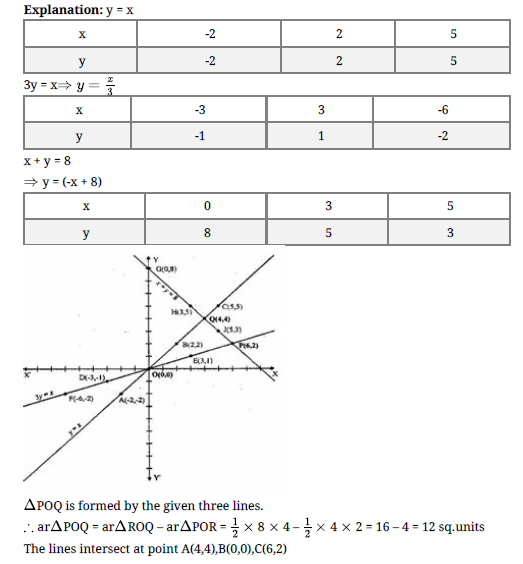
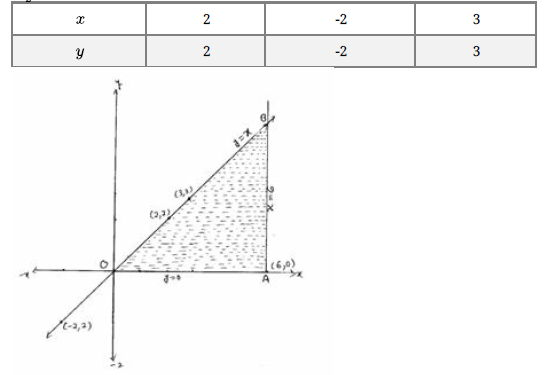
Q.- Determine graphically the co-ordinates of the vertices of the triangle, the equations of whose sides are: y=x,3y=x, x+y=8
Explanation: y = x
Ans- d. intersect only at a point or they coincide with each other
Explanation: A system of two linear equations in two variables is consistent, if their graphs intersect only at a point, because it has a unique solution or they may coincide with each other giving infinite solutions.
LINEAR EQUATIONS IN TWO VARIABLES
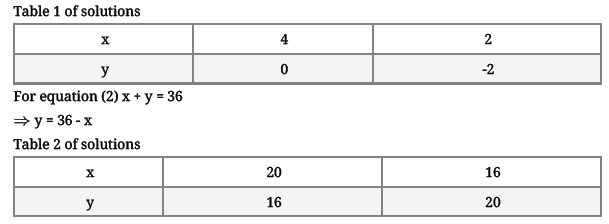
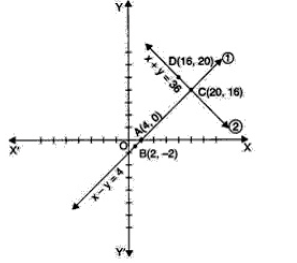
Q.- Half the perimeter of a rectangular garden, whose length is 4 m more than its width, is 36 m. find the dimensions of the garden.

More Question-
1) Find four solutions of the linear equation 5x – 4y = - 8
2) Find two solutions of the linear equation 2(x + 3) – 3(y + 1) = 0
3) Draw the graph of the linear equation 2x + 3y = 12. At what points the graph of the equation Cuts the x axis and the y axis
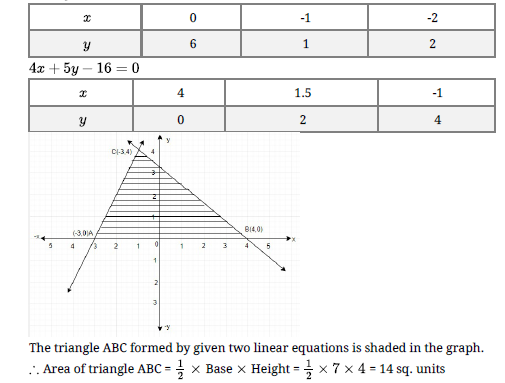
4) Draw the graphs of the equations x + y = 6 and 2x + 3y = 16on the same graph paper. Find the coordinates of the points where the two lines intersect
5) The auto rickshaw fare in a city is charged Rs 10 for the first km and Rs 4 per km for Subsequent distance covered. Write the linear equation to express the above statement Draw the graph of the linear equation
6) Check whether the graph of the linear equation 2x +3y = 12 passes through the point (1, 3)
7) If (2, 5) is a solution of the equation 2x + 3y = m, find the value of m (m= 19)
8) Frame a linear equations in the form ax + by + c = 0 by using the given values of a, b and c
a) a= -2, b =3, c= 4 b) a = 5, b= 0, c= -1
9) Find the value of k, if x = 2, y = 1 is a solution of the equation 2x + 3y = k (k = 7)
10) Give the geometric representation of (A) 3 x + 9 =0 as an equation in (a) one variable
(B) 2x +1= x - 4 (b) Two variable
11) Solve the equation 2x + 1 = x – 3 and represent the solution on the number line
12) Give the equation of two lines passing through (2, 14). How many more such lines are there and Why
13) Solve for x: a) (3 x + 2) / 7 + 4 (x + 1) / 5 = 2/3 (2x + 1) (x=4)
b) 8y + 21/4 = 3y + 7 (y = 7/20)
14) If present ages of son and father are expressed by x and y respectively and after ten years father Will be twice as old as his son. Write the relation between x and y
15) Does point (1, 3) lie on the line 3y = 2x + 8
16) If (2, 3) and (4, 0) lie on the graph of equation ax + by = 1. Find value of a and b.Plot the graph the equation obtained
17) Express the equation y = 2x + 3 in the standard form and find two solutions. Is (2, 3) it’s Solution?
18) Express y in terms of x from the equation 3x + 2y = 8 and check whether the points (4, -2) lies on the line.
19) write each of the following as an equation in two variables (in standard form):
(a) X = - 5 (b) y = 2 (c) 2x = 3 (d) 5y = 2
Pair of Linear Equations in Two Variables
More Question-
1.The solution of the system of equation and is √2x + √5y = 0 and √3x - √7y = 0 is
(A) x = √3, y = √5
(B) x = √2, y = √7
(C) x = 1, y = √2
(D) x = 0, y = 0
2.If a pair of values x, y satisfies an equation, then x and y are called _____ of equation.
3.The ratio between a two-digit number and the sum of digits of that number is 4 : 1. If the digit in the unit place is 3 more than the digit in the tenth place, what is that number ?
(A) 63
(B) 36
(C) 24
(D) None of these.
4.If the ratio of boys to girls in a class is B and the ratio of girls to boys is G, then B + G is
(A) greater than 1 or equal to 1
(B) greater than 1
(C) less than 1
(D) equal to 1
5.The income of P and Q are in the ratio 3 : 2 and expenses are in the ratio of 5 : 3. If both saveRs 200, What is the income of P ?
(A) Rs 700
(B) Rs 1000
(C) Rs 1200
(D) None of these.
6.Which of the following system of equations has no solution?
(A) 3x + y = 2, 9x + 3y = 6
(B) 4x - 7y + 28 = 0, 5y - 7x + 9 = 0
(C) 3x - 5y - 11 = 0, 6x - 10y - 7 = 0
(D) None of these.
7.The LCM of two numbers is 630 and their HCF is 9. If the sum of the numbers is 153, their difference is
(A) 72
(B) 27
(C) 81
(D) 18
8.For the equations 5x - 6y = 2 and 10x = 12y + 7
(A) there is no solution
(B) there exists unique solution
(C) there are two solutions
(D) there are infinite number of solutions.
9. For what value of p does the system of equations 2x - py = 0, 3x + 4y = has nonzero solution?
(A) p = - 6
(B) p = (-8/3)
(C) p = (-2/3)
(D) p = -(3/8)
10.The sum of the digits of a two digits number is 8. If the digits are reversed, the number is decreased by 54. Find the number.
(A) 35
(B) 17
(C) 71
(D) 53.
11.For what value of p will the system of equations 3x + y = 1, (2p - 1)x + (p- 1)y = (2P + 1) has no solution?
(A) p = 2
(B) p ≠ 2
(C) p = - 2
(D) p ≠ - 2
12.For what value of k, the system of equations x + 2y = 3, 5x + ky + 7 = 0 has unique solution?
(A) k = 10
(B) All real values except 10
(C) All natural numbers except 10
(D) None of these.
13.For what value of k, the system of equations kx - y = 2, 6x - 2y = 3 has infinitely many solutions?
(A) k = 3
(B) k ≠ 4
(C) k = 6
(D) Does not exist.
14.For what values of a and b will the equations 2x + 3y = 7, (a - b)x + (a + b)y = (3a + b - 2) represent coincident lines?
(A) a = 5, b = - 1
(B) a = 5, b = 1
(C) a = -5, b = - 1
(D) a = 5, b = - 1
15.Divide 62 into two parts such that fourth part of the first and two-fifth part of the second are in the ratio 2 : 3.
(A) 24, 38
(B) 32, 30
(C) 16, 32
(D) 40, 22
16.37 pens and 53 pencils together cost Rs320, while 53 pens and 37 pencils together cost Rs400. Find the cost of pen and that of a pencil
(A) 6.50, 1.50
(B) 2.50, 1.00
(C) 4.50, 1.50
(D) 6.50, 2.50
17.Solve the following system of linear equation
2(ax - by) + (a + 4b) = 0
2(bx + ay) + (b - 4a) = 0
(A) x = 1, y = 2
(B) x = -1/2, y = 2
(C) x = 1/2 , y = -2
(D) None of these
18.If a1/a2 ≠ b1/b2 then a1x + b1y + c1 = 0 & a2x + b2y + c2 = 0 will represent ______line
19.The solution of the system of equations 2x -3y+4xy = 0 and 6x + 5y - 2xy = 0 is
(A) x = 0, y = 0
(B) x = 1, y = -2
(C) Both 'a' and 'b'
(D) None of these.
20.Which of the following system of equations is consistent?
(A) 3x - y = 1, 6x - 2y = 5
(B) 4x + 6y - 7 = 0, 12x + 18y - 21 = 0
(C) 4x + 7y = 3, 8x + 14 y = 7
(D) 6x + 2y = 3, 5x + 6y = - 2.
21.The coordinates of the point where the line 2(x - 3) = y - 8 meet the x-axis is
(A) (3, 0)
(B) (2, 0)
(C) (-1, 0)
(D) (0, -1)
22.The coordinates of the points where the lines 3x - y = 5, 6x - y = 10 meet the y-axis are
(A) (0, -5), (0, -10)
(B) (-5, 0), (10, 0)
(C) (5, 0), (0, -10)
(D) (0, -5), (0, -10)
23.Which of the following system of equations has infinitely many solutions?
(A) 5x - 4y = 20, 7.5x - 6y = 0
(B) 2x -3y = 5, 3x - 4.5y = 7.5
(C) x + 5y - 3 = 0, 3x + 15y - 9 = 0
(D) All of these.
24.A system of simultaneous linear equation is said to be consistent, if it has __________ solution.
25.If x/b = y/a, bx + ay = a2 + b2, then the values of (x, y) are
(A) (a, b)
(B) (-a, -b)
(C) (b, -a)
(D) (b, a).
26.A system of simultaneous linear equation is said to be ________ if it has no solution.
27.The coordinates of the points where the lines 5x - y = 7, 10x + y = 15 meet the y-axis
(A) (0, -7), (0, 15)
(B) (-7, 0), (15, 0)
(C) (7, 0), (0, -15)
(D) (0, -7), (0, -15)
28.If a1x + b1y + c1 = 0 & a2x +b2y + c2 = 0 then what will be the condition of consistency of infinite many solution ?
29.If a1/a2 = b1/b2 ≠ c1/c2 then what will be the condition of a1x + b1y + c1 = 0 & a2x +b2y + c2 = 0?
30.Sum of two numbers in 48 and their difference is 20. Find the numbers.
31.If the difference of two numbers is 26 and one number is three times the other, find the numbers
32.The sum of two numbers is 128 and their difference is 16. Find the number
(A) 70 , 52
(B) 72, 56
(C) 70 , 56
(D) 72 , 52
33.The solution of the system of equations 2x + 3y + 5 = 0 and 3x - 2y - 12 = 0 is _________
(A) x = - 3, y = - 2
(B) x = 2, y = - 3
(C) x = 3, y = - 2
(D) x = 12, y = 13
34.The solution of the system of equations 2x + 5y / xy = 6 and 4x - 5y / xy + 3 = 0 (where x ≠ 0, y ≠ 0) is
(A) x = 1, y = 2
(B) x = 0, y = 0
(C) x = - 1, y = 2
(D) x = 1, y = -2
35.Solve for x and y :
47x + 31y = 63
31x + 47y = 15
(A) x = -2, y = 1
(B) x = 2, y = -1
(C) x = 2, y = 1
(D) None of these
36.Solve (2u + v) = 7uv
3(u + 3v) = 11uv
(A) u = 0, v = 0
(B) u = 1, v = 3/2
(C) Both of these
(D) None of these
37.Solve:
x + 2y + z = 7
x + 3z = 11
2x - 3y = 1
(A) x = 1, y = 2, z = -1
(B) x = 2, y = 1,z = 3
(C) x = -1, y = -2, z = 1
(D) x = 3, y = 1, z= - 2
38.Solve x + y + 2z = 9
2x - y + 2z = 6
3x + y + 4z = 17
(A) x = 0,y = 1,z = 2
(B) x = -1,y = -2,z = -3
(C) x =1,y= 2, z = 3
(D) None of these
39.For what value of k, will the following system of equations x + 2y + 7 = 0, 2x + ky + 14 = 0 represent coincident lines
(A) 2
(B) 3
(C) 4
(D) 5
40.Solve: 4x + 6/y = 15
6x - 8/y = 14 and hence, find 'p' if y = px - 2.
(A) 3/4
(B) 1
(C) 0
(D) 4/3
41.Show that the following system of equations has unique.solution
2x - 3y = 6
x + y = 1
(A) Unique solution
(B) No solution
(C) Infinite
(D) None of these
42.For what value of k the following system of equations has a unique solution:
x - ky = 2
3x + 2y = -5
(A) k ≠ -2/5
(B) k ≠ -1/3
(C) k ≠ -2/3
(D) None of these
43.Solve 2x + 3y = 11 and 2x - 4y = -24 and hence find the value of 'm' for which y = mx + 3
(A) 1
(B) 2
(C) -2
(D) -1
44.The coordinates of the point where the line 5(x - 4) = 2y - 25 meet the x-axis
(A) (4, 0)
(B) (5, 0)
(C) (-1, 0)
(D) (0, -1)
45.The taxi charges in a city comprise of a fixed charge together with the charge for the distance covered. For a journey of 10 km the charge paid is Rs75 and for a journey of 15 km the charge paid is Rs110.What will a person have to pay for traveling a distance of 25 km.
(A) 220
(B) 240
(C) 200
(D) 180
46.Solve the following system by the method of elimination( substitution)
2x - y = 5
3x + 2y = 5
(A) x = 2, y = 1
(B) x = 1, y = 1
(C) x = 3, y = 1
(D) None of these
47.What number must be added to each of the number 5,9,17,27 to make the numbers in proportion?
(A) 4
(B) 5
(C) 6
(D) 3
48.The difference between two numbers is 26 and one number isthree times the other. Find them.
(A) 30, 13
(B) 35, 12
(C) 39, 31
(D) 39, 13
49.Find the value of k for which the following syatem of equation has no solutions:
2x + ky = 1; 3x - 5y = 7
(A) 0
(B) 10/3
(C) -(10/3)
(D) 1
50.For what value of k the following equations are inconsistent?
x - 4y = 6, 3x + ky = 5
(A)10
(B)12
(C)-12
(D)-10
51.The ratio of two persons is 9:7 and the ratio of their expenditure is 4:3. If each of them saves Rs 200 per month, find their monthly incomes
A) 1000,800
(B) 1800,1400
(C) 1600,1200
(D) 1600,1400
52.Solve the following system of equation by the method of cross-multiplication. 11x + 15y = -23
7x - 2y = 20
(A) x = 2, y = 2
(B) x = 3, y = -3
(C) x = 2, y = -3
(D) None of these
53.Solve the following system of linear equation by using the method of elimination by equating the coefficients.
√3x - √2y = √3
√5x + √3y = √2
(A) x = 5(√10 - 3), y = 5√15 - 8√6
(B) x = 5, y = 5
(C) x = 5(√10+3), y = 5 (√15 + 8 √6)
(D) The given equations are
√3x - √2y = √3
√5x + √3y = √2
54.For what value of p does the system of equations 4x - py = 0, 5x + 6y = 0 has nonzero solution?
(A) p = - 8
(B) p = -24/5
(C) p = -5/6
(D) p = -(3/8)
<3M>
55. (a) Solve:
217x + 131y = 913 =..(i)
131x + 217y = 827 ..(ii)
(b) For what value of the system of Equation
3x + 5y =0
ux + 10y = 0 has unique solution
<6M>
56.The sum of a two - digit number and the number obtained by reversing the digits is 66. If the digits of the number differ by 2, find the number. How many such numbers are there?
57.Solve:
ax + by = a - b
bx - ay = a + b
By cross multiplication method.
58.A man has only 20 paise and 25 paise coins in his purse. If he has 50 coins in all totaling Rs 11.25 How many coins of each does he have?
59.On selling a tea set at 5% loss and a lemon set at 15% gain, a crockery seller gained Rs. 7.0 If he sells the tea set at 5% gain and the lemon set at 10% gain, the gain isRs 13. Find the actual price of the tea set and the lemon set.
60.A boat goes 30km upstream and 44km downstream is 10hrs. In 13 hrs it go 40km upstream and 55 km downstream. Determine the speed of the stream and that of boat in still water.
61. (a) Use elimination method to find all possible solutions of the following pair of equations.
2x + 3y = 8
4x + 6y = 7
(b) Determine the value on of ' u ' so that the following equations have no solutions.
(3u+1) x+3y - 2 = 0
(u2+1) x+(u-2)y - 5 = 0
62.a) The taxi charges in a city comprise of a fixed charge together with the charge for the distance covered. For a journey for 10km the charge paid is Rs 75 and for a journey of 15km the charge paid Rs 110. What will a person have to pay for traveling a distance of 25km.
(b) In ΔABC, ∠C = 3∠B = 2(∠A+∠B) Find the three angles.
63.Solve the given Equation by using the method of substitution.
2x+3y = 9
3x+4y = 5
64. Solve:
1/2x - 1/y = - 1
1/x + 1/2y = 8
65. Solve by cross multiplication, the following system of Equation:
x+y = 7
5x+12y = 7
66. Solve the following system of Equation -
8x - 3y = 5xy
6x - 5y = 2xy
67.a) For what value of 'u' will the following pair of Equation have infinitely many solutions.
ux+3y-(u-3) = 0
12x+uy - u = 0
(b) For what value of p does the pair of Equations given below has uniquesolution?
4x+py+8 = 0
2x+2y+2 = 0
68.A man sold a chair and a table together for Rs 1520 .There is a profit of 25% on the chair and 10% on table. By selling them together for Rs 1535, he could have made a profit of 10% on the chair and 25% on the table. Find the cost price of each.
69.Solve the given Equation by using the method of elimination by the coefficients:
x/10 + y/5 + 1 = 15
x/8 + y/6 = 15
Question 1. Solve graphically the system of linear equations: x + 3y = 11, 3x + 2y = 12
Answer: Let us solve the given system of linear equations:
\( x + 3y = 11 \) - (Equation 1)
\( 3x + 2y = 12 \) - (Equation 2)
From Equation 1, we can express \( x \) in terms of \( y \):
\( x = 11 - 3y \)
Substitute this expression for \( x \) into Equation 2:
\( 3(11 - 3y) + 2y = 12 \)
\( \implies 33 - 9y + 2y = 12 \)
\( \implies 33 - 7y = 12 \)
\( \implies 7y = 21 \)
\( \implies y = 3 \)
Substitute \( y = 3 \) back into the expression for \( x \):
\( x = 11 - 3(3) = 11 - 9 = 2 \)
Thus, the unique solution to the system is \( (2, 3) \). When plotted on a graph, the two lines intersect at the point \( (2, 3) \).
In simple words: Express one variable in terms of the other from the first equation, substitute it into the second, and solve to find the intersection point at \( (2, 3) \).
Exam Tip: For graphical solutions, always find at least three points for each line to ensure your plotted lines are perfectly straight and accurate.
Question 2. Draw the graph of the equation x – y + 1 = 0 and 3x + 2y – 12 = 0. Determine the coordinates of the vertices of the triangle Formed by these lines and the x – axis, and shade the triangular region
Answer: Let us analyze the two lines and find their key intersection points:
Line 1: \( x - y + 1 = 0 \)
To find its x-intercept, substitute \( y = 0 \):
\( x - 0 + 1 = 0 \implies x = -1 \). So, the first vertex is at \( (-1, 0) \).
Line 2: \( 3x + 2y - 12 = 0 \)
To find its x-intercept, substitute \( y = 0 \):
\( 3x + 0 - 12 = 0 \implies 3x = 12 \implies x = 4 \). So, the second vertex is at \( (4, 0) \).
Now, find the intersection of the two lines:
From Line 1, we have \( y = x + 1 \). Substitute this into Line 2:
\( 3x + 2(x + 1) - 12 = 0 \)
\( \implies 3x + 2x + 2 - 12 = 0 \)
\( \implies 5x - 10 = 0 \)
\( \implies x = 2 \)
Substitute \( x = 2 \) into \( y = x + 1 \) to get \( y = 3 \).
Therefore, the lines intersect at the point \( (2, 3) \).
The three vertices of the shaded triangular region formed by these lines and the x-axis are \( (-1, 0) \), \( (2, 3) \), and \( (4, 0) \).
In simple words: Find where each line crosses the horizontal x-axis, then find where the two lines cross each other. These three points make up the corners of the shaded triangle.
Exam Tip: Label the coordinates of all three vertices clearly on your graph sheet to secure full presentation marks.
Question 3. Check graphically whether the pair of linear equations 4x – y – 8 = 0 and 2x – 3y + 6 = 0 is consistent. Also find the vertices of the triangle formed by these lines with the x - axis
Answer: Let us find the points of intersection to determine consistency and locate the vertices of the triangle:
Line 1: \( 4x - y - 8 = 0 \)
To find its x-intercept, substitute \( y = 0 \):
\( 4x - 8 = 0 \implies x = 2 \). This gives the point \( (2, 0) \).
Line 2: \( 2x - 3y + 6 = 0 \)
To find its x-intercept, substitute \( y = 0 \):
\( 2x + 6 = 0 \implies x = -3 \). This gives the point \( (-3, 0) \).
Now, let us find the intersection point of the two lines:
From Line 1, we get \( y = 4x - 8 \). Substitute this into Line 2:
\( 2x - 3(4x - 8) + 6 = 0 \)
\( \implies 2x - 12x + 24 + 6 = 0 \)
\( \implies -10x + 30 = 0 \)
\( \implies x = 3 \)
Substitute \( x = 3 \) to find \( y \):
\( y = 4(3) - 8 = 4 \).
The lines intersect at a unique point \( (3, 4) \). Since they have a unique solution, the system of equations is consistent.
The vertices of the triangle formed by these lines and the x-axis are \( (2, 0) \), \( (-3, 0) \), and \( (3, 4) \).
In simple words: Since the two lines cross at a single point \( (3, 4) \), the system is consistent. The corners of the triangle formed with the x-axis are \( (2, 0) \), \( (-3, 0) \), and \( (3, 4) \).
Exam Tip: A system of linear equations is consistent if it has at least one solution (either a single unique solution or infinitely many solutions).
Question 4. Solve: a) x y / (x + y) = 1/5 , x y / (x - y) = 1/7
Answer: Let us invert both equations to simplify them:
\( \frac{x+y}{xy} = 5 \implies \frac{1}{y} + \frac{1}{x} = 5 \)
\( \frac{x-y}{xy} = 7 \implies \frac{1}{y} - \frac{1}{x} = 7 \)
Let \( u = \frac{1}{x} \) and \( v = \frac{1}{y} \). This gives the linear system:
\( v + u = 5 \) - (Equation 1)
\( v - u = 7 \) - (Equation 2)
Adding Equation 1 and Equation 2:
\( 2v = 12 \implies v = 6 \implies y = \frac{1}{6} \)
Subtracting Equation 2 from Equation 1:
\( 2u = -2 \implies u = -1 \implies x = -1 \)
The solution is \( x = -1 \) and \( y = \frac{1}{6} \).
In simple words: Flipping the fractions lets us split the equations into simpler parts, making it easy to solve for \( x \) and \( y \).
Exam Tip: For equations where variables are in the denominator, always use substitution with variables like \( u \) and \( v \) to linearize them first.
Question 4. Solve: b) 149x – 330y = - 511, - 330x + 149y = - 32
Answer: Since the coefficients are symmetric, let us first add and then subtract the two equations:
Adding the two equations:
\( (149 - 330)x + (-330 + 149)y = -511 - 32 \)
\( \implies -181x - 181y = -543 \)
Divide by \( -181 \):
\( x + y = 3 \) - (Equation A)
Subtracting the second equation from the first:
\( (149 - (-330))x + (-330 - 149)y = -511 - (-32) \)
\( \implies 479x - 479y = -479 \)
Divide by 479:
\( x - y = -1 \) - (Equation B)
Now, solve the simplified system of Equation A and Equation B:
Adding A and B: \( 2x = 2 \implies x = 1 \).
Subtracting B from A: \( 2y = 4 \implies y = 2 \).
The solution is \( x = 1 \) and \( y = 2 \).
In simple words: Adding and subtracting these symmetric equations gives two very simple equations, \( x + y = 3 \) and \( x - y = -1 \), which are quick to solve.
Exam Tip: When coefficients of \( x \) and \( y \) are interchanged in a system, always add and subtract the equations to simplify the system before solving.
Question 4. Solve: c) 37x + 43y = 123, 43x + 37y = 117
Answer: Let us apply the addition and subtraction method for symmetric coefficients:
Adding the two equations:
\( (37 + 43)x + (43 + 37)y = 123 + 117 \)
\( \implies 80x + 80y = 240 \)
Divide by 80:
\( x + y = 3 \) - (Equation A)
Subtracting the second equation from the first:
\( (37 - 43)x + (43 - 37)y = 123 - 117 \)
\( \implies -6x + 6y = 6 \)
Divide by 6:
\( -x + y = 1 \) - (Equation B)
Adding Equation A and Equation B:
\( 2y = 4 \implies y = 2 \)
Substitute \( y = 2 \) into Equation A:
\( x + 2 = 3 \implies x = 1 \)
The solution is \( x = 1 \) and \( y = 2 \).
In simple words: Simplify the symmetric system by adding and subtracting to get \( x+y=3 \) and \( -x+y=1 \), yielding \( x=1 \) and \( y=2 \).
Exam Tip: This shortcut prevents tedious and error-prone multiplications of large numbers like 37 and 43.
Question 4. Solve: d) (a – b) x + (a + b) y = a2 – 2ab – b2 , (a + b) x + (a + b) y = a2 + b2
Answer: Let us subtract the first equation from the second to eliminate the \( y \) term:
\( [(a + b) - (a - b)]x = (a^2 + b^2) - (a^2 - 2ab - b^2) \)
\( \implies (a + b - a + b)x = a^2 + b^2 - a^2 + 2ab + b^2 \)
\( \implies 2bx = 2ab + 2b^2 \)
\( \implies 2bx = 2b(a + b) \)
Divide both sides by \( 2b \) (assuming \( b \neq 0 \)):
\( x = a + b \)
Substitute \( x = a + b \) into the second equation:
\( (a + b)(a + b) + (a + b)y = a^2 + b^2 \)
\( \implies (a + b)^2 + (a + b)y = a^2 + b^2 \)
\( \implies (a + b)y = a^2 + b^2 - (a^2 + 2ab + b^2) \)
\( \implies (a + b)y = -2ab \)
\( \implies y = -\frac{2ab}{a+b} \)
The solution is \( x = a + b \) and \( y = -\frac{2ab}{a+b} \).
In simple words: Subtract the equations to eliminate the \( y \) term and find \( x \). Then substitute \( x \) back to get \( y \).
Exam Tip: Keep your algebraic expansions in brackets to avoid sign mistakes when subtracting long polynomial terms.
Question 4. Solve: e) a x – by = a2 + b2 , x – y = 2b
Answer: From the second equation, express \( x \) in terms of \( y \):
\( x = y + 2b \)
Substitute this expression for \( x \) into the first equation:
\( a(y + 2b) - by = a^2 + b^2 \)
\( \implies ay + 2ab - by = a^2 + b^2 \)
\( \implies (a - b)y = a^2 - 2ab + b^2 \)
\( \implies (a - b)y = (a - b)^2 \)
Divide both sides by \( (a - b) \) (assuming \( a \neq b \)):
\( y = a - b \)
Substitute \( y = a - b \) back into the expression for \( x \):
\( x = (a - b) + 2b = a + b \)
The solution is \( x = a + b \) and \( y = a - b \).
In simple words: Express \( x \) as \( y + 2b \), substitute it into the first equation, and simplify to find \( y = a - b \). Then substitute back to find \( x = a + b \).
Exam Tip: Substitution is highly effective here since the second equation is simple and has coefficients of 1 and -1.
Question 4. Solve: f) ax + by = a – b , bx – ay = a + b
Answer: Let us use the method of elimination. Multiply the first equation by \( a \) and the second equation by \( b \):
\( a^2x + aby = a^2 - ab \) - (Equation 1)
\( b^2x - aby = ab + b^2 \) - (Equation 2)
Adding Equation 1 and Equation 2:
\( (a^2 + b^2)x = a^2 - ab + ab + b^2 \)
\( \implies (a^2 + b^2)x = a^2 + b^2 \)
\( \implies x = 1 \)
Substitute \( x = 1 \) into the first given equation:
\( a(1) + by = a - b \)
\( \implies a + by = a - b \)
\( \implies by = -b \)
\( \implies y = -1 \)
The solution is \( x = 1 \) and \( y = -1 \).
In simple words: Multiply the equations to make the \( y \) coefficients equal and opposite. Add them to get \( x = 1 \), which then gives \( y = -1 \).
Exam Tip: Be careful with signs. In this question, adding the equations naturally cancels the \( ab \) and \( aby \) terms, leaving a clean result.
Question 4. Solve: g) 10 / (x + y) + 2 / (x - y) = 4 , 15 / (x + y) - 5 / (x - y) = - 2
Answer: Let \( u = \frac{1}{x+y} \) and \( v = \frac{1}{x-y} \). The equations become:
\( 10u + 2v = 4 \implies 5u + v = 2 \implies v = 2 - 5u \) - (Equation 1)
\( 15u - 5v = -2 \) - (Equation 2)
Substitute \( v \) from Equation 1 into Equation 2:
\( 15u - 5(2 - 5u) = -2 \)
\( \implies 15u - 10 + 25u = -2 \)
\( \implies 40u = 8 \)
\( \implies u = \frac{1}{5} \)
Substitute \( u = \frac{1}{5} \) into Equation 1 to find \( v \):
\( v = 2 - 5\left(\frac{1}{5}\right) = 1 \)
Now substitute back to find \( x \) and \( y \):
\( x + y = 5 \) - (Equation A)
\( x - y = 1 \) - (Equation B)
Adding A and B: \( 2x = 6 \implies x = 3 \).
Subtracting B from A: \( 2y = 4 \implies y = 2 \).
The solution is \( x = 3 \) and \( y = 2 \).
In simple words: Substitute \( u \) and \( v \) to turn the system into normal linear equations. Find \( u = 1/5 \) and \( v = 1 \), then solve \( x+y=5 \) and \( x-y=1 \).
Exam Tip: Double-check your final \( x \) and \( y \) values by putting them back into the original fraction equations to make sure they balance.
Question 4. Solve: h) x / a + y / b = a + b, x / a^2 + y / b^2 = 2
Answer: Let us express \( \frac{x}{a} \) from the first equation:
\( \frac{x}{a} = a + b - \frac{y}{b} \implies x = a^2 + ab - \frac{ay}{b} \)
Substitute this expression for \( x \) into the second equation:
\( \frac{a^2 + ab - \frac{ay}{b}}{a^2} + \frac{y}{b^2} = 2 \)
\( \implies 1 + \frac{b}{a} - \frac{y}{ab} + \frac{y}{b^2} = 2 \)
\( \implies y\left(\frac{1}{b^2} - \frac{1}{ab}\right) = 1 - \frac{b}{a} \)
\( \implies y\left(\frac{a - b}{ab^2}\right) = \frac{a - b}{a} \)
Dividing both sides by \( \frac{a-b}{a} \) (assuming \( a \neq b \)):
\( \frac{y}{b^2} = 1 \implies y = b^2 \)
Substitute \( y = b^2 \) back to find \( x \):
\( x = a^2 + ab - \frac{a(b^2)}{b} = a^2 + ab - ab = a^2 \)
The solution is \( x = a^2 \) and \( y = b^2 \).
In simple words: Solve by substitution to find that \( x = a^2 \) and \( y = b^2 \). This makes sense because \( a^2/a^2 + b^2/b^2 = 1+1 = 2 \).
Exam Tip: If the coefficients are fractions of \( a \) and \( b \), looking for patterns can help you guess and verify the solution in seconds.
Question 5. Find the value(s) of k for which the pair of linear equations k x + 3y = k – 2 and 12x + k y = k has no solution
Answer: For a pair of linear equations to have no solution, they must represent parallel lines. This occurs when:
\( \frac{a_1}{a_2} = \frac{b_1}{b_2} \neq \frac{c_1}{c_2} \)
Here, the equations are \( kx + 3y - (k - 2) = 0 \) and \( 12x + ky - k = 0 \).
Equating the first two ratios:
\( \frac{k}{12} = \frac{3}{k} \implies k^2 = 36 \implies k = \pm 6 \)
Now let us test both values against the third ratio constraint:
If \( k = 6 \):
\( \frac{a_1}{a_2} = \frac{6}{12} = \frac{1}{2} \)
\( \frac{b_1}{b_2} = \frac{3}{6} = \frac{1}{2} \)
\( \frac{c_1}{c_2} = \frac{6-2}{6} = \frac{4}{6} = \frac{2}{3} \)
Since \( \frac{1}{2} = \frac{1}{2} \neq \frac{2}{3} \), \( k = 6 \) is a valid solution.
If \( k = -6 \):
\( \frac{a_1}{a_2} = \frac{-6}{12} = -\frac{1}{2} \)
\( \frac{b_1}{b_2} = \frac{3}{-6} = -\frac{1}{2} \)
\( \frac{c_1}{c_2} = \frac{-6-2}{-6} = \frac{-8}{-6} = \frac{4}{3} \)
Since \( -\frac{1}{2} = -\frac{1}{2} \neq \frac{4}{3} \), \( k = -6 \) is also a valid solution.
Thus, the values are \( k = \pm 6 \).
In simple words: Solve \( \frac{k}{12} = \frac{3}{k} \) to get \( k = \pm 6 \). Both values work because they make the lines parallel but not identical.
Exam Tip: Always check both positive and negative values of \( k \) against the third ratio to make sure they do not lead to infinitely many solutions.
Question 6. Find the value of k, for which the pair of equations 3x + 5y = 0, k x + 10y = 0, has a non zero solution
Answer: A system of homogeneous linear equations \( a_1x + b_1y = 0 \) and \( a_2x + b_2y = 0 \) always has the trivial solution \( (0, 0) \). For it to have a non-zero (non-trivial) solution, the lines must be coincident:
\( \frac{a_1}{a_2} = \frac{b_1}{b_2} \)
\( \implies \frac{3}{k} = \frac{5}{10} \)
\( \implies \frac{3}{k} = \frac{1}{2} \)
\( \implies k = 6 \)
Thus, the value of \( k \) is 6.
In simple words: For a non-zero solution in homogeneous equations, the ratios of the coefficients must be equal. Setting \( 3/k = 5/10 \) gives \( k = 6 \).
Exam Tip: A homogeneous system of equations only has non-zero solutions when its lines overlap completely.
Question 7. Find the value of a and b for which the system of equation has infinitely many solutions: 2x + 3y = 7, (a – b) x + (a + b) y = 3a + b – 2
Answer: For a system of linear equations to have infinitely many solutions, the lines must be coincident, which requires:
\( \frac{a_1}{a_2} = \frac{b_1}{b_2} = \frac{c_1}{c_2} \)
Substituting the given coefficients:
\( \frac{2}{a - b} = \frac{3}{a + b} = \frac{7}{3a + b - 2} \)
From the first equality:
\( 2(a + b) = 3(a - b) \implies 2a + 2b = 3a - 3b \implies a = 5b \) - (Equation 1)
From the second equality:
\( \frac{3}{a + b} = \frac{7}{3a + b - 2} \)
Substitute \( a = 5b \) into this relation:
\( \frac{3}{5b + b} = \frac{7}{3(5b) + b - 2} \)
\( \implies \frac{3}{6b} = \frac{7}{16b - 2} \)
\( \implies \frac{1}{2b} = \frac{7}{16b - 2} \)
\( \implies 16b - 2 = 14b \)
\( \implies 2b = 2 \implies b = 1 \)
Substitute \( b = 1 \) into Equation 1:
\( a = 5(1) = 5 \)
Thus, \( a = 5 \) and \( b = 1 \).
In simple words: Match the ratios of the coefficients to get \( a = 5b \). Substitute this into the second ratio to find \( b = 1 \) and \( a = 5 \).
Exam Tip: Cross-multiply carefully and simplify fractions early to make solving the system much easier.
Question 8. Find the value of k, for which the given linear pair has a unique solution: 2x + 3y – 5 = 0, k x – 6y - 8 = 0
Answer: For a pair of linear equations to have a unique solution, they must represent intersecting lines. This condition is:
\( \frac{a_1}{a_2} \neq \frac{b_1}{b_2} \)
Substituting the coefficients of the given equations:
\( \frac{2}{k} \neq \frac{3}{-6} \)
\( \implies \frac{2}{k} \neq -\frac{1}{2} \)
\( \implies k \neq -4 \)
Thus, the pair of linear equations has a unique solution for all real values of \( k \) except \( k = -4 \).
In simple words: The lines will intersect at a single point as long as \( k \) is not equal to \( -4 \).
Exam Tip: Write your final answer clearly as "\( k \neq \text{value} \)" to show that all other numbers are acceptable.
Question 9. 10 students of class x took part in mathematics quiz. If the number of girls is 4 more than the number of boys, find the number of boys and number of girls who took part in the quiz.
Answer: Let the number of boys who participated be \( x \) and the number of girls be \( y \).
According to the problem:
Total number of students is 10:
\( x + y = 10 \) - (Equation 1)
The number of girls is 4 more than the number of boys:
\( y = x + 4 \implies -x + y = 4 \) - (Equation 2)
Adding Equation 1 and Equation 2:
\( 2y = 14 \implies y = 7 \)
Substitute \( y = 7 \) into Equation 1:
\( x + 7 = 10 \implies x = 3 \)
Thus, 3 boys and 7 girls took part in the quiz.
In simple words: Since girls plus boys equal 10, and girls are 4 more than boys, solving this system gives 3 boys and 7 girls.
Exam Tip: Always state what your variables \( x \) and \( y \) represent at the beginning of any word problem.
Question 10. The larger of the two supplementary angles exceeds the smaller by 18 degrees. Find the angles
Answer: Let the larger angle be \( x \) degrees and the smaller angle be \( y \) degrees.
Since they are supplementary, their sum is 180 degrees:
\( x + y = 180 \) - (Equation 1)
The larger angle exceeds the smaller by 18 degrees:
\( x - y = 18 \) - (Equation 2)
Adding Equation 1 and Equation 2:
\( 2x = 198 \implies x = 99^\circ \)
Substitute \( x = 99^\circ \) into Equation 1:
\( 99 + y = 180 \implies y = 81^\circ \)
Thus, the two angles are \( 99^\circ \) and \( 81^\circ \).
In simple words: Supplementary angles add up to 180. Since one is 18 degrees larger, the angles are 99 degrees and 81 degrees.
Exam Tip: Remember that supplementary angles sum to 180 degrees, while complementary angles sum to 90 degrees.
Question 11. In a two digit number, the sum of the digits is 9. If the digits are reversed, the number is increased by 9. Find the number
Answer: Let the tens digit be \( x \) and the units digit be \( y \).
The original two-digit number is \( 10x + y \).
Sum of the digits is 9:
\( x + y = 9 \) - (Equation 1)
When digits are reversed, the new number is \( 10y + x \). This new number is 9 more than the original number:
\( 10y + x = (10x + y) + 9 \)
\( \implies 9y - 9x = 9 \)
Divide by 9:
\( y - x = 1 \) - (Equation 2)
Adding Equation 1 and Equation 2:
\( 2y = 10 \implies y = 5 \)
Substitute \( y = 5 \) into Equation 1:
\( x + 5 = 9 \implies x = 4 \)
Thus, the original number is 45.
In simple words: The digits add up to 9. Reversing them increases the number by 9. Solving this gives the digits as 4 and 5, so the number is 45.
Exam Tip: Always represent a two-digit number as \( 10x + y \) where \( x \) is the tens digit and \( y \) is the units digit.
Question 12. The sum of digits of a two digit numbers is 7. If the digits are reversed, the new number decreased by 2 equals twice the original Number.Find the number
Answer: Let the tens digit be \( x \) and the units digit be \( y \).
The original number is \( 10x + y \).
The sum of the digits is 7:
\( x + y = 7 \implies y = 7 - x \) - (Equation 1)
The reversed number is \( 10y + x \). If this new number is decreased by 2, it equals twice the original number:
\( (10y + x) - 2 = 2(10x + y) \)
\( \implies 10y + x - 2 = 20x + 2y \)
\( \implies 8y - 19x = 2 \) - (Equation 2)
Substitute Equation 1 into Equation 2:
\( 8(7 - x) - 19x = 2 \)
\( \implies 56 - 8x - 19x = 2 \)
\( \implies 56 - 27x = 2 \)
\( \implies 27x = 54 \implies x = 2 \)
Substitute \( x = 2 \) into Equation 1:
\( y = 7 - 2 = 5 \)
Thus, the original number is 25.
In simple words: Set up equations using the sum of digits and the reversed number condition. Solving them gives the tens digit as 2 and the units digit as 5, making the number 25.
Exam Tip: Check your final answer with the word problem conditions: reversing 25 gives 52. \( 52 - 2 = 50 \), which is indeed twice of 25.
Question 13. A fraction becomes 4/5 if 1 is added to both the numerator and the denominator. However, if 5 is subtracted from both numerator and the denominator the fraction becomes ½. Find the fraction
Answer: Let the fraction be \( \frac{x}{y} \).
According to the first condition:
\( \frac{x + 1}{y + 1} = \frac{4}{5} \implies 5(x + 1) = 4(y + 1) \implies 5x - 4y = -1 \) - (Equation 1)
According to the second condition:
\( \frac{x - 5}{y - 5} = \frac{1}{2} \implies 2(x - 5) = y - 5 \implies y = 2x - 5 \) - (Equation 2)
Substitute Equation 2 into Equation 1:
\( 5x - 4(2x - 5) = -1 \)
\( \implies 5x - 8x + 20 = -1 \)
\( \implies -3x = -21 \implies x = 7 \)
Substitute \( x = 7 \) into Equation 2:
\( y = 2(7) - 5 = 9 \)
Thus, the required fraction is \( \frac{7}{9} \).
In simple words: Use the two conditions to write equations for the numerator and denominator. Solving them gives the fraction as \( \frac{7}{9} \).
Exam Tip: Leave your final answer as a fraction \( \frac{x}{y} \), rather than stating the separate values of \( x \) and \( y \).
Question 14. Two years ago, a father was five times as old as his son. Two years later, his age will be 8 more than three times the age of the son. Find the present ages of father and son
Answer: Let the present age of the father be \( F \) years and the son be \( S \) years.
Two years ago:
\( F - 2 = 5(S - 2) \implies F - 2 = 5S - 10 \implies F - 5S = -8 \) - (Equation 1)
Two years later:
\( F + 2 = 3(S + 2) + 8 \implies F + 2 = 3S + 6 + 8 \implies F - 3S = 12 \) - (Equation 2)
Subtract Equation 1 from Equation 2:
\( (F - 3S) - (F - 5S) = 12 - (-8) \)
\( \implies 2S = 20 \implies S = 10 \)
Substitute \( S = 10 \) into Equation 2:
\( F - 3(10) = 12 \implies F - 30 = 12 \implies F = 42 \)
Thus, the present age of the father is 42 years and the son is 10 years.
In simple words: Write equations for their ages 2 years ago and 2 years in the future. Solving these shows the father is currently 42 and the son is 10.
Exam Tip: Carefully add or subtract the years from the present age of both individuals when writing past or future conditions.
Question 15. 90% and 97% pure acid solutions and mixed to obtain 21 litres of 95% pure acid solution. Find the amount of each Type of acid to be mixed to form the mixture
Answer: Let \( x \) litres of the 90% pure acid solution and \( y \) litres of the 97% pure acid solution be mixed.
The total volume of the mixture is 21 litres:
\( x + y = 21 \implies y = 21 - x \) - (Equation 1)
The total pure acid content in the mixture must be 95% of 21 litres:
\( 0.90x + 0.97y = 0.95(21) \)
Multiply the entire equation by 100:
\( 90x + 97y = 95(21) \implies 90x + 97y = 1995 \) - (Equation 2)
Substitute Equation 1 into Equation 2:
\( 90x + 97(21 - x) = 1995 \)
\( \implies 90x + 2037 - 97x = 1995 \)
\( \implies -7x = -42 \implies x = 6 \)
Substitute \( x = 6 \) into Equation 1:
\( y = 21 - 6 = 15 \)
Thus, 6 litres of the 90% solution and 15 litres of the 97% solution must be mixed.
In simple words: Set up equations for total volume and total acid content. Solving them shows we need 6 litres of the first type and 15 litres of the second.
Exam Tip: Multiplying chemical percentage equations by 100 clears the decimals and prevents arithmetic errors.
Question 16. 2 women and 5 men can together finished a piece of work in 4 days, while 3 women and 6 men can finis h it in 3 days. Find the time taken by 1 woman alone to finish the work, and that taken by 1 man alone.
Answer: Let the time taken by 1 woman alone to finish the work be \( w \) days, and by 1 man alone be \( m \) days.
Rate of work of 1 woman \( = \frac{1}{w} \) per day, and rate of 1 man \( = \frac{1}{m} \) per day.
According to the first condition:
\( \frac{2}{w} + \frac{5}{m} = \frac{1}{4} \)
According to the second condition:
\( \frac{3}{w} + \frac{6}{m} = \frac{1}{3} \)
Let \( u = \frac{1}{w} \) and \( v = \frac{1}{m} \). This gives the linear system:
\( 2u + 5v = \frac{1}{4} \implies 8u + 20v = 1 \) - (Equation 1)
\( 3u + 6v = \frac{1}{3} \implies 9u + 18v = 1 \) - (Equation 2)
From Equation 1, express \( u \) in terms of \( v \):
\( u = \frac{1 - 20v}{8} \)
Substitute this into Equation 2:
\( 9\left(\frac{1 - 20v}{8}\right) + 18v = 1 \)
\( \implies 9 - 180v + 144v = 8 \)
\( \implies -36v = -1 \implies v = \frac{1}{36} \)
Substitute \( v = \frac{1}{36} \) back to find \( u \):
\( u = \frac{1 - 20(1/36)}{8} = \frac{16/36}{8} = \frac{2}{36} = \frac{1}{18} \)
Since \( w = \frac{1}{u} \) and \( m = \frac{1}{v} \), we get \( w = 18 \) days and \( m = 36 \) days.
Thus, a woman alone takes 18 days and a man alone takes 36 days to complete the work.
In simple words: Write equations for daily rates of work. Solving these shows that a woman alone takes 18 days, and a man alone takes 36 days.
Exam Tip: For work-time problems, always build equations based on the amount of work completed in exactly one day.
Question 17. A boat goes 16km upstream and 24km downstream in 6hrs. It can go 12km up and 36km down in the same time. Find the speed of the boat in still water and the speed of the stream.
Answer: Let the speed of the boat in still water be \( x \) km/hr, and speed of the stream be \( y \) km/hr.
Upstream speed \( = x - y \) and downstream speed \( = x + y \).
Let \( u = \frac{1}{x-y} \) and \( v = \frac{1}{x+y} \).
According to the first condition:
\( \frac{16}{x-y} + \frac{24}{x+y} = 6 \implies 16u + 24v = 6 \implies 8u + 12v = 3 \) - (Equation 1)
According to the second condition:
\( \frac{12}{x-y} + \frac{36}{x+y} = 6 \implies 12u + 36v = 6 \implies 2u + 6v = 1 \) - (Equation 2)
From Equation 2, express \( 2u \):
\( 2u = 1 - 6v \implies 8u = 4 - 24v \)
Substitute this into Equation 1:
\( (4 - 24v) + 12v = 3 \)
\( \implies 4 - 12v = 3 \implies 12v = 1 \implies v = \frac{1}{12} \)
Substitute \( v = \frac{1}{12} \) to find \( u \):
\( 2u = 1 - 6\left(\frac{1}{12}\right) = \frac{1}{2} \implies u = \frac{1}{4} \)
Therefore:
\( x - y = 4 \)
\( x + y = 12 \)
Adding these two simple equations:
\( 2x = 16 \implies x = 8 \) km/hr
\( y = 12 - 8 = 4 \) km/hr
Thus, the speed of the boat in still water is 8 km/hr, and the speed of the stream is 4 km/hr.
In simple words: Relate travel times upstream and downstream. Solving the system shows the boat's speed is 8 km/hr and the water's speed is 4 km/hr.
Exam Tip: Upstream speed is always \( x - y \) (slower) and downstream speed is always \( x + y \) (faster), where \( x \) is the boat's speed in still water.
Question 18. Students of a class are made to stand in rows. If 4 students are extra in a row , their would be 2 rows less. If 4 students are less in a row, there would be 4 more rows. Find the number of students in the class.
Answer: Let the number of rows be \( r \) and the number of students per row be \( s \).
The total number of students in the class is \( N = rs \).
According to the first condition:
\( (s + 4)(r - 2) = rs \)
\( \implies rs - 2s + 4r - 8 = rs \implies 4r - 2s = 8 \implies 2r - s = 4 \) - (Equation 1)
According to the second condition:
\( (s - 4)(r + 4) = rs \)
\( \implies rs + 4s - 4r - 16 = rs \implies 4s - 4r = 16 \implies s - r = 4 \) - (Equation 2)
From Equation 2, express \( s \) in terms of \( r \):
\( s = r + 4 \)
Substitute this expression for \( s \) into Equation 1:
\( 2r - (r + 4) = 4 \)
\( \implies r - 4 = 4 \implies r = 8 \)
Substitute \( r = 8 \) into the expression for \( s \):
\( s = 8 + 4 = 12 \)
The total number of students in the class is:
\( N = rs = 8 \times 12 = 96 \)
Thus, there are 96 students in the class.
In simple words: Multiplying rows by students per row gives the total count. Solving the equations shows we have 8 rows of 12 students each, totaling 96.
Exam Tip: Expanding the products of terms like \( (s+4)(r-2) \) correctly is essential to avoid dropping terms like \( rs \) or making sign errors.
Question 19. The perimeter of a rectangle is 44 cm. If its length is increased by 4 cm and its breadth is increased by 2cm, its area is increased by 72 sqcm. Find the dimensions of the rectangle.
Answer: Let the length of the rectangle be \( l \) cm and the breadth be \( b \) cm.
The perimeter is given as 44 cm:
\( 2(l + b) = 44 \implies l + b = 22 \implies b = 22 - l \) - (Equation 1)
The original area is \( lb \). According to the second condition:
\( (l + 4)(b + 2) = lb + 72 \)
\( \implies lb + 2l + 4b + 8 = lb + 72 \)
\( \implies 2l + 4b = 64 \implies l + 2b = 32 \) - (Equation 2)
Substitute Equation 1 into Equation 2:
\( l + 2(22 - l) = 32 \)
\( \implies l + 44 - 2l = 32 \)
\( \implies 44 - l = 32 \implies l = 12 \) cm
Substitute \( l = 12 \) into Equation 1:
\( b = 22 - 12 = 10 \) cm
Thus, the length of the rectangle is 12 cm and the breadth is 10 cm.
In simple words: Write equations for perimeter and area change. Solving them shows the rectangle has a length of 12 cm and a breadth of 10 cm.
Exam Tip: Be careful to verify that your final dimensions satisfy both conditions: \( 2(12 + 10) = 44 \) cm and \( (16 \times 12) - 120 = 72 \) sq cm.
Question 20. The sum of two numbers is 1000 and the difference between their squares is 256000. Find the numbers
Answer: Let the two numbers be \( x \) and \( y \).
According to the conditions:
\( x + y = 1000 \) - (Equation 1)
\( x^2 - y^2 = 256000 \) - (Equation 2)
We know the identity:
\( x^2 - y^2 = (x + y)(x - y) \)
Substitute the value of \( x + y \) from Equation 1 into Equation 2:
\( 1000(x - y) = 256000 \)
\( \implies x - y = 256 \) - (Equation 3)
Now, solve the system of Equation 1 and Equation 3:
Adding Equation 1 and Equation 3:
\( 2x = 1256 \implies x = 628 \)
Subtracting Equation 3 from Equation 1:
\( 2y = 744 \implies y = 372 \)
Thus, the two numbers are 628 and 372.
In simple words: Use the identity \( x^2 - y^2 = (x+y)(x-y) \) to find that the difference of the numbers is 256. Solving this with their sum (1000) gives 628 and 372.
Exam Tip: Using algebraic identities is much faster and cleaner than trying to substitute quadratic expressions directly.
Question 21. If (x + 2) is a factor of x3 + ax2 + 4bx + 12 and a + b = - 4, find the values of a and b
Answer: Since \( (x + 2) \) is a factor, \( x = -2 \) must be a zero of the polynomial.
\( (-2)^3 + a(-2)^2 + 4b(-2) + 12 = 0 \)
\( \implies -8 + 4a - 8b + 12 = 0 \)
\( \implies 4a - 8b + 4 = 0 \)
Divide the equation by 4:
\( a - 2b = -1 \) - (Equation 1)
We are given:
\( a + b = -4 \implies a = -4 - b \) - (Equation 2)
Substitute Equation 2 into Equation 1:
\( (-4 - b) - 2b = -1 \)
\( \implies -4 - 3b = -1 \)
\( \implies -3b = 3 \implies b = -1 \)
Substitute \( b = -1 \) into Equation 2:
\( a = -4 - (-1) = -3 \)
Thus, the values are \( a = -3 \) and \( b = -1 \).
In simple words: Use the factor theorem to get the equation \( a - 2b = -1 \). Solve this alongside \( a + b = -4 \) to find \( a = -3 \) and \( b = -1 \).
Exam Tip: The Factor Theorem states that if \( (x - \alpha) \) is a factor, substituting \( x = \alpha \) yields 0.
Question 22. Two numbers are in the ratio 3: 4 and if 4 are added to each, the ratio becomes 4:5. Find the numbers
Answer: Let the two numbers be \( 3k \) and \( 4k \).
According to the condition, if 4 is added to each, the ratio of the new numbers is 4:5:
\( \frac{3k + 4}{4k + 4} = \frac{4}{5} \)
Cross-multiplying:
\( 5(3k + 4) = 4(4k + 4) \)
\( \implies 15k + 20 = 16k + 16 \)
\( \implies 16k - 15k = 20 - 16 \)
\( \implies k = 4 \)
Now, find the original numbers:
First number \( = 3k = 3(4) = 12 \)
Second number \( = 4k = 4(4) = 16 \)
Thus, the two numbers are 12 and 16.
In simple words: Use a common variable \( k \) to represent the numbers as \( 3k \) and \( 4k \). Cross-multiply the ratio equation to find \( k = 4 \), which gives the numbers as 12 and 16.
Exam Tip: Expressing ratios using a common variable \( k \) makes setting up and solving algebraic fraction equations very straightforward.
Question 23. The ratio of incomes of two persons is 9: 7 and the ratio of their expenditures is 4 : 3. If each of them saves Rs. 200 per Month, find their monthly expenditures.
Answer: Let the monthly incomes of the two persons be Rs. \( 9x \) and Rs. \( 7x \), and their monthly expenditures be Rs. \( 4y \) and Rs. \( 3y \).
Since saving is income minus expenditure, and each saves Rs. 200:
\( 9x - 4y = 200 \) - (Equation 1)
\( 7x - 3y = 200 \) - (Equation 2)
Multiply Equation 1 by 3 and Equation 2 by 4 to eliminate the \( y \) term:
\( 27x - 12y = 600 \)
\( 28x - 12y = 800 \)
Subtracting the first multiplied equation from the second:
\( (28x - 27x) = 800 - 600 \implies x = 200 \)
Now find the value of \( y \) by substituting \( x = 200 \) into Equation 1:
\( 9(200) - 4y = 200 \)
\( \implies 1800 - 4y = 200 \)
\( \implies 4y = 1600 \implies y = 400 \)
Now, calculate their monthly incomes and expenditures:
Incomes:
First person: \( 9x = 9(200) = \text{Rs. } 1800 \)
Second person: \( 7x = 7(200) = \text{Rs. } 1400 \)
Expenditures:
First person: \( 4y = 4(400) = \text{Rs. } 1600 \)
Second person: \( 3y = 3(400) = \text{Rs. } 1200 \)
Thus, their monthly incomes are Rs. 1800 and Rs. 1400, and their monthly expenditures are Rs. 1600 and Rs. 1200.
In simple words: Write equations for savings (Income - Expenditure = 200) for both people. Solving them gives their incomes as Rs. 1800 and Rs. 1400, and their expenditures as Rs. 1600 and Rs. 1200.
Exam Tip: Always calculate both incomes and expenditures to make sure you answer any potential variation in the question completely.
Question 24. Sum of the areas of two squares is 468m2 .If the difference of their perimeter is 24m, find the sides of two square
Answer: Let the side lengths of the two squares be \( x \) m and \( y \) m, where \( x > y \).
The sum of their areas is:
\( x^2 + y^2 = 468 \) - (Equation 1)
The difference of their perimeters is 24 m:
\( 4x - 4y = 24 \implies x - y = 6 \implies x = y + 6 \) - (Equation 2)
Substitute Equation 2 into Equation 1:
\( (y + 6)^2 + y^2 = 468 \)
\( \implies y^2 + 12y + 36 + y^2 = 468 \)
\( \implies 2y^2 + 12y - 432 = 0 \)
Divide by 2:
\( y^2 + 6y - 216 = 0 \)
\( \implies (y + 18)(y - 12) = 0 \)
Since side length must be positive, we select \( y = 12 \) m.
Substitute \( y = 12 \) back into Equation 2:
\( x = 12 + 6 = 18 \) m
Thus, the side lengths of the two squares are 18 m and 12 m.
In simple words: Use the perimeter difference to express \( x = y + 6 \). Substitute this into the area equation to find the sides are 18 m and 12 m.
Exam Tip: Be sure to write the correct units (meters) alongside your final side length values.
Question 25. A boy travels for x hrs at 8km/hr and then for y hrs at 7km/hr. If he goes 37km altogether in 5hrs, find x and y
Answer: Let us write the equations using the given speed, time, and distance relations:
The total travel time is 5 hours:
\( x + y = 5 \implies y = 5 - x \) - (Equation 1)
The total distance traveled is 37 km (using Distance = Speed \( \times \) Time):
\( 8x + 7y = 37 \) - (Equation 2)
Substitute Equation 1 into Equation 2:
\( 8x + 7(5 - x) = 37 \)
\( \implies 8x + 35 - 7x = 37 \)
\( \implies x = 2 \) hours
Substitute \( x = 2 \) into Equation 1:
\( y = 5 - 2 = 3 \) hours
Thus, \( x = 2 \) and \( y = 3 \).
In simple words: Write equations for total hours (\( x + y = 5 \)) and total kilometers (\( 8x + 7y = 37 \)). Solving them yields \( x = 2 \) and \( y = 3 \).
Exam Tip: Double-check the arithmetic of your substitution step to ensure you do not make basic subtraction errors.
Question 26. Places A and B are 100km apart on a highway. One car starts from A and another from B at the same time. If the cars travel in The same direction at different speeds, they meet in 5 hrs. If they travel towards each other they meet in 1 hour. What are the Speeds of the two cars
Answer: Let the speed of the car starting from A be \( u \) km/hr, and the speed of the car starting from B be \( v \) km/hr (where \( u > v \)).
Case 1: When they travel in the same direction, the relative speed is \( u - v \). Since they meet in 5 hours:
\( 5(u - v) = 100 \implies u - v = 20 \) - (Equation 1)
Case 2: When they travel towards each other, the relative speed is \( u + v \). Since they meet in 1 hour:
\( 1(u + v) = 100 \implies u + v = 100 \) - (Equation 2)
Now, solve the system of Equation 1 and Equation 2:
Adding Equation 1 and Equation 2:
\( 2u = 120 \implies u = 60 \) km/hr
Substitute \( u = 60 \) into Equation 2:
\( 60 + v = 100 \implies v = 40 \) km/hr
Thus, the speeds of the two cars are 60 km/hr and 40 km/hr.
In simple words: Use relative speed concepts to find \( u - v = 20 \) and \( u + v = 100 \). Solving this simple system gives the speeds as 60 km/hr and 40 km/hr.
Exam Tip: Remember that relative speed is \( u - v \) when moving in the same direction, and \( u + v \) when moving in opposite directions (towards each other).
Free study material for Mathematics
Download Class 10 Mathematics Chapter 03 Pair of Linear Equations in Two Variables Practice Worksheets
Practice Exercises for Class 10 Mathematics Chapter 03 Pair of Linear Equations in Two Variables
Access structured practice worksheets for Chapter 03 Pair of Linear Equations in Two Variables aligned with the 2026 CBSE curriculum. These downloadable exercises for Class 10 Mathematics help students build accuracy and reinforce core concepts for upcoming school tests.
Step-by-Step Solutions and Practice Guidelines
Designed around the official curriculum for Class 10 Mathematics, these practice sheets guarantee standard compliance. Reviewing step-by-step solutions after completion sharpens your accuracy and clarifies complex sub-topics within Chapter 03 Pair of Linear Equations in Two Variables.
Enhance Speed with Online Practice
Consistent engagement with these exercises builds familiarity with recurring exam themes. If specific areas within Chapter 03 Pair of Linear Equations in Two Variables cause trouble, utilize our dedicated NCERT solutions for Class 10 Mathematics to clear up doubts immediately.
FAQs
You can download the latest chapter-wise printable worksheets for Class 10 Mathematics Chapter 03 Pair of Linear Equations in Two Variables for free from StudiesToday.com. These have been made as per the latest CBSE curriculum for this academic year.
Yes, Class 10 Mathematics worksheets for Chapter 03 Pair of Linear Equations in Two Variables focus on activity-based learning and also competency-style questions. This helps students to apply theoretical knowledge to practical scenarios.
Yes, we have provided solved worksheets for Class 10 Mathematics Chapter 03 Pair of Linear Equations in Two Variables to help students verify their answers instantly.
Yes, our Class 10 Mathematics test sheets are mobile-friendly PDFs and can be printed by teachers for classroom.
For Chapter 03 Pair of Linear Equations in Two Variables, regular practice with our worksheets will improve question-handling speed and help students understand all technical terms and diagrams.