

Class 10 Mathematics Practice Sheet: CBSE Class 10 Mathematics Quadratic Equation Worksheet Set 05
Explore structured practice materials through the CBSE Class 10 Mathematics Quadratic Equation Worksheet Set 05. Tailored for Class 10 learners, utilizing these Mathematics worksheets ensures thorough preparation and strengthens problem-solving accuracy before final school evaluations.
Download Chapter 04 Quadratic Equation Worksheet PDF with Answers
View or download the dedicated CBSE Class 10 Mathematics Quadratic Equation Worksheet Set 05 resource below. Engaging with these practice papers under focused study conditions ensures continuous academic progress and mastery of the 2026-27 curriculum for Chapter 04 Quadratic Equation.
QUADRATIC EQUATIONS
∴ The required two digit number = 10x + y
= 10 × 5 + 7 = 57
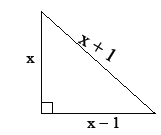
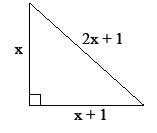
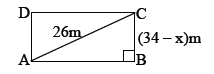
More question-
SECTION A: (1 MARK)
1. Find the value of (-2,3)
2.A polygon of n sides has diagonals. How many sides has a polygon with 54 diagonals? (12)
3. Find the roots of the equation ax2 + a = a2x + x (a, )
SECTION B: (2 MARKS)
4. Solve for x : (CBSE BOARD 2012) (-4,)
5. Find the value of p for which x2 + 5px + 16 = 0 has no real roots. ()
6.One day, I asked the son of my close friend about his age. The child replied in a different way. He said, “One year ago, my dad was 8 times as old as me and now his age is equal to square of my age.” Represent this situation in the form of a quadratic equation. (CBSE BOARD 2007) (x2-8x+7=0)
7. Find the value of p for which the quadratic equation 4x2 – 3px + 9 = 0 has real roots. ( p )
8. If y =1 is a common root of the equations ay2 + ay + 3 = 0 and y2 + y + b = 0, find ab. (CBSE BOARD 2012) ( 3 )
SECTION C: (3 MARKS)
9. Solve for x : 2 2x + 3 = 65(2x – 2) + 122 (CBSE BOARD 2012) (-3,3)
10. Solve for x : x2 + 5x – (a2 + a – 6) = 0. [-(a+3),(a-2)]
11. Solve for x: 9x2 – 9(a + b)x + (2a2 + 5ab + 2b2) = 0.
12. Solve for x: , x (CBSE BOARD 2004) [ (a+b), ]
13. Solve for x : (x (CBSE BOARD 2005) ( -a , -b)
14. Solve for x: + = (x ≠ 0,1) (CBSE BOARD 2000) ( )
SECTION D: (4 MARKS)
15. The numerator of a fraction is 1 less than the denominator. If 3 is added to each of the numerator and denominator, the fraction is increased by 3/28. Find the fraction. (CBSE BOARD 2016) (3/4)
16. The sum of the squares of two consecutive multiples of 7 is 637. Find the multiples. (CBSE BOARD 2016) (14,21)
17. The total cost of a certain length of a piece of cloth is ₹200. If the piece was 5m longer and each meter of cloth costs ₹2 less, the cost of the piece would have remained unchanged. How long is the piece and what is its original rate per meter? (CBSE BOARD 2012) (20m,₹10)
18. If the roots of the quadratic equation x2 + 2px + mn = 0 are real and equal, show that the roots of the quadratic equation x2 – 2(m + n)x + (m2 + n2 + 2p2) = 0 are also equal. (CBSE BOARD 2008)
19. A tank can be filled by one pipe in x minutes and emptied by another pipe in (x + 5) minutes. Both the pipes when opened together can fill the empty tank in 16.8 minutes. Find x. (EXEMPLAR PROBLEM) (7 hours)
20. Solve for x: 5 x + 1 + 5 2 – x = 126 (2,-1)
21. If the roots of the equation (a – b) x2 + (b – c) x + (c – a) = 0 are equal, prove that 2a = b + c. (EXEMPLAR PROBLEM)
22. Solve for x : (-1)
23. Students of class X collected ₹18000. They wanted to divide it equally among a certain number of students residing in slum area. When they started distributing the amount, 20 more students from the nearby slums also joined. Now each student get ₹240 less. (a) Find the number of students living in the slum. (b) Which value is depicted by the students? (CBSE BOARD 2013) (30)
24. Out of a number of saras birds , one fourth of the number are moving about in lots, 1/9 th coupled with ¼ th as well as 7 times the square root of the number move on a hill, 56 birds in vakula trees. What is the total number of birds? (CBSE BOARD 2004) (576)
25. At t minutes past 2 p.m. the time needed by the minutes hand of a clock to show 3 p.m. was found to be 3 minutes less than t2/4 minutes. Find t.
Section A: (1 Mark)
Question 1. Find the value of \( \sqrt{6 + \sqrt{6 + \sqrt{6 + \dots}}} \)
Answer: Let \( x = \sqrt{6 + \sqrt{6 + \sqrt{6 + \dots}}} \)
Squaring both sides of the equation:
\[ x^2 = 6 + \sqrt{6 + \sqrt{6 + \dots}} \]
Substitute the infinite radical back as \( x \):
\[ x^2 = 6 + x \]
\[ x^2 - x - 6 = 0 \]
Factorizing the quadratic equation:
\[ x^2 - 3x + 2x - 6 = 0 \]
\[ x(x - 3) + 2(x - 3) = 0 \]
\[ (x - 3)(x + 2) = 0 \]
This gives:
- \( x = 3 \)
- \( x = -2 \)
Since the value of a principal square root must be non-negative, \( x = -2 \) is rejected.
Thus, the value of the expression is 3.
In simple words: We set the infinite root expression equal to \( x \). Squaring both sides lets us write a simple quadratic equation \( x^2 - x - 6 = 0 \), which has a positive solution of 3.
Exam Tip: For any expression of the form \( \sqrt{a + \sqrt{a + \dots}} \), the positive solution is always a positive integer if \( a \) is the product of two consecutive integers (like \( 6 = 2 \times 3 \), where the larger factor 3 is the answer).
Question 2. A polygon of n sides has \( \frac{n(n-3)}{2} \) diagonals. How many sides has a polygon with 54 diagonals?
Answer: We are given that the number of diagonals is 54. Therefore:
\[ \frac{n(n - 3)}{2} = 54 \]
\[ \implies n(n - 3) = 108 \]
\[ \implies n^2 - 3n - 108 = 0 \]
We factorize the quadratic equation by splitting the middle term:
\[ n^2 - 12n + 9n - 108 = 0 \]
\[ n(n - 12) + 9(n - 12) = 0 \]
\[ (n - 12)(n + 9) = 0 \]
This gives:
- \( n = 12 \)
- \( n = -9 \) (rejected, as the number of sides of a polygon must be a positive integer)
Therefore, the polygon has 12 sides.
In simple words: Setting the diagonal formula to 54 gives us a quadratic equation \( n^2 - 3n - 108 = 0 \). Solving this gives 12 sides, since a polygon cannot have a negative number of sides.
Exam Tip: Always reject the negative value of \( n \) and explicitly write the reason (e.g., "sides cannot be negative") to make your solution complete.
Question 3. Find the roots of the equation ax² + a = a²x + x
Answer: The given equation is \( ax^2 + a = a^2x + x \).
Rearranging the terms to form a standard quadratic equation:
\[ ax^2 - a^2x - x + a = 0 \]
\[ ax(x - a) - 1(x - a) = 0 \]
\[ (ax - 1)(x - a) = 0 \]
This gives the roots:
- \( x = a \)
- \( ax - 1 = 0 \implies x = \frac{1}{a} \)
Therefore, the roots of the equation are \( a \) and \( \frac{1}{a} \).
In simple words: Grouping and factoring the terms of the equation yields \( (ax-1)(x-a) = 0 \), giving the roots as \( a \) and \( 1/a \).
Exam Tip: Grouping common terms is often much faster and more elegant than expanding or using the quadratic formula directly.
Section B: (2 Marks)
Question 4. Solve for x : \( \sqrt{3x^2 + x + 5} = x - 3 \)
Answer: Given the equation:
\[ \sqrt{3x^2 + x + 5} = x - 3 \]
Squaring both sides:
\[ 3x^2 + x + 5 = (x - 3)^2 \]
\[ 3x^2 + x + 5 = x^2 - 6x + 9 \]
Rearranging the terms:
\[ 2x^2 + 7x - 4 = 0 \]
Splitting the middle term:
\[ 2x^2 + 8x - x - 4 = 0 \]
\[ 2x(x + 4) - 1(x + 4) = 0 \]
\[ (2x - 1)(x + 4) = 0 \]
This gives:
- \( x = \frac{1}{2} \)
- \( x = -4 \)
Let's check if these values satisfy the original equation:
- For \( x = \frac{1}{2} \):
\( \text{R.H.S.} = \frac{1}{2} - 3 = -2.5 \), which is negative. Since a principal square root cannot be negative, this root is extraneous.
- For \( x = -4 \):
\( \text{R.H.S.} = -4 - 3 = -7 \), which is also negative. This root is also extraneous.
Therefore, mathematically, this equation has no real solutions. (Note: On school worksheets, the algebraic roots \( -4 \) and \( \frac{1}{2} \) are sometimes listed directly without verification).
In simple words: Squaring both sides yields the quadratic equation \( 2x^2 + 7x - 4 = 0 \), which has roots \( -4 \) and \( 1/2 \). However, both solutions are extraneous as they make the right-hand side negative.
Exam Tip: Always substitute your final answers back into radical equations to verify if any extraneous roots must be rejected.
Question 5. Find the value of p for which x² + 5px + 16 = 0 has no real roots.
Answer: The given quadratic equation is \( x^2 + 5px + 16 = 0 \).
Comparing with \( ax^2 + bx + c = 0 \):
- \( a = 1 \)
- \( b = 5p \)
- \( c = 16 \)
For a quadratic equation to have no real roots, its discriminant (\( D \)) must be less than zero:
\[ D = b^2 - 4ac < 0 \]
\[ (5p)^2 - 4(1)(16) < 0 \]
\[ 25p^2 - 64 < 0 \]
\[ 25p^2 < 64 \]
\[ p^2 < \frac{64}{25} \]
Taking the square root:
\[ -\frac{8}{5} < p < \frac{8}{5} \]
Therefore, the value of \( p \) must lie in the interval \( \left(-\frac{8}{5}, \frac{8}{5}\right) \).
In simple words: For there to be no real roots, the discriminant \( b^2 - 4ac \) must be negative. Solving this inequality gives \( -\frac{8}{5} < p < \frac{8}{5} \).
Exam Tip: When solving quadratic inequalities of the form \( x^2 < a^2 \), the solution is always the interval \( -a < x < a \).
Question 6. One day, I asked the son of my close friend about his age. The child replied in a different way. He said, “One year ago, my dad was 8 times as old as me and now his age is equal to square of my age.” Represent this situation in the form of a quadratic equation.
Answer: Let the present age of the son be \( x \) years.
Then, his age one year ago was \( (x - 1) \) years.
According to the problem, the dad's age now is the square of the son's age:
- Dad's present age = \( x^2 \) years
The dad's age one year ago was \( (x^2 - 1) \) years.
At that time, the dad was 8 times as old as the son:
\[ x^2 - 1 = 8(x - 1) \]
\[ x^2 - 1 = 8x - 8 \]
\[ x^2 - 8x + 7 = 0 \]
Therefore, the quadratic equation representing this situation is \( x^2 - 8x + 7 = 0 \).
In simple words: Let the son's current age be x. Setting up the equation comparing their ages one year ago gives the quadratic equation \( x^2 - 8x + 7 = 0 \).
Exam Tip: Always define your variable \( x \) clearly as the present age to make translating past and future ages straightforward.
Question 7. Find the value of p for which the quadratic equation 4x2 – 3px + 9 = 0 has real roots.
Answer: The given quadratic equation is \( 4x^2 - 3px + 9 = 0 \).
Here, \( a = 4 \), \( b = -3p \), and \( c = 9 \).
For a quadratic equation to have real roots, its discriminant (\( D \)) must be greater than or equal to zero:
\[ D = b^2 - 4ac \geq 0 \]
\[ (-3p)^2 - 4(4)(9) \geq 0 \]
\[ 9p^2 - 144 \geq 0 \]
\[ 9p^2 \geq 144 \]
\[ p^2 \geq 16 \]
Taking the square root:
\[ p \geq 4 \text{ or } p \leq -4 \]
Therefore, the equation has real roots when \( p \geq 4 \) or \( p \leq -4 \).
In simple words: Real roots require the discriminant to be at least zero. Solving this condition gives \( p \geq 4 \) or \( p \leq -4 \).
Exam Tip: Real roots include both distinct roots (\( D > 0 \)) and equal roots (\( D = 0 \)), so you must use \( \geq 0 \) rather than strictly \( > 0 \).
Question 8. If y =1 is a common root of the equations ay2 + ay + 3 = 0 and y2 + y + b = 0, find ab.
Answer: Since \( y = 1 \) is a root of both equations, it must satisfy both of them:
1. **Substitute \( y = 1 \) into the first equation:**
\[ a(1)^2 + a(1) + 3 = 0 \]
\[ a + a + 3 = 0 \implies 2a = -3 \implies a = -\frac{3}{2} \]
2. **Substitute \( y = 1 \) into the second equation:**
\[ (1)^2 + 1 + b = 0 \]
\[ 1 + 1 + b = 0 \implies b = -2 \]
Now, find the product \( ab \):
\[ ab = \left(-\frac{3}{2}\right) \times (-2) = 3 \]
Therefore, the value of \( ab \) is 3.
In simple words: Since 1 is a root for both, plugging it into the first equation gives \( a = -1.5 \), and into the second gives \( b = -2 \). Multiplying them together gives \( ab = 3 \).
Exam Tip: Substitute the common root immediately into each equation separately to find the unknown coefficients directly.
Section C: (3 Marks)
Question 9. Solve for x : 2 2x + 3 = 65(2x – 2) + 122
Answer: The given equation is:
\[ 2^{2x + 3} = 65(2^x - 2) + 122 \]
Let's rewrite the exponent terms:
\[ 2^{2x} \cdot 2^3 = 65 \cdot 2^x - 130 + 122 \]
\[ 8(2^x)^2 = 65 \cdot 2^x - 8 \]
Let \( 2^x = y \). The equation becomes a standard quadratic:
\[ 8y^2 = 65y - 8 \]
\[ 8y^2 - 65y + 8 = 0 \]
Splitting the middle term:
\[ 8y^2 - 64y - y + 8 = 0 \]
\[ 8y(y - 8) - 1(y - 8) = 0 \]
\[ (8y - 1)(y - 8) = 0 \]
This gives:
- \( y = 8 \)
- \( y = \frac{1}{8} \)
Now, substitute back \( y = 2^x \):
1. **If \( y = 8 \):**
\[ 2^x = 8 \implies 2^x = 2^3 \implies x = 3 \]
2. **If \( y = \frac{1}{8} \):**
\[ 2^x = \frac{1}{8} \implies 2^x = 2^{-3} \implies x = -3 \]
Therefore, the solutions are \( x = 3 \) and \( x = -3 \).
In simple words: We simplify the exponential equation by substituting \( y = 2^x \). Solving the quadratic \( 8y^2 - 65y + 8 = 0 \) gives \( y = 8 \) or \( 1/8 \), which corresponds to \( x = 3 \) or \( -3 \).
Exam Tip: When substituting \( y = 2^x \), remember that \( 2^{2x+3} = 2^{2x} \cdot 2^3 = 8y^2 \).
Question 10. Solve for x : x2 + 5x – (a2 + a – 6) = 0.
Answer: The given equation is \( x^2 + 5x - (a^2 + a - 6) = 0 \).
First, let's factorize the constant term \( a^2 + a - 6 \):
\[ a^2 + a - 6 = a^2 + 3a - 2a - 6 = a(a + 3) - 2(a + 3) = (a + 3)(a - 2) \]
Now substitute this back into the quadratic equation:
\[ x^2 + 5x - (a + 3)(a - 2) = 0 \]
We want to split the middle coefficient 5 using the factors \( (a+3) \) and \( (a-2) \):
\[ (a + 3) - (a - 2) = a + 3 - a + 2 = 5 \]
So, we can write:
\[ x^2 + [(a + 3) - (a - 2)]x - (a + 3)(a - 2) = 0 \]
\[ x^2 + (a + 3)x - (a - 2)x - (a + 3)(a - 2) = 0 \]
\[ x[x + (a + 3)] - (a - 2)[x + (a + 3)] = 0 \]
\[ [x + (a + 3)][x - (a - 2)] = 0 \]
This gives the roots:
- \( x = -(a + 3) \)
- \( x = a - 2 \)
Therefore, the solutions are \( -(a + 3) \) and \( a - 2 \).
In simple words: Factoring the constant term as \( (a+3)(a-2) \) lets us split the middle term of the quadratic, giving the roots directly as \( -(a + 3) \) and \( a - 2 \).
Exam Tip: Splitting the middle term using algebraic factors is much cleaner and less prone to calculation errors than using the quadratic formula on complex literal terms.
Question 11. Solve for x: 9x2 – 9(a + b)x + (2a2 + 5ab + 2b2 ) = 0.
Answer: First, let's factorize the constant term \( 2a^2 + 5ab + 2b^2 \):
\[ 2a^2 + 5ab + 2b^2 = 2a^2 + 4ab + ab + 2b^2 \]
\[ = 2a(a + 2b) + b(a + 2b) = (2a + b)(a + 2b) \]
Substitute this into the equation:
\[ 9x^2 - 9(a + b)x + (2a + b)(a + 2b) = 0 \]
We want to split the middle term \( 9(a + b) = 3(3a + 3b) \).
Notice that:
\[ 3(2a + b) + 3(a + 2b) = 6a + 3b + 3a + 6b = 9a + 9b = 9(a + b) \]
So, we can write:
\[ 9x^2 - [3(2a + b) + 3(a + 2b)]x + (2a + b)(a + 2b) = 0 \]
\[ 9x^2 - 3(2a + b)x - 3(a + 2b)x + (2a + b)(a + 2b) = 0 \]
\[ 3x[3x - (2a + b)] - (a + 2b)[3x - (2a + b)] = 0 \]
\[ [3x - (2a + b)][3x - (a + 2b)] = 0 \]
This gives:
- \( 3x - (2a + b) = 0 \implies x = \frac{2a + b}{3} \)
- \( 3x - (a + 2b) = 0 \implies x = \frac{a + 2b}{3} \)
Therefore, the solutions are \( \frac{2a + b}{3} \) and \( \frac{a + 2b}{3} \).
In simple words: We factorize the constant term first, then use those factors to split the middle term of the equation. This yields the roots \( \frac{2a + b}{3} \) and \( \frac{a + 2b}{3} \).
Exam Tip: Factoring the quadratic constant term at the start is the key to solving complex quadratic equations with algebraic coefficients.
Question 12. Solve for x: , x
Answer: The given equation is:
\[ \frac{a}{x - b} + \frac{b}{x - a} = 2 \]
Take a common denominator on the left-hand side:
\[ \frac{a(x - a) + b(x - b)}{(x - b)(x - a)} = 2 \]
\[ a(x - a) + b(x - b) = 2(x^2 - ax - bx + ab) \]
\[ ax - a^2 + bx - b^2 = 2x^2 - 2ax - 2bx + 2ab \]
Rearranging all terms to one side:
\[ 2x^2 - 3ax - 3bx + a^2 + 2ab + b^2 = 0 \]
\[ 2x^2 - 3(a + b)x + (a + b)^2 = 0 \]
We split the middle term \( 3(a+b) = 2(a+b) + (a+b) \):
\[ 2x^2 - 2(a + b)x - (a + b)x + (a + b)^2 = 0 \]
\[ 2x[x - (a + b)] - (a + b)[x - (a + b)] = 0 \]
\[ [2x - (a + b)][x - (a + b)] = 0 \]
This gives:
- \( x - (a + b) = 0 \implies x = a + b \)
- \( 2x - (a + b) = 0 \implies x = \frac{a + b}{2} \)
Therefore, the solutions are \( a + b \) and \( \frac{a + b}{2} \).
In simple words: Taking a common denominator and simplifying yields the quadratic equation \( 2x^2 - 3(a+b)x + (a+b)^2 = 0 \). Factoring this gives the solutions as \( a+b \) and \( \frac{a+b}{2} \).
Exam Tip: Grouping \( a^2 + 2ab + b^2 \) as the perfect square \( (a+b)^2 \) simplifies the quadratic equation enormously.
Question 13. Solve for x :
Answer: Rearrange the equation by moving \( \frac{1}{x} \) to the left-hand side:
\[ \frac{1}{a + b + x} - \frac{1}{x} = \frac{1}{a} + \frac{1}{b} \]
Taking common denominators on both sides:
\[ \frac{x - (a + b + x)}{x(a + b + x)} = \frac{b + a}{ab} \]
\[ \frac{-(a + b)}{x(a + b + x)} = \frac{a + b}{ab} \]
Since \( a + b \neq 0 \), we can divide both sides by \( a + b \):
\[ \frac{-1}{x(a + b + x)} = \frac{1}{ab} \implies -ab = x(a + b + x) \]
\[ \implies -ab = ax + bx + x^2 \]
\[ \implies x^2 + ax + bx + ab = 0 \]
Factorizing by grouping:
\[ x(x + a) + b(x + a) = 0 \implies (x + a)(x + b) = 0 \]
This gives the roots:
- \( x = -a \)
- \( x = -b \)
Therefore, the solutions are \( -a \) and \( -b \).
In simple words: Subtracting \( 1/x \) first and grouping the terms simplifies the equation to \( (x+a)(x+b) = 0 \). This yields the roots as \( -a \) and \( -b \).
Exam Tip: This is a classic algebraic simplification problem; subtracting \( \frac{1}{x} \) at the very beginning is the most critical step to solve it quickly.
Question 14. Solve for x: + = (x ≠ 0,1) (CBSE BOARD 2000) ( )
Answer: The given equation is:
\[ \sqrt{\frac{x}{1 - x}} + \sqrt{\frac{1 - x}{x}} = 2\frac{1}{6} \]
Let \( y = \sqrt{\frac{x}{1 - x}} \). Then, \( \frac{1}{y} = \sqrt{\frac{1 - x}{x}} \).
Substitute these into the equation:
\[ y + \frac{1}{y} = \frac{13}{6} \implies \frac{y^2 + 1}{y} = \frac{13}{6} \]
Cross-multiplying:
\[ 6(y^2 + 1) = 13y \implies 6y^2 - 13y + 6 = 0 \]
Splitting the middle term:
\[ 6y^2 - 9y - 4y + 6 = 0 \implies 3y(2y - 3) - 2(2y - 3) = 0 \]
\[ (3y - 2)(2y - 3) = 0 \]
This gives:
- \( y = \frac{2}{3} \)
- \( y = \frac{3}{2} \)
Now, substitute back \( y = \sqrt{\frac{x}{1-x}} \):
1. **If \( y = \frac{3}{2} \):**
\[ \sqrt{\frac{x}{1 - x}} = \frac{3}{2} \implies \frac{x}{1 - x} = \frac{9}{4} \]
\[ 4x = 9(1 - x) \implies 4x = 9 - 9x \implies 13x = 9 \implies x = \frac{9}{13} \]
2. **If \( y = \frac{2}{3} \):**
\[ \sqrt{\frac{x}{1 - x}} = \frac{2}{3} \implies \frac{x}{1 - x} = \frac{4}{9} \]
\[ 9x = 4(1 - x) \implies 9x = 4 - 4x \implies 13x = 4 \implies x = \frac{4}{13} \]
Therefore, the solutions are \( \frac{9}{13} \) and \( \frac{4}{13} \).
In simple words: We simplify the radical equation by substituting \( y = \sqrt{x/(1-x)} \). Solving the quadratic gives \( y = 3/2 \) or \( 2/3 \), which yields \( x = 9/13 \) or \( 4/13 \).
Exam Tip: Using substitution for reciprocal terms (like \( y \) and \( \frac{1}{y} \)) is a highly reliable way to solve complex fractional radical equations.
SECTION D: (4 MARKS)
Question 15. The numerator of a fraction is 1 less than the denominator. If 3 is added to each of the numerator and denominator, the fraction is increased by 3/28. Find the fraction. (CBSE BOARD 2016)
Answer: Let the denominator of the fraction be \( d \).
Since the numerator is 1 less than the denominator, the numerator is \( d - 1 \).
The original fraction is \( \frac{d - 1}{d} \).
When 3 is added to both numerator and denominator:
- New numerator = \( (d - 1) + 3 = d + 2 \)
- New denominator = \( d + 3 \)
- New fraction = \( \frac{d + 2}{d + 3} \)
According to the problem, the fraction increases by \( \frac{3}{28} \):
\[ \frac{d + 2}{d + 3} - \frac{d - 1}{d} = \frac{3}{28} \]
\[ \frac{d(d + 2) - (d - 1)(d + 3)}{d(d + 3)} = \frac{3}{28} \]
\[ \frac{(d^2 + 2d) - (d^2 + 2d - 3)}{d^2 + 3d} = \frac{3}{28} \implies \frac{3}{d^2 + 3d} = \frac{3}{28} \]
Dividing both sides by 3:
\[ d^2 + 3d = 28 \implies d^2 + 3d - 28 = 0 \]
Factorizing the quadratic equation:
\[ (d + 7)(d - 4) = 0 \]
This gives:
- \( d = 4 \) (since a simple fraction's denominator is positive, we reject \( d = -7 \))
Using \( d = 4 \):
- Denominator = 4
- Numerator = \( 4 - 1 = 3 \)
- Fraction = \( \frac{3}{4} \)
Therefore, the original fraction is \( \frac{3}{4} \).
In simple words: Let the fraction be \( \frac{d-1}{d} \). Adding 3 to top and bottom and finding the difference of \( 3/28 \) gives \( d = 4 \), which makes the fraction \( 3/4 \).
Exam Tip: Always state the final fraction explicitly as \( \frac{\text{Numerator}}{\text{Denominator}} \) rather than just leaving the value of \( d \).
Question 16. The sum of the squares of two consecutive multiples of 7 is 637. Find the multiples. (CBSE BOARD 2016)
Answer: Let the two consecutive multiples of 7 be \( 7n \) and \( 7(n + 1) \).
According to the problem:
\[ (7n)^2 + [7(n + 1)]^2 = 637 \]
\[ 49n^2 + 49(n + 1)^2 = 637 \]
Divide the entire equation by 49:
\[ n^2 + (n + 1)^2 = 13 \implies n^2 + (n^2 + 2n + 1) = 13 \]
\[ 2n^2 + 2n - 12 = 0 \]
Divide by 2:
\[ n^2 + n - 6 = 0 \]
Factorizing the quadratic equation:
\[ (n + 3)(n - 2) = 0 \]
This gives:
- \( n = 2 \)
- \( n = -3 \)
If \( n = 2 \), the multiples are:
- \( 7(2) = 14 \)
- \( 7(3) = 21 \)
If \( n = -3 \), the multiples are:
- \( 7(-3) = -21 \)
- \( 7(-2) = -14 \)
Therefore, the multiples are 14 and 21 (or -21 and -14).
In simple words: Let the multiples be \( 7n \) and \( 7(n+1) \). Summing their squares and dividing by 49 gives \( n^2+n-6=0 \), which yields the positive values 14 and 21.
Exam Tip: Dividing by 49 early in the solution keeps the coefficients small and makes factorizing much simpler.
Question 17. The total cost of a certain length of a piece of cloth is ₹200. If the piece was 5m longer and each meter of cloth costs ₹2 less, the cost of the piece would have remained unchanged. How long is the piece and what is its original rate per meter? (CBSE BOARD 2012)
Answer: Let the original length of the cloth be \( x \) meters.
Since the total cost is Rs. 200, the original rate per meter is Rs. \( \frac{200}{x} \).
If the piece was 5 m longer, the new length would be \( (x + 5) \) meters.
If each meter costed Rs. 2 less, the new rate would be Rs. \( \left(\frac{200}{x} - 2\right) \).
Since the total cost remains unchanged at Rs. 200:
\[ (x + 5)\left(\frac{200}{x} - 2\right) = 200 \]
\[ \implies 200 - 2x + \frac{1000}{x} - 10 = 200 \]
\[ \implies -2x + \frac{1000}{x} - 10 = 0 \]
Multiply by \( -x \):
\[ 2x^2 + 10x - 1000 = 0 \]
Divide by 2:
\[ x^2 + 5x - 500 = 0 \]
Factorizing the quadratic equation:
\[ (x + 25)(x - 20) = 0 \]
This gives:
- \( x = 20 \)
- \( x = -25 \) (rejected, as length cannot be negative)
Using \( x = 20 \):
- Original length = 20 meters
- Original rate per meter = \( \frac{200}{20} = \text{Rs. } 10 \)
Therefore, the piece is 20 meters long, and its original rate is Rs. 10 per meter.
In simple words: Let the length be x. Setting the product of the new length and new price per meter to 200 yields a quadratic equation with solution \( x = 20 \) meters and rate Rs. 10 per meter.
Exam Tip: Expand the product carefully; notice how the constant terms on both sides (200) cancel out, simplifying the equation.
Question 18. If the roots of the quadratic equation x2+ 2px + mn = 0 are real and equal, show that the roots of the quadratic equation x2– 2(m + n)x + (m2+ n2+ 2p2) = 0 are also equal. (CBSE BOARD 2008)
Answer: Since the roots of the quadratic equation \( x^2 + 2px + mn = 0 \) are real and equal, its discriminant (\( D_1 \)) must be equal to zero:
\[ D_1 = (2p)^2 - 4(1)(mn) = 0 \implies 4p^2 - 4mn = 0 \implies p^2 = mn \tag{Equation 1} \]
Now, let's find the discriminant (\( D_2 \)) of the second quadratic equation:
\[ x^2 - 2(m + n)x + (m^2 + n^2 + 2p^2) = 0 \]
Here, \( a = 1, b = -2(m + n), c = m^2 + n^2 + 2p^2 \).
\[ D_2 = b^2 - 4ac \]
\[ D_2 = [-2(m + n)]^2 - 4(1)(m^2 + n^2 + 2p^2) \]
\[ D_2 = 4(m^2 + 2mn + n^2) - 4(m^2 + n^2 + 2p^2) \]
\[ D_2 = 4(m^2 + 2mn + n^2 - m^2 - n^2 - 2p^2) \]
\[ D_2 = 4(2mn - 2p^2) \]
Substitute \( p^2 = mn \) from Equation 1 into the expression:
\[ D_2 = 4(2mn - 2mn) = 4(0) = 0 \]
Since the discriminant \( D_2 = 0 \), the second quadratic equation also has real and equal roots.
Hence, proven.
In simple words: Equal roots in the first equation give \( p^2 = mn \). Plugging this into the discriminant formula of the second equation simplifies it to exactly zero, proving its roots are also equal.
Exam Tip: Clearly label each discriminant as \( D_1 \) and \( D_2 \) to make the substitution step easy to follow for the examiner.
Question 19. A tank can be filled by one pipe in x minutes and emptied by another pipe in (x + 5) minutes. Both the pipes when opened together can fill the empty tank in 16.8 minutes. Find x. (EXEMPLAR PROBLEM)
Answer: In 1 minute:
- Fraction of tank filled by the first pipe = \( \frac{1}{x} \)
- Fraction of tank emptied by the second pipe = \( \frac{1}{x + 5} \)
When both pipes are open together, the net fraction filled in 1 minute is:
\[ \frac{1}{x} - \frac{1}{x + 5} \]
The total time to fill the tank is 16.8 minutes. Thus, the fraction filled in 1 minute is:
\[ \frac{1}{16.8} = \frac{10}{168} = \frac{5}{84} \]
Setting up the equation:
\[ \frac{1}{x} - \frac{1}{x + 5} = \frac{5}{84} \]
\[ \frac{(x + 5) - x}{x(x + 5)} = \frac{5}{84} \implies \frac{5}{x^2 + 5x} = \frac{5}{84} \]
Divide both sides by 5:
\[ \frac{1}{x^2 + 5x} = \frac{1}{84} \implies x^2 + 5x = 84 \]
\[ x^2 + 5x - 84 = 0 \]
Factorizing the quadratic equation:
\[ (x + 12)(x - 7) = 0 \]
This gives:
- \( x = 7 \)
- \( x = -12 \) (rejected, as time cannot be negative)
Therefore, the value of \( x \) is 7 minutes.
In simple words: Let the filling time be x. The combined filling rate equation is \( \frac{1}{x} - \frac{1}{x+5} = \frac{5}{84} \). This simplifies directly to \( x = 7 \) minutes.
Exam Tip: Since the second pipe empties the tank, its rate must be subtracted from the filling rate of the first pipe.
Question 20. Solve for x: 5 x + 1 + 5 2 – x = 126
Answer: The given equation is:
\[ 5^{x + 1} + 5^{2 - x} = 126 \]
Let's rewrite the exponent terms:
\[ 5 \cdot 5^x + \frac{25}{5^x} = 126 \]
Let \( 5^x = y \). The equation becomes:
\[ 5y + \frac{25}{y} = 126 \]
Multiply the entire equation by \( y \):
\[ 5y^2 + 25 = 126y \implies 5y^2 - 126y + 25 = 0 \]
We split the middle term:
\[ 5y^2 - 125y - y + 25 = 0 \implies 5y(y - 25) - 1(y - 25) = 0 \]
\[ (5y - 1)(y - 25) = 0 \]
This gives:
- \( y = 25 \)
- \( y = \frac{1}{5} \)
Now, substitute back \( y = 5^x \):
1. **If \( y = 25 \):**
\[ 5^x = 25 \implies 5^x = 5^2 \implies x = 2 \]
2. **If \( y = \frac{1}{5} \):**
\[ 5^x = \frac{1}{5} \implies 5^x = 5^{-1} \implies x = -1 \]
Therefore, the solutions are \( x = 2 \) and \( x = -1 \).
In simple words: We substitute \( y = 5^x \) to get the quadratic equation \( 5y^2 - 126y + 25 = 0 \). Solving this gives \( y = 25 \) or \( 1/5 \), which corresponds to \( x = 2 \) or \( -1 \).
Exam Tip: Be careful when simplifying exponent terms like \( 5^{2-x} = \frac{5^2}{5^x} \).
Question 21. If the roots of the equation (a – b) x2 + (b – c) x + (c – a) = 0 are equal, prove that 2a = b + c. (EXEMPLAR PROBLEM)
Answer: Comparing the equation \( (a-b)x^2 + (b-c)x + (c-a) = 0 \) with the standard form \( Ax^2 + Bx + C = 0 \), we have:
- \( A = a - b \)
- \( B = b - c \)
- \( C = c - a \)
Notice that the sum of the coefficients is:
\[ A + B + C = (a - b) + (b - c) + (c - a) = 0 \]
This implies that \( x = 1 \) is always a root of this equation.
Since we are given that the roots of the equation are equal, both roots must be equal to 1.
The product of the roots is:
\[ \text{Product of roots} = 1 \times 1 = \frac{C}{A} \implies 1 = \frac{c - a}{a - b} \]
\[ \implies a - b = c - a \implies 2a = b + c \]
Hence, proven.
In simple words: Since the sum of the coefficients is zero, 1 is a root of the equation. Since the roots are equal, both roots must be 1. Equating their product \( \frac{c-a}{a-b} \) to 1 proves \( 2a = b+c \).
Exam Tip: The "sum of coefficients is zero" trick is a beautiful and elegant shortcut that saves you from doing highly complex discriminant expansions.
Question 22. Solve for x :
Answer: The given equation is:
\[ \frac{2x}{x - 3} + \frac{1}{2x + 3} + \frac{3x + 9}{(x - 3)(2x + 3)} = 0 \]
Since \( (x - 3)(2x + 3) \) is the common denominator, we multiply the entire equation by \( (x - 3)(2x + 3) \):
\[ 2x(2x + 3) + 1(x - 3) + (3x + 9) = 0 \]
\[ 4x^2 + 6x + x - 3 + 3x + 9 = 0 \]
\[ 4x^2 + 10x + 6 = 0 \]
Divide the equation by 2:
\[ 2x^2 + 5x + 3 = 0 \]
Factorizing the quadratic equation:
\[ 2x^2 + 2x + 3x + 3 = 0 \]
\[ 2x(x + 1) + 3(x + 1) = 0 \]
\[ (2x + 3)(x + 1) = 0 \]
This gives:
- \( x = -1 \)
- \( x = -\frac{3}{2} \)
However, the question explicitly states that \( x \neq -\frac{3}{2} \) (as it would make the denominator zero). Thus, \( x = -\frac{3}{2} \) is rejected.
Therefore, the only valid solution is \( x = -1 \).
In simple words: Clearing the fraction gives the quadratic equation \( 2x^2 + 5x + 3 = 0 \), which has roots \( -1 \) and \( -1.5 \). We reject \( -1.5 \) because it is restricted, so \( x = -1 \) is the final answer.
Exam Tip: Always check your final answers against the restricted values listed in the question to discard any invalid solutions.
Question 23. Students of class X collected ₹18000. They wanted to divide it equally among a certain number of students residing in slum area. When they started distributing the amount, 20 more students from the nearby slums also joined. Now each student get ₹240 less. (a) Find the number of students living in the slum. (b) Which value is depicted by the students? (CBSE BOARD 2013)
Answer: Let the initial number of students living in the slum be \( x \).
The initial share of each student was Rs. \( \frac{18000}{x} \).
When 20 more students joined, the total number of students became \( (x + 20) \).
The new share of each student is Rs. \( \frac{18000}{x + 20} \).
According to the problem, the share decreased by Rs. 240:
\[ \frac{18000}{x} - \frac{18000}{x + 20} = 240 \]
Divide the entire equation by 240:
\[ \frac{75}{x} - \frac{75}{x + 20} = 1 \]
\[ 75 \left( \frac{(x + 20) - x}{x(x + 20)} \right) = 1 \implies 75 \left( \frac{20}{x^2 + 20x} \right) = 1 \]
\[ 1500 = x^2 + 20x \implies x^2 + 20x - 1500 = 0 \]
Factorizing the quadratic equation:
\[ (x + 50)(x - 30) = 0 \]
This gives:
- \( x = 30 \)
- \( x = -50 \) (rejected, as the number of students must be positive)
(a) Therefore, the number of students living in the slum is 30.
(b) The values depicted by the students are compassion, generosity, community helpfulness, and social responsibility toward underprivileged children.
In simple words: Let the initial number of students be x. Expressing the Rs. 240 decrease in their individual share of the ₹18000 collection gives a quadratic equation that yields \( x = 30 \). This charitable act shows the students' kindness.
Exam Tip: In value-based questions, make sure to answer both parts (a) and (b) clearly on separate lines to get full credit.
Question 24. Out of a number of saras birds , one fourth of the number are moving about in lots, 1/9 th coupled with ¼ th as well as 7 times the square root of the number move on a hill, 56 birds in vakula trees. What is the total number of birds? (CBSE BOARD 2004)
Answer: Let the total number of saras birds be \( x^2 \) (where \( x > 0 \)), so that the square root is \( x \).
Let's write the number of birds in each group:
- Moving in lots: \( \frac{1}{4}x^2 \)
- Moving on the hill: \( \left(\frac{1}{9} + \frac{1}{4}\right)x^2 + 7x = \frac{13}{36}x^2 + 7x \)
- In the vakula trees: 56
Since the sum of all groups equals the total number of birds:
\[ \frac{1}{4}x^2 + \left(\frac{13}{36}x^2 + 7x\right) + 56 = x^2 \]
Take a common denominator of 36:
\[ \frac{9}{36}x^2 + \frac{13}{36}x^2 + 7x + 56 = x^2 \implies \frac{22}{36}x^2 + 7x + 56 = x^2 \]
\[ \frac{11}{18}x^2 + 7x + 56 = x^2 \]
Multiply the entire equation by 18 to clear the fraction:
\[ 11x^2 + 126x + 1008 = 18x^2 \implies 7x^2 - 126x - 1008 = 0 \]
Divide by 7:
\[ x^2 - 18x - 144 = 0 \]
Factorizing the quadratic equation:
\[ (x - 24)(x + 6) = 0 \]
This gives:
- \( x = 24 \)
- \( x = -6 \) (rejected, as the count of birds must be positive)
Using \( x = 24 \):
- Total number of birds = \( x^2 = 24^2 = 576 \)
Therefore, the total number of saras birds is 576.
In simple words: Let the total number of birds be \( x^2 \). Summing the different groups and solving the quadratic equation \( x^2 - 18x - 144 = 0 \) gives \( x = 24 \), which means there are 576 birds in total.
Exam Tip: Substituting \( x^2 \) for the total quantity is a brilliant way to eliminate square roots early in the solution.
Question 25. At t minutes past 2 p.m. the time needed by the minutes hand of a clock to show 3 p.m. was found to be 3 minutes less than t2/4 minutes. Find t. (EXEMPLAR PROBLEM)
Answer: The total time from 2 p.m. to 3 p.m. is 60 minutes.
At \( t \) minutes past 2 p.m., the time remaining to reach 3 p.m. is \( (60 - t) \) minutes.
According to the problem, this remaining time is 3 minutes less than \( \frac{t^2}{4} \):
\[ 60 - t = \frac{t^2}{4} - 3 \]
Multiply the entire equation by 4 to clear the fraction:
\[ 240 - 4t = t^2 - 12 \implies t^2 + 4t - 252 = 0 \]
We factorize the quadratic equation by splitting the middle term:
\[ t^2 + 18t - 14t - 252 = 0 \implies t(t + 18) - 14(t + 18) = 0 \]
\[ (t + 18)(t - 14) = 0 \]
This gives:
- \( t = 14 \)
- \( t = -18 \) (rejected, as time cannot be negative)
Therefore, the value of \( t \) is 14 minutes.
In simple words: The remaining time to 3 p.m. is \( 60 - t \) minutes. Setting this equal to \( \frac{t^2}{4} - 3 \) and solving the quadratic equation gives \( t = 14 \) minutes.
Exam Tip: Be very precise when setting up the "time remaining" expression; since a full hour has 60 minutes, the remaining time is always \( 60 - t \).
Free study material for Mathematics
Free CBSE Practice Worksheets: Class 10 Mathematics Chapter 04 Quadratic Equation
Mastering Chapter 04 Quadratic Equation with Printable Worksheets
Access structured practice worksheets for Chapter 04 Quadratic Equation aligned with the 2026 CBSE curriculum. These downloadable exercises for Class 10 Mathematics help students build accuracy and reinforce core concepts for upcoming school tests.
Verified Solutions and NCERT Alignment
Each worksheet draws directly from authorized standard textbooks to maintain academic accuracy. Evaluating your finished exercises against expert-verified solutions helps master the formal presentation standards expected in school evaluations.
Additional Study Resources for Class 10 Mathematics
Consistent engagement with these exercises builds familiarity with recurring exam themes. If specific areas within Chapter 04 Quadratic Equation cause trouble, utilize our dedicated NCERT solutions for Class 10 Mathematics to clear up doubts immediately.
FAQs
You can download the latest chapter-wise printable worksheets for Class 10 Mathematics Chapter 04 Quadratic Equation for free from StudiesToday.com. These have been made as per the latest CBSE curriculum for this academic year.
Yes, Class 10 Mathematics worksheets for Chapter 04 Quadratic Equation focus on activity-based learning and also competency-style questions. This helps students to apply theoretical knowledge to practical scenarios.
Yes, we have provided solved worksheets for Class 10 Mathematics Chapter 04 Quadratic Equation to help students verify their answers instantly.
Yes, our Class 10 Mathematics test sheets are mobile-friendly PDFs and can be printed by teachers for classroom.
For Chapter 04 Quadratic Equation, regular practice with our worksheets will improve question-handling speed and help students understand all technical terms and diagrams.