

Class 10 Mathematics Practice Sheet: CBSE Class 10 Mathematics Circles Worksheet Set 01
Review targeted academic worksheets with the CBSE Class 10 Mathematics Circles Worksheet Set 01. Built according to official educational standards for the 2026-27 term, these downloadable Class 10 Mathematics resources support effective daily practice and detailed self-evaluation for Chapter 10 Circles.
Download Chapter 10 Circles Worksheet PDF with Answers
Navigate directly to the solved Mathematics worksheets using the digital viewer below. Each practice set includes detailed step-by-step solutions, allowing students to instantly cross-check their work and identify areas requiring further revision.
Question. AD is a diameter of a circle and AB is a chord. If AD = 34 cm, AB = 30 cm, the distance of AB from the centre of the circle is:
(A) 17 cm
(B) 15 cm
(C) 4 cm
(D) 8 cm

Answer : Draw OP ⊥ AB.
As perpendicular from the centre to a chord bisect the chord, so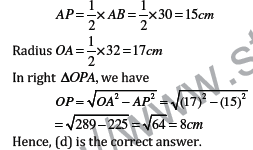
Question. If AB = 12 cm, BC = 16 cm and AB is perpendicular to BC, then the radius of the circle passing through the points A, B and C is:
(A) 6 cm
(B) 8 cm
(C) 10 cm
(D) 12 cm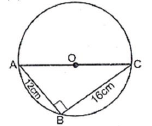
Answer : AB is perpendicular to BC, therefore ABC is a right triangle.
In right ΔABC , we have
Question. In Fig.10.5, if AOB is a diameter of the circle and AC = BC, then ∠CAB is equal to:
(A) 30º
(B) 60º
(C) 90º
(D) 45º
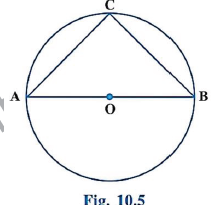
Answer : As AOB is a diameter of the circle,
∠C = 90º
[∵Angles in a semi-circle is 90º]
Now, AC = BC
∠A = ∠B
[∵Angles opposite to equal sides of triangle are equal]
0 ∠A+∠B +∠C =180º
⇒2∠A+ 90º =180º
⇒ 2∠A = 90º⇒∠A = 90º ÷ 2 = 45º
Hence, (d) is the correct answer.
Question. In Fig. 10.7, if ∠DAB = 60º, ∠ABD = 50º, then ∠ACB is equal to:
(A) 60º
(B) 50º
(C) 70º
(D) 80º
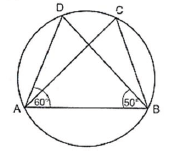
Answer : In ΔADB, we have
∠A+∠B +∠D =180
⇒ 60º + 50º +∠D =180º
⇒ ∠D =180 −110 = 70º
i.e., 0 ∠ABD = 70º
Now, ∠ACB = ∠ADB = 70º
[∵Angles in the same segment of a circle are equal]
Hence, (c) is the correct answer.
10. In Fig. 10.9, ∠AOB = 90º and ∠ABC = 30º, then ∠CAO is equal to:
(A) 30º
(B) 45º
(C) 90º
(D) 60º
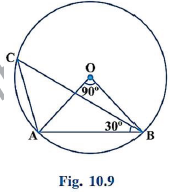
Answer : In ΔOAB, we have
OA = OB
[Radii of the same circle]
∴∠OAB = ∠OBA
∴ 2∠OAB = (180º −∠AOB)
= (180º −90º ) [∵Sum of angles of Δ is 180º]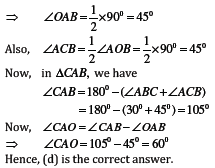
Write True or False and justify your answer in each of the following:
Question. Two chords AB and AC of a circle with centre O are on the opposite sides of OA.
Then ∠OAB = ∠OAC.
Answer : The given statement is false, because the angles will be equal if AB = AC.
Question. Through three collinear points a circle can be drawn.
Answer : The given statement is false because a circle through two points cannot pass through a point which is collinear to these two points.
Question. If AOB is a diameter of a circle and C is a point on the circle, then AC2 + BC2 = AB2
Answer : AOB is a diameter of a circle and C is a point on the circle.
∴ ∠ACB = 90º [∵Angle in a semicircle is a right angle]
In right ΔABC,
AC2 + BC2 = AB2 [By Pythagoras theorem]
Hence, the given statement is true.
Question. If A, B, C, D are four points such that ∠BAC = 30° and ∠BDC = 60°, then D is the centre of the circle through A, B and C.
Answer : The given statement is false because there can be many points D such that ∠BDC = 60° and each such point cannot be centre of the circle through A, B, C.
Question 1. At how many point does a tangent intersect to a circle?
(A) One
(B) Two
(C) Three
(D) Infinite
Answer: (A) One
In simple words: A tangent is a straight line that just brushes against the outer edge of a circle, touching it at exactly one single point.
Exam Tip: Always distinguish between a tangent (touches at one point) and a secant (intersects at two points) - this is a fundamental definition frequently tested in 1-mark questions.
Question 2. From a point P a tangent is drawn to circle of diameter 48 cm. The point P is situated at a distance of 25 cm from center O of the circle then the length of tangent is:
(A) 7 cm
(B) 14 cm
(C) 16 cm
(D) 24 cm
Answer: (A) 7 cm
In simple words: The diameter is 48 cm, so the radius of the circle is 24 cm. Using Pythagoras' theorem on the right-angled triangle formed by the radius, tangent, and center-line, the length of the tangent is \( \sqrt{25^2 - 24^2} = 7 \text{ cm} \).
Exam Tip: Be careful not to use the diameter directly in the Pythagorean calculation - always divide it by 2 first to get the radius.
Question 3. Two tangents are drawn at the end of a diameter of a circle. What is the distance between diameter if the area of circle is 154 cm2?
(A) 7 cm
(B) 14 cm
(C) 21 cm
(D) 28 cm
Answer: (B) 14 cm
In simple words: The area of the circle is 154 cm², which gives us a radius of 7 cm. Tangents drawn at the opposite ends of a diameter are parallel, so the distance between them is the full diameter, which is 14 cm.
Exam Tip: The distance between parallel tangents is always equal to the diameter of the circle. Solve for the radius \(r\) first using \( \pi r^2 = \text{Area} \).
Question 4. From a point Q the length of the tangent to a circle is 24 cm and radius of circle is 7 cm then the distance of a Q from center is:
(A) 12 cm
(B) 12.5cm
(C) 25 cm
(D) 50 cm
Answer: (C) 25 cm
In simple words: Using Pythagoras' theorem with the given radius of 7 cm and tangent length of 24 cm, the distance to the center is \( \sqrt{7^2 + 24^2} = 25 \text{ cm} \).
Exam Tip: The hypotenuse of the right triangle is always the line segment connecting the external point to the center of the circle.
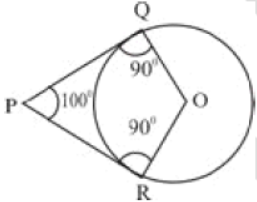
Question 5. If two tangents from point P are drawn to circle at points Q and R, if they are inclined at 100° then ∟QOR equal to (where O is center of circle)
(A) 70°
(B) 80°
(C) 90°
(D) 100°
Answer: (B) 80°
In simple words: The angle between the two tangents and the angle subtended by the radii at the center are supplementary, so \( \angle QOR = 180^\circ - 100^\circ = 80^\circ \).
Exam Tip: Because the angles at the points of contact are always \(90^\circ\), the opposite angles in the quadrilateral must sum to \(180^\circ\).
Question 6. From a point Q the length of tangent to circle is 24 cm and distance Q from the center is 25 cm then the area of circle is:
(A) 7\(\pi\)
(B) 14\(\pi\)
(C) 49\(\pi\)
(D) None of these
Answer: (C) 49\(\pi\)
In simple words: The radius of the circle is \( \sqrt{25^2 - 24^2} = 7 \text{ cm} \). The area is \( \pi r^2 = \pi \times 7^2 = 49\pi \text{ cm}^2 \).
Exam Tip: Keep your final answer in terms of \(\pi\) as shown in the options to avoid unnecessary decimal multiplication.
Question 7. Two centric circles are of radii 25 cm and 24 cm. then what is the length of the chord of the larger circle which touches the smaller circle?
(A) 7 cm
(B) 14 cm
(C) 21 cm
(D) 28 cm
Answer: (B) 14 cm
In simple words: The radius of the inner circle and half-chord form a right triangle with the outer radius. The half-chord is \( \sqrt{25^2 - 24^2} = 7 \text{ cm} \), so the total chord length is \( 2 \times 7 = 14 \text{ cm} \).
Exam Tip: Remember to multiply the calculated right-triangle base by 2 to find the full length of the bisected chord.
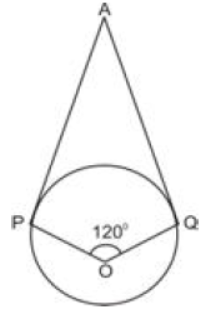
Question 8. In the given figure, if AP and AQ are two tangents is to circle with center O such that ∟POQ = 120° Then ∟PAQ is equal to
(A) 60°
(B) 70°
(C) 80°
(D) 100°
Answer: (A) 60°
In simple words: The angle at the center and the angle between the tangents add up to 180 degrees, so \( \angle PAQ = 180^\circ - 120^\circ = 60^\circ \).
Exam Tip: Keep the supplementary relationship between the center angle and the tangent inclination in mind for quick angle calculations.
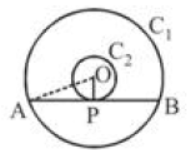
Question 9. If in the given figure radius of smaller and larger circles be 4 and 5 cm. Find the length of chord AB.
(A) 6 cm
(B) 8 cm
(C) 10 cm
(D) 12 cm
Answer: (A) 6 cm
In simple words: In concentric circles, the perpendicular from the center bisects the chord. The half-chord length is \( \sqrt{5^2 - 4^2} = 3 \text{ cm} \), which gives a total chord length of 6 cm.
Exam Tip: Drawing the radius of the larger circle to the endpoint of the chord creates a right triangle that makes this calculation easy.
Question 10. From a point A the length of the tangent to a circle is 8 cm and distance of A from the center is 10 cm. The diameter of circle is:
(A) 6 cm
(B) 12 cm
(C) 14 cm
(D) 16 cm
Answer: (B) 12 cm
In simple words: Using Pythagoras' theorem, the radius of the circle is \( \sqrt{10^2 - 8^2} = 6 \text{ cm} \). This means the diameter is \( 2 \times 6 = 12 \text{ cm} \).
Exam Tip: Be sure to read whether the question asks for the radius or the diameter in the final step.
Question 11. Two equal circles of radius r intersect such that each passes through the center of the other. The length of the common chord is .
(A) \(\sqrt{r}\)
(B) \(r\sqrt{2}\)
(C) \(r\sqrt{3}\)
(D) \(\frac{r\sqrt{3}}{2}\)
Answer: (C) \(r\sqrt{3}\)
In simple words: The distance between the centers is the radius \( r \). The common chord is bisected perpendicularly, forming a right-angled triangle with hypotenuse \( r \) and base \( r/2 \). The full chord length is \( 2 \times \sqrt{r^2 - (r/2)^2} = r\sqrt{3} \).
Exam Tip: This intersecting circles problem forms two equilateral triangles sharing a common base, so the chord is twice the altitude of an equilateral triangle of side \(r\).
Question 12. The common point of a tangent to circle and the circle is called:
(A) Centre
(B) Normal point
(C) Common point
(D) Point of contact
Answer: (D) Point of contact
In simple words: The single specific point where the tangent line touches the circle's boundary is called the point of contact.
Exam Tip: Remember this term - many theorems specifically refer to the "radius through the point of contact".
Question 13. A tangent AB at point A of a circle of radius 6 cm meets a line through center O at a point such that OB = 8m. The length of AB is:
(A) 12 cm
(B) 10 cm
(C) 8 cm
(D) \(2\sqrt{7} \text{ cm}\)
Answer: (D) \(2\sqrt{7} \text{ cm}\)
In simple words: Since \( OA \perp AB \), the triangle OAB is right-angled at A. Using Pythagoras' theorem: \( AB = \sqrt{OB^2 - OA^2} = \sqrt{8^2 - 6^2} = \sqrt{28} = 2\sqrt{7} \text{ cm} \).
Exam Tip: Simplify your square roots completely - write \(\sqrt{28}\) as its simplified surd form \(2\sqrt{7}\) as shown in the options.
Question 14. A line intersect the circle in two point is called:
(A) Tangent
(B) Secant
(C) Normal
(D) None of these
Answer: (B) Secant
In simple words: A line that passes through a circle and cuts across it at two distinct points is called a secant line.
Exam Tip: A tangent touches at one point whereas a secant passes through and intersects at two points. Keep this distinction clear.
Question 15. A circle may have:
(A) 2 tangents
(B) 4 tangents
(C) 8 tangents
(D) Infinite tangents
Answer: (D) Infinite tangents
In simple words: A circle consists of infinitely many points along its perimeter, and a distinct tangent line can be drawn at each of these points.
Exam Tip: Be sure to read the question carefully - a circle has infinite tangents in total, but only a maximum of two parallel tangents can exist at a time.
Question 16. How many parallel tangent a circle can have?
(A) 2
(B) 4
(C) 5
(D) 6
Answer: (A) 2
In simple words: Parallel tangents can only be drawn at the exact opposite ends of a diameter, which means a circle can have at most two parallel tangents at any given time.
Exam Tip: Parallel tangents are always drawn at the endpoints of a diameter, which is why the maximum number of parallel tangents is 2.
Question 17. How many tangents can be drawn from a point lying outsides to circle?
(A) one
(B) two
(C) four
(D) 5 infinite
Answer: (B) two
In simple words: From any single point situated outside a circle, you can draw exactly two unique tangent lines to the circle's boundary.
Exam Tip: Remember: zero tangents can be drawn from an internal point, one tangent from a point on the circle, and exactly two tangents from an external point.
Question 18. The tangents drawn at the ends of a diameters of a circle are:
(A) normal
(B) parallel to each other
(C) equal to each other
(D) none of these
Answer: (B) parallel to each other
In simple words: Tangents drawn at the ends of a diameter are perpendicular to the same line segment, which makes them parallel to each other.
Exam Tip: This is a standard proof question as well. Since both tangents make a \(90^\circ\) angle with the diameter, their alternate interior angles are equal, making them parallel.
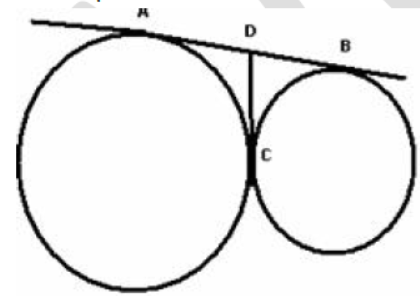
Question 19. In the given Fig., AB and CD are two common tangents to the two touching circles. If DC = 4 cm then AB is equal to
(A) 4cm
(B) 6cm
(C) 8 cm
(D) 12 cm
Answer: (C) 8 cm
In simple words: The common tangent segment DC bisects AB, so that \( AD = DC = 4 \text{ cm} \) and \( BD = DC = 4 \text{ cm} \). This gives a total length of \( AB = 4 + 4 = 8 \text{ cm} \).
Exam Tip: The intersection point of the common tangents acts as an external point from which equal tangent segments are drawn to both circles.
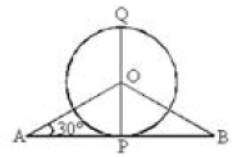
Question 20. In the given figure O is the center of circle and AB is tangent to circle. If PQ = 10 cm and ∟PAQ = 30° Then length of AB is
(A) 5 cm
(B) 10 cm
(C) \(\frac{20}{\sqrt{3}} \text{ cm}\)
(D) 15 cm
Answer: (C) \(\frac{20}{\sqrt{3}} \text{ cm}\)
In simple words: In right-angled triangle QPA (with \( \angle AQP = 30^\circ \)), the tangent length \( AP = \frac{10}{\sqrt{3}} \text{ cm} \). Since P is the midpoint, the entire length of the tangent \( AB = 2 \times AP = \frac{20}{\sqrt{3}} \text{ cm} \).
Exam Tip: Use trigonometric ratios like \(\tan(30^\circ)\) in the right-angled triangle formed by the diameter and the tangent line to solve for the missing segments.
Question 21. The lengths of two tangents from an external point to a circle are:
(A) equal
(B) unequal
(C) double
(D) none of these
Answer: (A) equal
In simple words: Any two tangent line segments drawn from the same external starting point to a circle are always identical in length.
Exam Tip: This theorem is the foundation for almost all calculations in Class X circle geometry. Always cite it during descriptive answers.
Question 22. Choose the correct statement/statements:
(A) Parallelogram circumscribing a circle is a rhombus.
(B) Tangents drawn at the ends of a diameter of a circle are equal.
(C) In two concentric circles he chord of the larger circle, which touches the smaller circle is bisected at the point of contact.
(D) All are correct
Answer: (D) All are correct
In simple words: All three geometric statements represent verified, fundamental theorems of circle geometry.
Exam Tip: Knowing these three statements as standard facts helps you solve complex descriptive problems much faster by directly applying them.
Question 23. A tangent PQ at a point P of a circle of radius 5 cm meets a line through the center O at a point Q so that OQ = 12 cm. Length PQ is:
(A) 12 cm
(B) 13 cm
(C) 8.5 cm
(D) \(\sqrt{119}\) cm
Answer: (D) \(\sqrt{119}\) cm
In simple words: Since \( OP \perp PQ \), the triangle OPQ is right-angled at P. Using Pythagoras' theorem: \( PQ = \sqrt{OQ^2 - OP^2} = \sqrt{12^2 - 5^2} = \sqrt{119} \text{ cm} \).
Exam Tip: A very common trap is to assume the hypotenuse is 12 and the tangent is 13. Remember that the line from the center to the external point (\(OQ\)) is always the hypotenuse.
Question 24. A tangent PQ at a point P of a circle of radius 6 cm meets a line through center O at a point Q so that OQ = 12 cm, length PQ is
(A) 12 cm
(B) 6 cm
(C) \(6\sqrt{3}\) cm
(D) 18 cm
Answer: (C) \(6\sqrt{3}\) cm
In simple words: Using Pythagoras' theorem on the right triangle OPQ: \( PQ = \sqrt{12^2 - 6^2} = \sqrt{108} = 6\sqrt{3} \text{ cm} \).
Exam Tip: Express your radical answers in their simplest surd form to match the multiple-choice options.
Question 25. If tangent PA and PB from a point P to a circle with center O are inclined to each other at an angle 30° then AOB is equal to:
(A) 50°
(B) 60°
(C) 70°
(D) 150°
Answer: (D) 150°
In simple words: The angle between the tangents and the center angle are supplementary, so \( \angle AOB = 180^\circ - 30^\circ = 150^\circ \).
Exam Tip: Opposite angles in the quadrilateral formed by the center, point of contact, and external point always sum to \(180^\circ\).
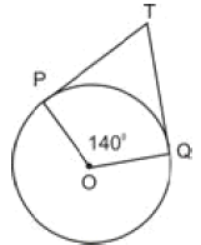
Question 26. In the figure shown below if TP and TQ are two tangents to a circle with centre O so that POQ = 140° then ZPTQ is equal to
(A) 40°
(B) 60°
(C) 80°
(D) 100°
Answer: (A) 40°
In simple words: The center angle and the angle between the tangents are supplementary, so \( \angle PTQ = 180^\circ - 140^\circ = 40^\circ \).
Exam Tip: This basic angle relationship is highly predictable - always use \(180^\circ\) subtraction to find the opposite angle.
Question 27. In a circle with center O, AB and CD are two diameters perpendicular to each other. The length of the chord AC is .
(A) 2AB
(B) \(\sqrt{2}\) AB
(C) \(\frac{1}{2}\) AB
(D) \(\frac{1}{\sqrt{2}}\) AB
Answer: (D) \(\frac{1}{\sqrt{2}}\) AB
In simple words: Let \( r \) be the radius. The diameter \( AB = 2r \). The right triangle AOC has legs \( r \) and \( r \), so \( AC = r\sqrt{2} \). Substituting \( r = AB/2 \) gives \( AC = \frac{AB}{\sqrt{2}} = \frac{1}{\sqrt{2}} AB \).
Exam Tip: Use variable \(r\) for the radius to simplify algebraic relations before substituting the diameter term back in.
Question 28. The tangent to a circle is …………… to the radius through the point of contact:
(A) parallel
(B) coincident
(C) perpendicular
(D) none of these
Answer: (C) perpendicular
In simple words: The tangent line makes an exact 90-degree angle with the radius drawn to the point of contact.
Exam Tip: This theorem is the foundation of almost all coordinate geometry and trigonometry applications in circle chapters.
Question 29. In figure if AB=AC, prove that BE=EC.
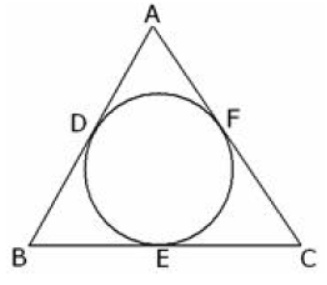
Answer: Let the circle touch the sides \( AB, AC, \) and \( BC \) of the triangle at \( D, F, \) and \( E \) respectively.
By the theorem of equal tangent lengths from an external point:
\( AD = AF \) (tangents from \( A \)) - (Equation 1)
\( BD = BE \) (tangents from \( B \)) - (Equation 2)
\( CE = CF \) (tangents from \( C \)) - (Equation 3)
We are given that:
\( AB = AC \)
\( \implies AD + BD = AF + CF \)
Subtracting Equation 1 (\( AD = AF \)) from both sides:
\( BD = CF \)
Now, using Equation 2 and Equation 3 to substitute these values:
\( BE = EC \).
Hence proved.
In simple words: Since the main sides of the triangle are equal, the paths from the top corner to the circle are equal. This leaves the remaining side segments equal, forcing the contact point at the base to lie exactly in the middle.
Exam Tip: Ensure that you explicitly write down the three sets of equal tangent pairs at each vertex before combining them in your proof.
Question 30. A point P is 13 cm from the centre of the circle. The length of the tangent drawn from P to the circle is 12 cm. Find the radius of the circle.
Answer: Let \( O \) be the center of the circle, and let \( T \) be the point of contact of the tangent drawn from point \( P \).
Since \( OT \perp PT \), the triangle OTP is right-angled at T.
Using Pythagoras' theorem:
\( OP^2 = OT^2 + PT^2 \)
\( \implies 13^2 = r^2 + 12^2 \)
\( \implies 169 = r^2 + 144 \)
\( \implies r^2 = 25 \implies r = 5 \text{ cm} \).
Therefore, the radius of the circle is 5 cm.
In simple words: The radius, tangent, and center-line form a right triangle. Using Pythagoras' theorem on 13 and 12 gives a radius of 5.
Exam Tip: This uses the standard Pythagorean triple \((5, 12, 13)\), which helps you verify your calculation instantly.
Question 31. In fig. AQ and AR are tangents from A to the circle with centre O. P is a point on the circle. Prove that AB+BP=AC+CP
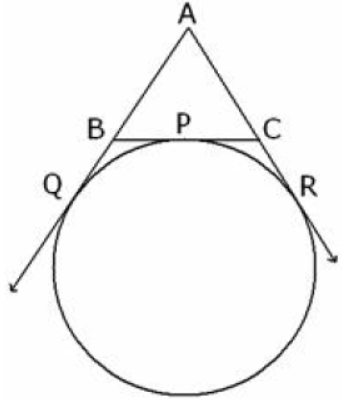
Answer: Since \( AQ \) and \( AR \) are tangents drawn from the external point \( A \) to the circle:
\( AQ = AR \) - (Equation 1)
Since the tangent line at \( P \) meets \( AQ \) at \( B \) and \( AR \) at \( C \), the segments from \( B \) and \( C \) are also equal:
\( BP = BQ \) (tangents from \( B \))
\( CP = CR \) (tangents from \( C \))
Now, from Equation 1:
\( AQ = AR \)
\( \implies AB + BQ = AC + CR \)
Replacing \( BQ \) with \( BP \) and \( CR \) with \( CP \):
\( AB + BP = AC + CP \).
Hence proved.
In simple words: The two main outer tangents are equal. Substituting the smaller matching tangent segments along the boundary keeps the sum of the paths equal on both sides.
Exam Tip: Label each tangent segment on your rough diagram to ensure your segment addition steps are clear and error-free.
Question 32. Prove that the segment joining the points of contact of two parallel tangents passes through the centre.
Answer: Let \( AB \) and \( CD \) be two parallel tangents to a circle with center \( O \), touching at points \( P \) and \( Q \) respectively.
We need to prove that the line segment \( PQ \) passes through the center \( O \).
Since \( AB \parallel CD \), the sum of consecutive interior angles is \( 180^\circ \).
Draw a line \( EF \) through \( O \) parallel to \( AB \) (and hence also parallel to \( CD \)).
The radius \( OP \) is perpendicular to tangent \( AB \), so \( \angle OPA = 90^\circ \). Since \( AB \parallel EF \), the alternate interior angle \( \angle POF = 90^\circ \).
Similarly, the radius \( OQ \) is perpendicular to tangent \( CD \), so \( \angle OQC = 90^\circ \). Since \( CD \parallel EF \), the alternate interior angle \( \angle QOF = 90^\circ \).
Now, sum of angles at \( O \):
\( \angle POF + \angle QOF = 90^\circ + 90^\circ = 180^\circ \).
Since the sum is \( 180^\circ \), the line \( POQ \) is a straight line, which means the segment \( PQ \) passes through the center \( O \).
Hence proved.
In simple words: Since parallel lines make right angles with the circle's radius at the points of contact, drawing a parallel line through the center shows that the two angles add up to 180 degrees, forming a straight diameter line.
Exam Tip: Constructing the auxiliary parallel line \(EF\) through the center \(O\) is the key step to proving collinearity.
Question 33. Two concentric circles have radii 5 cm and 3 cm . Find the length of the chord of the larger circle which touches the smaller circle.
Answer: Let \( AB \) be the chord of the larger circle of radius \( R = 5 \text{ cm} \) that is tangent to the inner circle of radius \( r = 3 \text{ cm} \).
The radius of the inner circle is perpendicular to the chord at the point of contact, bisecting it.
The half-chord length is:
\( \text{Half-chord} = \sqrt{R^2 - r^2} = \sqrt{5^2 - 3^2} = \sqrt{25 - 9} = \sqrt{16} = 4 \text{ cm} \).
The total length of the chord \( AB \) is:
\( AB = 2 \times 4 = 8 \text{ cm} \).
Therefore, the length of the chord is 8 cm.
In simple words: The inner radius and half-chord form a right triangle with the outer radius. Solving this gives a base of 4, which we double to get a total chord length of 8.
Exam Tip: This concentric circle chord problem uses the standard \((3,4,5)\) Pythagorean triple - make sure to multiply by 2 for the final chord length.
Question 34. Two tangents TP and TQ are drawn to a circle with centre O from an external point T. Prove that ∠PTQ = 2∠OPQ
Answer: Let \( \angle PTQ = \theta \).
Since \( TP = TQ \) (tangents from an external point are equal), the triangle \( TPQ \) is an isosceles triangle.
Therefore, the base angles are equal:
\( \angle TPQ = \angle TQP = \frac{180^\circ - \theta}{2} = 90^\circ - \frac{\theta}{2} \) - (Equation 1)
Since the radius \( OP \) is perpendicular to the tangent \( TP \), we have:
\( \angle OPT = 90^\circ \)
Now, find \( \angle OPQ \):
\( \angle OPQ = \angle OPT - \angle TPQ = 90^\circ - \left(90^\circ - \frac{\theta}{2}\right) = \frac{\theta}{2} \)
\( \implies 2 \angle OPQ = \theta \)
Since \( \theta = \angle PTQ \):
\( \angle PTQ = 2 \angle OPQ \).
Hence proved.
In simple words: The triangle near the external point has equal sides, so its corner angles are equal. Since the tangent is perpendicular to the radius, subtracting the corner angle from 90 degrees leaves exactly half of the main angle.
Exam Tip: This is a very common 6-mark board exam proof. Write down each angle relationship step-by-step to ensure full credit.
Question 35. A triangle ABC is drawn to circumscribe a circle of radius 4 cm such that the segments BD and DC into which BC is divided by the point of contact D are of lengths 8 cm an 6 cm respectively. Find the sides AB and AC.
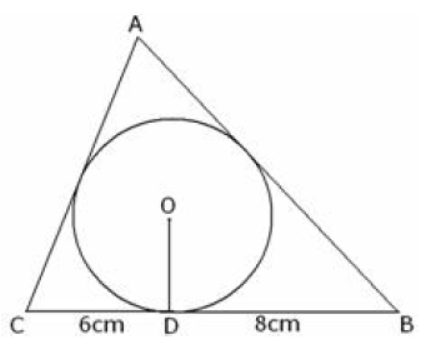
Answer: Let the circle touch \( AB \) at \( F \) and \( AC \) at \( E \).
Since \( BD = 8 \text{ cm} \implies BF = 8 \text{ cm} \).
Since \( CD = 6 \text{ cm} \implies CE = 6 \text{ cm} \).
Let \( AF = AE = x \).
The sides of \( \Delta ABC \) are:
\( a = BC = 8 + 6 = 14 \text{ cm} \)
\( b = AC = x + 6 \)
\( c = AB = x + 8 \)
The semi-perimeter \( s \) is:
\( s = \frac{14 + (x+6) + (x+8)}{2} = x + 14 \).
The area of \( \Delta ABC \) using Heron's formula is:
\( \text{Area} = \sqrt{s(s-a)(s-b)(s-c)} = \sqrt{(x+14)(x)(8)(6)} = \sqrt{48x(x+14)} \) - (Equation 1)
Also, the area using the inradius \( r = 4 \text{ cm} \) is:
\( \text{Area} = r \times s = 4(x + 14) \) - (Equation 2)
Equating both area equations:
\( 4(x+14) = \sqrt{48x(x+14)} \)
Squaring both sides:
\( 16(x+14)^2 = 48x(x+14) \)
Since \( x+14 \neq 0 \), dividing both sides by \( 16(x+14) \):
\( x+14 = 3x \implies 2x = 14 \implies x = 7 \text{ cm} \).
The sides are:
\( AB = x + 8 = 7 + 8 = 15 \text{ cm} \)
\( AC = x + 6 = 7 + 6 = 13 \text{ cm} \).
Therefore, the sides are 15 cm and 13 cm.
In simple words: Represent the sides in terms of an unknown \(x\). Find the area using both Heron's formula and the inradius-perimeter formula, then equate them to solve for \(x\) and find the sides.
Exam Tip: This long 6-mark problem is highly predictable. Be sure to show both Heron's formula and the \(r \times s\) area equations clearly.
Question 36. A circle is touching the side BC of ∆ABC at P and touching AB and AC produced at Q and R respectively. Prove that AQ = 1/2 (Perimeter of ∆ABC)
Answer: The perimeter of \( \Delta ABC \) is the sum of its three sides:
\( \text{Perimeter} = AB + BC + AC = AB + (BP + CP) + AC \) - (Equation 1)
Since lengths of tangents from an external point are equal:
\( BP = BQ \) (tangents from \( B \))
\( CP = CR \) (tangents from \( C \))
\( AQ = AR \) (tangents from \( A \))
Substitute \( BP = BQ \) and \( CP = CR \) into Equation 1:
\( \text{Perimeter} = AB + BQ + AC + CR \)
\( \implies \text{Perimeter} = AQ + AR \)
Since \( AQ = AR \):
\( \text{Perimeter} = 2 AQ \)
\( \implies AQ = \frac{1}{2} (\text{Perimeter of } \Delta ABC) \)
Hence proved.
In simple words: The perimeter of the triangle is exactly equal to the sum of the two long outer tangents from point A. Since both tangents are equal, one of them is exactly half of the total perimeter.
Exam Tip: Practice this derivation as it is one of the most frequently asked proofs in CBSE Class X board exams.
Question 37. If all the sides of a parallelogram touch a circle, show that the parallelogram is a rhombus.
Answer: Let \( ABCD \) be a parallelogram circumscribed about a circle.
We know that for any quadrilateral circumscribed about a circle, the sum of opposite sides is equal:
\( AB + CD = AD + BC \) - (Equation 1)
Since \( ABCD \) is a parallelogram, its opposite sides are equal:
\( AB = CD \)
\( AD = BC \)
Substitute these values into Equation 1:
\( AB + AB = AD + AD \)
\( \implies 2AB = 2AD \)
\( \implies AB = AD \)
Since the adjacent sides of the parallelogram are equal, all four sides of the parallelogram must be equal.
Therefore, \( ABCD \) is a rhombus.
Hence proved.
In simple words: For any shape circumscribing a circle, opposite sides added together are equal. Since a parallelogram already has equal opposite sides, this rule forces adjacent sides to be equal too, making it a rhombus.
Exam Tip: Be sure to write out the basic property \(AB + CD = AD + BC\) before applying the parallelogram properties to keep your proof complete.
Question 38. In fig. ABC is a right-angled at B such that BC=6 cm and AB=8 cm. Find the radius of its incircle.
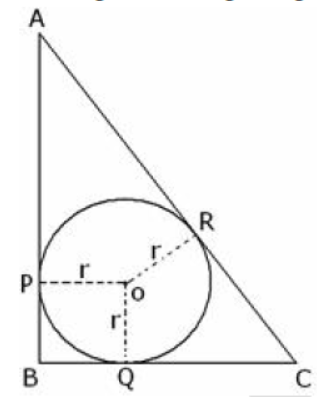
Answer: In right-angled triangle \( ABC \) with \( \angle B = 90^\circ \):
Using Pythagoras' theorem to find the hypotenuse \( AC \):
\( AC = \sqrt{AB^2 + BC^2} = \sqrt{8^2 + 6^2} = \sqrt{64 + 36} = 10 \text{ cm} \).
Using the standard right-triangle inradius formula:
\( r = \frac{AB + BC - AC}{2} \)
\( \implies r = \frac{8 + 6 - 10}{2} = \frac{4}{2} = 2 \text{ cm} \)
Therefore, the radius of the incircle is 2 cm.
In simple words: Find the hypotenuse first using Pythagoras' theorem (which is 10). Then, add the two shorter sides, subtract the hypotenuse, and divide by 2 to get the radius.
Exam Tip: This is a standard 6-mark or 3-mark problem. Proving the formula \( r = \frac{a+b-c}{2} \) can also be done using tangent segments for full descriptive credit.
Free study material for Mathematics
Free CBSE Practice Worksheets: Class 10 Mathematics Chapter 10 Circles
Practice Exercises for Class 10 Mathematics Chapter 10 Circles
Access structured practice worksheets for Chapter 10 Circles aligned with the 2026 CBSE curriculum. These downloadable exercises for Class 10 Mathematics help students build accuracy and reinforce core concepts for upcoming school tests.
Step-by-Step Solutions and Practice Guidelines
Each worksheet draws directly from authorized standard textbooks to maintain academic accuracy. Evaluating your finished exercises against expert-verified solutions helps master the formal presentation standards expected in school evaluations.
Enhance Speed with Online Practice
Wrap up your chapter revision by testing your knowledge against standard objective question formats. Explore our full library of free, up-to-date printable assignments to maximize your academic results in upcoming CBSE evaluations.
FAQs
You can download the latest chapter-wise printable worksheets for Class 10 Mathematics Chapter 10 Circles for free from StudiesToday.com. These have been made as per the latest CBSE curriculum for this academic year.
Yes, Class 10 Mathematics worksheets for Chapter 10 Circles focus on activity-based learning and also competency-style questions. This helps students to apply theoretical knowledge to practical scenarios.
Yes, we have provided solved worksheets for Class 10 Mathematics Chapter 10 Circles to help students verify their answers instantly.
Yes, our Class 10 Mathematics test sheets are mobile-friendly PDFs and can be printed by teachers for classroom.
For Chapter 10 Circles, regular practice with our worksheets will improve question-handling speed and help students understand all technical terms and diagrams.