

Official Class 10 Mathematics Worksheets: Chapter 10 Circles
Access comprehensive chapter-wise worksheets for Chapter 10 Circles using the CBSE Class 10 Mathematics Circles Worksheet Set 02. Designed to align with the 2026-27 academic syllabus for Class 10 Mathematics, these printable practice sets help students reinforce key concepts and improve their overall exam readiness.
Solved Practice Worksheets for Mathematics
Access the complete worksheet PDF for Class 10 Mathematics below. Regular practice with these targeted academic tasks builds familiarity with standard question patterns and helps secure higher marks in final school examinations.
Question. PQ is a tangent drawn from a point P to a circle with centre O and QOR is a diameter of the circle such that ∠POR = 120°, then ∠OPQ is
(a) 60°
(b) 45°
(c) 30°
(d) 90°
Answer: C
Question. If a regular hexagon is inscribed in a circle of radius r, then its perimeter is
(a) 3r
(b) 6r
(c) 9r
(d) 12r
Answer: B
Question. AB and CD are two chords of a circle intersecting at the point P outside the circle. If PA = 12 cm, CD = 7cm and PC = 15 cm, then AB is equal to
(a) 15.5 cm
(b) 4 cm
(c) 8 cm
(d) 10 cm
Answer: A
Question. In two concentric circles, if chords are drawn in the outer circle which touch the inner circle, then
(a) all chords are of different lengths.
(b) all chords are of same length.
(c) only parallel chords are of same length.
(d) only perpendicular chords are of same length.
Answer: B
Question. Number of tangents to a circle which are parallel to a secant, is
(a) 3
(b) 2
(c) 1
(d) infinite
Answer: B
Question. AB and CD are two common tangents to circles which touch each other at a point C. If D lies on AB such that CD = 4 cm, then AB is
(a) 12 cm
(b) 8 cm
(c) 4 cm
(d) 6 cm
Answer: B
Question. Two circles, both of radii a touch each other and each of them touches internally a circle of radius 2a. Then the radius of the circle which touches all the three circles is
(a) (1/2)a
(b) (2/3)a
(c) (3/4)a
(d) a
Answer: B
Question. Let ABCD be a square of side length 1, and G a circle passing through B and C, and touching AD. The radius of G is
(a) 3/8
(b) 1/2
(c) 1/√2
(d) 5/8
Answer: D
Question. Three circles of radii 1, 2 and 3 units respectively touch each other externally in the plane. The circumradius of the triangle formed by joining the centers of the circles is
(a) 1.5
(b) 2
(c) 2.5
(d) 3
Answer: C
Question. The length of tangent drawn from a point Q to a circle is 24 cm and distance of Q from the centre of circle is 25 cm. The radius of circle is
(a) 7 cm
(b) 12 cm
(c) 15 cm
(d) 24.5 cm
Answer: A
Question. Which of the following is a cyclic quadrilateral?
(a) Rhombus
(b) Rectangle
(c) Parallelogram
(d) Trapezium
Answer: B
Question. Which of the following is/are not correct?
(a) A secant is a line that intersects a circle in two distinct points.
(b) In a circle, the perpendicular from the centre to a chord bisects the chord.
(c) The point common to a circle and its tangent is called the point of contact.
(d) Adjacent angles of a cyclic quadrilateral are supplementary.
Answer: D
Question. Which of the following statement(s) is / are not correct ?
(a) The length of tangent from an external point P on circle with centre O is always less than OP.
(b) The tangent to the circumcircle of an isosceles triangle ABC at A, in which AB = AC, is parallel to BC.
(c) If angle between two tangents drawn from a point P to a circle of radius ‘a’ and centre ‘O’is 90°, then OP = a√2.
(d) None of these
Answer: D
Question. Which of the following statement(s) is/are correct?
(a) If a chord AB subtends an angle of 60° at the centre of a circle, then angle between the tangents at A and B is also 60°.
(b) The length of tangent from an external point on a circle is always greater than the radius of the circle.
(c) If a number of circle touch a given line segment PQ at a point A, then their centres lie on the perpendicular bisector of PQ.
(d) None of these
Answer: D
Question. Which of the following statement(s) is/are incorrect?
(a) Angle between the tangent line and the radius at the point of contact is 90°.
(b) A circle can have two parallel tangents atmost.
(c) The distance between two parallel tangents drawn to a circle is equal to twice of radius.
(d) A line intersecting a circle in two points is called a chord.
Answer: D
Question. A tangent PQ at a point P of a circle of radius 5 cm meets a line through the centre O at a point Q so that OQ = 12 cm. Length PQ is :
(a) 12 cm
(b) 13 cm
(c) 8.5 cm
(d) √119 cm
Answer: D
Question. If tangents PA and PB from a point P to a circle with centre O are inclined to each other at an angle of 80°, then ∠POA is equal to
(a) 50°
(b) 60°
(c) 70°
(d) 80°
Answer: A
Question. If angle between two radii of a circle is 130°, the angle between the tangents at the ends of the radii is :
(a) 90°
(b) 50°
(c) 70°
(d) 40°
Answer: B
DIRECTIONS : Study the given Case/Passage and answer the following questions.
Case/Passage-I
A Ferris wheel (or a big wheel in the United Kingdom) is an amusement ride consisting of a rotating upright wheel with multiple passenger-carrying components (commonly referred to as passenger cars, cabins, tubs, capsules, gondolas, or pods) attached to the rim in such a way that as the wheel turns, they are kept upright, usually by gravity. After taking a ride in Ferris wheel, Aarti came out from the crowd and was observing her friends who were enjoying the ride . She was curious about the different angles and measures that the wheel will form. She forms the figure as given below.
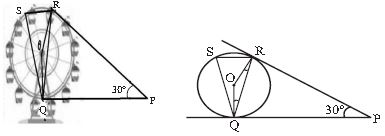
Question. In the given figure find ∠ROQ
(a) 60
(b) 100
(c) 150
(d) 90
Answer: C
Question. Find ∠RQP
(a) 75
(b) 60
(c) 30
(d) 90
Answer: A
Question. Find ∠RSQ
(a) 60
(b) 75
(c) 100
(d) 30
Answer: B
Question. Find ∠ORP
(a) 90
(b) 70
(c) 100
(d) 60
Answer: A
Case/Passage-II
Varun has been selected by his School to design logo for Sports Day T-shirts for students and staff. The logo design is as given in the figure and he is working on the fonts and different colours according to the theme.

In given figure, a circle with centre O is inscribed in a ΔABC, such that it touches the sides AB, BC and CA at points D, E and F respectively. The lengths of sides AB, BC and CA are 12 cm, 8 cm and 10 cm respectively.
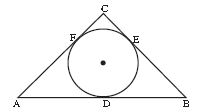
Question. Find the length of AD
(a) 7
(b) 8
(c) 5
(d) 9
Answer: A
Question. Find the Length of BE
(a) 8
(b) 5
(c) 2
(d) 9
Answer: B
Question. Find the length of CF
(a) 9
(b) 5
(c) 2
(d) 3
Answer: D
Question. If radius of the circle is 4cm, Find the area of ΔOAB
(a) 20
(b) 36
(c) 24
(d) 48
Answer: C
Question. Find area of ΔABC
(a) 50
(b) 60
(c) 100
(d) 90
Answer: B
Assertion & Reason
DIRECTIONS : Each of these questions contains an Assertion followed by Reason. Read them carefully and answer the question on the basis of following options. You have to select the one that best describes the two statements.
(a) If both Assertion and Reason are correct and Reason is the correct explanation of Assertion.
(b) If both Assertion and Reason are correct, but Reason is not the correct explanation of Assertion.
(c) If Assertion is correct but Reason is incorrect.
(d) If Assertion is incorrect but Reason is correct.
Question. Assertion: If in a circle, the radius of the circle is 3 cm and distance of a point from the centre of a circle is 5 cm, then length of the tangent will be 4 cm.
Reason:(hypotenuse)2 = (base)2 + (height)2
Answer: A
Question. Assertion: If in a cyclic quadrilateral, one angle is 40°, then the opposite angle is 140°
Reason: Sum of opposite angles in a cyclic quadrilateral is equal to 360°
Answer: C
Question. Assertion: If length of a tangent from an external point to a circle is 8 cm, then length of the other tangent from the same point is 8 cm.
Reason: length of the tangents drawn from an external point to a circle are equal.
Answer: A
Fill in the Blanks
DIRECTIONS : Complete the following statements with an appropriate word / term to be filled in the blank space(s).
Question. A tangent to a circle touches it at ............... point (s).
Answer: One
Question. A line intersecting a circle at two points is called a ...........
Answer: Secant
Question. A circle can have .............. parallel tangents at the most.
Answer: Two
Question. The common point of a tangent to a circle and the circle is called .................. .
Answer: Point of contact
Question. There is no tangent to a circle passing through a point lying ............ the circle.
Answer: inside
Question. The tangent to a circle is .............. to the radius through the point of contact.
Answer: perpendicular
Question. There are exactly two tangents to a circle passing through a point lying ........... the circle.
Answer: outside
Question. The lengths of the two tangents from an external point to a circle are ............. .
Answer: equal
Question. The tangents drawn at the ends of a diameter of a circle are .................. .
Answer: Parallel
True / False
DIRECTIONS : Read the following statements and write your answer as true or false.
Question. The tangent to a circle is a special case of the secant.
Answer: True
Question. The perpendicular at the point of contact to the tangent to a circle does not pass through the centre.
Answer: False
Question. A circle can have at the most two parallel tangents.
Answer: True
Question. If P is a point on a circle with centre C, then the line drawn through P and perpendicular to CP is the tangent to the circle at the point P.
Answer: True
Question. The centre of the circle lies on the bisector of the angle between the two tangents.
Answer: True
Question. A tangent to a circle is a line that intersects the circle at only one point.
Answer: True
Question. Two equal chords of a circle are always parallel.
Answer: False
Question. A line drawn from the centre of a circle to a chord always bisects it.
Answer: False
Question. Line joining the centers of two intersecting circles always bisect their common chord.
Answer: True
Question. In a circle, two chords PQ and RS bisect each other. Then PRQS is a rectangle.
Answer: True
Write True or False and justify your answer in each of the following:
Question. Two chords AB and CD of a circle are each at distances 4 cm from the centre. Then AB = CD.
Answer: We know that chords equidistant from the centre of a circle are equal.
Here we are given that two chords AB and CD of a circle are each at distance 4 cm (equidistance) from the centre of a circle. So, chords are equal, i.e., AB = CD.
Hence, the given statement is true.
Question. Two congruent circles with centres O and O′ intersect at two points A and B. Then ∠AOB = ∠AO′ B.
Answer: The given statement is true because equal chords of congruent circles subtend equal angles at the respective centre.
Question. A circle of radius 3 cm can be drawn through two points A, B such that AB = 6 cm.
Answer: Radius of circle = 3 cm,
∴ Diameter of circle = 2 × r = 2 × 3 cm = 6 cm
Now, AB = 6 cm, so the given statement is true because AB will be the diameter.
Question. ABCD is a cyclic quadrilateral such that ∠A = 90°, ∠B = 70°, ∠C = 95° and ∠D = 105°.
Answer: We know that opposite angles of a cyclic quadrilateral are supplementary.
Here, sum of opposite angles is not. 180º
∠A+∠C = 90° + 95° =185°
Hence, ABCD is not a cyclic quadrilateral. The given statement is false.
Question. If A, B, C and D are four points such that ∠BAC = 45° and ∠BDC = 45°, then A, B, C, D are concyclic.
Answer: The given statement is true, because the two angles ∠BAC = 45° and ∠BDC = 45° are in the same segment of a circle.
Question. In Fig. 10.3, if OA = 5 cm, AB = 8 cm and OD is perpendicular to AB, then CD is equal to:
(A) 2 cm
(B) 3 cm
(C) 4 cm
(D) 5 cm
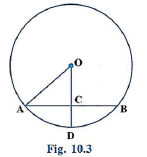
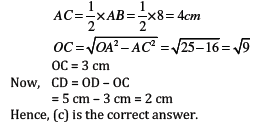
Answer: As perpendicular from the centre to a chord bisect the chord,
Question. In Fig.10.4, if ∠ABC = 20º, then ∠AOC is equal to:
(A) 20º
(B) 40º
(C) 60º
(D) 10º
Answer: Arc AC of a circle subtends AOC at the centre O and ABC at a point B on the remaining part of the circle,
∴ ∠AOC = 2∠ABC
= 2×20º ×40º
Hence, (b) is the correct answer.
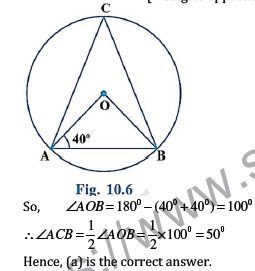
Question. In Fig. 10.6, if ∠OAB = 40º, then ∠ACB is equal to:
(A) 50º
(B) 40º
(C) 60º
(D) 70°
Answer: In ΔOAB,
OA = OB [Radii of circle]
∴∠OAB = ∠OBA = 40º
[∵Angles opposite to equal sides are equal]
Question. ABCD is a cyclic quadrilateral such that AB is a diameter of the circle circumscribing it and ∠ADC = 140º, then ∠BAC is equal to:
(A) 80º
(B) 50º
(C) 40º
(D) 30º

Answer: ∠ADC +∠ABC =180º
⇒ 140º +∠ABC =180º
∠ABC =180º −140º = 40º
ABCD is a cyclic quadrilateral such that AB is the diameter of the circle circumscribing it.
Now, Join AC.∠C = 90º
[∵Angle in a semi-circle is a right angle]
InDABC,we have
∠BAC =180 (90º + 40º )
0 = 50º
Hence, (b) is the correct answer.
Question. In Fig. 10.8, BC is a diameter of the circle and ∠BAO = 60º. Then ∠ADC is equal to:
(A) 30º
(B) 45º
(C) 60º
(D) 120º
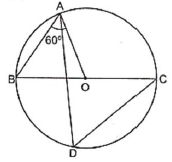
Answer: In ΔOAB, we have
OA = OB [Radii of the same circle]
∴ ∠ABO = ∠BAO [Angles opp. To equal sides are equal]
∴ ∠ABO = ∠BAO = 60º [Given]
Now, ∠ADC = ∠ABC = 60º
[∵ ∠ABC and ∠ADC are angles in the same segment of a circle, are equal]
Hence, ∠ADC = 60º
So, (c) is the correct answer.
1. Two tangents PA and PB are drawn from an external point P to a circle with centre o. Prove that AOBP is a cyclic quadrilateral
2. Prove that the parallelogram circumscribing a circle is a rhombus
3. Two tangents PQ and PR are drawn to a circle with centre o from an external point P. `prove that Angle QPR = 2 angle OQR
4. If circle is inscribed in a ΔABC having sides 8 cm ,10 cm, 12 cm as shown in the figure. Find AD, BE and CF C
10cm F E 8 cm
A D B
12 cm
5. A circle is touching the side BC of a triangle ABC at P and AB and AC produced at Q and R respectively
Prove that AQ = AR = ½ perimeter of triangle ABC
6. in the isosceles ΔABC, AB = AC, show that BE = EC
E
B C
A
7. In the figure, PA and PB are tangents from P to the circle with centre O. LN touches the circle at M,
Then show that PL + LM = PN+ NM
A L
O M P
B N
8. The tangent at any point of a circle is perpendicular to the radius through point of contact. Prove it
9. Two concentric circles are of radii 7 cm and r cm, where r > 7. A chord of the larger circle, of length 48 cm touches the smaller circle. Find the value of r ( 25 cm)
10. In figure a triangle ABC is drawn to circumscribe a circle of radius 2 cm such that the tangents BD And DC into which BC is divided by the point of contact Dare the lengths 4 cm and 3 cm. If area of ΔABC = 21 cm2, then find the lengths of sides AB and AC (7.5 cm, 6.5 cm)
11. Prove that the lengths of the tangents drawn from an external point to a circle are equal
12. Two tangents PA and PB are drawn to the circle with centre o such that ˪APB = 120⁰. Prove that OP = 2 AP
13. Two concentric circles are of radii 13 cm and 5 cm. Find the length of the chord of the larger circle Which touches the smaller circle (24 cm)
14. Prove that the intercept of a tangent between a pair of parallel tangents to a circle subtend a right Angle at the centre of the circle
Please click the below link to access CBSE Class 10 Circles (2)
Circles
Question 1. Two tangents PA and PB are drawn from an external point P to a circle with centre o. Prove that AOBP is a cyclic quadrilateral
Answer: Let us consider a circle with center \( O \) and two tangents \( PA \) and \( PB \) drawn from an external point \( P \).
The radius drawn to the point of contact is perpendicular to the tangent line at that point.
Therefore, \( OA \perp PA \) and \( OB \perp PB \).
This gives:
\( \angle OAP = 90^\circ \)
\( \angle OBP = 90^\circ \)
In quadrilateral \( AOBP \), the sum of all interior angles is \( 360^\circ \):
\( \angle OAP + \angle AOB + \angle OBP + \angle APB = 360^\circ \)
Substitute the values of \( \angle OAP \) and \( \angle OBP \):
\( 90^\circ + \angle AOB + 90^\circ + \angle APB = 360^\circ \)
\( 180^\circ + \angle AOB + \angle APB = 360^\circ \)
\( \angle AOB + \angle APB = 180^\circ \)
Since the sum of the opposite angles in the quadrilateral \( AOBP \) is \( 180^\circ \), \( AOBP \) is a cyclic quadrilateral.
In simple words: The angles between the tangents and radii at the touching points are both 90 degrees. Since these opposite angles add up to 180 degrees, the quadrilateral must be cyclic.
Exam Tip: State clearly that the radius is perpendicular to the tangent at the point of contact, as this is the key theorem used in this proof.
Question 2. Prove that the parallelogram circumscribing a circle is a rhombus
Answer: Let \( ABCD \) be a parallelogram circumscribing a circle with center \( O \). Let the circle touch the sides \( AB, BC, CD, \) and \( DA \) at points \( P, Q, R, \) and \( S \) respectively.
The lengths of tangents drawn from an external point to a circle are equal. Therefore, we have:
\( AP = AS \)
\( BP = BQ \)
\( CR = CQ \)
\( DR = DS \)
Adding these four equations together:
\( (AP + BP) + (CR + DR) = (AS + DS) + (BQ + CQ) \)
This simplifies to:
\( AB + CD = AD + BC \)
Since \( ABCD \) is a parallelogram, its opposite sides are equal, meaning \( AB = CD \) and \( AD = BC \). Substituting these into the equation:
\( AB + AB = AD + AD \)
\( 2AB = 2AD \)
\( \implies AB = AD \)
Since the adjacent sides of the parallelogram are equal, all four sides must be equal to each other (\( AB = BC = CD = DA \)).
Thus, \( ABCD \) is a rhombus.
In simple words: The sum of opposite sides of any shape drawn around a circle is equal. Since opposite sides of a parallelogram are already equal, all its sides must be equal, making it a rhombus.
Exam Tip: Group your tangent addition steps carefully so they pair up directly to form the full sides of the quadrilateral.
Question 3. Two tangents PQ and PR are drawn to a circle with centre o from an external point P. `prove that Angle QPR = 2 angle OQR
Answer: Let the angle between the two tangents be \( \angle QPR = \theta \).
Since tangents drawn from an external point are equal in length, we have \( PQ = PR \).
Therefore, \( \triangle PQR \) is an isosceles triangle, which means \( \angle PQR = \angle PRQ \).
The sum of angles in \( \triangle PQR \) is \( 180^\circ \):
\( \angle QPR + \angle PQR + \angle PRQ = 180^\circ \)
\( \theta + 2\angle PQR = 180^\circ \)
\( \angle PQR = 90^\circ - \frac{\theta}{2} \)
We know that the radius \( OQ \) is perpendicular to the tangent \( PQ \), so \( \angle OQP = 90^\circ \).
Now, let us find \( \angle OQR \):
\( \angle OQR = \angle OQP - \angle PQR \)
\( \angle OQR = 90^\circ - \left(90^\circ - \frac{\theta}{2}\right) = \frac{\theta}{2} \)
\( \angle OQR = \frac{1}{2} \angle QPR \)
\( \implies \angle QPR = 2\angle OQR \).
Hence proved.
In simple words: The angle between the chord and the tangent is equal to half the angle at the external point, showing that the main angle is double this value.
Exam Tip: Clearly write down the relation \( \angle OQP = 90^\circ \) to show how you perform the angle subtraction.
Question 4. If circle is inscribed in a ∆ABC having sides 8 cm ,10 cm, 12 cm as shown in the figure. Find AD, BE and CF
Answer: Let the points of contact of the inscribed circle with the sides \( AB, BC, \) and \( AC \) be \( D, E, \) and \( F \) respectively.
Let \( AD = x \), \( BE = y \), and \( CF = z \).
Since lengths of tangents from an external point are equal:
\( AF = AD = x \)
\( BD = BE = y \)
\( CE = CF = z \)
Given the side lengths of \( \triangle ABC \):
\( AB = x + y = 12 \text{ cm} \)
\( BC = y + z = 8 \text{ cm} \)
\( AC = x + z = 10 \text{ cm} \)
Adding these three equations:
\( 2(x + y + z) = 12 + 8 + 10 = 30 \)
\( \implies x + y + z = 15 \)
Now, we can solve for \( x, y, \) and \( z \):
\( x = (x + y + z) - (y + z) = 15 - 8 = 7 \text{ cm} \)
\( y = (x + y + z) - (x + z) = 15 - 10 = 5 \text{ cm} \)
\( z = (x + y + z) - (x + y) = 15 - 12 = 3 \text{ cm} \).
Therefore, we find:
\( AD = 7 \text{ cm} \)
\( BE = 5 \text{ cm} \)
\( CF = 3 \text{ cm} \).
In simple words: By setting up equal tangent segments from each vertex, we get a system of equations that lets us easily solve for the three lengths as 7 cm, 5 cm, and 3 cm.
Exam Tip: Summing all three equations first to find the value of \( x+y+z \) is the fastest way to solve this type of problem.
Question 5. A circle is touching the side BC of a triangle ABC at P and AB and AC produced at Q and R respectively Prove that AQ = AR = ½ perimeter of triangle ABC
Answer: Tangents drawn from an external point to a circle are equal in length.
From point \( A \), the tangents are \( AQ \) and \( AR \):
\( AQ = AR \quad \text{--- (Equation 1)} \)
From point \( B \), the tangents are \( BQ \) and \( BP \):
\( BQ = BP \quad \text{--- (Equation 2)} \)
From point \( C \), the tangents are \( CR \) and \( CP \):
\( CR = CP \quad \text{--- (Equation 3)} \)
Now, let us calculate the perimeter of \( \triangle ABC \):
\( \text{Perimeter} = AB + BC + AC \)
\( \text{Perimeter} = AB + (BP + CP) + AC \)
Using the substitutions from Equation 2 and Equation 3:
\( \text{Perimeter} = AB + BQ + CR + AC \)
\( \text{Perimeter} = (AB + BQ) + (AC + CR) \)
\( \text{Perimeter} = AQ + AR \)
Using Equation 1, we can write:
\( \text{Perimeter} = 2AQ \)
\( \implies AQ = \frac{1}{2} \text{ Perimeter of } \triangle ABC \).
Since \( AQ = AR \), we have:
\( AQ = AR = \frac{1}{2} \text{ perimeter of } \triangle ABC \).
Hence proved.
In simple words: The tangents from the main vertex are equal, and by breaking down the other sides into smaller equal tangent segments, we show they add up to the triangle's perimeter.
Exam Tip: Group adjacent terms together like \( (AB+BQ) \) clearly to show how they form the complete tangent lines \( AQ \) and \( AR \).
Question 6. in the isosceles ∆ABC, AB = AC, show that BE = EC
Answer: Let the circle touch the sides \( AB, AC, \) and \( BC \) at points \( D, F, \) and \( E \) respectively.
The lengths of tangents from each external vertex to the circle are equal:
\( AD = AF \)
\( BD = BE \)
\( CF = CE \)
We are given that \( \triangle ABC \) is isosceles with \( AB = AC \):
\( AB = AC \)
\( AD + BD = AF + CF \)
Subtract \( AD = AF \) from both sides:
\( BD = CF \)
Since \( BD = BE \) and \( CF = CE \), we get:
\( BE = CE \).
Therefore, \( BE = EC \).
Hence proved.
In simple words: Because the two main sides of the triangle are equal, the remaining segments that touch the third side must also be equal.
Exam Tip: Clearly write down which pairs of tangents are equal based on their originating external vertices.
Question 7. In the figure, PA and PB are tangents from P to the circle with centre O. LN touches the circle at M, Then show that PL + LM = PN+ NM
Answer: Tangents drawn from an external point to a circle are equal in length.
For external point \( P \):
\( PA = PB \quad \text{--- (Equation 1)} \)
For external point \( L \) with tangents \( LA \) and \( LM \):
\( LA = LM \quad \text{--- (Equation 2)} \)
For external point \( N \) with tangents \( NB \) and \( NM \):
\( NB = NM \quad \text{--- (Equation 3)} \)
We can rewrite Equation 1 by splitting the tangent segments:
\( PL + LA = PN + NB \)
Substitute the values from Equation 2 and Equation 3 into this relation:
\( PL + LM = PN + NM \).
Hence proved.
In simple words: Since the main tangents from P are equal, we can rewrite them by splitting them at the touching points. Substituting the smaller equal tangents proves the identity.
Exam Tip: Identify all three external points (\( P, L, N \)) clearly in your proof to justify the equal tangent substitutions.
Question 8. The tangent at any point of a circle is perpendicular to the radius through point of contact. Prove it
Answer: Let us consider a circle with center \( O \) and a tangent line \( XY \) that touches the circle at point \( P \).
We need to prove that \( OP \perp XY \).
Take any point \( Q \) on the tangent line \( XY \) other than \( P \). Join \( OQ \).
Since the tangent touches the circle at exactly one point \( P \), the point \( Q \) must lie outside the circle.
Therefore, the distance \( OQ \) is greater than the radius of the circle \( OP \):
\( OQ > OP \).
This inequality holds true for any point \( Q \) chosen on the line \( XY \) other than \( P \).
This means that \( OP \) is the shortest distance from the center \( O \) to the line \( XY \).
Since the shortest distance from a point to a line is always perpendicular, we have:
\( OP \perp XY \).
Hence proved.
In simple words: Any point on the tangent line other than the point of contact lies outside the circle, meaning the radius is the shortest path to the line, which makes it perpendicular.
Exam Tip: State clearly that any point on the tangent line other than the point of contact must lie in the exterior region of the circle.
Question 9. Two concentric circles are of radii 7 cm and r cm, where r > 7. A chord of the larger circle, of length 48 cm touches the smaller circle. Find the value of r
Answer: Let \( O \) be the common center. The radius of the inner circle is \( OP = 7 \) cm, and the radius of the outer circle is \( OA = r \) cm.
Let \( AB \) be the chord of the outer circle that is tangent to the inner circle at point \( P \). Thus, \( AB = 48 \) cm.
Since the radius \( OP \) is perpendicular to the tangent chord \( AB \):
\( OP \perp AB \).
A perpendicular line drawn from the center of a circle to a chord bisects the chord:
\( AP = PB = \frac{48}{2} = 24 \text{ cm} \).
In the right-angled \( \triangle OPA \), by Pythagoras' theorem:
\( OA^2 = OP^2 + AP^2 \)
\( r^2 = 7^2 + 24^2 \)
\( r^2 = 49 + 576 = 625 \)
\( r = \sqrt{625} = 25 \text{ cm} \).
Therefore, the value of \( r \) is 25 cm.
In simple words: The perpendicular from the center splits the 48 cm chord into two equal halves of 24 cm. Using a right-angled triangle with sides 7 cm and 24 cm, the hypotenuse (radius r) is 25 cm.
Exam Tip: State both the tangent perpendicularity theorem and the chord bisection theorem to secure full marks for this question.
Question 10. In figure a triangle ABC is drawn to circumscribe a circle of radius 2 cm such that the tangents BD And DC into which BC is divided by the point of contact Dare the lengths 4 cm and 3 cm. If area of ∆ABC = 21 cm2, then find the lengths of sides AB and AC
Answer: Let the circle with center \( O \) and radius \( r = 2 \) cm touch the sides \( BC, AC, \) and \( AB \) at points \( D, E, \) and \( F \) respectively.
Given \( BD = 4 \) cm and \( CD = 3 \) cm.
Since lengths of tangents from an external point are equal:
\( BF = BD = 4 \text{ cm} \)
\( CE = CD = 3 \text{ cm} \)
Let the remaining tangent segments be \( AF = AE = x \).
The sides of the triangle are:
\( a = BC = BD + CD = 4 + 3 = 7 \text{ cm} \)
\( b = AC = AE + CE = x + 3 \)
\( c = AB = AF + BF = x + 4 \).
The semi-perimeter \( s \) is:
\( s = \frac{a + b + c}{2} = \frac{7 + (x+3) + (x+4)}{2} = \frac{2x + 14}{2} = x + 7 \).
The area of \( \triangle ABC \) is equal to the sum of the areas of \( \triangle OBC, \triangle OCA, \) and \( \triangle OAB \):
\( \text{Area} = \frac{1}{2} a \cdot r + \frac{1}{2} b \cdot r + \frac{1}{2} c \cdot r \)
\( \text{Area} = \frac{1}{2} r (a + b + c) = r \cdot s \).
We are given the area is 21 \( \text{cm}^2 \) and the radius \( r = 2 \) cm:
\( 21 = 2(x + 7) \)
\( 21 = 2x + 14 \)
\( 2x = 7 \)
\( \implies x = 3.5 \text{ cm} \).
Now, we can find the side lengths:
\( AB = x + 4 = 3.5 + 4 = 7.5 \text{ cm} \)
\( AC = x + 3 = 3.5 + 3 = 6.5 \text{ cm} \).
Therefore, the side lengths are \( AB = 7.5 \) cm and \( AC = 6.5 \) cm.
In simple words: The area of a circumscribed triangle is equal to its semi-perimeter multiplied by the circle's radius. Solving this simple relation gives x = 3.5 cm, making the sides 7.5 cm and 6.5 cm.
Exam Tip: Expressing the total area as the sum of three smaller triangles is much faster and less prone to calculation errors than using Heron's formula.
Question 11. Prove that the lengths of the tangents drawn from an external point to a circle are equal
Answer: Let us consider a circle with center \( O \), and let two tangents \( PA \) and \( PB \) be drawn from an external point \( P \).
We need to prove that \( PA = PB \).
Join \( OA, OB, \) and \( OP \).
In \( \triangle OAP \) and \( \triangle OBP \):
\( OA = OB \) (Radii of the same circle)
\( \angle OAP = \angle OBP = 90^\circ \) (Radius is perpendicular to the tangent at the point of contact)
\( OP = OP \) (Common side)
Therefore, by the Right Angle-Hypotenuse-Side (RHS) congruence criterion:
\( \triangle OAP \cong \triangle OBP \).
By Corresponding Parts of Congruent Triangles (CPCT):
\( PA = PB \).
Hence proved.
In simple words: By drawing lines to form two right-angled triangles, we can show they are congruent using the RHS rule, which proves the tangents are equal.
Exam Tip: This is a key theorem in circle geometry; make sure you practice drawing the labeled diagram accurately.
Question 12. Two tangents PA and PB are drawn to the circle with centre o such that ˪APB = 120⁰. Prove that OP = 2 AP
Answer: Let \( PA \) and \( PB \) be two tangents drawn from an external point \( P \) to the circle with center \( O \).
We know that the line segment connecting the center to the external point bisects the angle between the tangents:
\( \angle APO = \angle BPO = \frac{120^\circ}{2} = 60^\circ \).
Since the radius \( OA \) is perpendicular to the tangent \( PA \), \( \triangle OAP \) is a right-angled triangle at \( A \).
In the right-angled \( \triangle OAP \):
\( \cos(\angle APO) = \frac{\text{Adjacent}}{\text{Hypotenuse}} = \frac{AP}{OP} \)
\( \cos(60^\circ) = \frac{AP}{OP} \)
Substitute \( \cos(60^\circ) = \frac{1}{2} \):
\( \frac{1}{2} = \frac{AP}{OP} \)
\( \implies OP = 2AP \).
Hence proved.
In simple words: The center line splits the 120-degree angle into two 60-degree halves. In the right-angled triangle formed, using the cosine ratio of 60 degrees directly proves that OP = 2AP.
Exam Tip: Trigonometric ratios are highly effective tools for solving circular tangent problems involving specific angles.
Question 13. Two concentric circles are of radii 13 cm and 5 cm. Find the length of the chord of the larger circle Which touches the smaller circle
Answer: Let \( O \) be the common center. The outer radius is \( R = 13 \) cm, and the inner radius is \( r = 5 \) cm.
Let \( AB \) be the chord of the outer circle that touches the inner circle at point \( P \).
Therefore, \( OP \perp AB \) and \( OP = 5 \) cm.
In the right-angled \( \triangle OPA \), by Pythagoras' theorem:
\( OA^2 = OP^2 + AP^2 \)
\( 13^2 = 5^2 + AP^2 \)
\( 169 = 25 + AP^2 \)
\( AP^2 = 144 \)
\( \implies AP = 12 \text{ cm} \).
Since the perpendicular line from the center to a chord bisects it:
\( AB = 2 \cdot AP = 2 \times 12 = 24 \text{ cm} \).
Therefore, the length of the chord is 24 cm.
In simple words: A right-angled triangle is formed with hypotenuse 13 cm and height 5 cm, making the base 12 cm. Doubling this base gives the chord length as 24 cm.
Exam Tip: This uses a standard Pythagorean triplet (5-12-13). Recognizing it instantly helps you double-check your calculations.
Question 14. Prove that the intercept of a tangent between a pair of parallel tangents to a circle subtend a right Angle at the centre of the circle
Answer: Let \( XY \) and \( X'Y' \) be two parallel tangents to a circle with center \( O \). Let \( AB \) be the intercepting tangent line segment that touches the circle at point \( C \).
We need to prove that \( \angle AOB = 90^\circ \).
Let \( P \) and \( Q \) be the points of contact of the parallel tangents \( XY \) and \( X'Y' \) respectively. Join \( OC \).
In \( \triangle OPA \) and \( \triangle OCA \):
\( OP = OC \) (Radii)
\( AP = AC \) (Tangents from external point \( A \))
\( OA = OA \) (Common side)
Therefore, \( \triangle OPA \cong \triangle OCA \), which gives:
\( \angle POA = \angle COA \quad \text{--- (Equation 1)} \).
Similarly, in \( \triangle OQB \) and \( \triangle OCB \):
\( \triangle OQB \cong \triangle OCB \), which gives:
\( \angle QOB = \angle COB \quad \text{--- (Equation 2)} \).
Since \( XY \parallel X'Y' \), the line segment \( PQ \) passing through the center is a straight diameter line:
\( \angle POA + \angle COA + \angle COB + \angle QOB = 180^\circ \)
Using the relations from Equation 1 and Equation 2:
\( 2\angle COA + 2\angle COB = 180^\circ \)
\( 2(\angle COA + \angle COB) = 180^\circ \)
\( \angle AOB = 90^\circ \).
Hence proved.
In simple words: By showing that the triangles at the top are congruent and those at the bottom are congruent, we sum their angles along the straight diameter line to prove the middle angle is exactly 90 degrees.
Exam Tip: Explicitly mention that \( PQ \) is a straight diameter line because the tangent lines at its endpoints are parallel.
Question 15. PQ is a chord of length 16 cm of a circle of radius 10 cm . The tangent at P and Q intersect at T. Find the length of PT
Answer: Let \( O \) be the center of the circle. Let \( OT \) intersect the chord \( PQ \) at point \( M \).
Since the line joining the center to the external point of intersection bisects the chord perpendicularly:
\( PM = \frac{16}{2} = 8 \text{ cm} \).
In the right-angled \( \triangle OMP \):
\( OM^2 = OP^2 - PM^2 = 10^2 - 8^2 = 100 - 64 = 36 \)
\( \implies OM = 6 \text{ cm} \).
Now, let us consider \( \triangle OMP \) and \( \triangle OPT \). Since \( \angle OMP = \angle OPT = 90^\circ \) and \( \angle POM \) is common, the triangles are similar:
\( \triangle OMP \sim \triangle OPT \).
Taking the ratio of corresponding sides:
\( \frac{PT}{PM} = \frac{OP}{OM} \)
\( \frac{PT}{8} = \frac{10}{6} \)
\( PT = \frac{80}{6} = \frac{40}{3} \approx 13.33 \text{ cm} \).
Therefore, the length of the tangent \( PT \) is \( \frac{40}{3} \) cm (or approximately 13.33 cm).
In simple words: We find OM = 6 cm using Pythagoras' theorem. Then, by using similar triangles, we calculate the tangent length PT to be 13.33 cm.
Exam Tip: Similar triangles offer a much faster and cleaner way to solve this common problem than using simultaneous quadratic equations.
Question 16. Prove that opposite sides of a quadrilateral circumscribing a circle subtend supplementary angles at the centre of the circle
Answer: Let \( ABCD \) be a quadrilateral circumscribing a circle with center \( O \). Let the circle touch the sides \( AB, BC, CD, \) and \( DA \) at points \( P, Q, R, \) and \( S \) respectively.
Join \( OP, OQ, OR, OS \) and the vertices \( OA, OB, OC, OD \).
Since tangents from an external point subtend equal angles at the center:
\( \triangle OPA \cong \triangle OSA \implies \angle 1 = \angle 2 \)
\( \triangle OPB \cong \triangle OQB \implies \angle 3 = \angle 4 \)
\( \triangle OQC \cong \triangle ORC \implies \angle 5 = \angle 6 \)
\( \triangle ORD \cong \triangle OSD \implies \angle 7 = \angle 8 \).
The sum of all angles around the point \( O \) is \( 360^\circ \):
\( \angle 1 + \angle 2 + \angle 3 + \angle 4 + \angle 5 + \angle 6 + \angle 7 + \angle 8 = 360^\circ \)
Substitute the equal angle values:
\( 2\angle 2 + 2\angle 3 + 2\angle 6 + 2\angle 7 = 360^\circ \)
\( 2(\angle 2 + \angle 3 + \angle 6 + \angle 7) = 360^\circ \)
\( (\angle 2 + \angle 3) + (\angle 6 + \angle 7) = 180^\circ \)
\( \angle AOB + \angle COD = 180^\circ \).
Similarly, we can prove:
\( \angle BOC + \angle AOD = 180^\circ \).
Hence proved.
In simple words: By showing that the triangles sharing matching tangent sides have equal central angles, we add them all up to 360 degrees to prove the opposite angles sum to 180 degrees.
Exam Tip: Numbering the 8 central angles in your diagram is a very helpful trick to make this proof simple to write and grade.
Question 17. Point P is26 cm away from the centre o of a circle and the lengths PT of the tangent drawn from P to Circle is 24 cm. Then the radius of the circle is
(a) 25 cm
(b) 26 cm
(c) 24 cm
(d) 10 cm
Answer: (d) 10 cm
In simple words: The radius, tangent, and center-line form a right triangle. Since \( \sqrt{26^2 - 24^2} = 10 \), the radius is exactly 10 cm.
Exam Tip: Use the difference-of-squares identity \( 26^2 - 24^2 = (26-24)(26+24) = 2 \times 50 = 100 \) to simplify the square root calculation.
Question 18. If two tangents inclined at an angle of 60⁰ are drawn to a circle of radius 3 cm, then the length of each Tangent is equal to
(a) \( \frac{3\sqrt{3}}{2} \) cm
(b) \( 2\sqrt{3} \) cm
(c) \( 3\sqrt{3} \) cm
(d) \( 6 \) cm
Answer: (c) \( 3\sqrt{3} \) cm
In simple words: The 60-degree angle is split into 30-degree halves. Using the trigonometric ratio \( \tan(30^\circ) \) with the 3 cm radius gives the tangent length as \( 3\sqrt{3} \) cm.
Exam Tip: Trigonometric ratios like \( \tan(30^\circ) \) are highly effective for calculating lengths in tangent problems.
Question 19. In fig AB, AC and PQ are tangents, If AB = 5 cm, then perimeter of ∆APQ is
Answer: Let the circle touch \( AB \) at \( B \), \( AC \) at \( C \), and \( PQ \) at point \( R \).
Lengths of tangents from an external vertex are equal:
\( AB = AC = 5 \text{ cm} \)
\( PR = PB \)
\( QR = QC \).
The perimeter of \( \triangle APQ \) is:
\( \text{Perimeter} = AP + AQ + PQ \)
\( \text{Perimeter} = AP + AQ + (PR + QR) \)
Using the equal tangent relations:
\( \text{Perimeter} = (AP + PB) + (AQ + QC) \)
\( \text{Perimeter} = AB + AC = 5 + 5 = 10 \text{ cm} \).
Therefore, the perimeter of \( \triangle APQ \) is 10 cm.
In simple words: The perimeter of the triangle is equal to the sum of the two main tangents, which is 5 + 5 = 10 cm.
Exam Tip: Remember the general rule: the perimeter of \( \triangle APQ \) is always exactly equal to twice the length of the tangent \( AB \).
Question 20. In figure PQ and PR are tangents to a circle with centre A. If ι QPA = 27⁰ , then ι QAR equals
(a) 63⁰
(b) 153⁰
(c) 126⁰
(d) 117⁰
Answer: (c) 126⁰
In simple words: The angle \( \angle QPA \) is half of the total angle at P, which is 54 degrees. Since the central angle and the angle between tangents are supplementary, the central angle is 180 - 54 = 126 degrees.
Exam Tip: The angle between two tangents and the angle subtended by the line segments joining the points of contact at the center are always supplementary.
Question 21. The length of the tangent drawn from a point 8 cm away from the centre of a circle of radius 6 cm is
(a) \( \sqrt{7} \) cm
(b) \( 2\sqrt{7} \) cm
(c) 10 cm
(d) 5 cm
Answer: (b) \( 2\sqrt{7} \) cm
In simple words: The tangent length is the third side of a right triangle: \( \sqrt{8^2 - 6^2} = \sqrt{28} = 2\sqrt{7} \) cm.
Exam Tip: Make sure you do not confuse the distance from the center (hypotenuse) with the radius or tangent length.
Question 22. TP, TQ are two tangents to a circle with centre o. so that m < POQ = 100⁰ then m < PTQ is equal to
(a) 60⁰
(b) 70⁰
(c) 80⁰
(d) 90⁰
Answer: (c) 80⁰
In simple words: The central angle and the tangent angle add up to 180 degrees. Thus, 180 - 100 = 80 degrees.
Exam Tip: This supplementary relationship is a standard, easy way to solve short questions on circles.
Question 23. Two circles are intersecting externally at a point , then the number of common tangents drawn are
(a) 2
(b) 3
(c) 4
(d) no common tangent
Answer: (b) 3
In simple words: Two externally touching circles can have three shared tangent lines: one transverse line through the touching point and two direct outer boundary lines.
Exam Tip: Sketch the circles to easily visualize and count the common tangent lines.
Question 24. A parallelogram circumscribing a circle is a
(a) square
(b) rectangle
(c) rhombus
(d) trapezium
Answer: (c) rhombus
In simple words: Any parallelogram drawn around a circle must have equal side lengths, which makes it a rhombus.
Exam Tip: This is a standard theorem that is very frequently tested in multiple-choice formats.
Question 25. I n the figure PA and PB are tangents to the circle with centre o. If < APB = 60⁰, then <OAB is
(a) 30⁰
(b) 60⁰
(c) 90⁰
(d) 15⁰
Answer: (a) 30⁰
In simple words: The triangle formed by the tangents is equilateral, making its base angles 60 degrees. Since the radius is perpendicular to the tangent, the inner angle is 90 - 60 = 30 degrees.
Exam Tip: Use the direct shortcut formula: \( \angle OAB = \frac{1}{2} \angle APB \). Here, \( \frac{60^\circ}{2} = 30^\circ \).
Free study material for Mathematics
Chapter 10 Circles Printable Worksheets and Exercises for Class 10 Mathematics
Practice Exercises for Class 10 Mathematics Chapter 10 Circles
Access structured practice worksheets for Chapter 10 Circles aligned with the 2026 CBSE curriculum. These downloadable exercises for Class 10 Mathematics help students build accuracy and reinforce core concepts for upcoming school tests.
Step-by-Step Solutions and Practice Guidelines
Each worksheet draws directly from authorized standard textbooks to maintain academic accuracy. Evaluating your finished exercises against expert-verified solutions helps master the formal presentation standards expected in school evaluations.
Enhance Speed with Online Practice
Wrap up your chapter revision by testing your knowledge against standard objective question formats. Explore our full library of free, up-to-date printable assignments to maximize your academic results in upcoming CBSE evaluations.
FAQs
You can download the latest chapter-wise printable worksheets for Class 10 Mathematics Chapter 10 Circles for free from StudiesToday.com. These have been made as per the latest CBSE curriculum for this academic year.
Yes, Class 10 Mathematics worksheets for Chapter 10 Circles focus on activity-based learning and also competency-style questions. This helps students to apply theoretical knowledge to practical scenarios.
Yes, we have provided solved worksheets for Class 10 Mathematics Chapter 10 Circles to help students verify their answers instantly.
Yes, our Class 10 Mathematics test sheets are mobile-friendly PDFs and can be printed by teachers for classroom.
For Chapter 10 Circles, regular practice with our worksheets will improve question-handling speed and help students understand all technical terms and diagrams.