

Chapter-wise Worksheets for Class 10 Mathematics: Chapter 11 Areas related to Circles
Explore structured practice materials through the CBSE Class 10 Mathematics Areas Related To Circles Worksheet Set 06. Tailored for Class 10 learners, utilizing these Mathematics worksheets ensures thorough preparation and strengthens problem-solving accuracy before final school evaluations.
Practice Class 10 Mathematics Worksheets: Chapter 11 Areas related to Circles
Navigate directly to the solved Mathematics worksheets using the digital viewer below. Each practice set includes detailed step-by-step solutions, allowing students to instantly cross-check their work and identify areas requiring further revision.
Question. The perimeter (in cm) of a square circumscribing a circle of radius a cm is
(a) 2a
(b) 4a
(c) 6a
(d) 8a
Answer: D
Question. It is proposed to build a single circular park equal in area to the sum of areas of two circular parks of diameters 16 m and 12 m in a locality. The radius of the new park is
(a) 10 m
(b) 12 m
(c) 15 m
(d) 18 m
Answer: A
Question. The area of the largest triangle that can be inscribed in a semi-circle of radius r units will be
(a) r sq. units
(b) r /2 sq. units
(c) r2 sq. units
(d) 2r sq. units
Answer: C
Question. In the given figure, O is the centre of the circle whose diameter is 14 cm.
Find the perimeter of the figure. (Use π = 22/7).
(a) 134cm
(b) 124cm
(c) 112cm
(d) 160cm
Answer: A
Question. A horse is tied to a pole with 28 m long rope. The perimeter of the field where the horse can graze is (Take π = 22/7)
(a) 60 cm
(b) 85 cm
(c) 124 cm
(d) 176 cm
Answer: D
Question. The area of the sector of a circle of radius 5 cm, if the corresponding arc length is 3.5 cm is
(a) 3.25 cm2
(b) 8.75 cm2
(c) 4.60 cm2
(d) 5.50 cm2
Answer: B
Question. The area of an equilateral triangle is 17320.5 cm2. With each vertex as centre, a circle is described with radius equal to half the length of the side of the triangle. The area of the triangle not included in the circles is (Use π = 3.14 and 3 = 1.73205).
(a) 1620.51 cm2
(b) 1810.25 cm2
(c) 2430.60 cm2
(d) None of the options
Answer: A
Question. ABCD is a square of side 4 cm. At each corner of the square, a quarter circle of radius 1 cm, and at the centre, a circle of radius 1 cm, are drawn, as shown in the given figure. The area of the shaded region is
(a) 8.46 cm2
(b) 7.25 cm2
(c) 9.71 cm2
(d) 10.43 cm2
Answer: C
Question. The radii of two circles are 8 cm and 6 cm respectively. The radius of the circle having area equal to the sum of the areas of the two circles is
(a) 5 cm
(b) 10 cm
(c) 12 cm
(d) 15 cm
Answer: B
Question. A regular hexagon is inscribed in a circle of radius 14 cm. Find the area of the circle falling outside the hexagon.
(a) 106.79 cm2
(b) 241.8 cm2
(c) 79.27 cm2
(d) 173.9 cm2
Answer: A
Question. A car has two wipers which do not overlap. Each wiper has a blade of length 21 cm sweeping through an angle 120°. The total area cleaned at each sweep of the blades is [Take π = 7/ 22 ]
(a) 360 cm2
(b) 448 cm2
(c) 556 cm2
(d) 924 cm
Answer: D
Question. If the perimeter and area of a circle are numerically equal; its radius will be
(a) 1 unit
(b) 2 units
(c) 4 units
(d) None of the options
Answer: B
Question. In a circular table cover of radius 32 cm, a design is formed having an equilateral triangle ABC in the middle, as shown below. The area of the design is
(a) 777.36 cm2
(b) 1888.11 cm2
(c) 2010.54 cm2
(d) None of the options
Answer: B
Question. An athlete runs on a circular track of radius 49 m and covers a distance of 3080 m along its boundary. How many rounds has he taken to cover this distance ? [Take π = 22 / 7]
(a) 5
(b) 8
(c) 10
(d) 15
Answer: C
Question. A square shaped bus shelter is supported on four circular poles-The circumference of each pole is ‘x’ m and the length of each side of the shelter is ‘y’ m. Find the area of the unsupported part of the shelter.
(a) (x2 – y2/p)m2
(b) (y2 + x2/p)m2
(c) (x2 – y2/p)m2
(d) (y2 – x2/p)m2
Answer: D
Question. The area of the largest circle that can be drawn inside the given rectangle of length ‘a’ cm and breadth ‘b’ cm (a > b) is
(a) 1/ 2 πb2 cm2
(b) 1/ 3 πb2 cm2
(c) 1/ 4 πb2 cm2
(d) π b2 cm2
Answer: C
Question. A wheel has diameter 84 cm. Number of complete revolutions must it make to cover 792 metres will be
(a) 100
(b) 160
(c) 220
(d) 300
Answer: D
Question. What is the area of the circle that can be inscribed in a square of side 6 cm?
(a) 9 π cm2
(b) 11 π cm2
(c) 16 π cm2
(d) 15 π cm2
Answer: A
Question. A sector of120° cut out from a circle has an area of 9 , 3/7 . What is the radius of the circle?
(a) 3cm
(b) 2.5 cm
(c) 3.5 cm
(d) 3.6 cm
Answer: A
Question. The difference of the areas of two segments of a circle formed by a chord of radius 5 cm subtending an angle of 90° at the centre is
(a) (25π/4 − 25/2) cm2
(b) (15π/ 4 − 7/ 2) cm2
(c) (7π/ 4 − 3/ 2) cm2
(d) None of the options
Answer: A
Question. The areas of two circles are in the ratio 9 : 4, then what is the ratio of their circumferences?
(a) 1 : 2
(b) 2 : 1
(c) 3 : 2
(d) 2 : 3
Answer: C
Question. The area of the square that can be inscribed in a circle of radius 8 cm is
(a) 256 cm2
(b) 128 cm2
(c) 64 √2 cm2
(d) 64 cm2
Answer: B
Question. A square ABCD is inscribed in a circle of radius 10 units. The area of the circle, not included in the square is (Take π = 3.14)
(a) 84 cm2
(b) 108 cm2
(c) 114 cm2
(d) 122 cm
Answer: C
Question. Find the area of the sector of a circle, whose radius is 6 m when the angle at the centre is 42° .
(a) 13. 2m2
(b) 14. 2m2
(c) 13. 4m2
(d) 14. 4m2
Answer: A
Question. The area of the shaded portion in the figure, given below, where a circular arc of radius 6 cm has been drawn with vertex O of an equilateral triangle OAB of side 12 cm as centre is
(a) 156.64 cm2
(b) 188.46 cm2
(c) 256.64 cm2
(d) 310.25 cm2
Answer: A
Question. An arc of length 15.7 cm subtends a right angle at the centre of the circle. Then the radius of the circle is
(a) 20 cm
(b) 10 cm
(c) 15 cm
(d) 12 cm
Answer: B
Question. What is The area of a sector of a circle of radius 16 cm cut off by an arc which is 18.5 cm long?
(a) 168 cm2
(b) 148 cm2
(c) 154 cm2
(d) 176 cm2
Answer: B
Question. The diameter of a circle whose circumference is equal to the sum of the circumference of the two circles of diameters 36 cm and 20 cm is
(a) 22 cm
(b) 32 cm
(c) 56 cm
(d) 84 cm
Answer: C
Question. What is the perimeter of a semi circular protractor whose diameter is 14cm?
Answer: 36 cm
Question. What is the radius of the circle whose circumference and area are numerically equal?
Answer: 2
Question. The length of a minute hand of a wall clock is 7 cm. What is the area swept by it is 30 minutes.
Answer: 12.8 cm
Question. A wire in the shape of square of perimeter 88 cm. is bent so as to form a circular ring. Find the radius of the ring.
Answer: 14 cm
Question. Find the area of a sector whose radius is ‘r’ and central angle is complete angle.
Answer: πr2
AREAS RELATED TO CIRCLES
MCQ
1. If the perimeter and area of a circle are numerically equal, then radius is
(a) 2 units (b) π units (c) 4 units (d) 7 units
2. Area of sector of circle with radius R and angle P is
(a) RPoπ2180× (b) 22180RPoπ× (c) RPoπ2360× (d) 22360RPoπ×
3. Length of the segement of a circle of radius R and angle P at centre is
(a) 22360RPoπ× (b) RPoπ2360× (c) 2360RPoπ× (d) RPoπ2180×
4. The difference between the circumference and the radius of the circle is 74 cm. The area of circle is
(a) 600 cm2 (b) 610 cm2 (c) 616 cm2 (d) 620 cm2
5. The circumference of a circle exceeds its diameter by 67.2 cm. The circumference of circle is
(a) 98.56 cm (b) 98 cm (c) 90 cm (d) 92 cm
6. The area of the two circles are in ratio 4 : 9. Ratio between their circumference is
(a) 1 : 2 (b) 2 : 3 (c) 3 : 4 (d) 4 : 5
7. The ratio of circumference of 2 circles is 3 : 1. Circumference of bigger circle is 39.36 cm, Radius of smaller circle is
(a) π2 cm (b) π5 cm (c) π56.6 cm (d) π23.1 cm
8. Find the distance covered by wheel of radius 21 dm when it makes 100 revolutions
(a) 1.32 km (b) 1.30 km (c) 1.31 km (d) 1.35 km
9. A car is moving with a speed of 22 decimetre/sec. Find the diameter of wheel if it performs 700 revolutions per second.
(a) 0.0 m (b) 0.2 m (c) 1.5 m (d) 0.1 m
10. If the perimeter of semicircular protractor is 36 cm. Its diameter is
(a) 10 cm (b) 12 cm (c) −15 cm (d) −14 cm
11. The perimeter of a circular field and a square field are same. Find the area of square field if area of circular field is 3850 m2.
(a) 3000 m2 (b) 4000 m2 (c) 3025 m2 (d) 3050 m2
12. The minute hand of a wall clock is of length 10.5 cm. Find area covered in 1 hour.
(a) 346.5 cm2 (b) 348.5 cm2 (c) 300.5 cm2 (d) 350 cm2
13. The inner circumference of a circular track is 24π. The track is 2 m wide everywhere. Find the quantity of wire required to surround the path completely
(a) 80 m (b) 81 m (c) 82 m (d) 88 m
14. The area of two concentric circles are 962.5 cm2 and 1386 cm2. The width of ring is
(a) 3.4 cm (b) 3.5 cm (c) 3.2 cm (d) 3.1 cm
Please click the below link to access CBSE Class 10 Mathematics Worksheet - Areas related to Circles (5)
Question 4. Draw a circle of radius 3.5 cm. From a point 9 cm away from its centre, construct the pair of tangents to the circle.
Answer:
Steps of Construction:
1. Mark a point O as the center and draw a circle of radius 3.5 cm.
2. Mark a point P which is 9 cm away from O, so that OP = 9 cm.
3. Bisect the line segment OP to find its midpoint M.
4. Draw a circle with M as the center and radius equal to OM (or MP) to cut the first circle at two points, say A and B.
5. Join PA and PB. These are the required tangents.
In simple words: Draw a circle first, then find the middle of the line from the center to the outside point. Use that middle point to draw another circle, and connect the dots where the two circles cross.
Exam Tip: Always make sure to highlight the final tangent lines PA and PB using a slightly darker line or a different color, and label all points clearly to score full marks.
Question 5. Draw a triangle ABC in which AB = 4.5 cm and BC = 8 cm and ∠ABC = 80o. Construct a triangle similar to ∆ABC with scale factor \(\frac{3}{8}\) . Justify the construction
Answer:
Steps of Construction:
1. Draw a line segment BC = 8 cm.
2. At point B, draw an angle of \( 80^\circ \). Cut an arc of radius 4.5 cm along this ray to find vertex A. Join AC to get triangle ABC.
3. Draw an acute angle ray BX downwards from BC.
4. Mark 8 equal points \( B_1, B_2, B_3, B_4, B_5, B_6, B_7, B_8 \) on BX.
5. Join \( B_8 \) to C.
6. From \( B_3 \), draw a line parallel to \( B_8 C \) to intersect BC at C'.
7. From C', draw a line parallel to CA to intersect AB at A'.
Triangle A'BC' is the required similar triangle.
Justification:
By construction, \( A'C' \parallel AC \). Therefore, in \( \Delta ABC \), we have \( \angle A'C'B = \angle ACB \) and \( \angle C'A'B = \angle CAB \) (corresponding angles). By AA similarity, \( \Delta A'BC' \sim \Delta ABC \). Thus, \( \frac{A'B}{AB} = \frac{BC'}{BC} = \frac{A'C'}{AC} = \frac{3}{8} \).
In simple words: Draw the original triangle first. Then make a slanted line below it with 8 equal parts, connect the 8th part to the corner, and draw parallel lines starting from the 3rd part to make a smaller similar triangle inside.
Exam Tip: When writing the justification, always reference the Basic Proportionality Theorem (Thales's Theorem) or AA similarity criteria to secure full marks.
Question 6. Construct an equilateral triangle of side 4.8 cm and then another triangle whose sides are \(\frac{7}{4}\) of the corresponding sides of the first triangle.
Answer:
Steps of Construction:
1. Draw a line segment BC = 4.8 cm.
2. With B and C as centers and radius 4.8 cm, draw arcs intersecting at A. Join AB and AC to form the equilateral triangle ABC.
3. Draw an acute angle ray BX downwards from B.
4. Mark 7 equal points \( B_1, B_2, B_3, B_4, B_5, B_6, B_7 \) on BX.
5. Join \( B_4 \) to C.
6. Extend BC. From \( B_7 \), draw a line parallel to \( B_4 C \) to meet the extension of BC at C'.
7. Extend BA. From C', draw a line parallel to CA to meet the extension of BA at A'.
Triangle A'BC' is the required triangle.
In simple words: Draw a triangle where all sides are equal. Then make a line going down with 7 equal segments, connect the 4th segment to the corner, and draw parallel lines outwards to build a bigger version of the triangle.
Exam Tip: Since the scale factor \(\frac{7}{4}\) is greater than 1, the newly constructed similar triangle will always be larger than the original triangle and lie on the extended segments.
AREAS RELATED TO CIRCLES
MCQ
Question 1. If the perimeter and area of a circle are numerically equal, then radius is
(a) 2 units
(b) π units
(c) 4 units
(d) 7 units
Answer: (a) 2 units
In simple words: When the distance around a circle matches its flat surface size, the distance from the center to the edge is exactly 2 units.
Exam Tip: Solve this quickly by setting \( 2\pi r = \pi r^2 \), which simplifies directly to \( r = 2 \).
Question 2. Area of sector of circle with radius R and angle P is
(a) \(\frac{P}{180^o} \times 2\pi R\)
(b) \(\frac{P}{180^o} \times 2\pi R^2\)
(c) \(\frac{P}{360^o} \times 2\pi R\)
(d) \(\frac{P}{360^o} \times 2\pi R^2\)
Answer: (d) \(\frac{P}{360^o} \times 2\pi R^2\)
In simple words: To find the area of a slice of a circle, we take the slice's angle over 360 and multiply it by the circle's area. (Note: The printed option (d) has a minor typo and mathematically corresponds to \(\frac{P}{360^o} \times \pi R^2\)).
Exam Tip: Pay close attention to options that look similar - ensure you do not confuse the formula for arc length with the formula for sector area.
Question 3. Length of the segement of a circle of radius R and angle P at centre is
(a) \(\frac{P}{360^o} \times 2\pi R^2\)
(b) \(\frac{P}{360^o} \times 2\pi R\)
(c) \(\frac{P}{360^o} \times \pi R^2\)
(d) \(\frac{P}{180^o} \times 2\pi R\)
Answer: (b) \(\frac{P}{360^o} \times 2\pi R\)
In simple words: The boundary line of a slice of a circle is calculated by dividing the slice angle by 360 and multiplying it by the total perimeter of the circle.
Exam Tip: The term "length of the segment" in this context refers to the length of the arc of the corresponding sector.
Question 4. The difference between the circumference and the radius of the circle is 74 cm. The area of circle is
(a) 600 cm2
(b) 610 cm2
(c) 616 cm2
(d) 620 cm2
Answer: (c) 616 cm2
In simple words: Since the perimeter minus the radius equals 74, we find the radius is 14 cm, giving us a final area of 616 square centimeters.
Exam Tip: Factor out the radius from the equation \( r(2\pi - 1) = 74 \) to simplify the calculations and prevent errors with fractions.
Question 5. The circumference of a circle exceeds its diameter by 67.2 cm. The circumference of circle is
(a) 98.56 cm
(b) 98 cm
(c) 90 cm
(d) 92 cm
Answer: (a) 98.56 cm
In simple words: The distance around the circle is 67.2 cm longer than the straight line crossing through its center, giving a total boundary length of 98.56 cm.
Exam Tip: Set up the relation as \( 2\pi r - 2r = 67.2 \), then solve for the diameter \( 2r \) first before finding the circumference.
Question 6. The area of the two circles are in ratio 4 : 9. Ratio between their circumference is
(a) 1 : 2
(b) 2 : 3
(c) 3 : 4
(d) 4 : 5
Answer: (b) 2 : 3
In simple words: When the areas are in a 4 to 9 ratio, the radii are in a 2 to 3 ratio, meaning their perimeters share that exact same 2 to 3 ratio.
Exam Tip: Remember that the ratio of the circumferences of two circles is always equal to the square root of the ratio of their areas.
Question 7. The ratio of circumference of 2 circles is 3 : 1. Circumference of bigger circle is 39.36 cm, Radius of smaller circle is
(a) \(\frac{2}{\pi}\) cm
(b) \(\frac{5}{\pi}\) cm
(c) \(\frac{6.56}{\pi}\) cm
(d) \(\frac{1.23}{\pi}\) cm
Answer: (c) \(\frac{6.56}{\pi}\) cm
In simple words: The smaller circle's perimeter is one-third of the larger one, which is 13.12 cm, meaning its radius is 6.56 divided by pi.
Exam Tip: Leave \(\pi\) in the denominator as given in the options to avoid unnecessary division and save time during the exam.
Question 8. Find the distance covered by wheel of radius 21 dm when it makes 100 revolutions
(a) 1.32 km
(b) 1.30 km
(c) 1.31 km
(d) 1.35 km
Answer: (a) 1.32 km
In simple words: A wheel with a radius of 21 decimeters rolls 1.32 kilometers when it spins around exactly 100 times.
Exam Tip: Be careful with unit conversions: 1 decimeter (dm) is equal to 0.1 meters, and 1000 meters equal 1 kilometer.
Question 9. A car is moving with a speed of 22 decimetre/sec. Find the diameter of wheel if it performs 700 revolutions per second.
(a) 0.0 m
(b) 0.2 m
(c) 1.5 m
(d) 0.1 m
Answer: (d) 0.1 m
In simple words: When the car travels at high speed, making 700 spins each second, the diameter of its wheel must be 0.1 meters. (Note: The unit "decimetre/sec" in the question is a typographical error for "decametre/sec").
Exam Tip: When faced with unusual units or potential typos in questions, perform the calculation with standard metric conversions to find the most logical option.
Question 10. If the perimeter of semicircular protractor is 36 cm. Its diameter is
(a) 10 cm
(b) 12 cm
(c) −15 cm
(d) −14 cm
Answer: (d) −14 cm
In simple words: A half-circle protractor with a total border of 36 cm has a diameter of 14 cm. (Note: The minus sign in the printed options is a typographical error).
Exam Tip: The total perimeter of a semicircular shape includes both the curved arc (\(\pi r\)) and the flat straight baseline (\(2r\)).
Question 11. The perimeter of a circular field and a square field are same. Find the area of square field if area of circular field is 3850 m2.
(a) 3000 m2
(b) 4000 m2
(c) 3025 m2
(d) 3050 m2
Answer: (c) 3025 m2
In simple words: When a circular area and a square area have matching borders, a circle of 3850 square meters means the square will have an area of 3025 square meters.
Exam Tip: Calculate the radius of the circle first using \(\pi r^2 = 3850\) to find the perimeter, and then divide it by 4 to get the square's side length.
Question 12. The minute hand of a wall clock is of length 10.5 cm. Find area covered in 1 hour.
(a) 346.5 cm2
(b) 348.5 cm2
(c) 300.5 cm2
(d) 350 cm2
Answer: (a) 346.5 cm2
In simple words: In one full hour, the minute hand sweeps across the entire clock face, covering an area of 346.5 square centimeters.
Exam Tip: Since the minute hand completes a full circle in 1 hour, simply find the total area of a circle with a radius equal to the hand's length.
Question 13. The inner circumference of a circular track is 24π. The track is 2 m wide everywhere. Find the quantity of wire required to surround the path completely
(a) 80 m
(b) 81 m
(c) 82 m
(d) 88 m
Answer: (d) 88 m
In simple words: To enclose the entire outer boundary of this track, we need exactly 88 meters of wire.
Exam Tip: Find the inner radius (\(r = 12\)), add the width to get the outer radius (\(R = 14\)), and calculate the outer circumference \(2\pi R\).
Question 14. The area of two concentric circles are 962.5 cm2 and 1386 cm2. The width of ring is
(a) 3.4 cm
(b) 3.5 cm
(c) 3.2 cm
(d) 3.1 cm
Answer: (b) 3.5 cm
In simple words: By finding the radii of the two nested circles as 21 cm and 17.5 cm, we find the track's width is 3.5 cm.
Exam Tip: The width of a ring is always calculated as the difference between the outer radius and the inner radius (\(R - r\)).
Question 15. The perimeter of a sector of a circle of radius 5.2 cm is 16.4 cm. The area of a sector is
(a) 15.1 cm2
(b) 15.5 cm2
(c) 15.6 cm2
(d) 15.9 cm2
Answer: (c) 15.6 cm2
In simple words: With a border of 16.4 cm and a radius of 5.2 cm, the sector's arc length is 6 cm, which gives us an area of 15.6 square centimeters.
Exam Tip: Use the formula \( \text{Area} = \frac{1}{2} \times r \times l \) when the arc length \(l\) and radius \(r\) are known, as it is much faster than finding the angle first.
Question 16. In a circle of radius 21 cm, and arc subtends an angle of 60o at centre. Find the length of arc
(a) 20 cm
(b) 22 cm
(c) 24 cm
(d) 26 cm
Answer: (b) 22 cm
In simple words: A sixty-degree slice of a 21 cm radius circle has a curved edge that measures exactly 22 centimeters.
Exam Tip: Simplify the fraction \(\frac{60}{360}\) to \(\frac{1}{6}\) immediately to make the multiplication with the circumference much simpler.
Question 17. A horse is placed for grazing inside a rectangular field of 40 m by 36 m and is tethered to one corner by a rope 14 m long. Over how much area it can graze ?
(a) 150 m2
(b) 152 m2
(c) 151 m2
(d) 154 m2
Answer: (d) 154 m2
In simple words: Tied to a corner with a 14-meter rope, the horse can graze over a quarter-circle area, which equals 154 square meters.
Exam Tip: The corner angle of a rectangle is always \(90^\circ\), which means the grazing area is exactly a quadrant (\(\frac{1}{4}\)) of a circle.
Question 18. A play ground is in form of a rectangle having semicircles on shorter sides. The area when the length of rectangular portion is 80 m and breadth is 42 m is
(a) 4746 m2
(b) 4756 m2
(c) 5740 m2
(d) 6750 m2
Answer: (a) 4746 m2
In simple words: The playground is made of a central rectangle and two half-circles at the ends, which add up to a total area of 4746 square meters.
Exam Tip: Combine the two semicircles on the shorter sides into one complete circle of diameter 42 m to calculate their areas together.
Question 19. In the fig. ABCD is rectangle having been inscribed in a circle of diameter BD = 10 cm, AB = 6 cm. Calculate area of shaded region.
(a) 30 cm2
(b) 40 cm2
(c) 50 cm2
(d) 60 cm2
Answer: (a) 30 cm2
In simple words: Subtracting the rectangular area of 48 square centimeters from the circle's area of 78.5 square centimeters leaves roughly 30 square centimeters of shaded space.
Exam Tip: Use Pythagoras theorem on the right triangle ABD to find the missing side of the rectangle before calculating its area.
Question 20. A square park has each side 100 m. At each corner of park, there is a flower bed in form of quadrant of radius 14 m. Find area of remaining part of park.
(a) 9548 m2
(b) 9348 m2
(c) 9384 m2
(d) 9684 m2
Answer: (c) 9384 m2
In simple words: Taking away the 4 corner flower beds (which equal one full circle) from the 10000 square meter park leaves 9384 square meters.
Exam Tip: Four quadrants of the same radius at the corners of a square always sum up to the area of one complete circle.
Question 21. A wire is in form of a circle of radius 28 cm. Find the area of square into which it can be bent
(a) 1936 cm2
(b) 1900 cm2
(c) 1836 cm2
(d) 1800 cm2
Answer: (a) 1936 cm2
In simple words: The 176 cm long wire can be reshaped into a square where each side is 44 cm, making its area 1936 square centimeters.
Exam Tip: When a wire is reshaped, its total length remains constant, meaning the perimeter of the new shape equals the circumference of the old one.
Question 22. Find the difference between the areas of a regular hexagon of side 72 cm and area of its inscribed circle
(a) 1260 cm2
(b) 1250 cm2
(c) 1240 cm2
(d) 1230 cm2
Answer: (a) 1260 cm2
In simple words: Calculating the hexagon's area and subtracting the area of the circle inside it leaves a difference of approximately 1260 square centimeters.
Exam Tip: The radius of an inscribed circle in a regular hexagon of side \(s\) is given by the formula \( r = \frac{\sqrt{3}}{2}s \).
Question 23. The lengths of smaller and bigger hands of watch are 3.50 cm and 4.62 cm respectively. Find the ratio of distances transversed from 6 am to 6 pm
(a) 15.84 : 1
(b) 16.82 : 3
(c) 15.82 : 3
(d) 16.84 : 1
Answer: (a) 15.84 : 1
In simple words: Over a 12-hour period, the minute hand travels 15.84 times the distance covered by the hour hand.
Exam Tip: Remember that in 12 hours, the hour hand completes 1 rotation while the minute hand completes 12 full rotations.
Question 24. If the diameter of a circle is increased by 40%. What will be it’s increase in area
(a) 96%
(b) 40%
(c) 80%
(d) 48%
Answer: (a) 96%
In simple words: Increasing the width of a circle by 40% causes its flat surface area to expand by 96%.
Exam Tip: Use the percentage scaling rule: if linear dimensions increase by \(x\%\), the area increases by \( (1 + x/100)^2 - 1 \) times 100%.
Question 25. If the sum of the areas of two circles with radii r1 and r2 is equal to the area of a circle of radius r, then r1 + r2
(a) > r2
(b) < r2
(c) = r2
(d) None of these
Answer: (c) = r2
In simple words: When the combined surfaces of two circles equal a third circle, the square of their individual radii adds up exactly to the square of the final radius: \(r_1^2 + r_2^2 = r^2\).
Exam Tip: This relation is directly derived from the area equation \( \pi r_1^2 + \pi r_2^2 = \pi r^2 \), which simplifies by dividing both sides by \(\pi\).
Question 26. The ratio of outer and inner perimeters of a circular path is 23 : 22. If path is 5 m wide, diameter of inner circle is
(a) 55 m
(b) 110 m
(c) 220 m
(d) 230 m
Answer: (c) 220 m
In simple words: Given the boundary ratio and the 5-meter width, the inner circle's radius is 110 meters, making its inner diameter 220 meters.
Exam Tip: Set up the ratio \( \frac{r+5}{r} = \frac{23}{22} \), solve for \(r\), and remember to multiply by 2 to get the diameter.
Question 27. The circumference of a circle is 100 cm. The side of a square inscribed in a circle is
(a) 50\(\sqrt{2}\) cm
(b) \(\frac{50\sqrt{2}}{\pi}\) cm
(c) \(\frac{100}{\pi}\) cm
(d) \(\frac{100\sqrt{2}}{\pi}\) cm
Answer: (b) \(\frac{50\sqrt{2}}{\pi}\) cm
In simple words: A square inside this circle has a diagonal matching the circle's diameter, which means each side of the square measures \(50\sqrt{2}/\pi\) cm.
Exam Tip: For any square inscribed in a circle, the diagonal of the square is always equal to the diameter of the circle (\(a\sqrt{2} = 2r\)).
Question 28. The area of largest triangle than can be inscribed in semicircle of radius r is
(a) r2
(b) 2r2
(c) r3
(d) 2r3
Answer: (a) r2
In simple words: The largest triangle you can fit inside a half-circle has a flat area equal to the square of the circle's radius.
Exam Tip: The maximum area occurs when the vertex of the triangle lies at the highest point of the semicircle, making its height equal to \(r\) and base equal to \(2r\).
Question 29. If radius is diminished by 10%, then it’s area is diminished by
(a) 10%
(b) 19%
(c) 20%
(d) 36%
Answer: (b) 19%
In simple words: Making a circle 10% smaller reduces its total surface area by exactly 19%.
Exam Tip: If the radius becomes \(0.9r\), the area scales as \(0.9^2 = 0.81\), which corresponds to a \(100\% - 81\% = 19\%\) reduction.
Question 30. If area of circle inscribed in equi ∆ is 48π sq. units, then perimeter of triangle is
(a) 17\(\sqrt{3}\) units
(b) 36 units
(c) 72 units
(d) 48\(\sqrt{3}\) units
Answer: (c) 72 units
In simple words: An inscribed circle of this size means the enclosing equilateral triangle has sides of 24 units, resulting in a total perimeter of 72 units.
Exam Tip: Use the standard inradius formula for an equilateral triangle: \( r = \frac{a}{2\sqrt{3}} \) to link the circle's radius with the triangle's side length.
Value Based Questions.
Question 1. A child prepares a poster on “Save Energy” on a square sheet whose each side measures 60 cm. At each corner of the sheet, she draws a quadrant of radius 17.5 cm in which she shows the ways to save energy. At the centre, she draws a circle of diameter 21 cm and writes a slogan in it. Find the area of the remaining sheet.
a) Write down the four ways by which the energy can be saved.
b) Write a slogan on “Save Energy”.
c) Why do we need to save energy?
Answer:
Calculation of Remaining Area:
1. Area of the square sheet \( = 60 \times 60 = 3600 \text{ cm}^2 \).
2. The four corner quadrants combine to form one complete circle of radius \( 17.5 \) cm:
Area of 4 quadrants \( = \pi r^2 = \frac{22}{7} \times 17.5 \times 17.5 = 962.5 \text{ cm}^2 \).
3. Area of the central circle of diameter 21 cm (radius \( 10.5 \) cm):
Area \( = \pi R^2 = \frac{22}{7} \times 10.5 \times 10.5 = 346.5 \text{ cm}^2 \).
4. Area of the remaining sheet \( = 3600 - (962.5 + 346.5) = 2291 \text{ cm}^2 \).
Sub-questions:
a) Four ways to save energy:
1. Switch off fans and lights when leaving a room.
2. Use natural light as much as possible during the day.
3. Switch to energy-saving LED bulbs instead of incandescent lights.
4. Use public transportation, walk, or bicycle for short commutes.
b) Slogan: "Save Energy, Save the Planet - A Brighter Future Begins Today!"
c) We need to save energy to conserve finite natural resources, reduce harmful greenhouse gas emissions, minimize pollution, and save on electricity expenses.
In simple words: The left-over paper area is 2291 square centimeters. Saving energy means turning off idle devices to help keep our earth clean and preserve natural fuel resources.
Exam Tip: State the unit of area as \(\text{cm}^2\) clearly at the end of your calculation steps to avoid losing minor presentation marks.
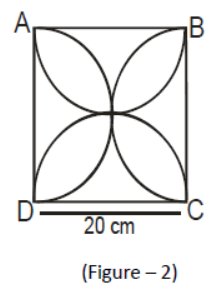
Question 2. On a square sheet of paper, Ananya forms a design as shown in the figure - 2 to prepare a poster on “Save Energy”. If each side of the Square is 20cm and semicircles are drawn with each side of the square as diameter, find the area of the shaded region.
i) How can we save energy?
ii) Why do we need to save energy?
Answer:
Calculation of Shaded Area:
1. Area of the square ABCD \( = 20 \times 20 = 400 \text{ cm}^2 \).
2. Let us divide the unshaded regions of the square into four parts labeled I, II, III, and IV.
3. Semicircles on opposite sides AB and CD cover a combined area equal to one circle of radius 10 cm:
Combined Area \( = \pi \times 10^2 = 100\pi = 314 \text{ cm}^2 \).
4. The unshaded area of parts I and III is \( 400 - 314 = 86 \text{ cm}^2 \). Similarly, the unshaded parts II and IV also have an area of \( 86 \text{ cm}^2 \).
5. Total unshaded area \( = 86 + 86 = 172 \text{ cm}^2 \).
6. Area of the shaded region (the flower petals) \( = \text{Area of square} - \text{Total unshaded area} = 400 - 172 = 228 \text{ cm}^2 \).
Sub-questions:
i) Energy can be saved by unplugging idle appliances, utilizing energy-efficient devices, and reducing heating/cooling usage.
ii) Conserving energy is vital to prevent the rapid depletion of coal and petroleum, reduce environmental degradation, and curb global warming.
In simple words: The flower pattern has a shaded area of 228 square centimeters. We must conserve power to safeguard our environment and make fossil fuels last longer.
Exam Tip: Be sure to write down the intermediate steps showing how you group and subtract the unshaded regions from the square to make your logic transparent to the examiner.
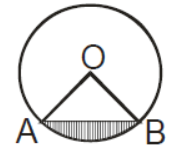
Question 3. A survey was conducted in a particular area to find its most polluted region and it was found that the shaded region is the most polluted. If the radius of the circular part that was surveyed is 14m and the angle formed between the two radii is 60o, find the area of the polluted region. (Take π = 3.14 and √3 = 1.732)
iii) How is pollution harmful?
iv) What steps can be taken to reduce pollution in any region?
Answer:
Calculation of Polluted Area:
1. The polluted region is the minor segment formed by chord AB.
2. Area of sector OAB \( = \frac{60}{360} \times \pi \times r^2 = \frac{1}{6} \times 3.14 \times 14^2 = 102.57 \text{ m}^2 \).
3. Area of equilateral triangle OAB \( = \frac{\sqrt{3}}{4} \times r^2 = \frac{1.732}{4} \times 14^2 = 84.87 \text{ m}^2 \).
4. Area of polluted region (shaded segment) \( = \text{Area of sector} - \text{Area of triangle} = 102.57 - 84.87 = 17.7 \text{ m}^2 \).
Sub-questions:
iii) Pollution causes severe breathing and heart conditions, damages flora and fauna, and drives global warming.
iv) Regions can reduce pollution by adopting renewable energy, enforcing stricter waste management, limiting single-use plastics, and planting trees.
In simple words: The polluted zone covers 17.7 square meters. Pollution threatens lives and damages nature, but we can fight it by using clean energy and planting forests.
Exam Tip: Since the central angle is \(60^\circ\), the triangle formed by the two radii and the chord is always equilateral. Use the direct formula \(\frac{\sqrt{3}}{4}r^2\) to compute its area.
Free study material for Mathematics
Chapter 11 Areas related to Circles Printable Worksheets and Exercises for Class 10 Mathematics
Practice Exercises for Class 10 Mathematics Chapter 11 Areas related to Circles
Review targeted practice exercises for Class 10 Mathematics Chapter 11 Areas related to Circles. Curated to match official CBSE guidelines, these printable problem sets support daily revision and improve overall test readiness.
Step-by-Step Solutions and Practice Guidelines
Designed around the official curriculum for Class 10 Mathematics, these practice sheets guarantee standard compliance. Reviewing step-by-step solutions after completion sharpens your accuracy and clarifies complex sub-topics within Chapter 11 Areas related to Circles.
Enhance Speed with Online Practice
Follow up your worksheet practice by attempting the interactive online MCQ tests for Chapter 11 Areas related to Circles to evaluate your execution speed. All printable assignments and revision sheets on our platform are updated for the 2026 session and available free of charge.
FAQs
You can download the latest chapter-wise printable worksheets for Class 10 Mathematics Chapter 11 Areas related to Circles for free from StudiesToday.com. These have been made as per the latest CBSE curriculum for this academic year.
Yes, Class 10 Mathematics worksheets for Chapter 11 Areas related to Circles focus on activity-based learning and also competency-style questions. This helps students to apply theoretical knowledge to practical scenarios.
Yes, we have provided solved worksheets for Class 10 Mathematics Chapter 11 Areas related to Circles to help students verify their answers instantly.
Yes, our Class 10 Mathematics test sheets are mobile-friendly PDFs and can be printed by teachers for classroom.
For Chapter 11 Areas related to Circles, regular practice with our worksheets will improve question-handling speed and help students understand all technical terms and diagrams.