

Official Class 10 Mathematics Worksheets: Chapter 13 Statistics
Access comprehensive chapter-wise worksheets for Chapter 13 Statistics using the CBSE Class 10 Mathematics Statistics Worksheet Set 05. Designed to align with the 2026-27 academic syllabus for Class 10 Mathematics, these printable practice sets help students reinforce key concepts and improve their overall exam readiness.
Solved Practice Worksheets for Mathematics
Navigate directly to the solved Mathematics worksheets using the digital viewer below. Each practice set includes detailed step-by-step solutions, allowing students to instantly cross-check their work and identify areas requiring further revision.
Statistics
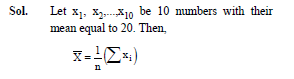
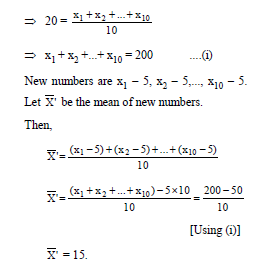
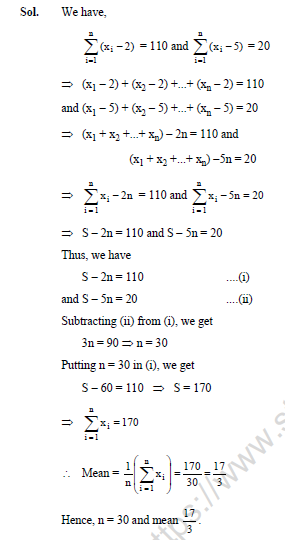
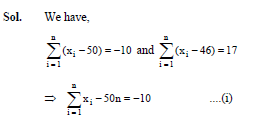
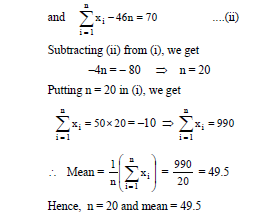
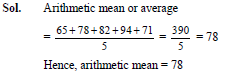
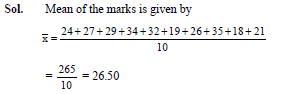
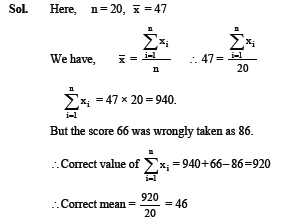
Q.- The mean of 10 numbers is 20. If 5 is subtracted from every number, what will be the new mean?
More question-
1.The mean of the six numbers is 43. If one of the no. is excluded, the mean of the remaining no. is41.Then the excluded no. is:
(A) 53
(B) 84
C) 12
(D) None
2.The average temperature of Tuesday,Wednesday & Thursday was 42°C. The average temperature of Wednesday, Thursday & Friday was 47°C, if the temperature on Tuesday was 43°C, then the temperature on Friday was:
(A) 53°C
(B) 49°C
(C) 50°C
(D) 58°C
3.The mean of first 5 multiple of 5 is:
(A) 14
(B) 16
(C) 13
(D) 15
4.The mean of 10 observations is 25. If one observation, namely 25, is deleted, the new mean is:
(A) 22
(B) 28
(C) 20
(D) 25
5.The mean of 6, y, 7, x, and 14 is 8 then:
(A) x +y = 13
(B) x - y =13
(C) 2x + y =13
(D) x2 + y2 =15
6.The average weight of a sample of 10 apples is 52 g. Later it was found that the weighing machinehad shown the weight of each apple 10 g less. The correct average weight of an apple is:
(A) 54 g
(B) 52 g
(C) 62 g
(D) 56 g
Question 1. The mean of the six numbers is 43. If one of the no. is excluded, the mean of the remaining no. is41. Then the excluded no. is:
(a) 53
(b) 84
(c) 12
(d) None
Answer: (a) 53
Sum of 6 numbers = \( 6 \times 43 = 258 \)
Sum of remaining 5 numbers = \( 5 \times 41 = 205 \)
Excluded number = \( 258 - 205 = 53 \).
In simple words: The total sum of all six numbers is 258. After taking one away, the remaining numbers add up to 205. The difference between these two totals is the value of the missing number, which is 53.
Exam Tip: Always find the total sum of the groups before and after an observation is removed. Subtracting these sums is the most reliable way to find the excluded value.
Question 2. The average temperature of Tuesday, Wednesday & Thursday was 42°C. The average temperature of Wednesday, Thursday & Friday was 47°C, if the temperature on Tuesday was 43°C, then the temperature on Friday was:
(a) 53°C
(b) 49°C
(c) 50°C
(d) 58°C
Answer: (d) 58°C
Let \( T \), \( W \), \( Th \), and \( F \) represent the temperatures of Tuesday, Wednesday, Thursday, and Friday.
\( T + W + Th = 3 \times 42 = 126^\circ\text{C} \)
Since \( T = 43^\circ\text{C} \):
\( 43 + W + Th = 126 \implies W + Th = 83^\circ\text{C} \)
Also:
\( W + Th + F = 3 \times 47 = 141^\circ\text{C} \)
Substituting \( W + Th = 83^\circ\text{C} \) into this equation:
\( 83 + F = 141 \implies F = 141 - 83 = 58^\circ\text{C} \).
In simple words: The combined temperature for the first three days is 126 degrees. Subtracting Tuesday's temperature leaves 83 degrees for Wednesday and Thursday. Adding this to Friday's group total of 141 degrees tells us Friday's temperature is 58 degrees.
Exam Tip: In multi-day average problems, isolate the shared days (Wednesday and Thursday here) to easily bridge and solve for the unknown day.
Question 3. The mean of first 5 multiple of 5 is:
(a) 14
(b) 16
(c) 13
(d) 15
Answer: (d) 15
The first five multiples of 5 are: 5, 10, 15, 20, 25.
Sum of these multiples = \( 5 + 10 + 15 + 20 + 25 = 75 \)
Mean = \( \frac{75}{5} = 15 \).
In simple words: We list the first five numbers we get when counting by fives (5, 10, 15, 20, 25). Adding them together gives 75, and dividing by 5 gives their average of 15.
Exam Tip: For any symmetric or equally spaced arithmetic sequence, the mean is always the exact middle term of the set.
Question 4. The mean of 10 observations is 25. If one observation, namely 25, is deleted, the new mean is:
(a) 22
(b) 28
(c) 20
(d) 25
Answer: (d) 25
Sum of 10 observations = \( 10 \times 25 = 250 \)
After deleting the observation 25, there are 9 remaining observations.
New sum = \( 250 - 25 = 225 \)
New mean = \( \frac{225}{9} = 25 \).
In simple words: The original total of all ten values is 250. Taking away a value that is exactly equal to the average does not change the balance, so the remaining nine values still average out to 25.
Exam Tip: Remember as a general shortcut: removing or adding an observation that is equal to the current mean will never change the mean of the dataset.
Question 5. The mean of 6, y, 7, x, and 14 is 8 then:
(a) x +y = 13
(b) x - y =13
(c) 2x + y =13
(d) \( x^2 + y^2 = 15 \)
Answer: (a) x + y = 13
There are 5 observations in total.
Sum of the observations = \( 6 + y + 7 + x + 14 = x + y + 27 \)
Given mean = 8:
\( \frac{x + y + 27}{5} = 8 \implies x + y + 27 = 40 \implies x + y = 13 \).
In simple words: All five values must add up to 40 to have an average of 8. Since the known numbers add up to 27, the remaining two unknown variables must combine to equal 13.
Exam Tip: Do not panic if you cannot find the individual values of x and y - the question only asks for their relationship, which comes directly from the sum formula.
Question 6. The average weight of a sample of 10 apples is 52 g. Later it was found that the weighing machinehad shown the weight of each apple 10 g less. The correct average weight of an apple is:
(a) 54 g
(b) 52 g
(c) 62 g
(d) 56 g
Answer: (c) 62 g
Since the machine showed each apple's weight to be 10 g less than its actual weight, we must add 10 g to each observation to get the correct weight.
By the properties of arithmetic mean, if a constant \( k \) is added to each observation, the mean also increases by \( k \).
Correct average weight = \( 52 + 10 = 62 \) g.
In simple words: Since every single apple was actually 10 grams heavier than recorded, the true average weight of the group must also be exactly 10 grams higher than the incorrect measurement.
Exam Tip: Avoid recalculating the entire sum in change-of-scale questions - apply the linear shift property of means directly to save valuable time.
Question 7. The average weight of a sample of 10 apples is 52 g. Later it was found that the weighing machinehad shown the weight of each apple 10 g less. The correct average weight of an apple is:
(a) 54 g
(b) 52 g
(c) 62 g
(d) 56 g
Answer: (c) 62 g
This is a duplicate of Question 6. Following the same logic:
True average = Recorded average + 10 g = 52 g + 10 g = 62 g.
In simple words: Because each apple's real weight is 10 grams more than measured, the correct average weight increases by 10 grams to 62 grams.
Exam Tip: If you see duplicate questions on an assignment, solve them consistently using the same logical steps.
Question 8. The average age of 5 teachers is 28 years. If one teacher is excluded the mean gets reduced by 2 years . The age of the excluded teacher is
(a) 26 years
(b) 33 years
(c) 36 years
(d) None
Answer: (c) 36 years
Sum of ages of 5 teachers = \( 5 \times 28 = 140 \) years.
When 1 teacher is excluded, there are 4 teachers left.
The new mean is reduced by 2 years, so it becomes \( 28 - 2 = 26 \) years.
Sum of ages of these 4 teachers = \( 4 \times 26 = 104 \) years.
Age of the excluded teacher = \( 140 - 104 = 36 \) years.
In simple words: The five teachers combined have a total age of 140 years. Without the excluded teacher, the other four combine to 104 years. The missing person's age is the difference, which is 36 years.
Exam Tip: Be careful to apply the change to the mean (reducing it from 28 to 26) rather than accidentally subtracting 2 years from the final age calculation.
Question 9. The mean of first six prime numbers is:
(a) 6.8
(b) 3.6
(c) 5.6
(d) 5.2
Answer: (a) 6.8
The first six prime numbers are: 2, 3, 5, 7, 11, and 13.
Sum of these prime numbers = \( 2 + 3 + 5 + 7 + 11 + 13 = 41 \)
Mean = \( \frac{41}{6} \approx 6.83 \).
In simple words: The first six prime numbers are 2, 3, 5, 7, 11, and 13. Adding them together gives 41, and dividing by 6 results in an average of approximately 6.8.
Exam Tip: Remember that 1 is not a prime number. The first prime number is always 2, which is also the only even prime number.
Question 10. The marks obtained by Rahul in school exam are 140, 153, 148, 150, and 154 respectively. Find the mean ……….
(a) 129
(b) 139
(c) 149
(d) 159
Answer: (c) 149
Sum of all marks = \( 140 + 153 + 148 + 150 + 154 = 745 \)
Number of exams = 5
Mean = \( \frac{745}{5} = 149 \).
In simple words: Adding up all of Rahul's marks gives a total score of 745. Dividing this total by his 5 exams gives his average score of 149.
Exam Tip: For sets of closely spaced numbers, you can use an assumed mean (like 150) to make the mental arithmetic of addition much quicker and safer.
Question 11. The mean of \( \frac{1}{3}, \frac{3}{4}, \frac{5}{6}, \frac{1}{2} \) and \( \frac{7}{12} \) is:
(a) \( \frac{1}{5} \)
(b) \( \frac{3}{5} \)
(c) \( \frac{2}{5} \)
(d) None
Answer: (b) \( \frac{3}{5} \)
To find the sum of these five fractions, we first find their least common multiple (LCM) of the denominators (3, 4, 6, 2, 12), which is 12:
\( \text{Sum} = \frac{1}{3} + \frac{3}{4} + \frac{5}{6} + \frac{1}{2} + \frac{7}{12} \)
\( \text{Sum} = \frac{4}{12} + \frac{9}{12} + \frac{10}{12} + \frac{6}{12} + \frac{7}{12} \)
\( \text{Sum} = \frac{4 + 9 + 10 + 6 + 7}{12} = \frac{36}{12} = 3 \).
The total number of terms is 5.
Mean = \( \frac{\text{Sum}}{\text{Number of terms}} = \frac{3}{5} \).
In simple words: We first rewrite all five fractions so they have the same bottom number (12). Adding them up gives 3 whole units, which we then divide by 5 to get our average of 3/5.
Exam Tip: Always make sure to reduce your fraction sum to its simplest form (like simplifying 36/12 to 3) before dividing by the total number of terms.
Question 12. The sum of 15 numbers is 435.The mean of those numbers is:
(a) 30
(b) 28
(c) 29
(d) None
Answer: (c) 29
Mean = \( \frac{\text{Sum of numbers}}{\text{Total count}} = \frac{435}{15} = 29 \).
In simple words: Since we already know the sum of all 15 values is 435, we simply divide this sum by 15 to get their average of 29.
Exam Tip: Basic division is the core of statistics. Write out your long division step-by-step to avoid simple calculation slips with double-digit divisors.
Question 13. The arithmetic mean of a - 2, a, & a + 2 is:
(a) 3a
(b) a - 2
(c) a + 2
(d) a
Answer: (d) a
There are 3 terms.
Sum of the terms = \( (a - 2) + a + (a + 2) = 3a \)
Mean = \( \frac{3a}{3} = a \).
In simple words: The minus two and plus two balance each other out when we add the terms together, leaving us with a total sum of 3a. Dividing this by 3 gives us a simple average of a.
Exam Tip: Recognize symmetrical terms immediately. For symmetric deviations like \( -d \) and \( +d \) around a value, the mean will always be that central value.
Question 14. The mean of all factors of 24 is:
(a) 7.5
(b) 7.75
(c) 7.25
(d) 7
Answer: (a) 7.5
The factors of 24 are: 1, 2, 3, 4, 6, 8, 12, and 24.
The total number of factors is 8.
Sum of the factors = \( 1 + 2 + 3 + 4 + 6 + 8 + 12 + 24 = 60 \)
Mean = \( \frac{60}{8} = 7.5 \).
In simple words: We first find all the numbers that can divide 24 evenly. Adding these eight numbers together gives 60, and dividing by 8 gives their average of 7.5.
Exam Tip: List your factors in pairs (like 1 and 24, 2 and 12, etc.) to make sure you do not miss any terms before adding them up.
Question 15. Mean of a set of observation is the value which:
(a) Occur most frequently
(b) Divides observation into two equal parts.
(c) Is a representative of whole group
(d) Is the sum of observations
Answer: (c) Is a representative of whole group
- Option (a) is the definition of Mode.
- Option (b) is the definition of Median.
- Option (c) describes Mean, as it represents the central value of the entire set of observations.
- Option (d) is simply the sum, not the average.
In simple words: The mean is a single average value that best represents the entire set of numbers as a whole.
Exam Tip: Understanding the verbal definitions of Mean, Median, and Mode is essential for answering conceptual theory questions correctly.
Question 16. The mean, of x - 5y, x - 3y, x - y , x + y , x + 3y & x + 5y is 12. Then the value of x is:
(a) 12
(b) 18
(c) Can't be determined
(d) Data is not sufficient
Answer: (a) 12
There are 6 terms in this dataset.
Sum of the terms = \( (x - 5y) + (x - 3y) + (x - y) + (x + y) + (x + 3y) + (x + 5y) \)
The \( y \) terms completely cancel out because of symmetry: \( -5y + 5y = 0 \), \( -3y + 3y = 0 \), and \( -y + y = 0 \).
Sum = \( 6x \)
Mean = \( \frac{6x}{6} = x \)
Since the mean is given as 12, we have \( x = 12 \).
In simple words: When we add all six expressions, the parts containing y cancel each other out, leaving us with a total sum of 6x. Dividing by 6 tells us the average is simply x, which means x must be 12.
Exam Tip: Do not let extra variables like y worry you. Look for positive and negative pairs that cancel out when you sum the observations.
Question 17. The arithmetic mean of five given number is 85. Their sum is:
(a) 85
(b) 425
(c) Between 85 and 425
(d) More than 425
Answer: (b) 425
Sum of numbers = \( \text{Mean} \times \text{Total count} = 85 \times 5 = 425 \).
In simple words: Since five numbers have an average value of 85, their total combined sum is simply 85 multiplied by 5, which is 425.
Exam Tip: Reversing the mean formula to find the sum of data (\( \sum x = n \cdot \bar{x} \)) is one of the most fundamental operations in statistics problems.
Question 18. The average marks scored by girls is 68 and that of the boys is 62. The average marks of the whole class is 64. The ratio of the girls & boys in the class is:
(a) 1 : 2
(b) 1 : 1
(c) 2 : 3
(d) 3 : 5
Answer: (a) 1 : 2
Let \( g \) be the number of girls and \( b \) be the number of boys.
Total marks of girls = \( 68g \)
Total marks of boys = \( 62b \)
Total marks of the whole class = \( 64(g + b) \)
Therefore, we can write:
\( 68g + 62b = 64g + 64b \)
\( 68g - 64g = 64b - 62b \)
\( 4g = 2b \)
\( \frac{g}{b} = \frac{2}{4} = \frac{1}{2} \).
The ratio of girls to boys is \( 1 : 2 \).
In simple words: We can solve this with a simple balance equation. The difference between the girls' average and class average is 4, and the difference for boys is 2, which means there must be twice as many boys as girls.
Exam Tip: You can also use the allegation method to find ratios quickly: difference of higher value to mean on one side, and mean to lower value on the other.
Question 19. the average of A & B is 25, B & C is 28, & C & A is 21. Then the average of A, B and C is:
(a) 23.66
(b) 25.66
(c) 26.66
(d) 24.66
Answer: (d) 24.66
Based on the averages given:
\( A + B = 2 \times 25 = 50 \) - (i)
\( B + C = 2 \times 28 = 56 \) - (ii)
\( C + A = 2 \times 21 = 42 \) - (iii)
Adding all three equations:
\( 2(A + B + C) = 50 + 56 + 42 = 148 \)
\( A + B + C = 74 \)
Average of A, B, and C = \( \frac{A + B + C}{3} = \frac{74}{3} \approx 24.66 \).
In simple words: Adding up all our pair totals tells us that twice the sum of A, B, and C is 148, so the three values add up to 74. Dividing this total by 3 gives their average of 24.66.
Exam Tip: When you have pairwise sums, adding all the equations together is the fastest way to find the total sum of all individual variables.
Question 20. The mean weight of a class of 34 students is 46.5 kg. If the weight of the teacher is included , the mean rises by 500 g. Then the weight of the teacher is
(a) 72 kg
(b) 52 kg
(c) 175 kg
(d) 64 kg
Answer: (d) 64 kg
Total weight of 34 students = \( 34 \times 46.5 = 1581 \) kg.
When the teacher's weight is added, the total group size is 35.
The new average increases by 500 g (which is \( 0.5 \) kg), becoming \( 46.5 + 0.5 = 47.0 \) kg.
Total weight of the 35 members = \( 35 \times 47 = 1645 \) kg.
Weight of the teacher = \( 1645 - 1581 = 64 \) kg.
In simple words: The students' combined weight is 1581 kg. Including the teacher increases the group average to 47 kg, bringing the new total to 1645 kg. The difference of 64 kg is the teacher's weight.
Exam Tip: Always make sure your units match. Convert grams to kilograms (\( 500\text{ g} = 0.5\text{ kg} \)) before adding it to the mean weight.
Question 21. A bus maintains an average speed of 60 kmph while going from P to Q and maintains an averagespeed of 90kmph while coming back from Q to P. The average speed of the bus is:
(a) 72 kmph
(b) 30 kmph
(c) 150 kmph
(d) 75 kmph
Answer: (a) 72 kmph
Since the distance from P to Q is the same as from Q to P, we find the average speed using the harmonic mean formula for equal distances:
\( \text{Average Speed} = \frac{2xy}{x + y} \)
where \( x = 60 \) kmph and \( y = 90 \) kmph.
\( \text{Average Speed} = \frac{2 \times 60 \times 90}{60 + 90} \)
\( \text{Average Speed} = \frac{10800}{150} = 72 \) kmph.
In simple words: Because the round-trip covers equal distances at different speeds, we calculate the average speed using the harmonic mean formula. This gives us 72 kmph, which is slightly lower than the simple average of the speeds.
Exam Tip: Never calculate average speed as a simple arithmetic average (\( \frac{60+90}{2} = 75 \)). Always use the harmonic mean formula \( \frac{2xy}{x+y} \) when travel distances are equal.
Question 22. The mean of 9 observations is 36. If the mean of the first 5 observations is 32 & that of the last 5 observations is 39 then the fifth observation is:
(a) 31
(b) 43
(c) 28
(d) 37
Answer: (a) 31
Sum of all 9 observations = \( 9 \times 36 = 324 \)
Sum of first 5 observations = \( 5 \times 32 = 160 \)
Sum of last 5 observations = \( 5 \times 39 = 195 \)
Adding the two smaller groups counts the fifth observation twice:
Sum of first 5 + Sum of last 5 = \( 160 + 195 = 355 \)
Fifth observation = \( 355 - 324 = 31 \).
In simple words: The total of all nine numbers is 324. When we add the first five and last five numbers together (which counts the middle fifth number twice), we get 355. The difference of 31 is the value of the fifth number.
Exam Tip: For overlapping group problems, the overlap value is always equal to the sum of the sub-groups minus the grand total sum.
Question 23. Out of 100 numbers , 20 were 4s, 40 were 5s, 30 were 6s and the remaining were 7s. The arithmetic mean of the number is:
(a) 5.3
(b) 5.4
(c) 6.1
(d) 6.5
Answer: (a) 5.3
Let us count the remaining numbers:
Remaining count = \( 100 - (20 + 40 + 30) = 10 \). These are all 7s.
Now, find the total sum of all 100 numbers:
\( \text{Sum} = (20 \times 4) + (40 \times 5) + (30 \times 6) + (10 \times 7) \)
\( \text{Sum} = 80 + 200 + 180 + 70 = 530 \)
Mean = \( \frac{530}{100} = 5.3 \).
In simple words: We find the total sum by multiplying each number by how many times it occurs. Adding these products gives 530, which divided by our total count of 100 values gives an average of 5.3.
Exam Tip: Be sure to compute the remaining count correctly first by subtracting the other counts from the total of 100.
Question 24. The mean of the values of 1,2,3--------n with respective frequencies x,2x,3x,………nx is
(a) \( \frac{n+1}{2} \)
(b) \( \frac{n}{2} + 1 \)
(c) \( \frac{2n+1}{3} \)
(d) \( \frac{1}{2}(n-1) \)
Answer: (c) \( \frac{2n+1}{3} \)
The mean is given by:
\( \text{Mean} = \frac{\sum f_i x_i}{\sum f_i} \)
Here, \( x_i = i \) and \( f_i = ix \).
\( \sum f_i = x + 2x + 3x + \dots + nx = x(1 + 2 + 3 + \dots + n) = x \frac{n(n+1)}{2} \)
\( \sum f_i x_i = (1 \cdot x) + (2 \cdot 2x) + (3 \cdot 3x) + \dots + (n \cdot nx) = x(1^2 + 2^2 + 3^2 + \dots + n^2) = x \frac{n(n+1)(2n+1)}{6} \)
Therefore, the mean is:
\( \text{Mean} = \frac{x \frac{n(n+1)(2n+1)}{6}}{x \frac{n(n+1)}{2}} = \frac{2n+1}{3} \).
In simple words: We find the sum of all weighted values and divide it by the total frequency. After factoring out x and using standard algebraic sum formulas, the expression simplifies cleanly to (2n + 1)/3.
Exam Tip: Knowing the formulas for the sum of the first n natural numbers and the sum of their squares is essential for simplifying algebraic mean problems.
<3M>
Question 25. Out of 100 numbers , 20 were 4s, 40 were 5s, 30 were 6s and the remaining were 7s. The arithmetic mean of the number is:
(a) 5.3
(b) 5.4
(c) 6.1
(d) 6.5
Answer: (a) 5.3
This is a duplicate of Question 23. Following the same steps:
Remaining count = \( 100 - (20 + 40 + 30) = 10 \). These are 7s.
Total sum = \( (20 \times 4) + (40 \times 5) + (30 \times 6) + (10 \times 7) = 530 \).
Arithmetic Mean = \( \frac{530}{100} = 5.3 \).
In simple words: We multiply each number by its frequency and add the results. Dividing this total sum of 530 by 100 yields an average of 5.3.
Exam Tip: For longer descriptive questions, show each multiplication and step of addition clearly to secure full marking points.
Question 26. The numbers of students absent in a class were recorded every day for 120 days and the information is given in the following frequency table. Find mean number of students absents per day by using short - cut method.
| No. of students absent (x) | 0 | 1 | 2 | 3 | 4 | 5 | 6 | 7 |
|---|---|---|---|---|---|---|---|---|
| No. of Days (f) | 1 | 4 | 10 | 50 | 34 | 15 | 4 | 2 |
Answer:
Let us use the short-cut method (Assumed Mean method).
Choose the assumed mean \( A = 3 \).
Let \( d_i = x_i - A = x_i - 3 \).
| \( x_i \) | \( f_i \) | \( d_i = x_i - 3 \) | \( f_i d_i \) |
|---|---|---|---|
| 0 | 1 | -3 | -3 |
| 1 | 4 | -2 | -8 |
| 2 | 10 | -1 | -10 |
| 3 | 50 | 0 | 0 |
| 4 | 34 | 1 | 34 |
| 5 | 15 | 2 | 30 |
| 6 | 4 | 3 | 12 |
| 7 | 2 | 4 | 8 |
| Total | \( \sum f_i = 120 \) | - | \( \sum f_i d_i = 63 \) |
Using the assumed mean formula:
\( \text{Mean} = A + \frac{\sum f_i d_i}{\sum f_i} \)
\( \text{Mean} = 3 + \frac{63}{120} \)
\( \text{Mean} = 3 + 0.525 = 3.525 \).
Therefore, the mean number of absent students per day is 3.525.
In simple words: We select a central value (3) as our guess average, calculate how much each value differs from it, multiply by the frequencies, and adjust our guess to find the true mean of 3.525.
Exam Tip: Setting up a neat table for the assumed mean method is key to scoring full marks. Always write down the formula before inserting your calculated sums.
Question 27. If the mean of the following data is 20.6 then find the value of p
X: 10 15 p 25 35
F: 3 10 25 7 5
Answer:
Let us construct the summation tables:
\( \sum f_i = 3 + 10 + 25 + 7 + 5 = 50 \)
\( \sum f_i x_i = (10 \times 3) + (15 \times 10) + (p \times 25) + (25 \times 7) + (35 \times 5) \)
\( \sum f_i x_i = 30 + 150 + 25p + 175 + 175 = 530 + 25p \)
Using the mean formula:
\( \text{Mean} = \frac{\sum f_i x_i}{\sum f_i} \)
\( 20.6 = \frac{530 + 25p}{50} \)
\( 20.6 \times 50 = 530 + 25p \)
\( 1030 = 530 + 25p \)
\( 25p = 1030 - 530 \)
\( 25p = 500 \)
\( p = \frac{500}{25} = 20 \).
Therefore, the value of \( p \) is 20.
In simple words: We multiply each value by its frequency and add them together. Setting the average equation equal to 20.6 allows us to solve a simple linear equation to find that p is 20.
Exam Tip: Be careful when multiplying decimals like \( 20.6 \times 50 \) - double-check your arithmetic steps so that you do not carry forward any simple slips.
Question 28. If the mean of the following data is 20, find the value of p.
X: 15 17 19 20+p 23
F: 2 3 4 5p 6
Answer:
Let us calculate the sums:
\( \sum f_i = 2 + 3 + 4 + 5p + 6 = 15 + 5p \)
\( \sum f_i x_i = (15 \times 2) + (17 \times 3) + (19 \times 4) + ((20 + p) \times 5p) + (23 \times 6) \)
\( \sum f_i x_i = 30 + 51 + 76 + 100p + 5p^2 + 138 \)
\( \sum f_i x_i = 295 + 100p + 5p^2 \)
Using the mean formula:
\( \text{Mean} = \frac{\sum f_i x_i}{\sum f_i} \)
\( 20 = \frac{295 + 100p + 5p^2}{15 + 5p} \)
\( 20(15 + 5p) = 295 + 100p + 5p^2 \)
\( 300 + 100p = 295 + 100p + 5p^2 \)
Subtracting \( 100p \) from both sides:
\( 300 = 295 + 5p^2 \)
\( 5p^2 = 5 \)
\( p^2 = 1 \)
Since frequency must be a positive value, we take the positive root:
\( p = 1 \).
Therefore, the value of \( p \) is 1.
In simple words: Setting up the weighted average formula gives us a quadratic equation where the linear terms containing p cancel out on both sides, letting us easily solve for p = 1.
Exam Tip: Linear terms canceling out from both sides is a very satisfying sign that your algebra is correct. Always make sure to state why you reject the negative root (since frequency cannot be negative).
Question 29. Find the Mean of following frequency distribution
Class-interval 0-10 10-20 20-30 30-40 40-50
No. of Workers 7 10 15 8 10
Answer:
First, let us construct the table to find the class marks (\( x_i \)) and products (\( f_i x_i \)):
| Class Interval | Frequency (\( f_i \)) | Class Mark (\( x_i \)) | \( f_i x_i \) |
|---|---|---|---|
| 0 - 10 | 7 | 5 | 35 |
| 10 - 20 | 10 | 15 | 150 |
| 20 - 30 | 15 | 25 | 375 |
| 30 - 40 | 8 | 35 | 280 |
| 40 - 50 | 10 | 45 | 450 |
| Total | \( \sum f_i = 50 \) | - | \( \sum f_i x_i = 1290 \) |
Using the direct mean formula:
\( \text{Mean} = \frac{\sum f_i x_i}{\sum f_i} \)
\( \text{Mean} = \frac{1290}{50} = 25.8 \).
Therefore, the mean of the distribution is 25.8.
In simple words: We find the midpoint for each interval and multiply it by the number of workers in that group. Adding these products together and dividing by the total of 50 workers gives us a mean of 25.8.
Exam Tip: Be sure to write down the formula for the class mark, \( x_i = \frac{\text{Lower Limit} + \text{Upper Limit}}{2} \), as this shows the examiner your methodology.
Question 30. Find the mean of the following frequency distributions:
Class-interval 0-6 6-12 12-18 18-24 24-30
No. of Workers 6 8 10 9 7
Answer:
First, let us construct the table to find the class marks (\( x_i \)) and products (\( f_i x_i \)):
| Class Interval | Frequency (\( f_i \)) | Class Mark (\( x_i \)) | \( f_i x_i \) |
|---|---|---|---|
| 0 - 6 | 6 | 3 | 18 |
| 6 - 12 | 8 | 9 | 72 |
| 12 - 18 | 10 | 15 | 150 |
| 18 - 24 | 9 | 21 | 189 |
| 24 - 30 | 7 | 27 | 189 |
| Total | \( \sum f_i = 40 \) | - | \( \sum f_i x_i = 618 \) |
Using the direct mean formula:
\( \text{Mean} = \frac{\sum f_i x_i}{\sum f_i} \)
\( \text{Mean} = \frac{618}{40} = 15.45 \).
Therefore, the mean of the distribution is 15.45.
In simple words: We find the midpoints of the groups, multiply by the number of workers, sum the results, and divide by the total count of 40 workers to get an average of 15.45.
Exam Tip: For non-integer answers, always carry out your division to at least two decimal places for completeness.
<5M>
Question 31. If the mean of the following distribution is 27, find the value of p:
Class-interval 0-10 10-20 20-30 30-40 40-50
No. of Workers 8 p 12 13 10
Answer:
This is a duplicate of Question 3 on page 1. Following the identical mathematical steps:
| Class Interval | Frequency (\( f_i \)) | Class Mark (\( x_i \)) | \( f_i x_i \) |
|---|---|---|---|
| 0 - 10 | 8 | 5 | 40 |
| 10 - 20 | p | 15 | \( 15p \) |
| 20 - 30 | 12 | 25 | 300 |
| 30 - 40 | 13 | 35 | 455 |
| 40 - 50 | 10 | 45 | 450 |
| Total | \( \sum f_i = 43 + p \) | - | \( \sum f_i x_i = 1245 + 15p \) |
Using the mean formula:
\( 27 = \frac{1245 + 15p}{43 + p} \)
\( 27(43 + p) = 1245 + 15p \)
\( 1161 + 27p = 1245 + 15p \)
\( 12p = 84 \)
\( p = 7 \).
Therefore, the value of \( p \) is 7.
In simple words: Setting up the weighted average formula with midpoints and frequencies gives us a linear equation in p, which we solve to get p = 7.
Exam Tip: Be sure to write down the table clearly as it is worth substantial marks in a 5-mark question format.
Question 32. The distribution below gives the weight of 30 students in a class. Find the median weight of students.
Weight (in Kg.) 40-50 50-60 60-70 70-80
F: 5 14 9 2
Answer:
Let us construct the cumulative frequency (cf) table:
| Weight (in Kg.) | Frequency (\( f \)) | Cumulative Frequency (\( cf \)) |
|---|---|---|
| 40 - 50 | 5 | 5 |
| 50 - 60 | 14 | 19 |
| 60 - 70 | 9 | 28 |
| 70 - 80 | 2 | 30 |
Here, total frequency \( N = 30 \implies \frac{N}{2} = 15 \).
The cumulative frequency just greater than 15 is 19, which corresponds to the class interval 50 - 60. Therefore, 50 - 60 is our median class.
From this median class, we identify the following values:
- Lower limit, \( l = 50 \)
- Cumulative frequency of the preceding class, \( cf = 5 \)
- Frequency of the median class, \( f = 14 \)
- Class size, \( h = 10 \)
Using the median formula:
\( \text{Median} = l + \left( \frac{\frac{N}{2} - cf}{f} \right) \times h \)
\( \text{Median} = 50 + \left( \frac{15 - 5}{14} \right) \times 10 \)
\( \text{Median} = 50 + \frac{100}{14} \)
\( \text{Median} = 50 + 7.14 = 57.14 \) kg.
Therefore, the median weight of the students is 57.14 kg.
In simple words: We find cumulative sums to locate where the 15th student's weight lies. This points to the 50-60 group, and using the formula gives us a median weight of 57.14 kg.
Exam Tip: Always state your final answer with correct units (like "kg") as units are an important part of scoring full presentation marks.
Question 33. Find the mode of the following distribution table.
V.0-10 10-20 20-30 30-40 40-50 50-60 60-70 70-80
F:58 7 12 28 20 10 10
Answer:
Note: The first frequency value in the OCR has a missing space and is parsed as 58, which is actually two frequencies: 5 for the 0 - 10 class and 8 for the 10 - 20 class.
Let us write down the corrected frequencies:
- 0 - 10: 5
- 10 - 20: 8
- 20 - 30: 7
- 30 - 40: 12
- 40 - 50: 28
- 50 - 60: 20
- 60 - 70: 10
- 70 - 80: 10
The highest frequency is 28, which corresponds to the class interval 40 - 50. Therefore, 40 - 50 is our modal class.
From this, we have:
- Lower limit, \( l = 40 \)
- Frequency of the modal class, \( f_1 = 28 \)
- Frequency of the preceding class, \( f_0 = 12 \)
- Frequency of the succeeding class, \( f_2 = 20 \)
- Class size, \( h = 10 \)
Using the formula for mode:
\( \text{Mode} = l + \left( \frac{f_1 - f_0}{2f_1 - f_0 - f_2} \right) \times h \)
\( \text{Mode} = 40 + \left( \frac{28 - 12}{2(28) - 12 - 20} \right) \times 10 \)
\( \text{Mode} = 40 + \left( \frac{16}{56 - 32} \right) \times 10 \)
\( \text{Mode} = 40 + \left( \frac{16}{24} \right) \times 10 \)
\( \text{Mode} = 40 + \frac{2}{3} \times 10 \)
\( \text{Mode} = 40 + 6.67 = 46.67 \).
Therefore, the mode of the distribution is 46.67.
In simple words: The group with the most observations is 40-50 (with 28 counts). Setting up the mode formula using this group and its neighbors gives us a final value of 46.67.
Exam Tip: Be sure to write the formula and plug in the numbers step-by-step so that the examiner can easily follow your arithmetic working.
Question 34. Draw cumulative frequency polygon for the following frequency distribution by less than method.
Marks 0-10 10-20 20-30 30-40 40-50 50-60
Answer:
Based on the continuation of the table on page 7, the student frequencies are:
- 0 - 10: 7
- 10 - 20: 10
- 20 - 30: 23
- 30 - 40: 51
- 40 - 50: 6
- 50 - 60: 3
Let us construct the "less than" cumulative frequency table:
| Marks Limit | Cumulative Frequency (cf) |
|---|---|
| Less than 10 | 7 |
| Less than 20 | \( 7 + 10 = 17 \) |
| Less than 30 | \( 17 + 23 = 40 \) |
| Less than 40 | \( 40 + 51 = 91 \) |
| Less than 50 | \( 91 + 6 = 97 \) |
| Less than 60 | \( 97 + 3 = 100 \) |
To draw the cumulative frequency polygon (ogive):
1. Plot the points \( (10, 7), (20, 17), (30, 40), (40, 91), (50, 97), (60, 100) \) on a graph paper with appropriate scale.
2. Connect these points sequentially with a smooth free-hand curve to form the cumulative frequency polygon.
In simple words: We find the cumulative running sums for each class upper limit. Plotting these sums against their respective limits and connecting them with a smooth line creates the ogive curve.
Exam Tip: Always label both axes clearly (X-axis for Upper Limits and Y-axis for Cumulative Frequency) to get full points for your graph.
Free study material for Mathematics
Chapter 13 Statistics Printable Worksheets and Exercises for Class 10 Mathematics
Mastering Chapter 13 Statistics with Printable Worksheets
Explore reliable practice questions for Chapter 13 Statistics tailored for Class 10 Mathematics learners. Use these structured worksheets to evaluate exam preparedness and strengthen problem-solving skills throughout the 2026 academic session.
Verified Solutions and NCERT Alignment
Designed around the official curriculum for Class 10 Mathematics, these practice sheets guarantee standard compliance. Reviewing step-by-step solutions after completion sharpens your accuracy and clarifies complex sub-topics within Chapter 13 Statistics.
Additional Study Resources for Class 10 Mathematics
Wrap up your chapter revision by testing your knowledge against standard objective question formats. Explore our full library of free, up-to-date printable assignments to maximize your academic results in upcoming CBSE evaluations.
FAQs
You can download the latest chapter-wise printable worksheets for Class 10 Mathematics Chapter 13 Statistics for free from StudiesToday.com. These have been made as per the latest CBSE curriculum for this academic year.
Yes, Class 10 Mathematics worksheets for Chapter 13 Statistics focus on activity-based learning and also competency-style questions. This helps students to apply theoretical knowledge to practical scenarios.
Yes, we have provided solved worksheets for Class 10 Mathematics Chapter 13 Statistics to help students verify their answers instantly.
Yes, our Class 10 Mathematics test sheets are mobile-friendly PDFs and can be printed by teachers for classroom.
For Chapter 13 Statistics, regular practice with our worksheets will improve question-handling speed and help students understand all technical terms and diagrams.