

Download CBSE MCQs for Class 10 Science: Practical Based
Explore reliable objective questions for Practical Based tailored for Class 10 learners. Utilizing these Science multiple-choice formats ensures thorough preparation and strengthens problem-solving speed for upcoming school assessments.
Chapter-wise Objective Questions: Practical Based
Navigate directly to the 50 objective questions for Practical Based using the digital viewer below. Each practice set includes verified answer keys, allowing students to instantly cross-check their work and identify areas requiring further revision.
Question. The diagram given below is the experimental set-up to show that carbon dioxide is given out during respiration. In this set-up what does the test tube marked (X) contain?
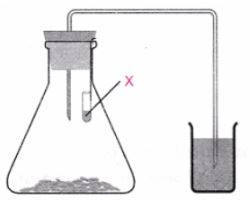
(a) Water
(b) Lime water
(c) Potassium hydroxide
(d) Hydrochloric acid
Answer: C
Question. In the experimental set-up, KOH solution has been kept in the flask to:
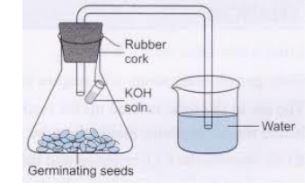
(a) react with water to generate oxygen.
(b) create a dry atmosphere for wet germinating seeds.
(c) absorb carbon dioxide so as to create a partial vacuum.
(d) remove impurities present in the air in the flask.
Answer: C
Question. In an airtight experimental set-up which was used by you in the laboratory to study respiration in germinating seeds, the seeds obtained the oxygen for respiration from:
(a) air in the flask
(b) water in the beaker
(c) water in the germinating seeds
(d) water used for soaking the seed
Answer: A
Question. Which of the following is not a feature of asexual reproduction?
(a) Two individuals of different sexes involved.
(b) No meiosis occurs.
(c) New individuals are genetically identical to the parents. .
(d) Offsprings are clones of parents.
Answer: A
Question. Name the cell components required for completion of aerobic respiration in a cell.
(a) Chloroplast and nucleus
(b) Ribosomes and ER
(c) Golgi body and lysosomes
(d) Cytoplasm and mitochondria
Answer: D
Question. The following figures illustrate binary fission in Amoeba in an incorrect sequence.
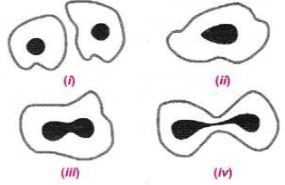
The correct sequence is:
(a) (i), (iii), (iv), (ii)
(b) (ii), (iii), (iv), (i)
(c) (iv), (iii), (ii), (i)
(d) (iii), (iv), (ii), (i)
Answer: B
Question. The type of respiration shown by the germinating seeds to release carbon dioxide is:
(a) Anaerobic respiration
(b) Aerobic respiration
(c) oxidative phosphorylation
(d) Incomplete oxidation
Answer: B
Question. Mention the sequence of budding in hydra:
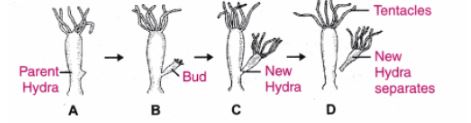
Correct sequence is
(a) A, B, C, D
(b) A, D, B, C
(c) C, A, B, D
(d) D, A, B, C
Answer: A
Question. A chain of yeast cells are formed because:
(a) yeast cells do not separate after budding*
(b) daughter cells are unable to survive without parent cells
(c) buds reproduce as soon as they are formed
(d) daughter cells stick together with the help of mucus
Answer: A
Question. The seeds used in experiment to show that carbon dioxide is given out during respiration are:
a) dry seeds
b) boiled seeds
c) crushed seeds
d) germinating seeds
Answer: D
Question. Which of the following substance is used to make all connections air tight in the experiment to show that carbon dioxide is produced during respiration:
(a) oil
(b) Vaseline
(c) ghee
(d) wax
Answer: B
Question. Out of the following diagrams which one depicts a stage in binary fission of Amoeba?
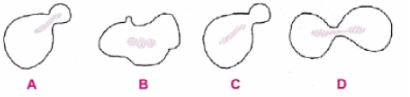
(a) A
(b) B
(c) C
(d) D
Answer: D
Question. After observing the prepared slides of binary fission in Amoeba and budding in yeast, the following observations were reported:
a. Single cells of Amoeba and Yeast were undergoing binary fission and budding respective
b. Cytokinesis was observed in the Yeast cell.
c. Elongated nucleus was dividing to form two daughter nuclei in Amoeba.
d. A chain of buds were observed due to reproduction in Amoeba. The correct observation(s) is/are:
(a) d, a and c
(b) c and d
(c) b only
(d) a and c
Answer: D
Question. Out of the four experimental set-ups shown below, which one will demonstrate the evolution of carbon dioxide during respiration of germinating seeds:
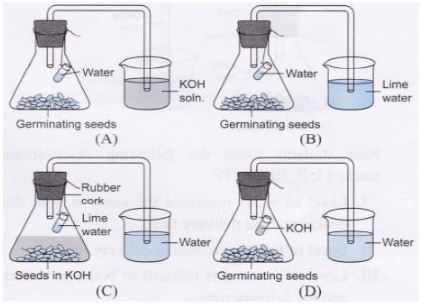
(a) A
(b) B
(c) C
(d) D
Answer: D
Question. A student is to conduct an experiment to show CO2 is released during respiration. List two precautions that he/she must take for obtaining correct observation.
Answer: Two precautions to be taken are:
(i) Germinating seeds (living) should be used.
(ii) The experiment set up must be air-tight.
Question. Students were asked to observe the permanent slides showing different stages of budding in yeast under high power of a microscope.
(a) Which adjustment screw (coarse/fine) were you asked to move to focus the slides?
(b) Draw three diagrams in correct sequence showing budding in yeast.
Answer: (a) A fine screw is used to focus the slides of budding in yeast under high power of a microscope.
(b) Sequence showing budding in yeast:
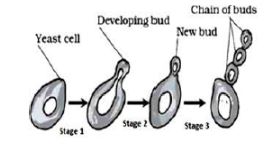
We hope you liked Biology Practical Class 10 based Questions provided above. Please let us know if you have any questions and problems in Biology Practical Class 10.
Free study material for Science
Practice MCQs for Class 10 Science Practical Based
Download Multiple Choice Questions: Practical Based (Class 10 Science)
Test your conceptual understanding of Practical Based with these targeted multiple-choice questions. Designed in alignment with the latest CBSE curriculum for Class 10 Science, these problem sets build accuracy and prepare students for objective exams.
Concept Clarification for Practical Based
Built using the official NCERT book for Class 10, these Science objective sets provide reliable academic guidance. Pair your practice with our recommended NCERT solutions to master optimal problem-solving approaches.
Additional Study Resources for Class 10 Science
Wrap up your chapter revision by testing your knowledge against standard question formats. Everything on our platform is provided free of charge.
FAQs
You can get most exhaustive CBSE Class 10 Science Practical Based MCQs for free on StudiesToday.com. These MCQs for Class 10 Science are updated for the 2026-27 academic session as per CBSE examination standards.
Yes, our CBSE Class 10 Science Practical Based MCQs include the latest type of questions, such as Assertion-Reasoning and Case-based MCQs. 50% of the CBSE paper is now competency-based.
By solving our CBSE Class 10 Science Practical Based MCQs, Class 10 students can improve their accuracy and speed which is important as objective questions provide a chance to secure 100% marks in the Science.
Yes, Science MCQs for Class 10 have answer key and brief explanations to help students understand logic behind the correct option as its important for 2026 competency-focused CBSE exams.
Yes, you can also access online interactive tests for CBSE Class 10 Science Practical Based MCQs on StudiesToday.com as they provide instant answers and score to help you track your progress in Science.