

Download CBSE MCQs for Class 10 Science: Practical Skills
Explore reliable objective questions for Practical Skills tailored for Class 10 learners. Utilizing these Science multiple-choice formats ensures thorough preparation and strengthens problem-solving speed for upcoming school assessments.
Chapter-wise Objective Questions: Practical Skills
View or download the dedicated Practical Skills MCQ resource below. Practicing these 50 objective questions regularly builds familiarity with standard exam patterns and helps secure higher marks in final Science evaluations.
PRACTICAL SKILLS IN SCIENCE
SECTION - A
Question. A student was asked by the teacher to mix the white of an egg with water taken in a beaker and then stir it well. The student would observe that:
(1) a pale yellow transparent solution is formed
(2) an opaque suspension is formed
(3) a translucent mixture is formed.
(4) egg white floats on the surface of water
Answer: 3
Question. Which one of the following is not the correct observation when a magnet is moved repeatedly through a mixture of Iron filings and Sulphur powder kept in a tray ?
(1) Most of the iron filings cling to the magnet at the poles.
(2) A black mass of iron sulphide is produced.
(3) Sulphur does not cling to the magnet.
(4) Sulphur powder is left behind in the tray.
Answer: 2
Question. The colour of the gas evolved on heating solid lead nitrate is :
(1) yellow
(2) brown
(3) greenish yellow
(4) green
Answer: 2
Question. Which of the following precaution is incorrect in the determination of boiling point of water ?
(1) The bulb of the thermometer should be kept about 4 - 5 cm above the surface of water.
(2) Pieces of pumice stone should be added to water before heating to avoid bumping.
(3) The final temperature should be noted carefully by keeping the eyes in line with level of mercury.
(4) The thermometer bulb should dip well below the surface of water.
Answer: 4
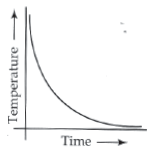
Question. Four students set up the experiment on plotting the temperature-time graph of a hot body as it cools to room temperature. They all perform the experiment using identical apparatus, under identical conditions and plot their graphs on similar graph papers using similar scales. The teacher asks them to observe their graphs carefully and list down the (approximate) values of the angles, made with the time axis, by the tangents to their graphs, at the beginning and towards the end of their observations. The values, noted by them, were as follows:
Student B : 65° ; 22°
Student C : 75° ; 14°
Student D : 85° ; 5°
The best noting is likely to be that of student:
(1) A
(2) B
(3) C
(4) D
Answer: 4
Question. While performing the experiment on determining the velocity of a pulse through a stretched string, a student has to choose from:
(i) a tightly knit thick cotton string of length 5 m or a woollen string of length 7 m.
(ii) a stop clock of least count 1 s or a stop watch of least count 0.5 s.
For best results he should prefer the combination of :
(1) cotton string and stop clock.
(2) cotton string and stop watch.
(3) woollen string and stop clock.
(4) woollen string and stop watch.
Answer: 2
Question. A student has to choose from two available measuring cylinders, and two available
spring balances, with the specifications listed below:
Cylinder C1 : Capacity = 50 mL ; diameter = 1.25 cm, least count = 0.5 mL
Cylinder C2 : Capacity=100 mL ; diameter = 2.5 cm, least count = 1.0 mL
Spring Balance S1: Least count = 2 gwt, zero error = Nil
Spring Balance S2 : Least count = 1 gwt, zero error = + 2 gwt
The solid, whose density is to be determined, is available as a cube of side 1 cm.
The combination, he/she should prefer, is :
(1) C1 ; S1
(2) C1 ; S2
(3) C2 ; S1
(4) C2 ; S2
Answer: 4
Question. The ‘D’ (or protractor) used for measuring the angle of incidence (∠ i) and the angle of reflection (∠ r), has to be positioned in the ways illustrated in figures: 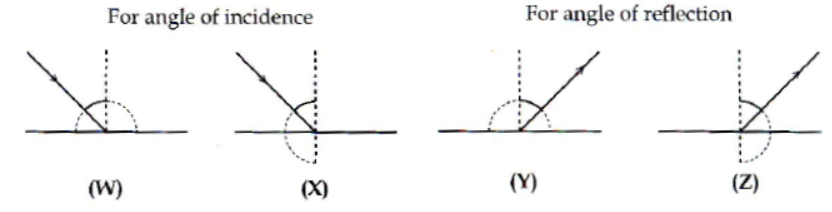
(1) W and Y respectively.
(2) W and Z respectively.
(3) X and Y respectively.
(4) X and Z respectively.
(1) intercalated discs
(2) transverse muscle fibres
(3) many nuclei in the periphery
(4) many cells fused together
Answer: 3
Question. Which one of the following is the correct method of obtaining an onion peel ?
(1) Mash the onion leaf and select the thinnest part
(2) Take a thick scale leaf and make thin sections using a blade
(3) Draw out a thin and transparent piece from the concave surface of scale leaf using forceps
(4) Use a needle and forceps to remove a thin peel from the convex surface of a scale leaf.
Answer: 3
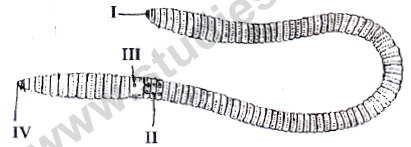
(2) II
(3) III
(4) IV
Answer: 4
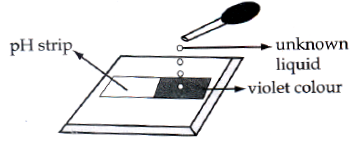
(2) dilute sodium hydroxide
(3) water
(4) dilute acetic acid
Answer: 2

(2) II
(3) III
(4) IV
Answer: 4
Question. A student took solid quick lime in a china dish and added a small amount of water. He heard:
(1) a popping sound
(2) a crackling sound
(3) a hissing sound
(4) no sound at all.
Answer: 3
Question. The following apparatus is available in the laboratory
Battery : adjustable from 0 to 6 V
Resistors : 4 Ω and 12 Ω
Ammeters : A1 of Range 0 to 5 A; Least Count 0.25 A
A2 of Range 0 to 3 A ; Least Count 0.1 A
Voltmeters : V1 of Range 0 to 10 V; Least Count 0.5 V
V2 of Range 0 to 5 V; Least Count 0.1 V
For the experiment to find the equivalent resistance of the parallel combination of the two given resistors, the best choice would be :
(1) ammeter A1 and voltmeter V1.
(2) ammeter A1 and voltmeter V2.
(3) ammeter A2 and voltmeter V1.
(4) ammeter A2 and voltmeter V2.
Answer: 3
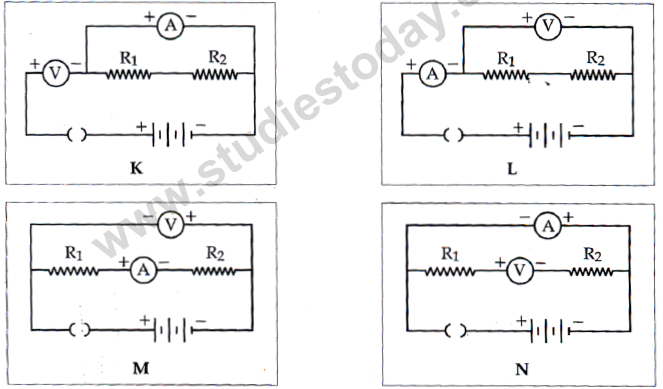
(2) L
(3) M
(4) N
Answer: 2
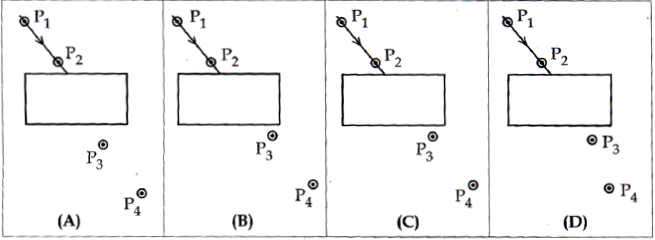
(2) (B)
(3) (C)
(4) (D)
Answer: 1
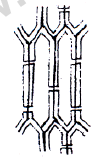
(2) thick cell wall with pits and no nuclei.
(3) large central vacuole and pits in the cell membrane.
(4) long fibre like shape and absence of cytoplasm.
Answer: 4
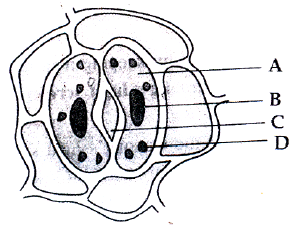
Question. In the diagram of the stomatal pore given below the marking corresponding to the chloroplast is :
(1) (A)
(2) (B)
(3) (C)
(4) (D)
Answer: 4
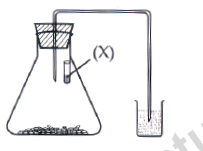
(2) Lime water
(3) Potassium hydroxide
(4) Hydrochloric acid
Answer: 3
(1) dissolution, filtration and evaporation
(2) filtration, evaporation and dissolution
(3) sublimation, dissolution and evaporation
(4) dissolution, evaporation and sublimation.
Answer: 1

(2) 5.9 g/ cc
(3) 5.85 g/ cc
(4) 5.75 g/ cc
Answer: 4
Question. Upon observing slides showing stages of reproduction in amoeba and yeast, students reported the following observations :
(i) Cytokinesis was seen in the yeast cell.
(ii) A chain of buds was seen due to reproduction in amoeba.
(iii) In amoeba, elongated nucleus was dividing to form two daughter nuclei.
(iv) Single cells of amoeba and yeast were undergoing binary fission and budding respectively.
The correct observations are :
(1) (i) and (ii) only
(2) (ii) only
(3) (iii) and (iv) only
(4) (i), (iii) and (iv) only
Answer: 3
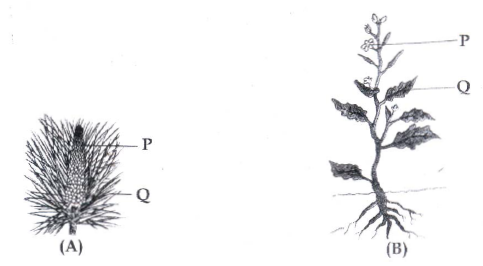
(ii) The part marked P in (A) is for defence and in (B) is for absorption of minerals.
(iii) The part marked Q in (A) and (B) are for nutrition.
(iv) The part marked Q in (A) is for food storage and in (B) for making seeds.
The correct statements are:
(1) (i) and (iv)
(2) (i) and (iii)
(3) (ii) and (iv)
(4) (ii) and (iii)
Answer: 2
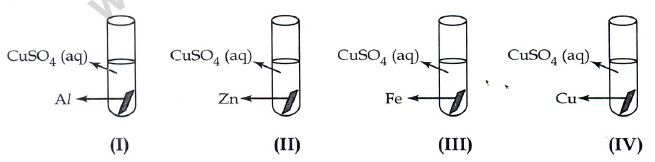
(2) (I), (II)
(3) (I), (II), (III)
(4) (II), (III), (IV)
Answer: 3
Question. A student was provided with acetic acid by the teacher and asked to conduct an experiment to study the reaction of acetic acid with litmus solution and sodium bicarbonate. The student would have reported:
(1) blue litmus solution turned red, a colourless gas was evolved with sodium bicarbonate.
(2) red litmus solution turned blue, a brown gas was evolved with sodium bicarbonate.
(3) blue litmus solution remained blue, a green gas was evolved with sodium bicarbonate.
(4) red litmus solution remained red, a yellow gas was evolved with sodium bicarbonate.
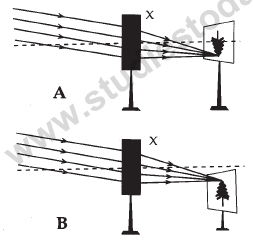
(2) A and the device X is a concave mirror.
(3) B and the device X is a convex lens.
(4) B and the device X is a concave mirror.
Answer: 1

The average value of the ratio V / I in the observations recorded in the above circuit would be :
(1) more than 6 Ω
(2) equal to 9 Ω
(3) between 3 Ω and 6 Ω
(4) less than 3 Ω
Answer: 4
Question. While performing the experiment with raisins to determine the percentage of water absorbed by them, a student recorded the following data:
Weight of the water in the beaker = 50 g
Weight of raisins before soaking = 20 g
Weight of raisins after soaking for one hour = 30 g
Weight of water left in the beaker after the experiment was over = 40 g
The percentage of water absorbed by raisins is :
(1) 10
(2) 20
(3) 45
(4) 50
Answer: 4
Question. In the experiment to prove that light is necessary for photosynthesis, the leaf should be tested for starch after the following four steps:
(i) Keep the potted plant in sunlight for at least 3 - 4 hours.
(ii) Keep the potted plant in complete darkness for about 48 hours.
(iii) Cover a leaf of the plant with black paper strip.
(iv) Pluck the leaf.
The correct sequence of these steps is :
(1) (i), (iii), (iv), (ii)
(2) (i), (iv), (iii), (ii)
(3) (ii), (iv), (iii), (i)
(4) (ii), (iii), (i), (iv)
Answer: 4
Free study material for Science
Multiple Choice Questions (MCQs) for Class 10 Science Practical Skills
Download Multiple Choice Questions: Practical Skills (Class 10 Science)
Explore reliable practice questions for Practical Skills tailored for Class 10 Science learners. Use these multiple-choice formats to evaluate preparedness and strengthen problem-solving skills.
Concept Clarification for Practical Skills
Built using the official NCERT book for Class 10, these Science objective sets provide reliable academic guidance. Pair your practice with our recommended NCERT solutions to master optimal problem-solving approaches.
Additional Study Resources for Class 10 Science
Explore our broader library of printable assignments, chapter notes, and mock tests designed to support continuous revision and secure higher marks in CBSE assessments.
FAQs
You can get most exhaustive CBSE Class 10 Science Practical Skills MCQs Set 02 for free on StudiesToday.com. These MCQs for Class 10 Science are updated for the 2026-27 academic session as per CBSE examination standards.
Yes, our CBSE Class 10 Science Practical Skills MCQs Set 02 include the latest type of questions, such as Assertion-Reasoning and Case-based MCQs. 50% of the CBSE paper is now competency-based.
By solving our CBSE Class 10 Science Practical Skills MCQs Set 02, Class 10 students can improve their accuracy and speed which is important as objective questions provide a chance to secure 100% marks in the Science.
Yes, Science MCQs for Class 10 have answer key and brief explanations to help students understand logic behind the correct option as its important for 2026 competency-focused CBSE exams.
Yes, you can also access online interactive tests for CBSE Class 10 Science Practical Skills MCQs Set 02 on StudiesToday.com as they provide instant answers and score to help you track your progress in Science.