CBSE Class 10 Science Carbon and its Compounds MCQs Set 02

Science Objective Questions and Answers: Chapter 04 Carbon and its Compounds

Access targeted multiple-choice questions for Chapter 04 Carbon and its Compounds designed to align with the latest CBSE academic syllabus for Class 10 Science. These objective practice sets help students evaluate their conceptual understanding and improve exam readiness.

Download Chapter 04 Carbon and its Compounds MCQs with Answers

View or download the dedicated Chapter 04 Carbon and its Compounds MCQ resource below. Practicing these 50 objective questions regularly builds familiarity with standard exam patterns and helps secure higher marks in final Science evaluations.

Question : Which of the following statements about diamond and graphite is true?

a) They have same crystal structure
b) They have same degree of hardness
c) They have same electrical conductivity
d) They have same chemical properties.
Answer : D  
 
 
Question : Graphite is good conductor of electricity due to the
a) presence of hexagonal rings 
b) presence of ions
c) presence van der waal forces 
d) presence of free electron
Answer : D
 
Question : Which of the following is a crystalline form of carbon ?
a) Charcoal 
b) Coal 
c) Graphite 
d) Lamp black
Answer : C
 
Question : Which of the following statements regarding graphite is not correct?
a) Graphite is a black and soft crystalline substance
b) Graphite is manufactured by heating coke at 3000oC.
c) Graphite is a bad conductor of heat and electricity.
d) Graphite possesses a metallic lustre and soapy touch.
Answer : C
 
Question : Organic compounds will always contains
a) carbon 
b) hydrogen
c) nitrogen 
d) sulphur
Answer : A
 
Question : Organic compounds are generally
a) covalent in nature 
b) ionic in nature
c) insoluble in organic solvents 
d) soluble in water
Answer : A
 
Question : The isomers always possess similar
a) chemical properties 
b) molecular formula
c) physical properties 
d) structural formula
Answer : B
 
Question : No of protons, electrons and neutrons respectively in carbon atom is
a) 6,6,8 
b) 6,6,6 
c) 8,6,8 
d) 6,7,8
Answer : B
 
Question : A compound with the molecular formula C2H2 must contain
a) all single bonds 
b) one double bond
c) one triple bond 
d) none of the above
Answer : B
 
Question : The general formula of alkane series is
a) Cn H2n–2 
b) Cn H2n 
c) Cn H2n+2 
d) Cn H2n+4
Answer : C
 
Question : The next higher homologue of propane is
a) C2H6 
b) C3H4 
c) C4H10 
d) C5H12 
Answer : C
 
 
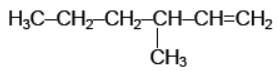
Question : The correct IUPAC name of the compound
 CBSE Class 10 Chemistry Carbon and Its Compounds MCQs
a) 4-ethylpent-1-ene 
b) 2-ethylpent-4-ene 
c) 4-methylhex-1-ene 
d) 3-methylhex-1-ene
Answer : D
 
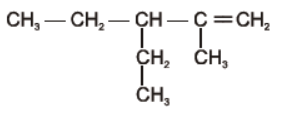
Question : IUPAC name of the compound given below is
CBSE Class 10 Chemistry Carbon and Its Compounds MCQs
a) 2-methyl-3-ethyl-1-pentene 
b) 3-ethyl-4-methyl-4-pentene
c) 3-ethyl-2-methyl-1-pentene 
d) 3-methyl-2-ethyl-1-pentene
Answer : C
 
Question : Which of the following name is wrong for CH2=CHCH2Cl ?
a) Chloro propene 
b) 1-Chloroprop-3-ene
c) 3-Chloroprop-1-ene 
d) 3-Chloropropylene
Answer : B
 
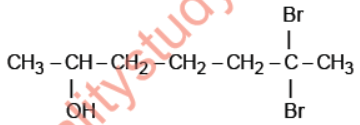
Question : IUPAC name of the compound given below is
CBSE Class 10 Chemistry Carbon and Its Compounds MCQs
a) 6, 6-dibromoheptan-2-ol 
b) 2, 2-dibromoheptan-6-ol
c) 6, 6-dibromoheptan-2-al 
d) None of these
Answer : A
 
Question : Which of the following represents neopentyl alcohol ?
a) CH3CH(CH3)CH2CH2OH 
b) (CH3)3CCH2OH
c) CH3CH2CH2CH2OH 
d) CH3CH2CH(OH)CH2
Answer : B
 
Question : The IUPAC name of acetyl acetone is :
a) 2,5–pentanedione 
b) 2,4–pentenedione
c) 2,4–hexanedione 
d) 2,4–pentanedione
Answer : B
 
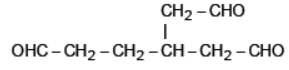
Question : IUPAC name of the compound is :
CBSE Class 10 Chemistry Carbon and Its Compounds MCQs
a) 4, 4-di(formylmethyl) butanal 
b) 2-(formylmethyl) butane-1, 4-dicarbaldehyde
c) hexane-3-acetaldial 
d) 3-(formylmethyl) hexanedial
Answer : D
 
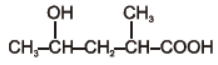
Question : The IUPAC name of is :-
CBSE Class 10 Chemistry Carbon and Its Compounds MCQs
a) 1-Hydroxy-4-methylpentanoic acid 
b) 1-Methyl-3-hydroxypentanoic acid
c) 4-Hydroxy-2-methylpentanoic acid 
d) 4-Carboxypentanol-2
Answer : C
 
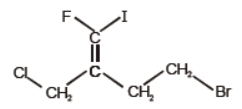
Question : The correct IUPAC name of the compound is :
CBSE Class 10 Chemistry Carbon and Its Compounds MCQs
a) 4-Bromo-1-chloro-2-fluoroiodomethylbutene
b) 4-Bromo-2-chloromethyl-1-fluoro-1-iodobut-1-ene
c) 2-(2-Bromoethyl)-3-chloro-1-fluoro-1-iodoprop-1-ene
d) 1-Bromo-3-chloromethyl-4-fluoro-4-iodobut-1-ene
Answer : A
 
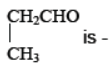
Question : The IUPAC name of
CBSE Class 10 Chemistry Carbon and Its Compounds MCQs
a) propanal 
b) propanol
c) propanoic aldehyde 
d) 2-methylethanal
Answer : A
 
Question : Which of the following pairs is an example of chain isomer ?
a) CH3 – CH2 – OH and CH3OCH3
b) CH3 – CH2 – CHO and CH3 – COCH3
c) CH3 – CH2 – CH2 – CH2 – CH3 and CH3–(CH3)CH–CH2–CH3
d) All of the above
Answer : D
 
Question : The oxidation of CH3CH2CHO produces
a) CH3COOH 
b) CH3CH2COOH
c) CH3COCH 
Answer : B
 
Question : Identify the 'product' in the reaction CH3COOH + C2H5OH → conce.H2SO4  Product + H2O
a) alcohol 
b) aldehyde 
c) ketone 
d) ester
Answer : D
 
Question : Identify the 'product' in the reaction CH3COOH → LiAIH4 'product' + H2O
a) aldehyde 
b) alcohol 
c) ketone 
d) acid
Answer : A
 
Question : The 'product' in the reaction CH3CH2OH 350ºC  Al2O3 'product' + H2O is
a) alkane 
b) alkene 
c) alkyne 
d) none of these
Answer : B
 
Question : The 'product' of the reaction CH2 = CH2 [O]KMnO4 'product' is
a) CH3COOH 
b) HOCH2CH2OH
c) COOH
     ↓
     COOH
d) none of these
Answer : B
 
Question : Total number of non-cyclic structural isomers of C4H10 are
a) 5 
b) 7 
c) 2 
d) 4
Answer : C
 
Question : Oils on treating with hydrogen in the presence of palladium or nickel catalyst form fats. This is an example of
a) Addition 
b) Displacement
c) Substitution 
d) Oxidation
Answer : A
 
Question : Oxidation of alcohol in presence of alk.KMnO4 results in formation of
a) aldehyde
b) ester 
c) acid 
d) ketone
Answer : C
 
Question : C2H5OH in presence of conc) H2SO4 convert into ethene. What role does sulphuric acid plays here ?
a) reducing agent 
b) oxidizing agent
c) dehydrating agent 
d) both B and C
Answer : C
 

Question :  Which of the following statements about diamond and graphite is true?

  • a) They have same chemical properties.
  • b) They have same crystal structure
  • c) They have same degree of hardness
  • d) They have same electrical conductivity

Answer :  A


Question :  The difference in the molecular formula and molecular mass of CH4 and C2H6 is:

  • a) CH2 and 14u
  • b) CH3 and 12u
  • c) CH2 and 12u
  • d) CH3 and 14u

Answer :  A


Question :  Which of the following are members of the same homologous series:

  • a) C2H5OH and C3H7OH
  • b) CH4 and C2H4
  • c) CH3OH and CH3Cl
  • d) CH3OCH3 and C2H5OH

Answer :  A


Question :  The IUPAC name of the following;

  • a) Butanol
  • b) Butanal
  • c) Butanoic acid
  • d) Pentane

Answer :  A


Question :  Which of the following represents cyclohexane:

  • a) C6H12
  • b) C6H14
  • c) C6H10
  • d) C6H6

Answer :  A


Question :  The number of isomers of C6H14 are

  • a) 6
  • b) 4
  • c) 5
  • d) 7

Answer :  A


Question :  Ethane and ethene can be distinguished by using:

  • a) Bromine water
  • b) Chlorine water
  • c) I2
  • d) HCl

Answer :  A


Question :  Catenation is maximum in:

  • a) Carbon
  • b) Oxygen
  • c) Sulphur
  • d) Phosphorous

Answer :  A


Question :  Methane reacts with one mole of Chlorine in presence of sunlight to give _________. The reaction is called_______.

  • a) Chloromethane, substitution
  • b) Dichloromethane, addition
  • c) Trichloromethane, elimination
  • d) Tetra chloro methane, combustion

Answer :  A


Question :  Which amongst the following does not conduct electricity:

  • a) C3H7OH
  • b) CH3COOH
  • c) HCOOH
  • d) NaCl(aq)

Answer :  A


Question :  The number of covalent bonds in C5H12 is:

  • a) 16
  • b) 15
  • c) 17
  • d) 18

Answer :  A


Question :  Which among the following contains triple bond:

  • a) C2H2
  • b) C2H4
  • c) C3H4
  • d) C2H6

Answer :  A


Question :  On adding NaHCO3 to acetic acid, a gas is evolved which turns lime water milky due to the formation of:

  • a) Calcium Carbonate
  • b) Calcium Hydroxide
  • c) Calcium bicarbonate
  • d) Calcium Acetate

Answer :  A


Question :  2ml of acetic acid is added to 5ml of water and was shaken up for 1minute, it was noticed that:

  • a) A clear and homogeneous solution is formed
  • b) The acid formed a separate layer on the top of water
  • c) Water formed a separate layer on the top of the acid
  • d) A pink and clear solution is formed

Answer :  A


Question :  Sodium carbonate solution is added to dilute ethanoic aci It is observed that :

  • a) A gas evolves
  • b) A solid settles at the bottom
  • c) The mixture becomes warm
  • d) The colour of the mixture

Answer :  A


Question :  The odour of acetic acid resembles that of:

  • a) Vinegar
  • b) Tomato
  • c) Kerosene
  • d) Lemon juice

Answer :  A


Question :  Carboxylic acid containing one carbon atom is

  • a) Formic acid
  • b) Citric acid
  • c) Acetic acid
  • d) Vinegar

Answer :  A


Question :  100% pure ethanol is called

  • a) Absolute alcohol
  • b) Acetic acid
  • c) Denatured alcohol
  • d) Power alcohol

Answer :  A


Question :  A functional group mainly determines the

  • a) Chemical properties
  • b) Physical properties
  • c) Both
  • d) None of these

Answer :  A


Question :  — C=O represents the functional group:

  • a) ketones
  • b) Alcohols
  • c) Carboxylic acids
  • d) Acids

Answer :  A


Multiple Choice Questions (MCQs) for Class 10 Science Chapter 04 Carbon and its Compounds

Chapter MCQs with Answers for Class 10 Science

Review structured objective questions for Class 10 Science Chapter 04 Carbon and its Compounds. Built according to official CBSE guidelines, these MCQ sets support daily revision and core concept reinforcement.

Expert Practice Material for Class 10 Science

Built using the official NCERT book for Class 10, these Science objective sets provide reliable academic guidance. Pair your practice with our recommended NCERT solutions to master optimal problem-solving approaches.

Complete Your Chapter Revision

Follow up your worksheet practice by attempting the interactive online Science MCQ test for this chapter to evaluate your execution speed. All platform resources are free to access.

FAQs

Where can I access latest CBSE Class 10 Science Carbon and its Compounds MCQs Set 02?

You can get most exhaustive CBSE Class 10 Science Carbon and its Compounds MCQs Set 02 for free on StudiesToday.com. These MCQs for Class 10 Science are updated for the 2026-27 academic session as per CBSE examination standards.

Are Assertion-Reasoning and Case-Study MCQs included in the Science Class 10 material?

Yes, our CBSE Class 10 Science Carbon and its Compounds MCQs Set 02 include the latest type of questions, such as Assertion-Reasoning and Case-based MCQs. 50% of the CBSE paper is now competency-based.

How do practicing Science MCQs help in scoring full marks in Class 10 exams?

By solving our CBSE Class 10 Science Carbon and its Compounds MCQs Set 02, Class 10 students can improve their accuracy and speed which is important as objective questions provide a chance to secure 100% marks in the Science.

Do you provide answers and explanations for CBSE Class 10 Science Carbon and its Compounds MCQs Set 02?

Yes, Science MCQs for Class 10 have answer key and brief explanations to help students understand logic behind the correct option as its important for 2026 competency-focused CBSE exams.

Can I practice these Science Class 10 MCQs online?

Yes, you can also access online interactive tests for CBSE Class 10 Science Carbon and its Compounds MCQs Set 02 on StudiesToday.com as they provide instant answers and score to help you track your progress in Science.