

Multiple Choice Questions (MCQs) for Class 10 Science: Chapter 12 Magnetic Effects of Electric Current
Explore reliable objective questions for Chapter 12 Magnetic Effects of Electric Current tailored for Class 10 learners. Utilizing these Science multiple-choice formats ensures thorough preparation and strengthens problem-solving speed for upcoming school assessments.
Practice Chapter 12 Magnetic Effects of Electric Current MCQs for Class 10 Science
View or download the dedicated Chapter 12 Magnetic Effects of Electric Current MCQ resource below. Practicing these 50 objective questions regularly builds familiarity with standard exam patterns and helps secure higher marks in final Science evaluations.
Case/Passage – 1
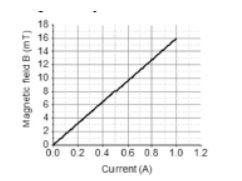
A solenoid is a long helical coil of wire through which a current is run in order to create a magnetic field. The magnetic field of the solenoid is the superposition of the fields due to the current through each coil. It is nearly uniform inside the solenoid and close to zero outside and is similar to the field of a bar magnet having a north pole at one end and a south pole at the other depending upon the direction of current flow. The magnetic field produced in the solenoid is dependent on a few factors such as, the current in the coil, number of turns per unit length etc. The following graph is obtained by a researcher while doing an experiment to see the variation of the magnetic fieldwith respect to the current in the solenoid. The unit of magnetic field as given in the graph attached is in milli-Tesla (mT) and the current is given in Ampere.
Question. What will happen if a soft iron bar is placed inside the solenoid?
(a) The bar will be electrocuted resulting in shortcircuit.
(b) The bar will be magnetised as long as there is current in the circuit.
(c) The bar will be magnetised permanently.
(d) The bar will not be affected by any means.
Answer: B
Question. From the graph deduce which of the following statements is correct.
(a) For a current of 0.8A the magnetic field is 13 mT
(b) For larger currents, the magnetic field increases nonlinearly.
(c) For a current of 0.8A the magnetic field is 1.3 mT
(d) There is not enough information to find the magnetic field corresponding to 0.8A current.
Answer: A
Question. The magnetic field lines produced inside the solenoid are similar to that of …
(a) a bar magnet 10
(b) a straight current carrying conductor
(c) a circular current carrying loop
(d) electromagnet of any shape
Answer: A
Question. What type of energy conversion is observed in a linear solenoid?
(a) Mechanical to Magnetic
(b) Electrical to Magnetic
(c) Electrical to Mechanical
(d) Magnetic to Mechanical
Answer: C
Question. After analysing the graph a student writes the following statements.
I. The magnetic field produced by the solenoid is inversely proportional to the current.
II. The magnetic field produced by the solenoid is directly proportional to the current.
III. The magnetic field produced by the solenoid is directly proportional to square of the current.
IV. The magnetic field produced by the solenoid is independent of the current.
Choose from the following which of the following would be the correct statements
(a) Only IV
(b) I and III and IV
(c) I and II
(d) Only II
Answer: D
Case/Passage – 2
For a conductor of length L carrying a current of I in a field B the force experienced by the conductor F→= I L→ x→ B If the current-carrying conductor in the form of a loop of any arbitrary shape is placed in a uniform field, then, F→ =0 i.e., the net magnetic force on a current loop in a uniform magnetic field is always zero. Here it must be kept in mind that in this situation different parts of the loop may experience elemental force due to which the loop may be under tension or may experience a torque.
Direction of force can be determined by fleming’s left hand rule, right hand palm rule or screw rule.
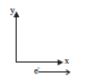
Question. An electron moving with uniform velocity in x-direction enters a region of uniform magnetic field along y-direction. Which of the following physical quantity(ies) is (are) non-zero and remain constant?
I. Velocity of the electron
II. Magnitude of the momentum of the electron.
III. Force on the electron.
IV. The kinetic energy of electron.
(a) Only I andII.
(b) Only III and IV.
(c) All four
(d) Only II and IV.
Answer: D
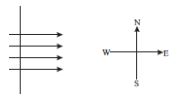
Question. A wire is lying horizontally in the north-south direction and there is a horizontal magnetic field pointing towards and the east. Some positive charges in the wire move north and an equal number of negative charges move south. The direction of force on the wire will be
(a) east
(b) down, into the page
(c) up, out of the page
(d) west
Answer: B
Question. Which of the following can produce a magnetic field?
(a) Electric charges at rest
(b) Electric charges in motion
(c) Only by permanent magnets
(d) Electric charges whether at rest or in motion
Answer: B
Question. The direction of induced current is obtained by
(a) Fleming’s left hand rule
(b) Maxwell’s cork-screw rule
(c) Ampere’s rule
(d) Fleming’s right hand rule
Answer: D
Question. Four situations are given below-
I. An infinitely long wire carrying current
II. A rectangular loop carrying current
III. A solenoid of finite length carrying current
IV. A circular loop carrying current.
In which of the above cases will the magnetic field produced be like that of a bar magnet?
(a) I
(b) I and III
(c) Only III
(d) Only IV
Answer: C
Case/Passage – 3
The strength of the magnetic field produced by a currentcarrying circular coil (or circular wire) depends on (i) Current flowing through the coil. (ii) Radius of the circular coil. (iii) Number of turns of wire in the circular coil.
Question. What type of curve we get, between magnetic field and distance along the axis of a current carrying circular coil?
(a) Straight
(b) Circular
(c) Parabolic
(d) None of the options
Answer: D
Question. A long horizontal power line is carrying a current of 100 A in the east-west direction. The direction of magnetic field at a point 1.0 m below it is
(a) south to north
(b) north to south
(c) east to west
(d) west to east
Answer: B
Question. If a current carrying straight conductor is placed is east-west direction, then the direction of the force experienced by the conductor due to earth’s magnetic field is:
(a) downward
(b) upward
(c) east-west
(d) west east
Answer: A
Case/Passage – 4
Study this table related to wattage of home appliances and answer the questions that follow.
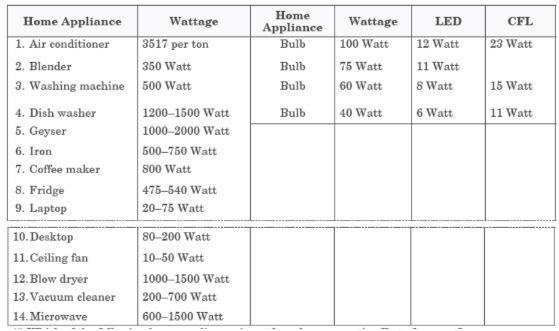
Question. Which of the following will to consume least power?
(a) Laptop
(b) Desktop
(c) Printer
(d) Blender
Answer: A
Question. Many appliance works on the principle of electromagnetic induction. The role which depicts the direction of induced current is as
(a) Faraday’s rule
(b) Henery’s rule
(c) Fleming’s rule
(d) Maxwell’s rule
Answer: C
Question. Which of the following home applicance is not based on magnetic effect of current?
(a) Ceiling fan
(b) Blender
(c) Geyser
(d) Washing Machine
Answer: C
Question. Which of the following will consume maximum power?
(a) Fridge
(b) Iron
(c) Air conditioner
(d) Coffee maker
Answer: C
Question. Which of the following lighting device is best to use in terms of power consumption?
(a) Bulb
(b) CFL
(c) Tube light
(d) LED
Answer: D
Case/Passage – 5
A magnetic stripe card, also referred to as a swipe card or magstripe, is a plastic card with a magnetic strip attached on its surface. This stripe is made of tiny iron-based components whose magnetism can be modified and can therefore be used to store information. A magstripe is quite similar to a magnetic recording tape, which you might find in videotape or a music cassette. The magnetic strip on a card can be ‘written’ or encoded with information because the tiny iron-based particles that make up the strip can be magnetised in different directions by a device that produces a strong magnetic field. This device is a ‘solenoid’, which is basically a coil wound into a tightly packed helix. The wire is wound around a highpermeable, metallic core that produces a strong magnetic field when a current is passed through it. This device encodes the required information onto the stripe, which is then pasted on a plastic card. When a card with a magnetic strip is moved back and forth over the ‘reader head’ , a voltage is induced in the coils of the card reader device. A card reader consists of solenoid too – the same component that is used to write information in the magnetic strip.
This voltage can be amplified and recorded electronically, which is finally read by a computer (or a processor installed within the reader) to authenticate a user (in the case of identity cards) or a transaction (in the case of credit/debit cards).
Question. The force on a wire inside a magnetic field increase when
(a) The current is increased
(b) Strength of magnetic field increases
(c) Length of wire is increased
(d) All of the options
Answer: D
Question. The factors on which one magnetic field strength produced by current carrying solenoids depends are
(a) Magnitude of current
(b) Number of turns
(c) Heat produced
(d) Both (a) and (b)
Answer: D
Question. Which of the following are the devices that uses magnetic theory to record data
(a) The hotel key cards
(b) Audio tapes
(c) CD’s
(d) All of the options
Answer: D
Question. The information of users which are read by the ATM machines are stored on
(a) Magnetic box on card
(b) Magnetic strip on card
(c) Inside ATM machine
(d) None of the options
Answer: B
Question. Name the scientist who gave the principle of electromagnetic field
(a) Oersted
(b) Faraday
(c) Bohr
(d) Ampere
Answer: A
Free study material for Science
Multiple Choice Questions (MCQs) for Class 10 Science Chapter 12 Magnetic Effects of Electric Current
Class 10 Science Chapter 12 Magnetic Effects of Electric Current Objective Test Questions
Explore reliable practice questions for Chapter 12 Magnetic Effects of Electric Current tailored for Class 10 Science learners. Use these multiple-choice formats to evaluate preparedness and strengthen problem-solving skills.
NCERT-Aligned Objective Questions and Solutions
Built using the official NCERT book for Class 10, these Science objective sets provide reliable academic guidance. Pair your practice with our recommended NCERT solutions to master optimal problem-solving approaches.
Next Steps in Your Exam Preparation
Follow up your worksheet practice by attempting the interactive online Science MCQ test for this chapter to evaluate your execution speed. All platform resources are free to access.
FAQs
You can get most exhaustive CBSE Class 10 Science Case Study Questions Magnetic Effects of Electric Current MCQs Set 05 for free on StudiesToday.com. These MCQs for Class 10 Science are updated for the 2026-27 academic session as per CBSE examination standards.
Yes, our CBSE Class 10 Science Case Study Questions Magnetic Effects of Electric Current MCQs Set 05 include the latest type of questions, such as Assertion-Reasoning and Case-based MCQs. 50% of the CBSE paper is now competency-based.
By solving our CBSE Class 10 Science Case Study Questions Magnetic Effects of Electric Current MCQs Set 05, Class 10 students can improve their accuracy and speed which is important as objective questions provide a chance to secure 100% marks in the Science.
Yes, Science MCQs for Class 10 have answer key and brief explanations to help students understand logic behind the correct option as its important for 2026 competency-focused CBSE exams.
Yes, you can also access online interactive tests for CBSE Class 10 Science Case Study Questions Magnetic Effects of Electric Current MCQs Set 05 on StudiesToday.com as they provide instant answers and score to help you track your progress in Science.