

Class 9 Science Study Guide: CBSE Class 9 Science Natural Resources Notes
Review targeted academic resources with the CBSE Class 9 Science Natural Resources Notes. Built according to official CBSE standards for the 2026-27 term, these downloadable Class 9 Science study materials support effective daily practice and deeper conceptual understanding for Chapter 14 Natural Resources.
Download Chapter 14 Natural Resources Study Material PDF
Access the complete useful resource PDF for Class 9 Science below. Regular practice with these targeted academic notes builds familiarity with complex topics and helps secure higher marks in final school evaluations.
CBSE Class 9 Science Natural Resources Notes. There are many more useful educational material which the students can download in pdf format and use them for studies. Study material like concept maps, important and sure shot question banks, quick to learn flash cards, flow charts, mind maps, teacher notes, important formulas, past examinations question bank, important concepts taught by teachers. Students can download these useful educational material free and use them to get better marks in examinations. Also refer to other worksheets for the same chapter and other subjects too. Use them for better understanding of the subjects.
RESOURCES ON THE EARTH
Biosphere:
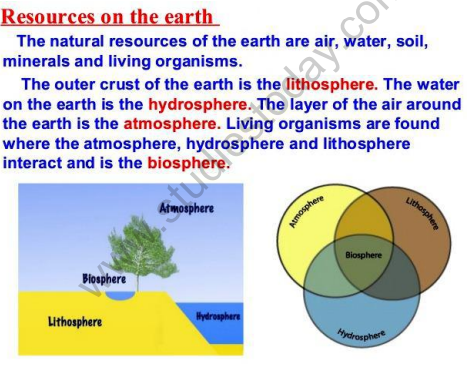
The whole combination of animals, plants and non-living beings which by their interaction make the planet earth a live and vibrant place is called biosphere.
Biotic Components:
Living things constitute the biotic component of the biosphere.
Abiotic Components:
The air, the water and the soil form the non-living or a biotic component of the biosphere. The air is called the hygrosphere, the water is hydrosphere and the soil is called lithosphere.
AIR
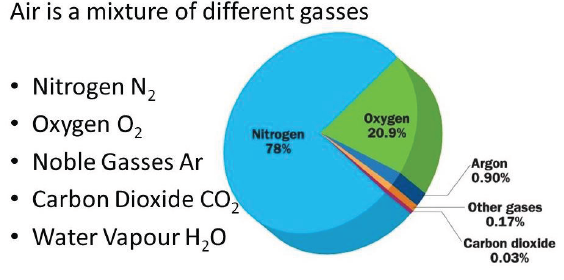
Air is a mixture of many gases like nitrogen, oxygen, carbon dioxide and water vapour. All living beings need oxygen to break down glucose molecules and get energy for their activities. This results in the production of carbon dioxide. Another process which results in the consumption of oxygen and the concomitant production of carbon dioxide is combustion. This includes not just human activities, which burn fuels to get energy, but also forest fires. Despite this, the percentage of carbon dioxide in our atmosphere is a mere fraction of a percent because of carbon dioxide fixation.
Carbon Dioxide Fixation
(i) Green plants convert carbon dioxide into glucose in the presence of Sunlight and
(ii) Many marine animals use carbonates dissolved in sea-water to make their shells.
The Role of the Atmosphere in Climate Control:
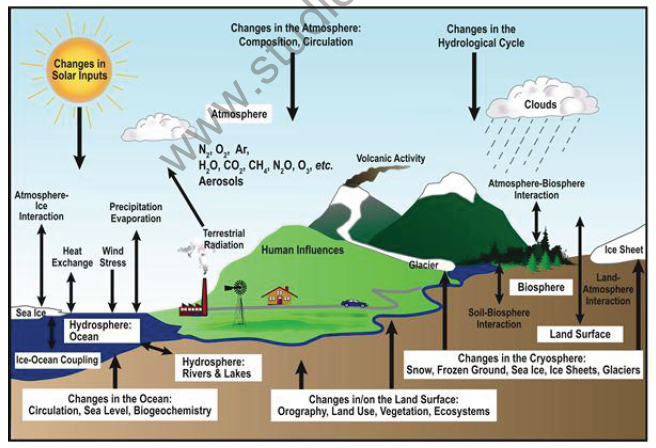
Atmosphere covers the Earth, like a blanket. We know that air is a bad conductor of heat. The atmosphere keeps the average temperature of the Earth fairly steady during the day and even during the course of the whole year. The atmosphere prevents the sudden increase in temperature during the daylight hours. And during the night, it slows down the escape of heat into outer space. The moon, which is about the same distance from the Sun that the Earth is, with no atmosphere, the temperature ranges from –190º C to 110º C.
THE MOVEMENT OF AIR: WINDS
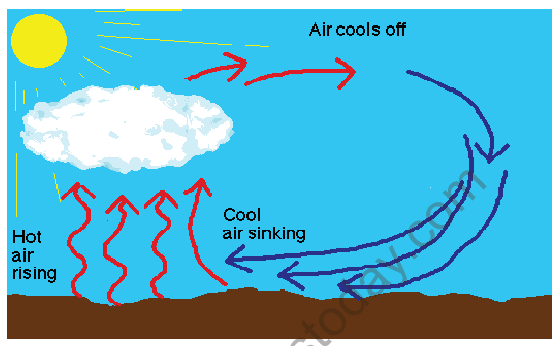
These phenomena are the result of changes that take place in our atmosphere due to the heating of air and the formation of water vapour. Water vapour is formed due to the heating of water bodies and the activities of living organisms. The rise in temperature creates a low pressure zone which attracts cool air from high pressure zone and pushes up the hot air. Thus the atmosphere can be heated from below by the radiation that is reflected back or re-radiated by the land or water bodies. On being heated, convection currents are set up in the air.
AIR POLLUTION
An air pollutant is known as a substance in the air that can cause harm to humans and the environment. Pollutants can be in the form of solid particles, liquid droplets, or gases. In addition, they may be natural or man-made. Pollutants can be classified as either primary or secondary. Usually, primary pollutants are substances directly emitted from a process, such as ash from a volcanic eruption, the carbon monoxide gas from a motor vehicle exhaust or sulfur dioxide released from factories. Secondary pollutants are not emitted directly. Rather, they form in the air when primary pollutants react or interact. An important example of a secondary pollutant is ground level
ozone - one of the many secondary pollutants that make up photochemical smog.

RAIN
When water bodies are heated during the day, a large amount of water evaporates and goes into the air. Some amount of water vapour also gets into the atmosphere because of various biological activities. This air also gets heated. The hot air rises up carrying the water vapour with it. As the air rises, it expands and cools. This cooling causes the water vapour in the air to condense in the form of tiny droplets. This condensation of water is facilitated if some particles could act as the ‘nucleus’ for these drops to form around. Once the water droplets are formed, they grow bigger by the ‘condensation’ of these water droplets. When the drops have grown big and heavy, they fall down in the form of rain. Rainfall patterns are decided by the prevailing wind patterns. In large parts of India, rains are mostly brought by the southwest or north-east monsoons.

WATER: A WONDER LIQUID
Water occupies a very large area of the Earth’s surface and is also found underground. Some amount of water exists in the form of water vapour in the atmosphere. Most of the water on Earth’s surface is found in seas and ocean sand is saline. Fresh water is found frozen in the icecaps at the two poles and on snow covered mountains. The underground water and the water in rivers, lakes and ponds is also fresh. However, the availability of fresh water varies from place to place. Practically every summer, most places have to face a shortage of water. And in rural areas, where water supply systems have not been installed, people are forced to spend considerable amounts of time in fetching water from faraway sources. Importance of Water: All cellular processes take place in a water medium. All the reactions that take place within our body and within the cells occur between substances that are dissolved in water. Substances are also transported from one part of the body to the other in a dissolved form. Hence, organisms need to maintain the level of water within their bodies in order to stay alive. Terrestrial life-forms require fresh water for this because their bodies cannot tolerate or get rid of the high amounts of dissolved salts in saline water. Thus, water sources need to be easily accessible for animals and plants to survive on land.
WATER POLLUTION
Water pollution is the contamination of water bodies such as lakes, rivers, ocean and groundwater caused by human activities, which can be harmful to organisms and plants thatlive in these water bodies. Some of the causes of water pollution are shown in below figure:
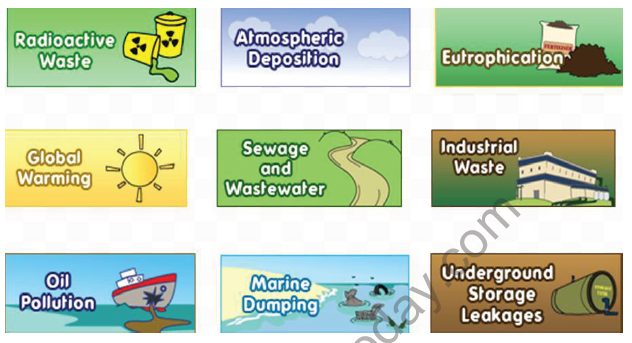
We use the term water-pollution to cover the following effects:
1. The addition of undesirable substances to water-bodies. These substances could be the fertilizers and pesticides used in farming or they could be poisonous substances, like mercury salts which are used by paper-industries. These could also be disease-causing organisms, like the bacteria which cause cholera.
2. The removal of desirable substances from water-bodies. Dissolved oxygen is used by the animals and plants that live in water. Any change that reduces the amount of this dissolved oxygen would adversely affect these aquatic organisms. other nutrients could also be depleted from the water bodies.
3. A change in temperature. Aquatic organisms are used to a certain range of temperature in the water-body where they live, and a sudden marked change in this temperature would be dangerous for them or affect their breeding. The eggs and larvae of various animals are particularly susceptible to temperature changes. SOIL
Soil is an important resource that decides the diversity of life in an area. The outermost layer of our Earth is called the crust and the minerals found in this layer supply a variety of nutrients to life-forms. The factors or processes that make soil:
• The Sun: The Sun heats up rocks during the day so that they expand. At night, these rocks cool down and contract. Since all parts of the rock do not expand and contract at the same rate, this results in the formation of cracks and ultimately the huge rocks break up into smaller pieces.
• Water: Water helps in the formation of soil in two ways. One, water could get into the cracks in the rocks formed due to uneven heating by the Sun. If this water later freezes, it would cause the cracks to widen. Two, flowing water wears away even hard rock over long periods of time. Fast flowing water often carries big and small particles of rock downstream. These rocks rub against other rocks and the resultant abrasion causes the rocks to wear down into smaller and smaller particles. The water then takes these particles along with it and deposits it further down its path. Soil is thus found in places far away from its parent rock.
• Wind: In a process similar to the way in which water rubs against rocks and wears them down, strong winds also erode rocks down. The wind also carries sand from one place to the other like water does.
Please click the link below to download CBSE Class 9 Science Natural Resources Notes.
Free study material for Science
Free CBSE Study Guides: Class 9 Science Chapter 14 Natural Resources
Quick Revision Material for Chapter 14 Natural Resources
Explore essential learning tools for Class 9 Science Chapter 14 Natural Resources. This curated collection features in-depth notes and targeted practice questions built around the active 2026 curriculum to streamline your daily revision.
Expert Notes and Solved Exam Questions
Designed around the official curriculum, these study guides guarantee standard compliance. Reviewing step-by-step solutions clarifies complex sub-topics within Chapter 14 Natural Resources and demystifies standard marking schemes for Science evaluations.
Additional Study Resources for Class 9
Wrap up your chapter revision by testing your knowledge against standard objective question formats. Explore our full library of free, up-to-date sample papers and online assessments to secure top grades in your CBSE examinations.
FAQs
Our advanced study package for Chapter 14 Natural Resources includes detailed concepts, diagrams, Mind Maps, and explanation of complex topics to ensure Class 9 students learn as per syllabus for 2026 exams.
The Mind Maps provided for Chapter 14 Natural Resources act as visual anchors which will help faster recall during high-pressure exams.
Yes, teachers use our Class 9 Science resources for lesson planning as they are in simple language and have lot of solved examples.
Yes, You can download the complete, mobile-friendly PDF of the Science Chapter 14 Natural Resources advanced resources for free.
Yes, our subject matter experts have updated the Chapter 14 Natural Resources material to align with the rationalized NCERT textbooks and have removed deleted topics and added new competency-based questions.