

Download CBSE Class 9 Science Useful Resources
Access comprehensive study materials and useful resources for Human Disease using the CBSE Class 9 Science Human Disease Exam Notes. Designed to align with the 2026-27 CBSE academic guidelines, these advanced resources help Class 9 Science students reinforce core concepts beyond standard textbooks.
Access CBSE Study Guides and Summaries
Navigate directly to the advanced Science study materials using the digital viewer below. Each resource pack includes detailed conceptual summaries and solved practice questions, allowing students to instantly reinforce their learning.
CBSE Class 9 Science Human Disease Exam Notes. Please refer to the examination notes which you can use for preparing and revising for exams. These notes will help you to revise the concepts quickly and get good marks.
Question. Endemic diseases are caused by :-
(A) bacteria
(B) environment
(C) human culture
(D) immoral society
Answer: A
Question. A balanced diet has
(A) vegetarian and non-vegetarian dishes
(B) salty and sweet dishes
(C) carbohydrates, fats and proteins
(D) all nutrients, water and roughage
Answer: D
Question. Botulism is caused by :-
(A) Salmonella typhae
(B) Clostridium botulinum
(C) Crasticium botulinum
(D) Staphylococci
Answer: B
Question. The term non-essential amino acids' is applied to fatty acids that are
(A) synthesized in the body
(B) water-soluble
(C) required by the body but not essential
(D) useless
Answer: A
Question. Deformed bones are associated with
(A) pellagra
(B) beriberi
(C) anaemia
(D) rickets
Answer: D
Question. Vitamins are
(A) inorganic substances that cannot by synthesised by animal
(B) inorganic substance that can be synthesised by the animal
(C) organic substances that cannot be synthesised by animal
(D) organic.substances that can be synthesised by animal
Answer: C
Question. In goitre, there is swelling of the
(A) eyes
(B) limbs
(C) abdomen
(D) thyroid gland
Answer: D
Question. Castle intrinsic factor relates to intestinal absorption of
(A) cobalamin
(B) thiamine
(C) riboflavin
(D) pyridoxine
Answer: A
Question. Syphilis is an example of :-
(A) water-borne disease
(B) advanced from of jaundice
(C) air-borne disease
(D) venereal disease
Answer: B
Question. Kwashiorkor is likely in children who get
(A) low-iron diet
(B) low-vitamin diet
(C) low-fat diet
(D) low-protein diet
Answer: D
Question. The energy produced by 1 g of carbohydrate is
(A) 4.2 cal
(B) 4.2 kcal
(C) 9 joules
(D) 9.2 kcal
Answer: B
Question. Which of the following nutrients do not provide energy for animals?
(A) Fats
(B) Carbohydrates
(C) Vitamins
(D) Proteins
Answer: C
Question. An example of an airborn disease from the following is :-
(A) cholera
(B) small pox
(C) typhoid
(D) AIDS
Answer: B
Question. About 70% of our energy requirements should be met by
(A) vitamins
(B) fats
(C) proteins
(D) carbohydrates
Answer: D
Question. Vitamin A is responsible for
(A) rhodopsin
(B) night blindness
(C) pellagra
(D) cirrhosis
Answer: B
Question. Night blindness is due to
(A) excessive drinking of alcohol
(B) excess secretion of adrenals
(C) vitamin A deficiency
(D) inheritance by X-chromosome
Answer: C
Question. Anaemia is related to
(A) iodine deficiency
(B) food adulteration
(C) iron deficiency
(D) all of these
Answer: C
Question. Cod liver oil is source of
(A) vitamin B
(B) vitamin C
(C) iodine
(D) vitamin A
Answer: D
Question. Insects like cockroach and spider and responsible for food poisoning and diseases. They play the role of a :-
(A) vector
(B) causative agent
(C) carrier
(D) All of these
Answer: A
Question. Cholesterol is synthesised in
(A) Brunner's
(B) Pancreas
(C) liver
(B) Spleen
Answer: C
Question. Pernicious anaemia failure of erythrocytes to mature is mainly due to lack of
(A) vitamin K
(B) thiamine
(C) pyridoxine
(D) cyanocobalamin
Answer: D
Question. Gastroenteritis is a disease caused by :-
(A) virus
(B) fungi
(C) algae
(D) bacteria
Answer: D
Question. The common housefly is responsible for causing many water-borne diseases. Its role is that of a :-
(A) carrier
(B) vector
(C) causative agent
(D) None of these
Answer: B
Question. Vitamin B2 is related with
(A) FMN
(B) NAD
(C) NADH
(D) ATP
Answer: A
Question. Ascariasis is a disease caused by :-
(A) bacteria
(B) fungal growth
(C) worms
(D) None of these
Answer: C
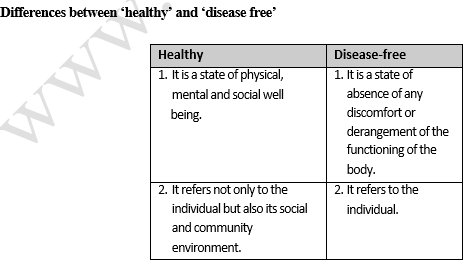
HEALTH
In is a state of being well enough to function well physically mentally & socially.
Personal & Community issue both matter for health
Our social environment is an important factor in our individual health. Human begins live in societies in villages, towns or cities. In such places, even our physical environment is decided by our social environment.
Public health services : These services ensure
(i) proper removal and disposal of garbage,
(ii) proper drainage of sewage,
(iii) clean drinking water and unadulterated food items,
(iv) vector and pest control,
(v) proper vaccination and other health care services etc. If public health services are inadequate, the helath of individual citizens is bound to be affected despite taking best personal hygiene and consuming the balanced diet.
Economic conditions: Food is earned by doing job. Proper earning is necessary to provide adequate and nutritious food to everyone in the family.
Social equality and harmony : Similarly, social equality and harmony are necessary for individual helath. It involves participation in one another’s joys and sorrow, helping others and receiving help at the time of need etc.
Personal hygiene : It involves individual’s cleanliness. It can be achieved by washing of soiled hand, regular cleaning of teeth, care of eyes, taking bath, wearing clean clothes, timely vaccination against dangered diseases etc
Symptoms : These are the manifestations or evidences of the presence of disease(s). Symptoms indicate that there is some abnormality in the body. For instance, we have headache or cough or loose motions or wound with pus, all these are symptoms of some disease(s).
On the basis of the symptoms, the physicians do the following :
• They look for the signs of a particular disease.
• They get laboratory tests done on the patients to further confirm the disease.
Signs: These provide information about the presence of particular disease. These are distinct for different diseases.

- Sources (causes) of Disease :
• Generally, factors affecting health may be divided into following groups -
(a) Intrinsic factors and
(b) Extrinsic factors
(A) Intrinsic or Internal Factors :
• The disease causing factors which exist with in the human body are called intrinsic factors.
• The important intrinsic factors which affect human health are the following -
♦ Malfunctioning or improper functioning of various body parts.
♦ Genetic disorders
♦ Hormonal imbalances
♦ Malfunctioning of immune system
• The diseases caused by intrinsic sources or factors are called organic or metabolic diseases.
• Some of the diseases caused by intrinsic sources are -
♦ Cardiac failure
♦ Kidney failure
♦ Osteoporosis (Pore in bones)
♦ Myopia or short sightedness
♦ Sickle cell anaemia etc.
(B) Extrinsic or External Factor :
• The factors causing diseases and existing outside the human body are called extrinsic or external factors.
• The important extrinsic factors which upset human health are the following -
♦ Unbalanced diet
♦ Diseases causing micro-organism such as viruses, bacteria, fungi etc.
♦ Environmental pollutants.
♦ Tobacco, alcohol and narcotic drugs.
• Extrinsic factors affect the health of our body by interfering with normal fuctioning of the body system.
• Some of diseases caused by extrinsic factors are–
♦ Kwashiorkor
♦ Marasmus
♦ Night blindness
♦ Beri Beri etc.
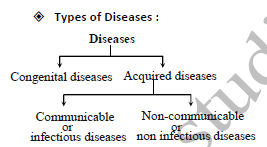
• Human diseases are broadly grouped into two categories -
Congenital Diseases :
• These diseases are those which are present since birth.
Acquired Diseases :
• These diseases are those which develop after birth.
Acquired Diseases :
Acquired diseases can be broadly classified into two types -
♦ Communicable ♦ Non-communicable
Acquired diseases can be broadly classified into two types -
- Infectious (communicable) Diseases :
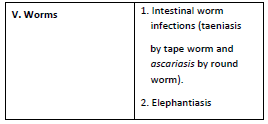
These diseases are spread from infected person to other in various ways, i.e., through air, water, food, physical contact, sexual act and insects. The causative agents of these diseases are called pathogens or infectious agents. These may be viruses, bacteria, fungi, protozoans (single-called animals) and different kinds of worms (multicellular organisms). Common diseases caused by these infectious agents are mentioned in Table.

Please click on below link to download pdf file for CBSE Class 9 Science Human Disease Exam Notes.
Free study material for Science
Free CBSE Study Guides: Class 9 Science Human Disease
Core Study Kit: Class 9 Science Human Disease
Explore essential learning tools for Class 9 Science Human Disease. This curated collection features in-depth notes and targeted practice questions built around the active 2026 curriculum to streamline your daily revision.
NCERT-Aligned Solutions for Human Disease
Built using official NCERT guidelines for Class 9 Science, these materials provide reliable academic support. Integrating past examination questions and step-by-step solutions helps students understand official CBSE grading criteria.
Next Steps in Your Exam Preparation
For peak performance in upcoming evaluations, integrate official Science sample papers directly into your study schedule. Follow up your revision by attempting online MCQ tests for Human Disease to refine calculation speed and precision.
FAQs
Our advanced study package for Human Disease includes detailed concepts, diagrams, Mind Maps, and explanation of complex topics to ensure Class 9 students learn as per syllabus for 2026 exams.
The Mind Maps provided for Human Disease act as visual anchors which will help faster recall during high-pressure exams.
Yes, teachers use our Class 9 Science resources for lesson planning as they are in simple language and have lot of solved examples.
Yes, You can download the complete, mobile-friendly PDF of the Science Human Disease advanced resources for free.
Yes, our subject matter experts have updated the Human Disease material to align with the rationalized NCERT textbooks and have removed deleted topics and added new competency-based questions.