

Download CBSE Class 9 Science Useful Resources
Access comprehensive study materials and useful resources for Chapter 13 Why Do We Fall Ill using the CBSE Class 9 Science Why do we fall ill Notes. Designed to align with the 2026-27 CBSE academic guidelines, these advanced resources help Class 9 Science students reinforce core concepts beyond standard textbooks.
Access CBSE Study Guides and Summaries
Navigate directly to the advanced Science study materials using the digital viewer below. Each resource pack includes detailed conceptual summaries and solved practice questions, allowing students to instantly reinforce their learning.
CBSE Class 9 Science Why do we fall ill Notes. There are many more useful educational material which the students can download in pdf format and use them for studies. Study material like concept maps, important and sure shot question banks, quick to learn flash cards, flow charts, mind maps, teacher notes, important formulas, past examinations question bank, important concepts taught by teachers. Students can download these useful educational material free and use them to get better marks in examinations. Also refer to other worksheets for the same chapter and other subjects too. Use them for better understanding of the subjects.
HEALTH AND ITS FAILURE
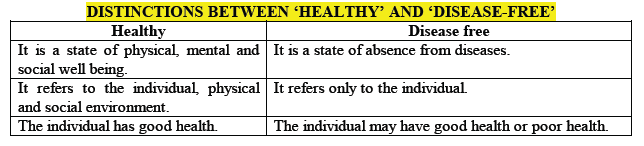
Good health is a very hard thing to measure, but it is one of life's most precious things. The World Health Organisation has defined health as a state of complete physical, mental and social well-being.
Community health can be defined as "All the personal health along with the environmental services for the importance of health of community".
Some of the health services are given below:
(i) Establishment of health care services like primary health centers, district hospitals, community health centers, medical colleges, all Indian institutes, regional hospitals etc.
(ii) Provision of safe drinking water and proper disposal of garbage.
(iii) Prevention of harmful insect breeding sites.
(iv) Management of different types of environmental pollution by Central and State Pollution Control Boards.
(v) Preventive vaccinations against number of diseases like tuberculosis, diphtheria, whooping cough, tetanus, measles, hepatitis, etc.
(vi) Provision of family planning advices and services.
(vii) Provision of medical care to school going children.
(viii) Prevention of food adulteration.
(ix) Health education.
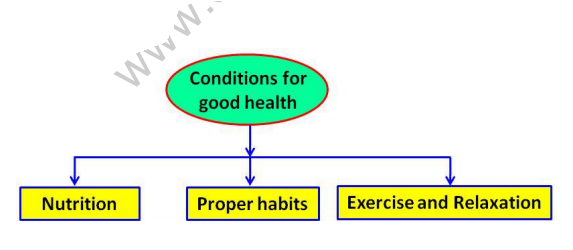
CONDITIONS ESSENTIAL FOR GOOD HEALTH
There are several conditions which have to be fulfilled for good health. The important ones are
(i) Nutrition,
(ii) Proper habits, and
(iii) Exercise and relaxation.
(i) Nutrition
Nutrition can be defined as the procurement of substances necessary for growth, development, maintenance and activities of a living organism. We obtain food from various plant and animal sources. In order to keep healthy and energetic, we need to take food. It takes care of the daily energy need also. We consume energy even while sleeping. Energy requirement depends on individual, age and special need. Growing children, pregnant women and nursing mothers need more energy.
(ii) Proper Habits
Another important aspect of good health is to observe proper dietary habits that are consumption of balanced diet and at fixed time. Good personal and domestic hygiene is very
essential. Take full care of the following aspects.
• Your food should be fresh and kept away from dust, flies, insect and microbes to avoid any infection and spoilage.
• Utensils should be kept clean.
• You should wash your face and hands with soap before eating or handling the food.
• Food should be cooked with good feelings and cheerful state.
• Smoking, chewing tobacco, drinking alcohol, taking addictive drugs are bad habits and should be avoided.
• They can have damaging effects on our body and mind.
(iii) Exercise and Relaxation
Regular exercise is necessary to keep our body fit. These exercises vary with age, physical condition and nature of work of the individual. In the case of sedentary worker, exercise is
even more essential. Another aspect of health is regular sleep and relaxation. The duration of sleep also varies with age and nature of work. Infants sleep for long hours, which is necessary for them to grow. For children, an average of eight hours of sound sleep is sufficient. For adults six hours of sleep is enough. Relaxation improves the capacity to work. Relaxation may be defined as an activity or recreation, which provides a relief or diversion from work or effort. There are various ways of relaxation. Yoga and meditation relax the body and mind. Listening to music and reading magazines are also relaxing.
PERSONAL AND COMMUNITY ISSUES BOTH MATTER FOR HEALTH
Health is a state of physical, mental and social well being. The conditions necessary for good health are :-
i) Good physical and social environment.
ii) Good economic conditions.
iii) Social equality and harmony.
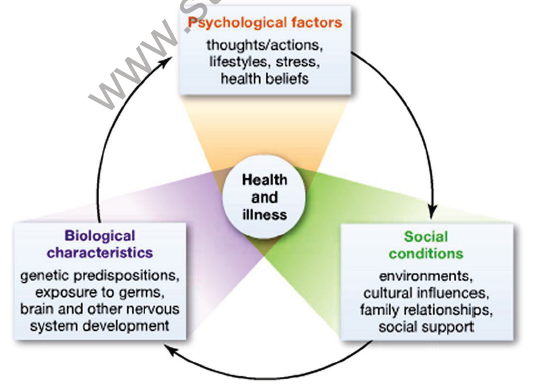
• Good physical and social environment includes clean surroundings, good sanitation, proper garbage disposal and clean drinking water.
• Good economic conditions includes job opportunities for all for earning to have nutritious food and to lead a healthy life.
• Social equality and harmony are necessary for a healthy and peaceful life.
DISEASE AND ITS CAUSES
A person may be regarded as suffering from a disease when his body does not function properly. Minor and major disorders of the body may lead to diseases. Infectious diseases are
caused by germs. One of the greatest achievements in the history of mankind is the demonstration by Pasteur, Koch and others of germs or microbes that cause diseases. Microbes
are the microscopic organisms such as virus, bacteria, some fungi and protozoans that are responsible for causing diseases in human beings. Cholera, tetanus, typhoid, diphtheria and
pneumonia are some common diseases caused by bacteria. Polio, common cold, influenza, measles, chicken pox and AIDS are diseases caused by virus. Amoebic dysentery and malaria are caused by protozoans.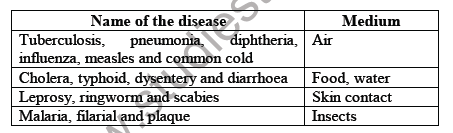
ACUTE AND CHRONIC DISEASES
When a person is affected by a disease either the normal functioning or the appearance of one or more systems of the body changes for the worse. These changes give rise to signs of the disease called symptoms. On the basis of the symptoms the physicians look for the signs of a particular disease and conduct tests to confirm the disease.
Types of diseases :- Diseases are of different types. They are :- i) Acute diseases :- are diseases which last only for a short period of time and does not have long term effect on health. Eg:- cold, cough, typhoid, cholera etc. ii) Chronic disease :- are diseases which lasts for a long time and has long term drastic effect on health. Eg :- diabetes, tuberculosis, elephantiasis, arthritis, cancer etc.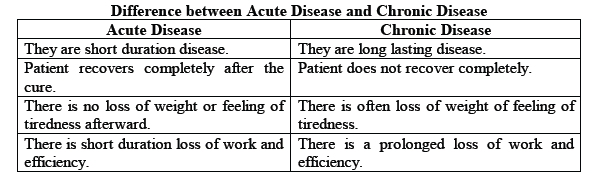
CHRONIC DISEASES AND POOR HEALTH
Chronic disease is a disease that persists for a long time. Chronic diseases are the major cause of death and disability worldwide. The total number of people dying from chronic iseases is double that of all infectious diseases (including HIV/AIDS, tuberculosis and malaria), maternal and parental conditions, and nutritional deficiencies combined. 80% of chronic disease deaths occur in low and middle income countries and half are in women. Without action to address the causes, deaths from chronic disease will increase by 17% between 2005 and 2015.
Chronic diseases
• Cardiovascular diseases, mainly heart disease and • chronic respiratory diseases;
• Stroke; • diabetes;
• Cancer; • genetic disorders.
• others, such as mental disorders, vision and hearing
• impairment, oral diseases, bone and joint disorders,
HEART DISEASE
There are many forms of heart disease. Coronary heart disease, also known as coronary artery disease or ischaemic heart disease, is the leading cause of death globally. It is caused by
disease of the blood vessels (atherosclerosis) of the heart.
STROKE
Stroke is a disease of thebrain caused by interference to the blood supply. Stroke and heart disease are the main cardiovascular diseases.
CANCER
Cancer describes a range of diseases in which abnormal cells proliferate and spread out of control. Other terms used are tumours and neoplasms. There are many types of cancer and all organs of the body can become cancerous.
CHRONIC RESPIRATORY DISEASES
Diseases of the lung take many forms. Chronic obstructive respiratory disease and asthma are the most common forms. Chronic obstructive respiratory disease is caused by irreversible obstruction of the larger airways in the lung; asthma is caused by reversible obstruction of the smaller airways in the lung.
DIABETES
Diabetes is characterized by raised blood glucose (sugar) levels. This results from a lack of the hormone insulin, which controls blood glucose levels, and/or an inability of the body’s tissues to respond properly to insulin. The most common type of diabetes is type 2, which accounts for about 90% of all diabetes and is largely the result of excessive weight and physical inactivity. The usual childhood form of diabetes (type 1 diabetes) is caused by an absolute lack of insulin. Without insulin, type 1 diabetes is rapidly fatal.
WHAT CAUSES CHRONIC DISEASES?
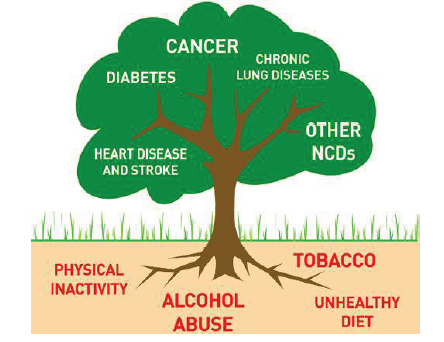
The causes (risk factors) of chronic diseases are well established and well known; a small set of common risk factors are responsible for most of the main chronic diseases. These risk
factors are modifiable and the same in men and women:
♦unhealthy diet;
♦physical inactivity;
♦tobacco use.
These causes are expressed through the intermediate risk factors of raised blood pressure, raised glucose levels, abnormal blood lipids, overweight and obesity. The major modifiable
risk factors, in conjunction with the non-modifiable risk factors of age and heredity, explain the majority of new events of heart disease, stroke, chronic respiratory diseases and some
important cancers. The relationship between the major modifiable risk factors and the main chronic diseases is similar in all regions of the world.
OTHER RISK FACTORS
Many more risk factors for chronic diseases have been identified, but they account for a smaller proportion of disease. Harmful alcohol use is an important contributor to the global
burden of disease but its relationship to chronic disease is more complex. Other risk factors for chronic disease include infectious agents that are responsible for cervical and liver cancers, and some environmental factors, such as air pollution, which contribute to a range of chronic diseases including asthma and other chronic respiratory diseases.
PSYCHOSOCIAL AND GENETIC FACTORS ALSO PLAY A ROLE.
• Childhood risk
There is now extensive evidence from many countries that conditions before birth and in early childhood influence health in adult life. For example, low birth weight is now known
to be associated with increased rates of high blood pressure, heart disease, stroke and diabetes.
• Risk accumulation
Ageing is an important marker of the accumulation of modifiable risks for chronic disease: the impact of risk factors increases over the life course.
• Underlying determinants
The underlying determinants of chronic diseases are a reflection of the major forces driving social, economic and cultural change – globalization, urbanization, population ageing, and
the general policy environment
• Poverty
Chronic diseases and poverty are interconnected in a vicious circle. At the same time, poverty and worsening of already existing poverty are caused by chronic diseases. The
poor are more vulnerable for several reasons, including greater exposure to risks and decreased access to health services.
Please click the link below to download CBSE Class 9 Science Why do we fall ill Notes.
Free study material for Science
Useful Resources and Notes for Class 9 Science Chapter 13 Why Do We Fall Ill
Essential Notes for Class 9 Science
Explore essential learning tools for Class 9 Science Chapter 13 Why Do We Fall Ill. This curated collection features in-depth notes and targeted practice questions built around the active 2026 curriculum to streamline your daily revision.
Verified Solutions for Class 9 Science
Designed around the official curriculum, these study guides guarantee standard compliance. Reviewing step-by-step solutions clarifies complex sub-topics within Chapter 13 Why Do We Fall Ill and demystifies standard marking schemes for Science evaluations.
Enhance Accuracy with Online Tests
For peak performance in upcoming evaluations, integrate official Science sample papers directly into your study schedule. Follow up your revision by attempting online MCQ tests for Chapter 13 Why Do We Fall Ill to refine calculation speed and precision.
FAQs
Our advanced study package for Chapter 13 Why Do We Fall Ill includes detailed concepts, diagrams, Mind Maps, and explanation of complex topics to ensure Class 9 students learn as per syllabus for 2026 exams.
The Mind Maps provided for Chapter 13 Why Do We Fall Ill act as visual anchors which will help faster recall during high-pressure exams.
Yes, teachers use our Class 9 Science resources for lesson planning as they are in simple language and have lot of solved examples.
Yes, You can download the complete, mobile-friendly PDF of the Science Chapter 13 Why Do We Fall Ill advanced resources for free.
Yes, our subject matter experts have updated the Chapter 13 Why Do We Fall Ill material to align with the rationalized NCERT textbooks and have removed deleted topics and added new competency-based questions.