

Download CBSE Class 9 Science Useful Resources
Explore structured advanced study materials through the CBSE Class 9 Science Motion Sure Shot Questions. Tailored for Class 9 learners, utilizing these Science resources ensures thorough preparation and strengthens foundational knowledge before final CBSE evaluations.
Access CBSE Study Guides and Summaries
Navigate directly to the advanced Science study materials using the digital viewer below. Each resource pack includes detailed conceptual summaries and solved practice questions, allowing students to instantly reinforce their learning.
CBSE Class 9 Science Motion Sure Shot Questions. There are many more useful educational material which the students can download in pdf format and use them for studies. Study material like concept maps, important and sure shot question banks, quick to learn flash cards, flow charts, mind maps, teacher notes, important formulas, past examinations question bank, important concepts taught by teachers. Students can download these useful educational material free and use them to get better marks in examinations. Also refer to other worksheets for the same chapter and other subjects too. Use them for better understanding of the subjects.
1. If the displacement of an object is proportional to square of time, then the object moves with
(a) uniform velocity
(b) uniform acceleration
(c) increasing acceleration
(d) decreasing acceleration
2. The distance time graph of a body coincides with its time axis. The body must be
(a) in uniform motion
(b) at rest
(c) in uniformly accelerated motion
(d) in zig-zag motion
3. From the given v – t graph (see below Fig.), it can be inferred that the object is
(a) in uniform motion
(b) at rest
(c) in non-uniform motion
(d) moving with uniform acceleration
4. The velocity time graph of a body is parallel to the time axis. The body is
(a) at rest
(b) having uniform acceleration
(c) having zero acceleration
(d) having non-uniform acceleration
5. A particle is moving in a circular path of radius r. The displacement after half a circle would be:
(a) Zero
(b) π r
(c) 2 r
(d) 2π r
6. A body is thrown vertically upward with velocity u, the greatest height h to which it will rise is,
(a) u/g (b) u2/2g (c) u2/g (d) u/2g
7. The numerical ratio of displacement to distance for a moving object is
(a) always less than 1
(b) always equal to 1
(c) always more than 1
(d) equal or less than 1
8. Suppose a boy is enjoying a ride on a merry-go-round which is moving with a constant speed of 10 m/s. It implies that the boy is
(a) at rest
(b) moving with no acceleration
(c) in accelerated motion
(d) moving with uniform velocity
9. Area under a v – t graph represents a physical quantity which has the unit
(a) m2
(b) m
(c) m3
(d) m/s
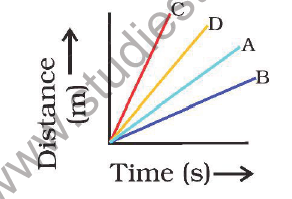
10. Four cars A, B, C and D are moving on a levelled road. Their distance versus time graphs are shown in below Fig.. Choose the correct statement
(a) Car A is faster than car D.
(b) Car B is the slowest.
(c) Car D is faster than car C.
(d) Car C is the slowest.
11. Slope of a velocity – time graph gives
(a) the distance
(b) the displacement
(c) the acceleration
(d) the speed
12. In which of the following cases of motions, the distance moved and the magnitude of displacement are equal?
(a) If the car is moving on straight road
(b) If the car is moving in circular path
(c) The pendulum is moving to and fro
(d) The earth is revolving around the Sun
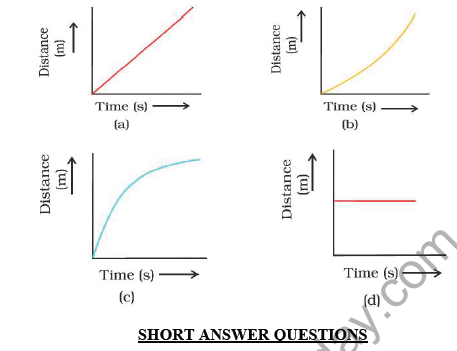
13. Which of the following figures (see below Figure) represents uniform motion of a moving object correctly?
SHORT ANSWER QUESTIONS
14. The displacement of a moving object in a given interval of time is zero. Would the distance travelled by the object also be zero? Justify you answer.
15. How will the equations of motion for an object moving with a uniform velocity change?
16. A car starts from rest and moves along the x-axis with constant acceleration 5 m/s2 for 8 seconds. If it then continues with constant velocity, what distance will the car cover in 12 seconds since it started from the rest?
17. A motorcyclist drives from A to B with a uniform speed of 30 km/h and returns back with a speed of 20 km/h. Find its average speed.
18. Draw a velocity versus time graph of a stone thrown vertically upwards and then coming downwards after attaining the maximum height.
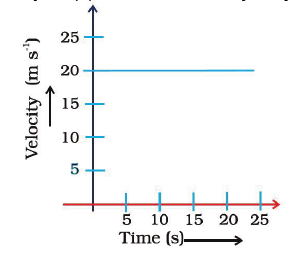
19. The velocity-time graph (see below Figure) shows the motion of a cyclist. Find (i) its acceleration (ii) its velocity and (iii) the distance covered by the cyclist in 15 seconds.
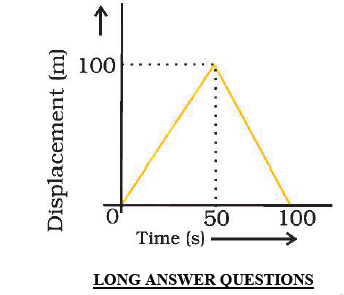
20. A girl walks along a straight path to drop a letter in the letterbox and comes back to her initial position. Her displacement–time graph is shown in below figure. Plot a velocity– time graph for the same.
LONG ANSWER QUESTIONS
21. An object starting from rest travels 20 m in first 2 s and 160 m in next 4 s. What will be the velocity after 7 s from the start.
22. An electron moving with a velocity of 5 × 10⁴ m/s enters into a uniform electric field and acquires a uniform acceleration of 104 m/s2 in the direction of its initial motion.
(i) Calculate the time in which the electron would acquire a velocity double of its initial velocity.
(ii) How much distance the electron would cover in this time?
23. Obtain a relation for the distance travelled by an object moving with a uniform acceleration in the interval between 4th and 5th seconds.
24. Two stones are thrown vertically upwards simultaneously with their initial velocities u1 and u2 respectively. Prove that the heights reached by them would be in the ratio of 2 2 u1 :u2 ( Assume upward acceleration is –g and downward acceleration to be +g ).
25. An object is dropped from rest at a height of 150 m and simultaneously another object is dropped from rest at a height 100 m. What is the difference in their heights after 2 s if both the objects drop with same accelerations? How does the difference in heights vary with time?
Please click the link below to download CBSE Class 9 Science Motion Sure Shot Questions
Free study material for Science
Useful Resources and Notes for Class 9 Science Chapter 07 Motion
Quick Revision Material for Chapter 07 Motion
Review targeted study resources for Chapter 07 Motion tailored for Class 9 learners. Utilizing these structured notes and quick-revision tools ensures complete alignment with current CBSE evaluation standards.
Expert Notes and Solved Exam Questions
Each resource draws directly from authorized textbooks to maintain academic accuracy. Evaluating solved examples allows Class 9 students to master the formal presentation and answer-writing standards expected in upcoming school exams.
Additional Study Resources for Class 9
For peak performance in upcoming evaluations, integrate official Science sample papers directly into your study schedule. Follow up your revision by attempting online MCQ tests for Chapter 07 Motion to refine calculation speed and precision.
FAQs
Our advanced study package for Chapter 07 Motion includes detailed concepts, diagrams, Mind Maps, and explanation of complex topics to ensure Class 9 students learn as per syllabus for 2026 exams.
The Mind Maps provided for Chapter 07 Motion act as visual anchors which will help faster recall during high-pressure exams.
Yes, teachers use our Class 9 Science resources for lesson planning as they are in simple language and have lot of solved examples.
Yes, You can download the complete, mobile-friendly PDF of the Science Chapter 07 Motion advanced resources for free.
Yes, our subject matter experts have updated the Chapter 07 Motion material to align with the rationalized NCERT textbooks and have removed deleted topics and added new competency-based questions.