

Official CBSE Study Materials for Class 9 Science
Access comprehensive study materials and useful resources for Chapter 11 Sound using the CBSE Class 9 Science Sound Notes. Designed to align with the 2026-27 CBSE academic guidelines, these advanced resources help Class 9 Science students reinforce core concepts beyond standard textbooks.
Advanced Resources for Science
Navigate directly to the advanced Science study materials using the digital viewer below. Each resource pack includes detailed conceptual summaries and solved practice questions, allowing students to instantly reinforce their learning.
CBSE Class 9 Science Sound Notes. There are many more useful educational material which the students can download in pdf format and use them for studies. Study material like concept maps, important and sure shot question banks, quick to learn flash cards, flow charts, mind maps, teacher notes, important formulas, past examinations question bank, important concepts taught by teachers. Students can download these useful educational material free and use them to get better marks in examinations. Also refer to other worksheets for the same chapter and other subjects too. Use them for better understanding of the subjects.
Sound
Sound is a mechanical wave and needs a material medium like air, water, steel etc. for its propagation.
A medium is the substance or material through which a pulse or a wave moves.
INTEXT QUESTIONS
1. How does the sound produced by a vibrating object in a medium reach your ear?
Ans: When an object vibrates, it forces the neighbouring particles of the medium to vibrate. These vibrating particles then force the particles adjacent to them to vibrate. In this way, vibrations produced by an object are transferred from one particle to another till it reaches the ear.
LONGITUDINAL AND TRANSVERSE WAVE
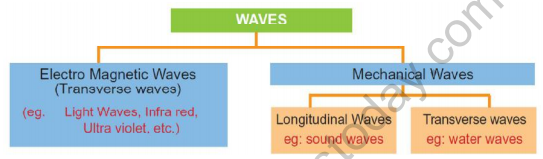
A longitudinal wave is a wave where the particles in the medium move parallel to the direction of propagation of the wave.
“If the particles of a medium vibrate in a direction, parallel to or along the direction of propagation of wave, it is called longitudinal wave”
Sound waves are pressure waves caused by objects which are vibrating. Sound waves need a medium through which to travel.
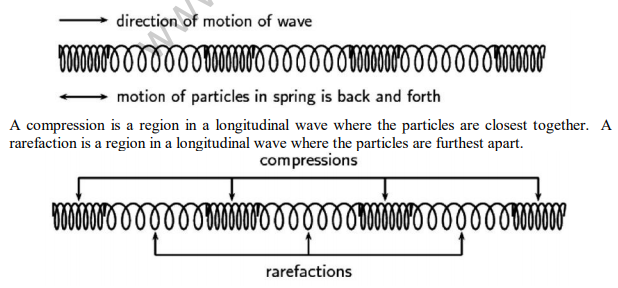
A compression is a region in a longitudinal wave where the particles are closest together. A rarefaction is a region in a longitudinal wave where the particles are furthest apart.
TRANSVERSE WAVE
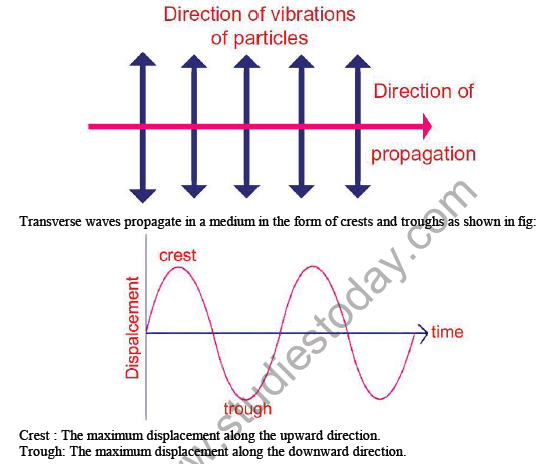
“If the particles of the medium vibrate in a direction, perpendicular to the direction of propagation, the wave is called transverse wave.” Example: water waves, vibrations of stretched string.
INTEXT QUESTIONS PAGE NO. 163
1. Explain how sound is produced by your school bell.
Ans: When the school bell vibrates, it forces the adjacent particles in air to vibrate. This disturbance gives rise to a wave and when the bell moves forward, it pushes the air in front
of it. This creates a region of high pressures known as compression. When the bell moves backwards, it creates a region of low pressure know as rarefaction. As the bell continues to
move forward and backward, it produces a series of compressions and rarefactions. This makes the sound of a bell propagate through air.
2. Why are sound waves called mechanical waves?
Ans: Sound waves force the medium particles to vibrate. Hence, these waves are known as mechanical waves. Sound waves propagate through a medium because of the interaction of
the particles present in that medium.
3. Suppose you and your friend are on the moon. Will you be able to hear any sound produced by your friend?
Ans: Sound needs a medium to propagate. Since the moon is devoid of any atmosphere, you cannot hear any sound on the moon.
CHARACTERISTICS OF SOUND
Sound can be distinguished from each other by the following three characteristics:
1. Loudness or Intensity
2. Pitch or Frequency
3. Quality or Timbre
1. Loudness
The sensation produced in the ear, which enables us to distinguish between a loud, and a faint sound is called loudness.
The amplitude of the wave determines the loudness or softness of a sound basically.
Intensity
The intensity of sound is defined as the amount of energy passing per unit time per unit area in a direction perpendicular to the area.
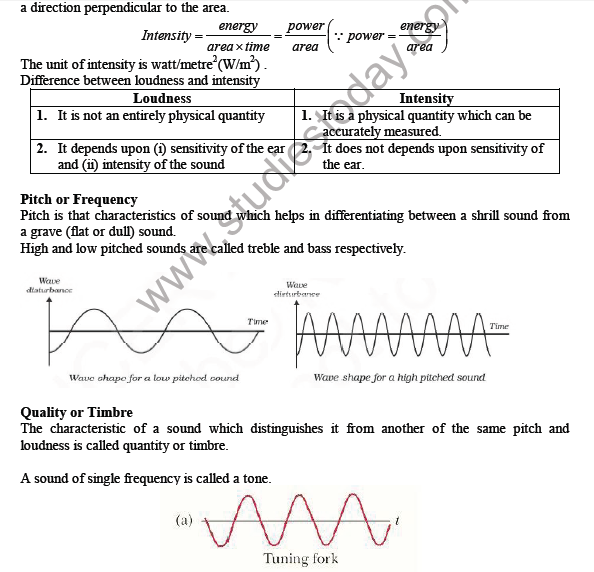
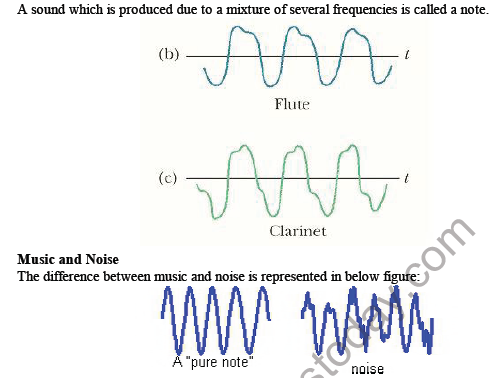
First figure is regular and has a definite amplitude. It represents a musical sound.
A musical sound can be defined as a pleasant continuous and uniform sound produced by regular and periodic vibrations. Example: The pleasant sound produced by a guitar, piano,
tuning fork etc.
The second curve represents a noise. The curve is irregular and has no definite amplitude.
Musical sound is pleasant to hear and is of rich quality. Noise on the other hand is unpleasant to hear.
Noise can be defined as an irregular succession of disturbances, which are discordant and unpleasant to the ear.
TERMS RELATED TO SOUND WAVES
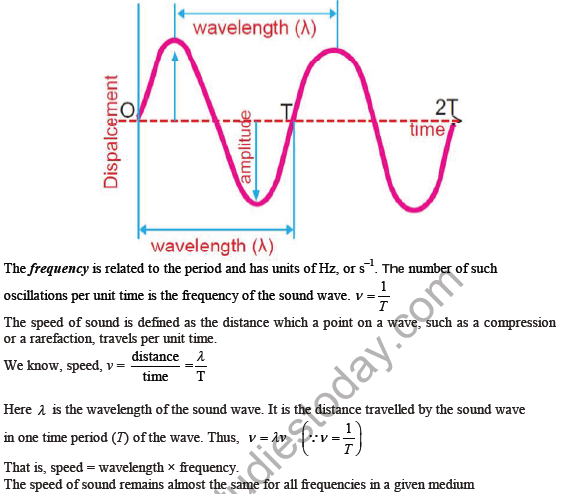
The amplitude A is the maximum excursion of a particle of the medium from the particles undisturbed position.
The wavelength is the horizontal length of one cycle of the wave.
The period is the time required for one complete cycle.
Please click the link below to download CBSE Class 9 Science Sound Notes.
Free study material for Science
Useful Resources and Notes for Class 9 Science Chapter 11 Sound
Core Study Kit: Class 9 Science Chapter 11 Sound
Review targeted study resources for Chapter 11 Sound tailored for Class 9 learners. Utilizing these structured notes and quick-revision tools ensures complete alignment with current CBSE evaluation standards.
NCERT-Aligned Solutions for Chapter 11 Sound
Each resource draws directly from authorized textbooks to maintain academic accuracy. Evaluating solved examples allows Class 9 students to master the formal presentation and answer-writing standards expected in upcoming school exams.
Next Steps in Your Exam Preparation
Maximize your grade potential by utilizing Class 9 Science practice papers in tandem with these structured notes. All printable assignments and interactive mock tests on our platform are updated for the 2026 session and available free of charge.
FAQs
Our advanced study package for Chapter 11 Sound includes detailed concepts, diagrams, Mind Maps, and explanation of complex topics to ensure Class 9 students learn as per syllabus for 2026 exams.
The Mind Maps provided for Chapter 11 Sound act as visual anchors which will help faster recall during high-pressure exams.
Yes, teachers use our Class 9 Science resources for lesson planning as they are in simple language and have lot of solved examples.
Yes, You can download the complete, mobile-friendly PDF of the Science Chapter 11 Sound advanced resources for free.
Yes, our subject matter experts have updated the Chapter 11 Sound material to align with the rationalized NCERT textbooks and have removed deleted topics and added new competency-based questions.