

Class 9 Science Study Guide: CBSE Class 9 Science Force and laws of motion Sure Shot Questions
Explore structured advanced study materials through the CBSE Class 9 Science Force and laws of motion Sure Shot Questions. Tailored for Class 9 learners, utilizing these Science resources ensures thorough preparation and strengthens foundational knowledge before final CBSE evaluations.
Download Chapter 08 Force and Laws of Motion Study Material PDF
View or download the dedicated CBSE Class 9 Science Force and laws of motion Sure Shot Questions resource below. Engaging with these advanced study guides under focused conditions ensures continuous academic progress and mastery of the 2026-27 curriculum for Chapter 08 Force and Laws of Motion.
CBSE Class 9 Science Force and laws of motion Sure Shot Questions. There are many more useful educational material which the students can download in pdf format and use them for studies. Study material like concept maps, important and sure shot question banks, quick to learn flash cards, flow charts, mind maps, teacher notes, important formulas, past examinations question bank, important concepts taught by teachers. Students can download these useful educational material free and use them to get better marks in examinations. Also refer to other worksheets for the same chapter and other subjects too. Use them for better understanding of the subjects.
Multiple Choice Questions
1. Which of the following statement is not correct for an object moving along a straight path in an accelerated motion?
(a) Its speed keeps changing
(b) Its velocity always changes
(c) It always goes away from the earth
(d) A force is always acting on it
2. The forces of action and reaction are
(a) always equal only
(b) always equal and opposite
(c) always equal but in same direction
(d) always unequal and opposite.
3. According to the third law of motion, action and reaction
(a) always act on the same body
(b) always act on different bodies in opposite directions
(c) have same magnitude and directions
(d) act on either body at normal to each other
4. The action and reaction forces at
(a) on different bodies always
(b) on some body always
(c) on same body, sometimes
(d) on different bodies, sometimes
5. A goalkeeper in a game of football pulls his hands backwards after holding the ball shot at the goal. This enables the goal keeper to
(a) exert larger force on the ball
(b) reduce the force exerted by the ball on hands
(c) increase the rate of change of momentum
(d) decrease the rate of change of momentum
6. The inertia of an object tends to cause the object
(a) to increase its speed
(b) to decrease its speed
(c) to resist any change in its state of motion
(d) to decelerate due to friction
7. Principle of conservation of linear momentum is deduced from
(a) Newton’s first law
(b) Newton’s second law
(c) Newton’s third law
(d) none of the above
8. The function of mud guards is based on
(a) inertia of rest
(b) inertia of direction
(c) inertia of motion
(d) none of the above
(b) never cancel
(c) cancel sometimes
(d) cannot say
10. A passenger in a moving train tosses a coin which falls behind him. It means that motion of the train is
(a) accelerated
(b) uniform
(d) along circular tracks
11. An object of mass 2 kg is sliding with a constant velocity of 4 m s–1 on a frictionless horizontal table. The force required to keep the object moving with the same velocity is
(a) 32 N
(b) 0 N
(c) 2 N
(d) 8 N
12. Rocket works on the principle of conservation of
(a) mass
(b) energy
(c) momentum
(d) velocity
13. A water tanker filled up to 2/3 of its height is moving with a uniform speed. On suddenapplication of the brake, the water in the tank would
(a) move backward
(b) move forward
(c) be unaffected
(d) rise upwards
14. Inertia of a body in linear motion is measured by its
(a) mass
(b) momentum
(c) velocity
(d) none of the above
15. What mass of a body can attain an acceleration of 5m/s2 under a force of 250 N?
(a) 5 kg
(b) 250 kg
(c) 50 kg
(d) 10 kg
SHORT ANSWER QUESTIONS
16. There are three solids made up of aluminium, steel and wood, of the same shape and same volume. Which of them would have highest inertia?
17. Two balls of the same size but of different materials, rubber and iron are kept on the smooth floor of a moving train. The brakes are applied suddenly to stop the train. Will the balls start rolling? If so, in which direction? Will they move with the same speed? Give reasons for your answer.
19. A horse continues to apply a force in order to move a cart with a constant speed. Explain why?
20. Suppose a ball of mass m is thrown vertically upward with an initial speed v, its speed decreases continuously till it becomes zero. Thereafter, the ball begins to fall downward and attains the speed v again before striking the ground. It implies that the magnitude of initial and final momentums of the ball are same. Yet, it is not an example of conservation of momentum. Explain why ?
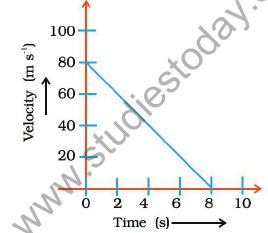
21. Velocity versus time graph of a ball of mass 50 g rolling on a concrete floor is shown in below Figure. Calculate the acceleration and frictional force of the floor on the ball.
22. A truck of mass M is moved under a force F. If the truck is then loaded with an object equal to the mass of the truck and the driving force is halved, then how does the acceleration change?
23. Why does a gun recoil on firing? Obtain an expression for recoil velocity of gun.
24. A rocket can move in air free space, but a jet plane cannot. Why?
25. Two friends on roller-skates are standing 5 m apart facing each other. One of them throws a ball of 2 kg towards the other, who catches it, How will this activity affect the position of the two? Explain your answer.
26. Water sprinkler used for grass lawns begins to rotate as soon as the water is supplied. Explain the principle on which it works.
LONG ANSWER QUESTIONS
27. Using second law of motion, derive the relation between force and acceleration. A bullet of 10 g strikes a sand-bag at a speed of 103 m/s and gets embedded after travelling 5 cm.
Calculate
(i) the resistive force exerted by the sand on the bullet
(ii) the time taken by the bullet to come to rest.
28. Derive the unit of force using the second law of motion. A force of 5 N produces an acceleration of 8 m/s2 on a mass m1 and an acceleration of 24 m/s2 on a mass m2 . What acceleration would the same force provide if both the masses are tied together?
29. State and explain Newton’s third law of motion. How will you prove it experimentally?
30. What is momentum? Write its SI unit. Interpret force in terms of momentum. Represent the following graphically
(a) momentum versus velocity when mass is fixed.
(b) momentum versus mass when velocity is constant.
Please click the link below to download CBSE Class 9 Science Force and laws of motion Sure Shot Questions.
Free study material for Science
Useful Resources and Notes for Class 9 Science Chapter 08 Force and Laws of Motion
Core Study Kit: Class 9 Science Chapter 08 Force and Laws of Motion
Review targeted study resources for Chapter 08 Force and Laws of Motion tailored for Class 9 learners. Utilizing these structured notes and quick-revision tools ensures complete alignment with current CBSE evaluation standards.
NCERT-Aligned Solutions for Chapter 08 Force and Laws of Motion
Each resource draws directly from authorized textbooks to maintain academic accuracy. Evaluating solved examples allows Class 9 students to master the formal presentation and answer-writing standards expected in upcoming school exams.
Next Steps in Your Exam Preparation
For peak performance in upcoming evaluations, integrate official Science sample papers directly into your study schedule. Follow up your revision by attempting online MCQ tests for Chapter 08 Force and Laws of Motion to refine calculation speed and precision.
FAQs
Our advanced study package for Chapter 08 Force and Laws of Motion includes detailed concepts, diagrams, Mind Maps, and explanation of complex topics to ensure Class 9 students learn as per syllabus for 2026 exams.
The Mind Maps provided for Chapter 08 Force and Laws of Motion act as visual anchors which will help faster recall during high-pressure exams.
Yes, teachers use our Class 9 Science resources for lesson planning as they are in simple language and have lot of solved examples.
Yes, You can download the complete, mobile-friendly PDF of the Science Chapter 08 Force and Laws of Motion advanced resources for free.
Yes, our subject matter experts have updated the Chapter 08 Force and Laws of Motion material to align with the rationalized NCERT textbooks and have removed deleted topics and added new competency-based questions.