

Download CBSE Class 9 Science Useful Resources
Review targeted academic resources with the CBSE Class 9 Science Motion Exam Notes. Built according to official CBSE standards for the 2026-27 term, these downloadable Class 9 Science study materials support effective daily practice and deeper conceptual understanding for Chapter 07 Motion.
Access CBSE Study Guides and Summaries
Navigate directly to the advanced Science study materials using the digital viewer below. Each resource pack includes detailed conceptual summaries and solved practice questions, allowing students to instantly reinforce their learning.
CBSE Class 9 Science Motion Exam Notes. Please refer to the examination notes which you can use for preparing and revising for exams. These notes will help you to revise the concepts quickly and get good marks.
INTRODUCTION
When a body does not change its position with time, we can say that the body is at rest, while if a body changes its position with time, it is said to be in motion.
*An object is said to be a point object if it changes its position by distances which are much greater than its size.
*A point or some stationary object with respect to which a body continuously changes its position in the state of motion is known as origin or reference point.
TYPE OF MOTION
1.According to Directions
*One dimensional motion is the motion of a particle moving along a straight line.
*Two dimensional motion A particle moving along a curved path in a plane has 2-dimensional motion.
*Three dimensional motion Particle moving randomly in space has 3-dimensional motion.
2.According to state of motion
Uniform Motion
*A body is said to be in a state of uniform motion if it travels equal distances in equal intervals of time.
*If the time distance graph is a straight line the motion is said to be uniform motion.
Non-uniform motion
*A body has a non-uniform motion if it travels unequal distances in equal intervals of time. Ex. a freely falling body.
*Time - distance graph for a body with non-uniform motion is a curved line.
Ø TERMS USED TO DEFINE MOTION
(i) Distance and displacement
(ii) Speed and velocity
(iii) Acceleration
(i) Distance & Displacement
♦ The path length between the initial and final positions of the particle gives the distance covered by the particle.
♦ The minimum distance between the initial and final positions of a body during that time interval is called displacement
♦ Distance and displacement both are measured in meter in m.k.s. system.
Difference between distance and displacement
♦ Distance travelled is a scalar quantity while displacement is a vector quantity.
♦ When a body continuously moves in the same straight line and in the same direction then displacement will be equal to the distance travelled. But if the body changes its direction while moving, then the displacement is smaller than the distance travelled.
Dis placement £ Distance
♦ Displacement in any interval of time may be zero, positive or negative where as distance cannot be negative..
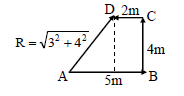
Ex.1 A person travels a distance of 5 m towards east, then 4 m towards north and then 2 m towards west.
(i) Calculate the total distance travelled. (ii) Calculate the resultant displacement.
Sol. (i) Total distance travelled by the person
= 5 m + 4 m + 2 m = 11 m
(ii) To calculate the resultant displacement, we choose a convenient scale, where 1 cm represents 1 m. We draw a 5 cm long line AB towards east and then 4 cm long line BC towards north. Finally,
a 2 cm long line CD towards west. The resultant displacement is calculated by joining the initial position A to the final position D. We measure AB = 5 cm.
Since 1 cm = 1 m
\ 5 cm = 5 m
Hence, the displacement of the person
R = 32 + 42
= 5m towards AD.
Ex.2 A body is moving in a straight line. Its distances from origin are shown with time in Fig. A, B, C, D and E represent different parts of its motion. Find the following : (i) Displacement of the body in first 2 seconds.
(ii) Total distance travelled in 7 seconds.
(iii) Displacement in 7 seconds
Sol. (i) Displacement of the body in first 2s = 40m
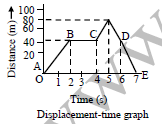
(ii) From t = 0 to t = 7 s, the body has moved a distance of 80 m from origin and it has again come back to origin. Therefore, the total distance covered = 80 × 2 = 160 m
(iii) Since the body has come back to its initial position, the displacement is zero.
(ii) Speed and Velocity
♦ The 'distance' travelled by a body in unit time interval is called its speed. When the position of a body changes in particular direction, then speed is denoted by 'velocity'. i.e. the rate of change of displacement of a body is called its Velocity.
♦ Speed is a scalar quantity while velocity is a vector quantity.
♦ Speed = dis tance / time
♦ Velocity = displaceme nt / time
♦ Unit : In M.K.S. system = ms–1
In C.G.S. system = cm/s
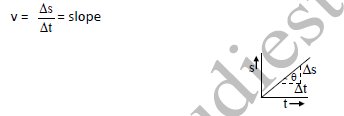
♦ If time distance graph is given then speed can be given by the slope of the line, at given time
♦ The area of velocity time graph gives displacement travelled.
Types of speed
(a) Average and Instantaneous speed
Average speed :
It is obtained by dividing the total distance travelled by the total time interval. i.e
average speed = total distance / total time
Average velocity = displaceme nt total time
♦ Average speed is a scalar, while average velocity is a vector.
♦ For a moving body average speed can never be –ve or zero (unless t ® ¥), while average velocity can be i.e. vav > 0 while vav > = or < 0
♦ In general average speed is not equal to magnitude of average velocity. However it can be so if the motion is along a straight line without change in direction
♦ If a particle travels distances L1, L2, L3 at speeds v1, v2, v3 etc respectively, then Ds
♦ If a particle travels at speeds v1, v2 etc for intervals t1, t2 etc respectively, then
Instantaneous speed :
The speed of a body at a particular instant of time is called its instantaneous speed.
(b) Uniform and Non uniform speed
Uniform speed :
If an object covers equal distance in equal interval of time, then time speed graph of an object is a straight line parallel to time axis then body is moving with a uniform speed.
Non-uniform speed :
If the speed of a body is changing with respect to time it is moving with a non-uniform speed.
Ex.3 The distance between two points A and B is 100 m. A person moves from A to B with a speed of
20 m/s and from B to A with a speed of 25 m/s. Calculate average speed and average velocity.
Sol. (i) Distance from A to B = 100 m Distance from B to A = 100 m Thus, total distance = 200 m
Time taken to move from A to B, is given by
Please click on below link to download pdf file for CBSE Class 9 Science Motion Exam Notes.
Free study material for Science
Useful Resources and Notes for Class 9 Science Chapter 07 Motion
Core Study Kit: Class 9 Science Chapter 07 Motion
Review targeted study resources for Chapter 07 Motion tailored for Class 9 learners. Utilizing these structured notes and quick-revision tools ensures complete alignment with current CBSE evaluation standards.
NCERT-Aligned Solutions for Chapter 07 Motion
Each resource draws directly from authorized textbooks to maintain academic accuracy. Evaluating solved examples allows Class 9 students to master the formal presentation and answer-writing standards expected in upcoming school exams.
Next Steps in Your Exam Preparation
Wrap up your chapter revision by testing your knowledge against standard objective question formats. Explore our full library of free, up-to-date sample papers and online assessments to secure top grades in your CBSE examinations.
FAQs
Our advanced study package for Chapter 07 Motion includes detailed concepts, diagrams, Mind Maps, and explanation of complex topics to ensure Class 9 students learn as per syllabus for 2026 exams.
The Mind Maps provided for Chapter 07 Motion act as visual anchors which will help faster recall during high-pressure exams.
Yes, teachers use our Class 9 Science resources for lesson planning as they are in simple language and have lot of solved examples.
Yes, You can download the complete, mobile-friendly PDF of the Science Chapter 07 Motion advanced resources for free.
Yes, our subject matter experts have updated the Chapter 07 Motion material to align with the rationalized NCERT textbooks and have removed deleted topics and added new competency-based questions.