

Official CBSE Study Materials for Class 9 Science
Explore structured advanced study materials through the CBSE Class 9 Science Diversity in Living Organisms Notes. Tailored for Class 9 learners, utilizing these Science resources ensures thorough preparation and strengthens foundational knowledge before final CBSE evaluations.
Advanced Resources for Science
Access the complete useful resource PDF for Class 9 Science below. Regular practice with these targeted academic notes builds familiarity with complex topics and helps secure higher marks in final school evaluations.
CBSE Class 9 Science Diversity in Living Organisms Notes. There are many more useful educational material which the students can download in pdf format and use them for studies. Study material like concept maps, important and sure shot question banks, quick to learn flash cards, flow charts, mind maps, teacher notes, important formulas, past examinations question bank, important concepts taught by teachers. Students can download these useful educational material free and use them to get better marks in examinations. Also refer to other worksheets for the same chapter and other subjects too. Use them for better understanding of the subjects.
CLASSIFICATION
Biodiversity: The variety of living beings found in geographical area is called biodiversity of that area. Amazon rainforests is the largest biodiversity hotspot in the world. Need for Classification: Classification is necessary for easier study of living beings. Without proper classification, it would be impossible to study millions of organisms which exist on this earth.
BASIS OF CLASSIFICATION
Ancient Greek thinker Aristotle classified living beings on the basis of their habitat. He classified them into two groups, i.e. those living in water and those living on land. But his classification was too simple to justify inclusion of a particular organism into a particular group.
Some examples of scientific bases of classification are as follows:
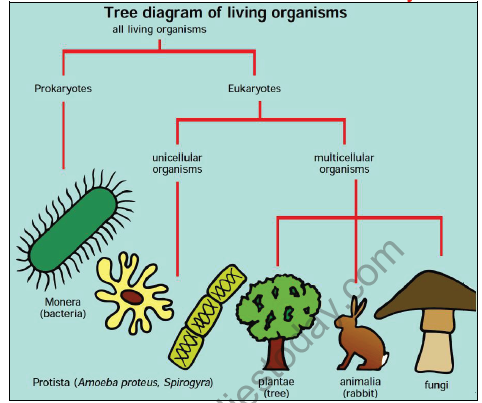
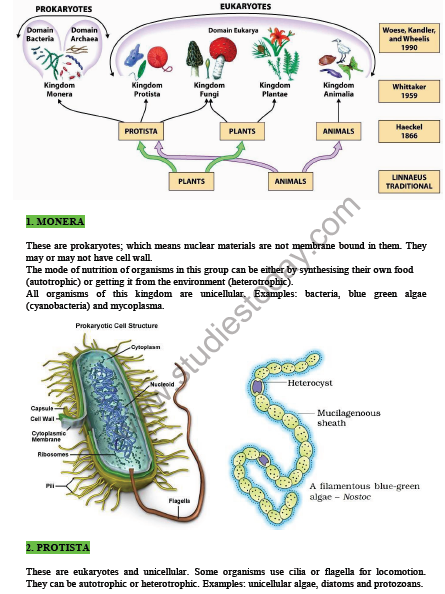
Organization of nucleus: Nucleus may or may not be organized in an organism. On this basis, organisms can be divided into two groups, viz. prokaryotes and eukaryotes.
(a) Prokaryotes:
When nucleus is not organized, i.e. nuclear materials are not membrane bound; the organism is called prokaryote.
(b) Eukaryotes:
When nucleus is organized, i.e. nuclear materials are membrane bound; the organism is called eukaryote.
Number of cells: An organism can be composed of a single cell or many cells. An organism with a single cell is called unicellular organism. On the other hand, an organism with more than one cell is called multicellular organism.
Mode of Nutrition
On this basis, organisms can be divided into two broad groups, i.e. autotrophs and heterotrophs. An autotroph makes its own food, while a heterotroph depends on other organisms for food.
Level of Organisation
Even in case of multicellular organisms, there can be different levels of organization. When a cell is responsible for all the life processes, it is called cellular level or organization. When some cells group together to perform specific function, it is called tissue level of organization. When tissues group together to form some organs, it is called organ level of organization. Similarly organ system level of organization is seen in complex organisms.
Classification and Evolution
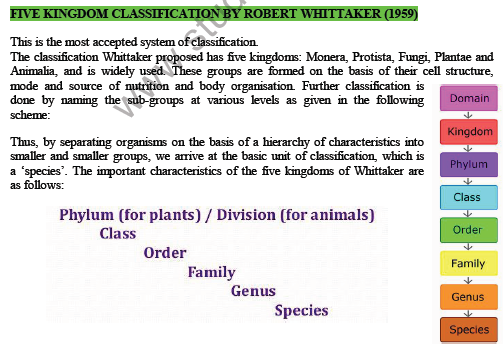
It is a well established fact that all the life forms have evolved from a common ancestor. Scientists have proved that the life begun on the earth in the form of simple life forms. During the course of time, complex organism evolved from them. So, classification is also based on evolution. A simple organism is considered to be primitive while a complex organism is considered to be advanced.

Please click the link below to download CBSE Class 9 Science Diversity in Living Organisms Notes.
Free study material for Science
CBSE Class 9 Science Study Material: Chapter 07 Diversity In Living Organisms
Core Study Kit: Class 9 Science Chapter 07 Diversity In Living Organisms
Explore essential learning tools for Class 9 Science Chapter 07 Diversity In Living Organisms. This curated collection features in-depth notes and targeted practice questions built around the active 2026 curriculum to streamline your daily revision.
NCERT-Aligned Solutions for Chapter 07 Diversity In Living Organisms
Designed around the official curriculum, these study guides guarantee standard compliance. Reviewing step-by-step solutions clarifies complex sub-topics within Chapter 07 Diversity In Living Organisms and demystifies standard marking schemes for Science evaluations.
Next Steps in Your Exam Preparation
For peak performance in upcoming evaluations, integrate official Science sample papers directly into your study schedule. Follow up your revision by attempting online MCQ tests for Chapter 07 Diversity In Living Organisms to refine calculation speed and precision.
FAQs
Our advanced study package for Chapter 07 Diversity In Living Organisms includes detailed concepts, diagrams, Mind Maps, and explanation of complex topics to ensure Class 9 students learn as per syllabus for 2026 exams.
The Mind Maps provided for Chapter 07 Diversity In Living Organisms act as visual anchors which will help faster recall during high-pressure exams.
Yes, teachers use our Class 9 Science resources for lesson planning as they are in simple language and have lot of solved examples.
Yes, You can download the complete, mobile-friendly PDF of the Science Chapter 07 Diversity In Living Organisms advanced resources for free.
Yes, our subject matter experts have updated the Chapter 07 Diversity In Living Organisms material to align with the rationalized NCERT textbooks and have removed deleted topics and added new competency-based questions.