

Advanced Study Material for Class 9 Science: Chapter 10 Work and Energy
Access comprehensive study materials and useful resources for Chapter 10 Work and Energy using the CBSE Class 9 Science Work and Energy Exam Notes. Designed to align with the 2026-27 CBSE academic guidelines, these advanced resources help Class 9 Science students reinforce core concepts beyond standard textbooks.
Practice Class 9 Science Resources: Chapter 10 Work and Energy
View or download the dedicated CBSE Class 9 Science Work and Energy Exam Notes resource below. Engaging with these advanced study guides under focused conditions ensures continuous academic progress and mastery of the 2026-27 curriculum for Chapter 10 Work and Energy.
CBSE Class 9 Science Work and Energy Exam Notes. Please refer to the examination notes which you can use for preparing and revising for exams. These notes will help you to revise the concepts quickly and get good marks.
WORK
Definition : In our daily life "work" implies an activity resulting in muscular or mental exertion. However, in physics the term 'work' is used in a specific sense involves the displacement of a particle or body under the action of a force. "work is said to be done when the point of application of a force moves.
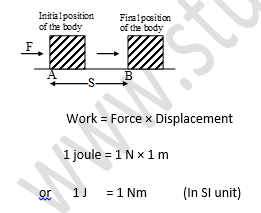
Work done in moving a body is equal to the product of force exerted on the body and the distance moved by the body in the direction of force.
Work = Force × Distance moved in the direction of force.
The work done by a force on a body depends on two factors :
(i) Magnitude of the force, and
(ii) Distance through which the body moves (in the direction of force)
Unit of Work
When a force of 1 newton moves a body through a distance of 1 meter in its own direction, then the work done is known as 1 joule.
Ex.1How much work is done by a force of 10N in moving an object through a distance of 1 m in the direction of the force ?
Sol The work done is calculated by using the formula:
W = F × S
Here, Force, F = 10 N And, Distance, S = 1 m
So, Work done, W = 10 × 1 J
= 10 J
Thus, the work done is 10 joules
Ex.2 Find the work done by a force of 10 N in moving an object through a distance of 2 m.
Sol. Work done = Force × Distance moved Here, Force = 10 N Distance moved = 2 m
Work done, W = 10 N × 2 m = 20 Joule = 20 J
WORK DONE ANALYSIS
♦ Work done when force and displacement are along same line.
♦ Work done by a force : Work is said to be done by a force if the direction of displacement is the same as the direction of the applied force.
♦ Work done against the force : Work is said to be done against a force if the direction of the displacement is opposite to that of the force.
Work done against Gravity : To lift an object, an applied force has to be equal and opposite to the force of gravity acting on the object. If 'm' is the mass of the object and 'h' is the height through which it is raised, then the upward force
(F) = force of gravity = mg
If 'W' stands for work done, then
W = F . h = mg . h
Thus W = mgh
Therefore we can say that, "The amount of work done is equal to the product of weight of the body and the vertical distance through which the body is lifted.
Ex.3 Calculate the work done in pushing a cart, through a distance of 100 m against the force of friction equal to 120 N.
Sol. Force, F = 120 N; Distance, s = 100 m
Using the formula, we have
W = Fs = 120 N × 100 m = 12,000 J
Ex.4 A body of mass 5 kg is displaced through a distance of 4m under an acceleration of 3 m/s2. Calculate the work done.
Sol. Given :mass, m = 5 kg acceleration, a = 3 m/s2
Force acting on the body is given by
F = ma = 5 × 3 = 15 N Now, work done is given by
W= Fs = 15 N × 4 m = 60 J
Ex.5 Calculate the work done in raising a bucket full of water and weighing 200 kg through a height of 5 m. (Take g = 9.8 ms–2).
Sol. Force of gravity
mg = 200 × 9.8 = 1960.0 N
h = 5 m
Work done, W = mgh
or W= 1960 × 5 = 9800 J
♦ Work done when force and displacement are inclined (Oblique case)
Consider a force 'F' acting at angle q to the direction of displacement 's' as shown in fig.
♦ Work done when force is perpendicular to Displacement
q = 90º
W = F.S × cos 90º = F.S × 0 = 0
Thus no work is done when a force acts at right angle to the displacement.
♦ Special Examples :
When a bob attached to a string is whirled along a circular horizontal path, the force acting on the bob acts towards the centre of the circle and is called as the centripetal force. Since the bob is always displaced perpendicular to this force, thus no work is done in this case.
Earth revolves around the sun. A satellite moves around the earth. In all these cases, the direction of displacement is always perpendicular to the direction of force (centripetal force) and hence no work is done.
A person walking on a road with a load on his head actually does no work because the weight of the load (force of gravity) acts vertically downwards, while the motion is horizontal that is perpendicular to the direction of force resulting in no work done. Here, one can ask that if no work is done, then why the person gets tired. It is because the person has to do work in moving his muscles or to work against friction and air resistance.
Ex.6 A boy pulls a toy cart with a force of 100 N by a string which makes an angle of 60º with the horizontal so as to move the toy cart by a distance horizontally. Calculate the work done.
Sol. Given F = 100 N, s = 3 m, q = 60º.
Work done is given by
W = Fs cos q = 100 × 2 × cos 60º
= 100 × 3 × 1/2
1 = 150 J (Q cos 60º = 1/2 )
Ex.7 An engine does 64,000 J of work by exerting a force of 8,000 N. Calculate the displacement in the direction of force.
Sol. | Given W = 64,000 J; | F = 8,000 N |
Work done is given by | W = Fs | |
or 64000 = 8000 × s | ||
or s = 8 m |
Ø POWER
♦ Definition : Power is defined as the rate of doing work
Power = Work done /T ime taken
P = W/t
In other words, power is the work done per unit time, power is a scalar quantity.
Since W = F.S therefore
P = =FS/t = F × V = force × velocity
Unit of power : The S.I. unit of power is watt and it is the rate of doing work at 1 joule per second.
1 watt =
1 joule
1seconds
1 kilowatt = 1 kW = 1000 W
1 Horse power = 1 H.P. = 746 W
Ex.8 A machine raises a load of 750 N through a height of 15 m in 5s. Calculate : (i) the work done by the machine.
(ii) the power at which the machine works.
Sol. (i) Work done is given by W = F.s
Here F = 750 N; s = 15 m
W = 750 × 15 = 11250 J
= 11.250 kJ
(ii) Now, power of the machine is given by
P =W/t
Here, W = 11250 J; t = 5 s
Power P = 11250J /5s = 2250 W = 2.250 kW
Ex.9 A weight lifter lifted a load of 100 kg to a height of 3 m in 10 s. Calculate the following: (i) amount of work done
(ii) power developed by him
Sol. (i) Work done is given by
W = F . s
Here, F = mg = 100 × 10 = 1000 N
W = 1000 N × 3 m = 3000 joule
(ii) Now, P = W/t , where W = 3000 J and t = 10 s
P = 3000 J/10 s = 300 W
Ex.10 A water pump raises 60 liters of water through a height of 20 m in 5 s. Calculate the power of the pump. (Given: g = 10 m/s2, density of water = 1000 kg/m3)
Sol. Work done, W = F.s ...(1)
Here, F = mg ...(2) But, Mass = volume × density
Volume = 60 liters = 60 × 10–3 m3
Density = 1000 kg/m3
Mass , m = (60 × 10–3 m3) × (1000 kg/m3) = 60 kg
Equation (2) becomes
F = 60 kg × 10 m/s2 = 600 N
Now, W = F . s = 600 N × 20 m = 12000 J \ Power = W/t = 12000J/5s= 2400 W
Free study material for Science
CBSE Class 9 Science Study Material: Chapter 10 Work and Energy
Quick Revision Material for Chapter 10 Work and Energy
Review targeted study resources for Chapter 10 Work and Energy tailored for Class 9 learners. Utilizing these structured notes and quick-revision tools ensures complete alignment with current CBSE evaluation standards.
Expert Notes and Solved Exam Questions
Built using official NCERT guidelines for Class 9 Science, these materials provide reliable academic support. Integrating past examination questions and step-by-step solutions helps students understand official CBSE grading criteria.
Additional Study Resources for Class 9
Maximize your grade potential by utilizing Class 9 Science practice papers in tandem with these structured notes. All printable assignments and interactive mock tests on our platform are updated for the 2026 session and available free of charge.
FAQs
Our advanced study package for Chapter 10 Work and Energy includes detailed concepts, diagrams, Mind Maps, and explanation of complex topics to ensure Class 9 students learn as per syllabus for 2026 exams.
The Mind Maps provided for Chapter 10 Work and Energy act as visual anchors which will help faster recall during high-pressure exams.
Yes, teachers use our Class 9 Science resources for lesson planning as they are in simple language and have lot of solved examples.
Yes, You can download the complete, mobile-friendly PDF of the Science Chapter 10 Work and Energy advanced resources for free.
Yes, our subject matter experts have updated the Chapter 10 Work and Energy material to align with the rationalized NCERT textbooks and have removed deleted topics and added new competency-based questions.