

Class 9 Science Study Guide: CBSE Class 9 Science The Cell Exam Notes
Access comprehensive study materials and useful resources for The Cell using the CBSE Class 9 Science The Cell Exam Notes. Designed to align with the 2026-27 CBSE academic guidelines, these advanced resources help Class 9 Science students reinforce core concepts beyond standard textbooks.
Download The Cell Study Material PDF
Access the complete useful resource PDF for Class 9 Science below. Regular practice with these targeted academic notes builds familiarity with complex topics and helps secure higher marks in final school evaluations.
CBSE Class 9 Science The Cell Exam Notes. Please refer to the examination notes which you can use for preparing and revising for exams. These notes will help you to revise the concepts quickly and get good marks.
History
In 1665, Robert Hooke observed the cell in a cork slice with the help of a primitive microscope. He saw that cork resembled the structure of a honey comb consisting of many little compartments. Robert Hooke called these boxes cells. Cell is a Latin word for 'little room.'
Unicellular And Multicellular Organisms
All living organisms are made up of one or more cells. On the basis of cell number, organism are grouped into 2 categories -
Unicellular organisms :
* Organism in which a single cell make the whole body. For example, Amoeba, Paramecium, bacteria & Chlamydomonas.
Multicellular organism :
* Organism in which body contains more than one cell. For example - Plante, animals & fungi.
Cell Size :
* The size of different cells ranges between broad limits.
* Some plants and animals cells are visible to the naked eye.
* Most cells are visible only with microscope
- The prokaryotic cells usually range between
1 to 10 mm.
- The eukaryotic cells usually range between 10 to 100 mm.
- Amoeba proteus may reach a diameter of 0.5 mm.
- The smallest cells are those of Mycoplasma laidlawiil (0.1µ in dimeter) or PPLO (pleuro pneumonia like organism).
- The largest cell is egg of an Ostrich.
- Cell Shape :

- The shape of cell may be variable or fixed.
- Variable shape occur in Amoeba, WBC etc.
- Fixed shape occur in most plant and animals.
- Cells may be diverse shapes such as polyhedral (8, 12 or 14 sides) spherical (e.g. eggs of mainly animals), spindle shaped (Smooth muscle fibres), elongated (e.g. Nerves cells) so on.
Ø ULTRA STRUCTURE OF CELLS
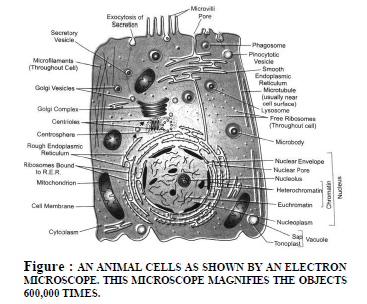
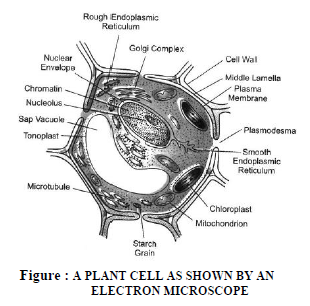
- Plasma Membrane :
Introduction :
Figure : A PLANT CELL AS SHOWN BY AN ELECTRON MICROSCOPE
- Cell surface in all the cells is enclosed by a living membrane which is called cell membrane by
- Nageli and C. Kramer (1855).
Historical Account :
- J.Q. Plower (1931) coined the term Plasmalemma for cell membrane.
Ultrastructure :
- Plasma membrane forms outer covering of each cell.
- It is present in both plant and animal cells.
- Plasma membrane is a living, thin, delicate elastic, selectively permeable membrane.
- It separates contents of a cell from the surrounding medium.
- Fluid Mosaic Model :
- In 1972, Singer Nicolson proposed this model. According to this, cell membrane consists-two layers of phospholipid molecules, phospholipid & protein molecules are arranged as a mosaic.
- Phospholipid molecules have their polar heads directed outward non polar tail pointing inward.
- The proteins are of two types :
- Peripheral and integral. Peripheral proteins are located superficially while integral proteins are embeded in the phospholipid matrix. The protein monolayer have elasticity & mechanical support to the lipid matrix.

Figure : STRUCTURAL DETAIL OF PLASMA MEMBRANE ACCORDING TO FLUID MOSAIC MODEL
- Functions of Plasma Membrane :
- The main function of plasma membrane is to regulate the movement of molecules inside and outside the cell.
- It allow the movement of gaseous substance from high concentration to low concentration which known as diffusion.
- Water also obeys the low of diffusion . The movement of water molecule through a selectively permeable membrane is called osmosis.
- The flexibility of cell membrane also enables the cell to engulf in food, which is also known as endocytosis. For example – in Amoeba
- Cell wall :
- In plants, one another rigid is called 'Cell wall'. It is made up of cellulose which provide structural strength to plant.
- Function of cell wall :
- It maintains the shape of cell.
- It protect the cells from mechanical injury & prevents their desication.
- It provide mechanical support against gravity. It is due to rigid cell walls that the aerial part of plant are able to keep erect & expose their leaves to sunlight.
- Cell walls permit the cells to with stand very dilute external media without bursting.
- Nucleus :
- It is the most important part of cell which control all the activities of cell.
- Structure of Nucleus :
- The nucleus has a double layered covering called nuclear membrane.
- The nuclear membrane has pores inside the nucleus to its outside, that is, to the cytoplasm.
- The nucleus contains chromosomes, which are visible as rod-shaped structures only when the cell is about to divide.
- Chromosomes are composed of DNA and protein.
- Functional segments of DNA are called genes.
- In a cell which is not dividing, this DNA is present as part of chromatin material.
- Function of nucleus :
- It play a important role in cellular reproduction.
- DNA contain the information necessary for constructing & organizing cells.
Please click on below link to download pdf file for CBSE Class 9 Science The Cell Exam Notes.
Free study material for Science
Useful Resources and Notes for Class 9 Science The Cell
Quick Revision Material for The Cell
Access comprehensive study material for The Cell, including revision notes, concept maps, and high-probability questions. These resources are designed in alignment with the latest 2026 CBSE syllabus for Class 9 Science to support effective exam preparation.
Expert Notes and Solved Exam Questions
Each resource draws directly from authorized textbooks to maintain academic accuracy. Evaluating solved examples allows Class 9 students to master the formal presentation and answer-writing standards expected in upcoming school exams.
Additional Study Resources for Class 9
Maximize your grade potential by utilizing Class 9 Science practice papers in tandem with these structured notes. All printable assignments and interactive mock tests on our platform are updated for the 2026 session and available free of charge.
FAQs
Our advanced study package for The Cell includes detailed concepts, diagrams, Mind Maps, and explanation of complex topics to ensure Class 9 students learn as per syllabus for 2026 exams.
The Mind Maps provided for The Cell act as visual anchors which will help faster recall during high-pressure exams.
Yes, teachers use our Class 9 Science resources for lesson planning as they are in simple language and have lot of solved examples.
Yes, You can download the complete, mobile-friendly PDF of the Science The Cell advanced resources for free.
Yes, our subject matter experts have updated the The Cell material to align with the rationalized NCERT textbooks and have removed deleted topics and added new competency-based questions.