

Advanced Study Material for Class 9 Science: Chapter 02 Is Matter Around Us Pure
Explore structured advanced study materials through the CBSE Class 9 Science Is matter around us pure Notes. Tailored for Class 9 learners, utilizing these Science resources ensures thorough preparation and strengthens foundational knowledge before final CBSE evaluations.
Practice Class 9 Science Resources: Chapter 02 Is Matter Around Us Pure
Access the complete useful resource PDF for Class 9 Science below. Regular practice with these targeted academic notes builds familiarity with complex topics and helps secure higher marks in final school evaluations.
CBSE Class 9 Science Is matter around us pure Notes. There are many more useful educational material which the students can download in pdf format and use them for studies. Study material like concept maps, important and sure shot question banks, quick to learn flash cards, flow charts, mind maps, teacher notes, important formulas, past examinations question bank, important concepts taught by teachers. Students can download these useful educational material free and use them to get better marks in examinations. Also refer to other worksheets for the same chapter and other subjects too. Use them for better understanding of the subjects.
Is matter around us pure Notes
Matters can be classified into two types – Pure substances and Impure substances.
Pure substances – Pure substances are of two types – Elements and Compounds.
Impure substances – All mixture are considered as impure substances.
Colour, odour, density, melting point and boiling point are often treated as physical properties of matter. The physical properties of a substance can be observed or measured without changing its composition. The term “impure” is different from adulteration. According to scientists, the term “pure” means single form of matter.
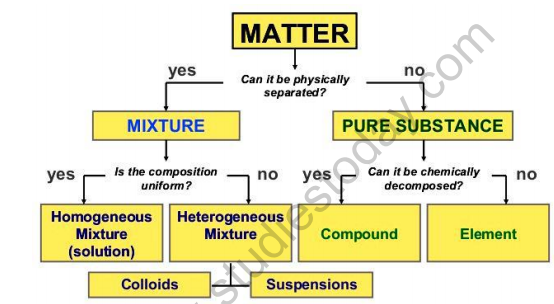
Most of the substances in our surroundings are not in their pure form and are called mixture. Substances which are made of two or more matters and which can be separated by physical methods are known as mixtures, such as mixture of salt and water, mixture of sugar and water, mixture of different gases, air, etc.
In a mixture, components do not combine chemically or through any chemical change. In a mixture, components do not lose their properties. Mixtures are of two types on the basis of their composition - Homogeneous mixture and Heterogeneous mixture.
HOMOGENEOUS MIXTURE
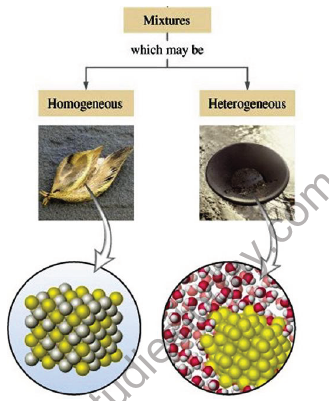
Mixtures which have uniform composition throughout are called Homogeneous Mixture. For example – mixture of salt and water, mixture of sugar and water, air, lemonade, soda water, etc.
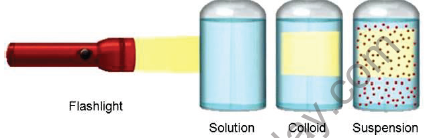
Mixture of salt in water is an example of homogeneous mixture. In this mixture, the boundary of salt and water cannot be differentiated. When a ray of light is passed through the mixture of salt and water, the path of light is not seen.
General Properties of Homogeneous Mixture:
* All solutions are the examples of homogeneous mixture.
* The particles of a homogeneous mixture are less the one nanometer.
• A homogenous mixture does not show Tyndall effect.
• The boundaries of particles cannot be differentiated.
• The constituent particles of homogenous mixture cannot be separated using centrifugation or decantation.
• Alloys are the examples of solution.
HETEROGENEOUS MIXTURE
Mixtures which do not have uniform composition throughout are called Heterogeneous Mixture. For example – mixture of soil and sand, mixture of sulphur and iron fillings, mixture of oil and water etc. The boundaries of constituent particles of a homogeneous mixture can be identified easily; as a homogeneous mixture has two or more distinct phases.
General Properties of Heterogeneous Mixture:
• Most of the mixtures are heterogeneous except solutions and alloys.
• The constituent particles are present uniformly in a heterogeneous mixture.
• The components of a heterogeneous mixture can be identified easily.
• Generally, two or more phases are present in a heterogeneous mixture.
• Particles of a heterogeneous mixture are sized between one nanometer and one micrometer or more.
• Heterogeneous mixtures show Tyndall effect.
INTEXT QUESTIONS PAGE NO. 15
Q1. What is meant by a pure substance?
Answer: A pure substance is the one that consists of a single type of particles, i.e., all constituent particles of the substance have the same chemical nature. Pure substances can be classified as elements or compounds.
Q2. List the points of differences between homogeneous and heterogeneous mixtures.
Answer:
• A homogeneous mixture is a mixture having a uniform composition throughout the mixture. For example: salt in water, sugar in water, copper sulphate in water
• A heterogeneous mixture is a mixture having a non-uniform composition throughout the mixture. For example: sodium chloride and iron fillings, salt and sulphur, oil and water.
TYPES OF MIXTURE
Mixture can be categorised in three types on the basis of their particles’ size. These are; solution, suspension and colloid.
SOLUTION
Mixture of two or more substances with one phase only, i.e. having no distinct boundary of constituent particles are called solution. For example, solution of sugar and water, solution of salt and water, lemonade, soft drinks, etc. Solution is a homogeneous mixture of two or more substances.
In a solution, components are mixed in such a way that they appear as only one phase. Seeing by naked eye, constituent particles of a solution cannot be identified because particles are mixed evenly throughout.
In a solution, there are two types of components – one is called solute and other is called solvent.
Solute – Substance which is present in smaller quantity in a mixture is called solute.
Solvent – Substance in a mixture which is present in larger quantity in a mixture is called solvent.
Example: In the solution of salt and water, salt is present in small quantity while water is present in larger quantity. Here salt is solute and water is solvent.

Solution of tincture iodine is made by dissolving iodine in alcohol. In this solution, iodine is solute and alcohol is solvent.
Air is mixture of many gases. Since air consists of only one phase, thus it is considered as solution. Air consists about 78% of nitrogen and 22% rest of other gases. Thus in the case of air, nitrogen can be called as solvent and rest other gases as solutes.
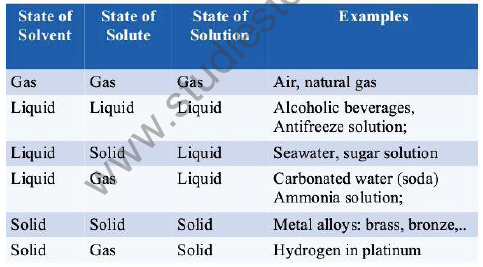
Solvent and solute can be solid, liquid or gas.
TYPES OF SOLUTION
Solid - solid solution – Solution of two or more solids are generally known as solid-solid solution. For example – alloys. Alloy is a homogeneous mixture of two or more metals and non metals or two metals or two non-metals. The components of an alloy cannot be separated by physical methods, their boundaries are not distinct and they can have variable compositions, thus alloy is considered as solution.
Solid – Liquid solution – Solution of solid and liquid is called solid-liquid solution. For example - solution of salt and water.
Liquid – liquid solution – Solution of two miscible liquids are called liquid-liquid solution, such as solution of water and acetic acid. The solution of acetic acid in water is known as vinegar.
Gas - liquid solution – Solution of gas into liquid is called gas-liquid solution. For example –
Soft drink. In soft drink, carbon dioxide is usually dissolved in liquid, because of which a hiss sound comes while opening the cap of the bottle.
Gas-gas solution – Solution of two or more gas is called gas-gas solution. For example – air, which is the solution of many gases, such as hydrogen, oxygen, carbon dioxide, etc.
General Characteristics of Solution:
• Solutions are homogeneous mixture of two or more substances.
• Constituent particles of a solution are mixed evenly throughout.
• There is only one phase in a solution.
• Boundaries of constituent particles cannot be distinguished.
• The size of particles of solution is smaller than one nanometer.
• Solutions do not show Tyndall effect, because, small particles of solution do not scatter the ray of light.
• Solute cannot be separated by using filtration or decantation.
• Solutions are stable, since when left undisturbed the particles do not settle in bottom.
SATURATED AND UNSATURATED SOLUTIONS
Saturated Solution: When a solution cannot dissolve more solute at a given temperature, the point is called saturation point of the solution and solution is called saturated solution. This means, no more solute can be dissolved in a saturated solution at a given temperature.
Unsaturated Solution: Solution in which more solution can dissolved at a given temperature, is called unsaturated solution.
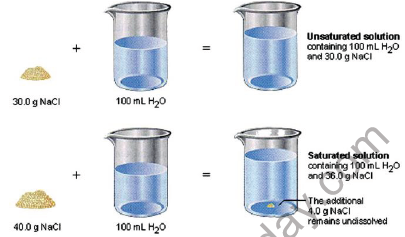
Solubility: Solubility is the amount of solute in a saturated solution at a given temperature. In other words, maximum capacity to dissolve a solute in a solution at a given temperature is called solubility.
Different solvents can dissolve different amount of solute. This means different solvents have different solubility Solubility increases with increase in temperature.
Please click the link below to download CBSE Class 9 Science Is matter around us pure Notes.
Free study material for Science
Science Class 9 Exam Resources: Chapter 02 Is Matter Around Us Pure
Quick Revision Material for Chapter 02 Is Matter Around Us Pure
Review targeted study resources for Chapter 02 Is Matter Around Us Pure tailored for Class 9 learners. Utilizing these structured notes and quick-revision tools ensures complete alignment with current CBSE evaluation standards.
Expert Notes and Solved Exam Questions
Designed around the official curriculum, these study guides guarantee standard compliance. Reviewing step-by-step solutions clarifies complex sub-topics within Chapter 02 Is Matter Around Us Pure and demystifies standard marking schemes for Science evaluations.
Additional Study Resources for Class 9
Maximize your grade potential by utilizing Class 9 Science practice papers in tandem with these structured notes. All printable assignments and interactive mock tests on our platform are updated for the 2026 session and available free of charge.
FAQs
Our advanced study package for Chapter 02 Is Matter Around Us Pure includes detailed concepts, diagrams, Mind Maps, and explanation of complex topics to ensure Class 9 students learn as per syllabus for 2026 exams.
The Mind Maps provided for Chapter 02 Is Matter Around Us Pure act as visual anchors which will help faster recall during high-pressure exams.
Yes, teachers use our Class 9 Science resources for lesson planning as they are in simple language and have lot of solved examples.
Yes, You can download the complete, mobile-friendly PDF of the Science Chapter 02 Is Matter Around Us Pure advanced resources for free.
Yes, our subject matter experts have updated the Chapter 02 Is Matter Around Us Pure material to align with the rationalized NCERT textbooks and have removed deleted topics and added new competency-based questions.