

Official CBSE Study Materials for Class 9 Science
Explore structured advanced study materials through the CBSE Class 9 Science Tissue Exam Notes. Tailored for Class 9 learners, utilizing these Science resources ensures thorough preparation and strengthens foundational knowledge before final CBSE evaluations.
Advanced Resources for Science
View or download the dedicated CBSE Class 9 Science Tissue Exam Notes resource below. Engaging with these advanced study guides under focused conditions ensures continuous academic progress and mastery of the 2026-27 curriculum for Chapter 06 Tissues.
CBSE Class 9 Science Tissue Exam Notes. Please refer to the examination notes which you can use for preparing and revising for exams. These notes will help you to revise the concepts quickly and get good marks.
Tissue
"A tissues may be defined as a group or collection of similar or dissimilar cells that perform a common function & have a common origin."
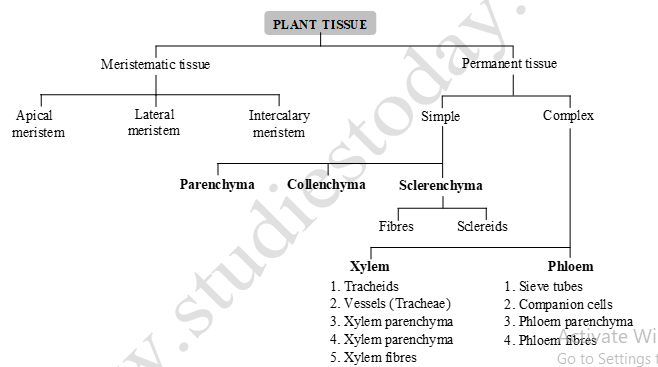
PLANT TISSUE
Classification of Plant Tissues :
- A plant body is made up of different kinds of tissue. They are basically of two types - Meristamatic & permanent
Meristematic tissue :
- Meristematic tissues may be defined as a group or collection of living cells which ar located specific locations and divide continuously to add new cells to the plant body.
Characteristics of meristematic tissues :
- The cells of meristematic tissues are similar in structure and have thin and elastic primary cell walls made up of cellulose.
- These meristematic cells may be rounded, oval, polygonal or rectangular in shape
- They are compactly arranged without intercellular spaces between them
- Each cell contains dense or abundant cytoplasm and a large prominent nucleus.
- The dense protoplasm of meristematic cell contains few small vacuoles or no vacuoles at all.
Apical meristem :
- This meristem is located at the growing apices of main and lateral shoots and roots. These cells are responsible for linear growth of an organ. Example root apical meristem and shoot apical meristem
Lateral meristem :
- This meristem consists of initials which divide mainly in one plane and cause the organ to increase in diameter and girth. The lateral meristem usually occurs on the sides both in stem and root. Lateral meristem is of two types, i.e., in the form of cork cambium and in vascular bundles of dicots in the form of vascular cambium. The activity of this cambium results in the formation of secondary growth.
Intercalary meristem :
- This meristem is located in between the regions of permanent tissues. The intercalary meristem are usually persent at the base of node, base of internode or at the base of the leaf. They are responsible for growth of leaves and internodes.

Permanent Tissues
Definition :
- These tissues are derived from the meristematic tissues but their cells have lost the ability of division and have attained their different forms.
They are of these types-Simple and Complex.
Simple Permanent Tissues :
- These tissues are made up of cells which are structurally and functionally similar. These are of three types -
Parenchyma Collenchyma
Sclerenchyma Protective tissue
Parenchyma :
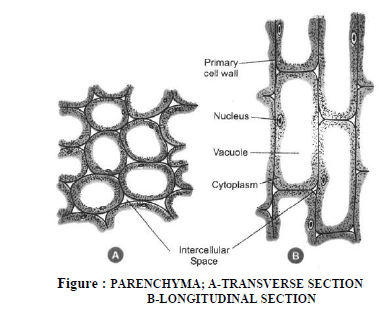
- The parenchyma tissue is composed of living cells which are variable in thin morphology and physiology but generally having thin wall and a polyhedral shape and concern with vegetative activities of the plant.
- They have inter cellular spaces between them.
- They act as storage for food and water.
Types of Parenchyma : Aerenchyma :
- In hydrophytes, the intercellular space between cells become wide & filled with air.
- Such a parenchymatous tissue having large air spaces is called Aerenchyma.
- These help in gaseous exchange and provide buoyancy to plant.
Chlorenchyma :
- When parenchyma is richly supplied with chloroplasts, it is called chlorenchyma.
- They are found in leaf mesophyll, sepals, phylloclades, phyllodes, cladodes etc. It is photosynthetic in function and posses chlorophyll.
Collenchyma :
- It was discovered and coined by schleiden (1839).
- The cells are living with intercellular space in between the cells or junctional places filled with cellulose and pectin.
- Generally they are longer than parenchyma
- Usually they are known as living mechanical tissue owing to their supportive functions.
- It provides flexibility and strength to young plant organ.

- They were discovered and coined by Mettenius (1805).
- The cells are long, narrow, pointed at ends, thick walled and lignified. They are the dead cells.
- It impart hardness to plant parts and give mechanical strength.
Protective Tissue :
- It includes epidermis and cork.
Epidermis :
- It is usually present in the outermost layer of the plant body such as leaves, flowers, stem and roots.
- Epidermis is one cell thick and is covered with cuticle.
- Cuticle is a water proof layer of a waxy substance called cutin which is secreted by epidermal cells.
- The main function of epidermis is to protect the plant from desication and infection.
Please click on below link to download pdf file for CBSE Class 9 Science Tissue Exam Notes.
Free study material for Science
Science Class 9 Exam Resources: Chapter 06 Tissues
Quick Revision Material for Chapter 06 Tissues
Access comprehensive study material for Chapter 06 Tissues, including revision notes, concept maps, and high-probability questions. These resources are designed in alignment with the latest 2026 CBSE syllabus for Class 9 Science to support effective exam preparation.
Expert Notes and Solved Exam Questions
Each resource draws directly from authorized textbooks to maintain academic accuracy. Evaluating solved examples allows Class 9 students to master the formal presentation and answer-writing standards expected in upcoming school exams.
Additional Study Resources for Class 9
Maximize your grade potential by utilizing Class 9 Science practice papers in tandem with these structured notes. All printable assignments and interactive mock tests on our platform are updated for the 2026 session and available free of charge.
FAQs
Our advanced study package for Chapter 06 Tissues includes detailed concepts, diagrams, Mind Maps, and explanation of complex topics to ensure Class 9 students learn as per syllabus for 2026 exams.
The Mind Maps provided for Chapter 06 Tissues act as visual anchors which will help faster recall during high-pressure exams.
Yes, teachers use our Class 9 Science resources for lesson planning as they are in simple language and have lot of solved examples.
Yes, You can download the complete, mobile-friendly PDF of the Science Chapter 06 Tissues advanced resources for free.
Yes, our subject matter experts have updated the Chapter 06 Tissues material to align with the rationalized NCERT textbooks and have removed deleted topics and added new competency-based questions.