

Official CBSE Study Materials for Class 9 Science
Access comprehensive study materials and useful resources for Chapter 11 Sound using the CBSE Class 9 Science Sound Exam Notes. Designed to align with the 2026-27 CBSE academic guidelines, these advanced resources help Class 9 Science students reinforce core concepts beyond standard textbooks.
Advanced Resources for Science
Access the complete useful resource PDF for Class 9 Science below. Regular practice with these targeted academic notes builds familiarity with complex topics and helps secure higher marks in final school evaluations.
CBSE Class 9 Science Sound Exam Notes. Please refer to the examination notes which you can use for preparing and revising for exams. These notes will help you to revise the concepts quickly and get good marks.
PERIODIC MOTION
(i) When a body repeats its motion continuously on a definite path in a definite interval of time then its motion is called periodic motion.
(ii) The constant interval of time after which the motion is repeated is called the 'Time period of motion.' (T)
Example : Time period of hour hand is 12 hours.
OSCILLATRY MOTION
(i) If a body in periodic motion moves along the same path to and fro about a definite point (equilibrium position), then the motion of the body is a vibratory motion or oscillatory motion
Note: Resultant force acting on the particle is zero in equilibrium condition.
(ii) It is to be noted here that every oscillatory motion is periodic but every periodic motion is not oscillatory
INTODUCTION TO WAVE MOTION
Most of us have seen the formation of ripples when a small stone (pebble) is dropped into a pond. The disturbances created by the stone in the water produces ripples which move outwards towards the shore of the pond.
If you examine the motion of a leaf floating near the disturbance for a short while on a steady day, you would see that the leaf moves up and down about its original position, but does not move away or towards the source of disturbance. This indicates that the disturbance (such as a water wave) moves from one place to another, but the water is not carried with it. The water particles simply move up and down their mean positions.
The formation of ripples on the surface of water is an example of wave motion.
Wave Motion : The movement of a disturbance produced in one part of a medium to another involving the transfer of energy but not the transfer of matter is called wave motion.
Examples :
(i) Formation of ripples on the water surface.
(ii) Propagation of sound waves through air or any other material medium.
Ø CHARACTERISTICS OF WAVE MOTION
The main characteristics of wave motion are described below :
In wave motion, the particles of the medium vibrate about their mean positions. The particles of the medium do not move from one place to another.
A wave motion travels at the same speed in all directions in the given medium. The speed of a wave depends upon the nature of the medium through which it travels.
During a wave motion, energy is transferred from one point of the medium to another. There is no transfer of matter through the medium.
Ø CLASSIFICATION OF WAVE MOTION
(A) On the Bases of Necessity of Medium Required
MECHANICAL WAVES :
The wave which propagates only in a material medium are called elastic or mechanical waves.
Example : Sound waves, Water waves (ripples), Waves on stretched strings, Earthquake waves and th
Shock waves produced by a supersonic aircraft are mechanical (or elastic) waves.
ELECTROMAGNETIC WAVES :
Wave which do not require any material medium for their propagation are called. electromagnetic waves.
Example : Light waves, Radio waves, Television waves, and X-rays are electromagnetic waves. Thus, Light waves, Radio and Television waves, and X-rays can also travel through vaccum.
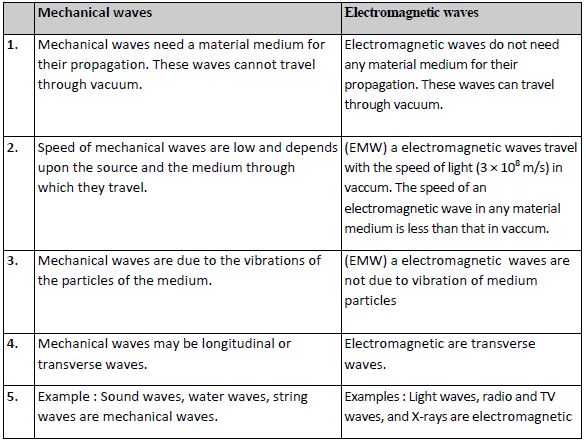
Difference between Mechanical waves & electromagnetic waves
(B) On the Basis of mode of Vibration of the Particle
TRANSVERSE WAVES
A wave in which the particles of the medium oscillate about their mean position in a direction perpendicular to the direction of propagation of the wave is called a transverse wave.
Transverse waves can travel through solids and over the surface of liquids, but not through gases.
Examples : Following are the examples of transverse waves :
(i) The water waves (ripples) produced on the surface of water is transverse waves. In water waves, the molecules of water move up and down from their mean positions.
(ii) A pulse on a slinky when it is given a jerk is a transverse wave.
(iii) All electromagnetic waves, e.g., light waves, radio waves etc., are transverse waves.
(iv) The waves produced in a stretched string when plucked are transverse waves. When a string of sitar (a musical instrument) or guitar is plucked, transverse waves are produced in the string.
Graphical Representation :
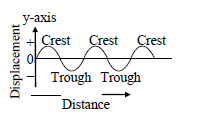
(a) Crest : The highest point on the hump in a transverse wave is called a crest. Thus, the point of maximum positive displacement on a transverse wave is called a crest.
(b) Trough : The lowest point on the depression in a transverse wave is called a trough. Thus, the point of maximum negative displacement on a transverse wave is called a trough.
LONGITUDINAL WAVES :
A wave in which the particle of the medium oscillate (vibrate) to and fro about their mean position in the direction of propagation of the wave is called a longitudinal wave.
Longitudinal waves can be produced in any medium, viz., in solids, liquids and in gases.
Example :
(i) Sound waves are longitudinal waves.
(ii) The waves produced in a spring (slinky) by compressing a small portion of it and releasing are longitudinal waves.
Graphical Representation :
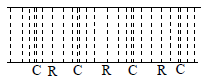
(a) Compression : The part of a longitudinal wave in which the density of the particles of the medium is higher than the normal density is called a compression.
(b) Rarefaction : The part of a longitudinal wave in which the density of the particles of the medium is lesser than the normal density is called a rarefaction.
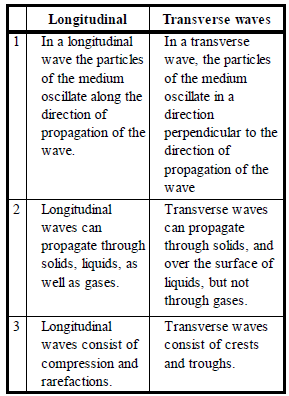
Difference between Transverse & Longitudinal Wave
Ø TERMS USED FOR DEFINING WAVE MOTION
Wave Length : The distance between two nearest points in a wave which are in the same phase of vibration is called the wave length. In simple words it is the length of one complete wave. It is denoted by lambda, l.
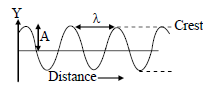
Amplitude : The amplitude of a wave is the magnitude of maximum displacement of the vibrating particles on the either side of their mean position. It is denoted by the letter A and its SI unit is metre (m).
Time-Period : The time required to produce one complete wave (or cycle) is called time-period of the wave.
Frequency : The frequency of an oscillating particle is the number of oscillations completed in one second.
The unit of frequency is hertz (or Hz). The frequency of the wave is 1\T. It is generally represented by n (nu)
Wave Velocity : The distance travelled by the wave in one second is called the wave velocity. It is represented by 'v' and its unit is ms–1
Please click on below link to download pdf file for CBSE Class 9 Science Sound Exam Notes.
Free study material for Science
Free CBSE Study Guides: Class 9 Science Chapter 11 Sound
Quick Revision Material for Chapter 11 Sound
Review targeted study resources for Chapter 11 Sound tailored for Class 9 learners. Utilizing these structured notes and quick-revision tools ensures complete alignment with current CBSE evaluation standards.
Expert Notes and Solved Exam Questions
Built using official NCERT guidelines for Class 9 Science, these materials provide reliable academic support. Integrating past examination questions and step-by-step solutions helps students understand official CBSE grading criteria.
Additional Study Resources for Class 9
Wrap up your chapter revision by testing your knowledge against standard objective question formats. Explore our full library of free, up-to-date sample papers and online assessments to secure top grades in your CBSE examinations.
FAQs
Our advanced study package for Chapter 11 Sound includes detailed concepts, diagrams, Mind Maps, and explanation of complex topics to ensure Class 9 students learn as per syllabus for 2026 exams.
The Mind Maps provided for Chapter 11 Sound act as visual anchors which will help faster recall during high-pressure exams.
Yes, teachers use our Class 9 Science resources for lesson planning as they are in simple language and have lot of solved examples.
Yes, You can download the complete, mobile-friendly PDF of the Science Chapter 11 Sound advanced resources for free.
Yes, our subject matter experts have updated the Chapter 11 Sound material to align with the rationalized NCERT textbooks and have removed deleted topics and added new competency-based questions.