

Advanced Study Material for Class 9 Science: Chapter 10 Work and Energy
Access comprehensive study materials and useful resources for Chapter 10 Work and Energy using the CBSE Class 9 Science Work and energy Notes. Designed to align with the 2026-27 CBSE academic guidelines, these advanced resources help Class 9 Science students reinforce core concepts beyond standard textbooks.
Practice Class 9 Science Resources: Chapter 10 Work and Energy
View or download the dedicated CBSE Class 9 Science Work and energy Notes resource below. Engaging with these advanced study guides under focused conditions ensures continuous academic progress and mastery of the 2026-27 curriculum for Chapter 10 Work and Energy.
CBSE Class 9 Science Work and energy Notes. There are many more useful educational material which the students can download in pdf format and use them for studies. Study material like concept maps, important and sure shot question banks, quick to learn flash cards, flow charts, mind maps, teacher notes, important formulas, past examinations question bank, important concepts taught by teachers. Students can download these useful educational material free and use them to get better marks in examinations. Also refer to other worksheets for the same chapter and other subjects too. Use them for better understanding of the subjects.
WORK AND ENERGY
WORK
Work (W) is said to be done, when a force (F) acts on the body and point of application of the force is displaced (s) in the direction of force.
Work done = force x displacement
W = F x s
i). If the body is displaced in the same direction of force, work is done by a force
ii). If the displacement is against a force, the work is done against the force.
iii). If the displacement is perpendicular to the direction of the force, work done is zero.
Unit of work
Unit of work is joule (J). One joule of work is said to be done when a force of 1 newton acting on a body displacing it by a distance of 1 m.
Larger units of work are
i) kilojoule (1000 joule)
ii) megajoule (10 lakh joule)
NUMERICALS
1. A force of 10 N acts on an object. The object is displaced through 12 m, in the direction of the force. If the force acts all through the displacement, find the work done by the force.

2. A porter lifts a luggage of 15 kg from the ground and puts it on his head 1.5 m above the ground. Calculate the work done by him on the luggage.
3. A boy pushes a book by applying a force of 40 N. Find the work done by this force on the book is displaced through 25 cm along the path.
4. A ball of mass 1 kg thrown upwards, reaches a maximum height of 4 m. Calculate the work done by the force of gravity during the vertical displacement. (g = 10m/s2)
5. Find the amount of work done by a labourers who carrier ‘n’ bricks of ‘m’ kg each to the roof of a house ‘h’ metre high by climbing a ladder.
6. An engine pulls a train 1 km over a level track. Calculate the work done by the train given that the frictional resistance is 5 x 10⁵ N.
7. A man weighing 70 kg carries a weight of 10 kg on the top of a tower 100 m high. Calculate the work done by the man (g = 10m/s2).
8. A boy of mass 55 kg runs up a flight of 40 stairs, each measuring 0.15m. Calculate the work done by the boy.
9. Calculate the work done in lifting 200 kg of water through a vertical height of 6 metres (g = 10m/s2).
10. A crane pulls up a car of mass 500 kg to a vertical height of 4 m. Calculate the work done by the crane.
11. A force of 5 N acts on an object. The object id displaced through 8 m, in the direction of the force. If the force acts all through the displacement, find the work done by the force.
12. A porter lifts a luggage of 15 kg from the ground and puts it on his head 1.5 m above the ground. Calculate the work done by him on the luggage.
13. Calculate the work done by a student in lifting 0.5 kg book from the ground and keeping it on a shelf 1.5m high.
14. A collie carries a load of 50 kg on his head and walks on a level road upto 100 m. What is the work done by him?
15. A car weighing 1000 kg and traveling at 30m/s stops at a distance of 50m decelerating uniformly. What is the force exerted on it by the brakes? What is the work done by the brakes?
INTEXT QUESTIONS PAGE NO. 148
1. A force of 10 N acts on an object. The displacement is, say 8 m, in the direction of the force. Let us take it that the force acts on the object through the displacement. What is the work done in this case?
Ans: When a force F acts on an object to displace it through a distance S in its direction, then the work done W on the body by the force is given by:
Work done = Force × Displacement
W = F × S
where, F = 7 N , S = 8 m
Therefore, work done, W = 7 × 8 = 56 Nm = 56 J
1. When do we say that work is done?
Ans: Work is done whenever the given conditions are satisfied:
(i) A force acts on the body.
(ii) There is a displacement of the body caused by the applied force along the direction of the applied force.
2. Write an expression for the work done when a force is acting on an object in the direction of its displacement.
Ans: When a force F displaces a body through a distance S in the direction of the applied force, then the work done W on the body is given by the expression:
Work done = Force × Displacement
W = F × s
3. Define 1 J of work.
Ans: 1 J is the amount of work done by a force of 1 N on an object that displaces it through a distance of 1 m in the direction of the applied force.
4. A pair of bullocks exerts a force of 140 N on a plough. The field being ploughed is 15 m long. How much work is done in ploughing the length of the field?
Ans: Work done by the bullocks is given by the expression:
Work done = Force × Displacement
W = F × d
Where,
Applied force, F = 140 N
Displacement, d = 15 m
W = 140 × 15 = 2100 J
Hence, 2100 J of work is done in ploughing the length of the field.
ENERGY
The energy of the body is defined as its capacity to do work.
Unit of energy
Energy is measured in terms of work. Unit of energy is also joule. One joule of energy is required to do one joule of work.
DIFFERENT FORMS OF ENERGY
We live in a world where we have energy in many different forms. Some important forms of energy are mechanical energy, chemical energy, light energy, heat energy, electrical energy, nuclear energy and sound energy.
MECHANICAL ENERGY
The energy used to displace a body or to change the position of the body or to deform the body
is known as mechanical energy.
Mechanical energy is of two types
i) Kinetic energy ii) Potential energy
KINETIC ENERGY
Energy possessed by an object due to its motion is called kinetic energy.
Kinetic energy of an object increases with its speed. Kinetic energy of an object moving with a velocity is equal to the work done on it to make it acquire that velocity.
Example-1 Kinetic energy of a hammer is used to drive a nail into the wall.
Example-2 Bullet fi red from a gun can penetrate into a target due to its kinetic energy.
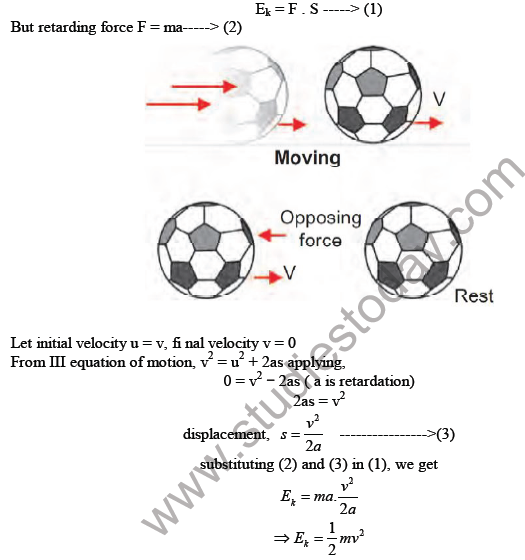
EXPRESSION FOR KINETIC ENERGY
Let a body (ball) of mass m is moving with an initial velocity v. If it is brought to rest by applying a retarding (opposing) force F, then it comes to rest by a displacement S. Let, Ek =
work done against the force used to stop it.
INTEXT QUESTIONS PAGE NO. 152
1. What is the kinetic energy of an object?
Ans: Kinetic energy is the energy possessed by a body by the virtue of its motion. Every moving
object possesses kinetic energy. A body uses kinetic energy to do work. Kinetic energy of hammer is used in driving a nail into a log of wood, kinetic energy of air is used to run
wind mills, etc.
2. Write an expression for the kinetic energy of an object.
Ans: If a body of mass m is moving with a velocity v, then its kinetic energy Ek is given by the expression, Ek = 1/2 E mv2 . Its SI unit is Joule (J).
3. The kinetic energy of an object of mass, m moving with a velocity of 5 ms–1 is 25 J.
What will be its kinetic energy when its velocity is doubled? What will be its kinetic energy when its velocity is increased three times?
Ans: Expression for kinetic energy is Ek = 1/2 E mv2
m = Mass of the object
v = Velocity of the object = 5 m/s
Given that kinetic energy, Ek = 25 J
(i) If the velocity of an object is doubled, then v = 5 × 2 = 10 m/s.
Therefore, its kinetic energy becomes 4 times its original value, because it is proportional to the square of the velocity. Hence, kinetic energy = 25 × 4 = 100 J.
(ii) If velocity is increased three times, then its kinetic energy becomes 9 times its original value, because it is proportional to the square of the velocity. Hence, kinetic energy = 25 × 9 = 225 J.
Please click the link below to download CBSE Class 9 Science Work and energy Notes.
Free study material for Science
Free CBSE Study Guides: Class 9 Science Chapter 10 Work and Energy
Core Study Kit: Class 9 Science Chapter 10 Work and Energy
Explore essential learning tools for Class 9 Science Chapter 10 Work and Energy. This curated collection features in-depth notes and targeted practice questions built around the active 2026 curriculum to streamline your daily revision.
NCERT-Aligned Solutions for Chapter 10 Work and Energy
Designed around the official curriculum, these study guides guarantee standard compliance. Reviewing step-by-step solutions clarifies complex sub-topics within Chapter 10 Work and Energy and demystifies standard marking schemes for Science evaluations.
Next Steps in Your Exam Preparation
For peak performance in upcoming evaluations, integrate official Science sample papers directly into your study schedule. Follow up your revision by attempting online MCQ tests for Chapter 10 Work and Energy to refine calculation speed and precision.
FAQs
Our advanced study package for Chapter 10 Work and Energy includes detailed concepts, diagrams, Mind Maps, and explanation of complex topics to ensure Class 9 students learn as per syllabus for 2026 exams.
The Mind Maps provided for Chapter 10 Work and Energy act as visual anchors which will help faster recall during high-pressure exams.
Yes, teachers use our Class 9 Science resources for lesson planning as they are in simple language and have lot of solved examples.
Yes, You can download the complete, mobile-friendly PDF of the Science Chapter 10 Work and Energy advanced resources for free.
Yes, our subject matter experts have updated the Chapter 10 Work and Energy material to align with the rationalized NCERT textbooks and have removed deleted topics and added new competency-based questions.