

Class 9 Science Study Guide: CBSE Class 9 Science Gravitation Exam Notes
Access comprehensive study materials and useful resources for Chapter 09 Gravitation using the CBSE Class 9 Science Gravitation Exam Notes. Designed to align with the 2026-27 CBSE academic guidelines, these advanced resources help Class 9 Science students reinforce core concepts beyond standard textbooks.
Download Chapter 09 Gravitation Study Material PDF
View or download the dedicated CBSE Class 9 Science Gravitation Exam Notes resource below. Engaging with these advanced study guides under focused conditions ensures continuous academic progress and mastery of the 2026-27 curriculum for Chapter 09 Gravitation.
CBSE Class 9 Science Gravitation Exam Notes. Please refer to the examination notes which you can use for preparing and revising for exams. These notes will help you to revise the concepts quickly and get good marks.
FORCE OF GRAVITATION
Any two particles in the universe attract each other. This force is called the force of gravitation. This concept was given by Newton.
NEWTON’S LAW OF GRAVITATION
According to newton, "Any two bodies in universe attract each other with a force directly proportional to the product of their masses and inversely proportional to the square of the distance between them."
Mathematical expression
Let A and B be two particle of mass m1 and m2 respectively. Let the distance AB = r. By the law of gravitational, the particle A attracts the particle B with a force F such that.

Here G is a constant known as the universal constant of gravitation. G = 6.67 × 10⁻¹¹ Nm2/kg2
*G is independent of the masses of the bodies and the distance between them.
*Newton's law of gravitation is applicable for everybody in the universe.
Note : The force between any two bodies in the universe is called the force of gravitation while the force with which earth attracts a body is called the force of gravity.
Some Scientific Phenomenon Based on Gravitational Force :
• The gravitational force between the sun and the earth keeps the earth moving around the sun.
• The gravitational force b/w the earth and the moon keeps the moon moving around the earth.
• Existence of our solar system is due to gravitational force.
• Gravitation force of the sun and the moon on the earth's water surface is responsible for the tides in sea.
• Atmosphere above the earth is held due to gravitational force of the earth.
• Gravitational force between the sun and planet keeps the planet moving around the sun.
• Gravitational force is responsible for providing the centripetal force required by the planets.
• The attractive force of the earth is responsible for providing the centripetal force required by moon.
Newton's Third Law of Motion and Law of Gravitation :
• Newton's third law of motion is applicable to gravitation also.
Ex. if the earth exerts a force of attraction on a body, the body also exerts an equal and opposite force of attraction on the earth.
• As a = F/m
mass of the body is larger, acceleration produced will be smaller and vice versa.
Ex. 1 Calculate the force between two masses of 100 kg and 1000 kg separated by a distance of 10 m (G = 6.67 × 10⁻¹¹ Nm2/kg2).
Sol. According to Newton's law of gravitation, force of attraction between two bodies is
F = Gm1m2 /r 2
Here, m1 = 100 kg; m2 = 1000 kg ;
r = 10 m ; G = 6.67 × 10⁻¹¹Nm2/kg2
\ F = 6.67 x 10–11 x 100 x 1000 / (10)2
= 6.67 × 10⁻⁸ N
Ex. 2 Given mass of earth = 6 × 1024 kg, radius of earth = 6.4 × 10⁶ m. Calculate the force of attraction experienced by a man of mass 50 kg.
Sol. Force of gravitation is given by the expression, F = Gm1m2 /r 2
Here, mass of earth, m1 = 6 × 1024 kg;
mass of man, m2 = 50 kg
Distance between them is to be taken equal to the radius of earth.
r = 6.4 × 10⁶ m
Substituting these values, we get
F = 6.67 x10–11 x 6 x1024 x 50/ (6.4 x 10⁶ )2 = 488.5 N
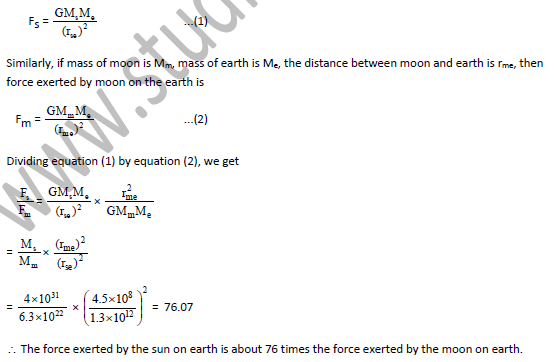
Ex. 3 Compare the gravitational forces exerted by the sun and the moon on earth. Which exerts a greater force on earth ?
(Given : mass of sun, Ms = 4 × 1031 kg; mass of moon, Mm = 6.3 × 10²² kg; distance between sun and earth, rse=1.3× 10¹² m and the distance between moon and earth, rme= 4.5 × 10⁸m)
Sol. If mass of sun is Ms and mass of earth is Me and distance between the sun and earth is rse, then force exerted by the sun on earth is
then force exerted by the sun on earth is
Ex. 4 If mass and radius of earth is 6.0 × 1024 kg and 6.4 × 10⁶ m respectively, calculate the force exerted by earth on a body of mass
1 kg. Also, calculate :
(i) acceleration produced in the body of mass
1 kg, and
(ii) acceleration produced in the earth
Sol. From Newton's law of gravitation, we know that the force of attraction between two bodies is given by
F = Gm1m2 /r 2
Here, m1 = mass of earth = 6.0 × 1024 kg;
m2 = mass of body = 1 kg
r = distance between the two bodies
= radius of earth = 6.4 × 10⁶ m
G = 6.67 × 10⁻¹¹ Nm2/kg2
\ F = 6.67 x10–11 x 6.0 x1024 x 1 / (6.4 x10⁶ )2 = 9.8 N
This shows that earth exerts a force of 9.8 N on a body of mass of 1 kg. The body will exert an equal force of attraction of 9.8 N on earth.
(i) Acceleration produced in the body of mass 1kg
Force = mass × acceleration
\ Acceleration, a =F /m= 9.8/1 = 9.8 m/s2
Thus, the acceleration produced in a body of mass 1 kg due to attraction of earth is
9.8 m/s2, which is quite large. Thus, when a body is released, it falls towards the earth with an acceleration of 9.8 m/s2, which can be easily observed.
(ii) Acceleration produced in the earth
Similarly, acceleration of earth is given by
= Force /M assof eart h =9.8/ 6.0 ´1024
= 1.63 × 10⁻²⁴ m/s2
This shows that the acceleration produced in the earth by a body of mass 1 kg is
1.63 × 10⁻²⁴ m/s2 which is very small and cannot be observed.
Ø EARTH'S GRAVITATIONAL FORCE
The force which earth exerts on a body is called 'force of gravity'. i.e. F =
GM m/R 2
Where M = mass of the earth, R = radius of the earth.
Due to this force, a body released from some height on the earth's surface falls towards the earth with its velocity increasing at a constant rate.
Acceleration due to Gravity : The acceleration produced in a body due to attraction of earth is called the acceleration due to gravity and is denoted by 'g'.
g = GM/R 2 = 9.8 m/s2
near the earth surface
g on moon » g e/6 = 9.8/6 m/s2
A body moving upwards with some initial velocity, experiences a retardation of
9.8 m/s2 & its velocity decreases continuously unless it becomes zero.
After this, it again starts falling towards the earth with the same acceleration of 9.8 m/s2.
The value of g is minimum at equator and maximum at poles.
The value of g does not depend upon the mass of the body falling towards the earth.
Please click on below link to download pdf file for CBSE Class 9 Science Gravitation Exam Notes.
Free study material for Science
Useful Resources and Notes for Class 9 Science Chapter 09 Gravitation
Core Study Kit: Class 9 Science Chapter 09 Gravitation
Access comprehensive study material for Chapter 09 Gravitation, including revision notes, concept maps, and high-probability questions. These resources are designed in alignment with the latest 2026 CBSE syllabus for Class 9 Science to support effective exam preparation.
NCERT-Aligned Solutions for Chapter 09 Gravitation
Each resource draws directly from authorized textbooks to maintain academic accuracy. Evaluating solved examples allows Class 9 students to master the formal presentation and answer-writing standards expected in upcoming school exams.
Next Steps in Your Exam Preparation
Wrap up your chapter revision by testing your knowledge against standard objective question formats. Explore our full library of free, up-to-date sample papers and online assessments to secure top grades in your CBSE examinations.
FAQs
Our advanced study package for Chapter 09 Gravitation includes detailed concepts, diagrams, Mind Maps, and explanation of complex topics to ensure Class 9 students learn as per syllabus for 2026 exams.
The Mind Maps provided for Chapter 09 Gravitation act as visual anchors which will help faster recall during high-pressure exams.
Yes, teachers use our Class 9 Science resources for lesson planning as they are in simple language and have lot of solved examples.
Yes, You can download the complete, mobile-friendly PDF of the Science Chapter 09 Gravitation advanced resources for free.
Yes, our subject matter experts have updated the Chapter 09 Gravitation material to align with the rationalized NCERT textbooks and have removed deleted topics and added new competency-based questions.