

Download CBSE Class 9 Science Useful Resources
Explore structured advanced study materials through the CBSE Class 9 Science Gravitation Notes. Tailored for Class 9 learners, utilizing these Science resources ensures thorough preparation and strengthens foundational knowledge before final CBSE evaluations.
Access CBSE Study Guides and Summaries
Navigate directly to the advanced Science study materials using the digital viewer below. Each resource pack includes detailed conceptual summaries and solved practice questions, allowing students to instantly reinforce their learning.
CBSE Class 9 Science Gravitation Notes. There are many more useful educational material which the students can download in pdf format and use them for studies. Study material like concept maps, important and sure shot question banks, quick to learn flash cards, flow charts, mind maps, teacher notes, important formulas, past examinations question bank, important concepts taught by teachers. Students can download these useful educational material free and use them to get better marks in examinations. Also refer to other worksheets for the same chapter and other subjects too. Use them for better understanding of the subjects.
Class 9 Science, Chapter 10 Gravitation. These notes cover Newton's universal law of gravitation, the value of G, Kepler's laws, free fall and the acceleration due to gravity g, mass and weight, weight on the Moon, thrust and pressure, buoyancy, Archimedes' principle, the laws of floatation, density and relative density, with intext questions, exercise answers and solved numericals.
Topics Covered
1. Newton's universal law of gravitation and the value of G
2. Kepler's laws of planetary motion
3. Free fall and acceleration due to gravity
4. Mass and weight, weight on the Moon
5. Thrust and pressure
6. Buoyancy and Archimedes' principle
7. Laws of floatation, density and relative density
CHAPTER - 10 GRAVITATION
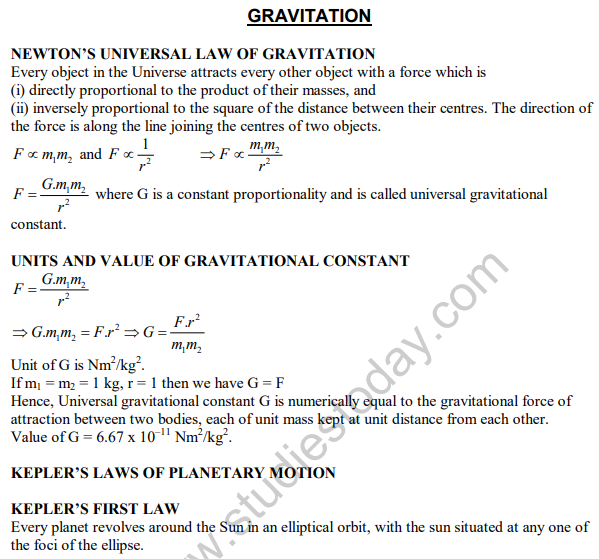
NEWTON'S UNIVERSAL LAW OF GRAVITATION
Every object in the Universe attracts every other object with a force which is
(i) directly proportional to the product of their masses, and
(ii) inversely proportional to the square of the distance between their centres. The direction of the force is along the line joining the centres of two objects.
F ∝ m₁m₂ and F ∝ \( \frac{1}{r^2} \) ⇒ F ∝ \( \frac{m_1 m_2}{r^2} \)
F = \( \frac{G m_1 m_2}{r^2} \) where G is a constant proportionality and is called universal gravitational constant.
UNITS AND VALUE OF GRAVITATIONAL CONSTANT
F = \( \frac{G m_1 m_2}{r^2} \) ⇒ G m₁m₂ = F r² ⇒ G = \( \frac{F r^2}{m_1 m_2} \)
Unit of G is Nm²/kg².
If m₁ = m₂ = 1 kg, r = 1 then we have G = F
Hence, Universal gravitational constant G is numerically equal to the gravitational force of attraction between two bodies, each of unit mass kept at unit distance from each other.
Value of G = 6.67 × 10⁻¹¹ Nm²/kg².
KEPLER'S LAWS OF PLANETARY MOTION
KEPLER'S FIRST LAW
Every planet revolves around the Sun in an elliptical orbit, with the sun situated at any one of the foci of the ellipse.
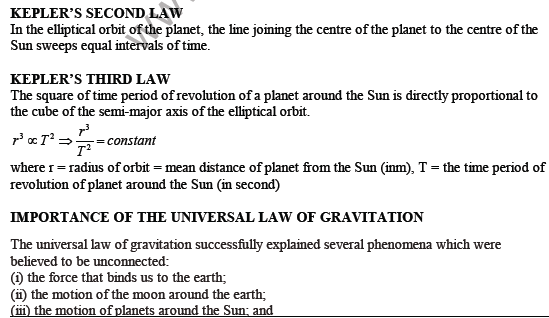
KEPLER'S SECOND LAW
In the elliptical orbit of the planet, the line joining the centre of the planet to the centre of the Sun sweeps equal areas in equal intervals of time.
KEPLER'S THIRD LAW
The square of time period of revolution of a planet around the Sun is directly proportional to the cube of the semi-major axis of the elliptical orbit.
r³ ∝ T² ⇒ \( \frac{r^3}{T^2} \) = constant
where r = radius of orbit = mean distance of planet from the Sun (in m), T = the time period of revolution of planet around the Sun (in second)
IMPORTANCE OF THE UNIVERSAL LAW OF GRAVITATION
The universal law of gravitation successfully explained several phenomena which were believed to be unconnected:
(i) the force that binds us to the earth;
(ii) the motion of the moon around the earth;
(iii) the motion of planets around the Sun; and
(iv) the tides due to the moon and the Sun.
INTEXT QUESTIONS PAGE NO. 134
1. State the universal law of gravitation
Answer:
1. The universal law of gravitation states that every object in the universe attracts every other object with a force called the gravitational force.
2. The force acting between two objects is directly proportional to the product of their masses and inversely proportional to the square of the distance between their centres.
3. For two objects of masses m₁ and m₂ and the distance between them r, the force (F) of attraction acting between them is F = \( \frac{G m_1 m_2}{r^2} \).
4. Here G is the universal gravitation constant, G = 6.67 × 10⁻¹¹ Nm²/kg².
Teacher's Note:
a) State both proportionalities, one for the masses and one for the distance.
b) Mention that the force acts along the line joining the centres of the two objects.
2. Write the formula to find the magnitude of the gravitational force between the earth and an object on the surface of the earth.
Answer:
1. Let ME be the mass of the Earth and m be the mass of an object on its surface. If R is the radius of the Earth, then according to the universal law of gravitation, the gravitational force (F) acting between the Earth and the object is given by the relation:
2. F = \( \frac{G M_E m}{R^2} \)
Teacher's Note:
a) On the surface the distance r is replaced by the radius R of the Earth.
b) G, ME and R are constants, so the force depends only on m.
FREE FALL
When an object falls from any height under the influence of gravitational force only, it is known as free fall. In the case of free fall no change of direction takes place but the magnitude of velocity changes because of acceleration.
This acceleration acts because of the force of gravitation and is denoted by 'g'. This is called acceleration due to gravity.
EXPRESSION FOR ACCELERATION DUE TO GRAVITATION 'g'.
Let mass of the object put under free fall = m.
And acceleration due to gravity = g.
Therefore, according to Newton's Second Law of Motion which states that Force is the product of mass and acceleration,
F = m × g ----------------- (i)
Now, according to Universal Law of gravitation,
F = G \( \frac{M m}{d^2} \) ................. (ii)
Thus, from above two expressions, we get
m g = G \( \frac{M m}{d^2} \), so g = \( \frac{G M}{d^2} \) ................. (iii)
Where, g is acceleration due to gravity,
G is the Universal Gravitational Constant.
M is the mass of earth.
And d is the distance between object and centre of earth.
WHEN OBJECT IS NEAR THE SURFACE OF EARTH
When an object is near the surface of earth, the distance between object and centre of the earth will be equal to the radius of earth because the distance of object is negligible in comparison of the radius of earth.
Let the radius of earth is equal to R.
Therefore, after substituting 'R' at the place of 'd' we get,
g = \( \frac{G M}{R^2} \) ................. (iv)
Since, earth is not a perfect sphere rather it has oblique shape. Therefore, radius at the equator is greater than at the poles.
Since, value of 'g' is reciprocal of the square of radius of earth, thus, the value of 'g' will be greater at the poles and less at the equator.
And the value of 'g' will decrease with increase of distance of object from earth.
Calculation of value of 'g'
We know that g = \( \frac{G M}{R^2} \)
The accepted value of G is 6.673 × 10⁻¹¹ Nm²/kg².
The mass of earth, M = 6 × 10²⁴ kg
The radius of earth, R = 6.4 × 10⁶ m
Therefore, after substituting the value of G, M and R in the expression for 'g' we get,
g = \( \frac{6.673 \times 10^{-11} \times 6 \times 10^{24}}{(6.4 \times 10^{6})^2} \)
⇒ g = 9.8 m/s²
Motion of an object under the influence of gravitational force of earth
The expression for 'g' is written as g = \( \frac{G M}{R^2} \)
Since, the value of 'g' does not depend upon the mass or distance of an object, therefore, all objects fall over the earth with the same rate.
The equations for motion are as follows:
v = u + at ........... (i)
s = ut + \( \frac{1}{2} \) at² .......... (ii)
v² = u² + 2as ......... (iii)
Therefore, the equations of motion are also applied to calculate the velocity, distance, etc by replacing 'a' by 'g'. After substituting 'g' at the place of 'a' we get above equations as follows:
v = u + gt ........... (iv)
s = ut + \( \frac{1}{2} \) gt² .......... (v)
v² = u² + 2gs ......... (vi)
In the calculation; initial velocity (u), final velocity (v), time taken (t), or distance covered (s), the value of 'g' is taken as positive in the case of object moving towards earth and taken as negative in the case of object is thrown in opposite direction of earth.
MASS
Mass is the measurement of inertia and inertia is the property of any object which opposes the change in state of the object. It is inertia because of which an object in rest has tendency to remain in rest and an object in motion has tendency to remain in motion.
Inertia depends upon the mass of an object. Object having greater mass has greater inertia and vice versa. Mass of an object remains constant everywhere, i.e. mass will remain same whether that object is at the moon, at the earth or anywhere in the universe.
WEIGHT
Earth attracts every object towards it. We know that force is the product of mass and acceleration due to gravity.
This means, F = m × g ----------------------- (i)
The force by which earth attracts an object towards it is called the weight of the object, which is the product of mass (m) of the object and acceleration due to gravity (g).
Weight is denoted by 'W'.
Therefore, by substituting in the expression 'F = mg' we get,
W = m × g ------------------------------ (ii)
Since weight is the force which is acting vertically downwards, therefore, weight has both magnitude and direction and hence it is a vector quantity.
Since the value of 'g' is always constant at a given place,
Therefore, expression 'W = m × g' can be written as follows:
W ∝ m -------------------- (iii)
This means weight of any object is directly proportional to its mass, i.e. weight will increase with the increase of mass and decrease with decrease in mass.
This is the cause that weight of any object is the measure of its mass.
The unit of weight
Since, weight of an object is equal to the force by which an object is attracted towards earth, therefore, unit of weight is same as the unit of force.
Therefore, Unit of weight is 'newton (N)'.
WEIGHT OF AN OBJECT ON THE SURFACE OF MOON
Let ME be the mass of the Earth and m be an object on the surface of the Earth. Let RE be the radius of the Earth. According to the universal law of gravitation, weight WE of the object on the surface of the Earth is given by,
WE = \( \frac{G M_E m}{R_E^2} \)
Let MM and RM be the mass and radius of the moon. Then, according to the universal law of gravitation, weight WM of the object on the surface of the moon is given by:
WM = \( \frac{G M_M m}{R_M^2} \)
Dividing, \( \frac{W_M}{W_E} = \frac{M_M R_E^2}{M_E R_M^2} \)
where, ME = 5.98 × 10²⁴ kg, MM = 7.36 × 10²² kg
RE = 6.4 × 10⁶ m, RM = 1.74 × 10⁶ m
\( \frac{W_M}{W_E} = \frac{7.36 \times 10^{22} \times (6.4 \times 10^{6})^2}{5.98 \times 10^{24} \times (1.74 \times 10^{6})^2} \) = 0.167 ≈ \( \frac{1}{6} \)
Therefore, the weight of an object on the moon is \( \frac{1}{6} \)th its weight on the earth.
NUMERICAL
1. The gravitational force between two objects is F. How will this force change when (i) distance between them is reduced to half (ii) the mass of each object is quadrupled?
Answer:
1. F = \( \frac{G m_1 m_2}{r^2} \), so F ∝ \( \frac{1}{r^2} \) and F ∝ m₁m₂.
2. (i) When r becomes \( \frac{r}{2} \), the new force F′ = \( \frac{G m_1 m_2}{(r/2)^2} \) = 4F. The force becomes four times.
3. (ii) When each mass becomes 4 times, F′ = \( \frac{G (4m_1)(4m_2)}{r^2} \) = 16F. The force becomes sixteen times.
Teacher's Note:
a) Halving the distance squares the factor 2, and quadrupling each mass gives 4 × 4.
b) Never add the factors; combine them by multiplying.
2. A sphere of mass 40kg is attracted by a second sphere of mass 15kg when their centres are 20 cm apart, with a force of 0.1 milligram weight. Calculate the value of gravitational constant.
Answer:
1. m₁ = 40 kg, m₂ = 15 kg, r = 20 cm = 0.2 m.
2. F = 0.1 milligram weight = 0.1 × 10⁻⁶ kg × 9.8 m/s² = 9.8 × 10⁻⁷ N.
3. G = \( \frac{F r^2}{m_1 m_2} \) = \( \frac{9.8 \times 10^{-7} \times (0.2)^2}{40 \times 15} \).
4. G = 6.53 × 10⁻¹¹ Nm²/kg².
Teacher's Note:
a) Convert the force from milligram weight to newton first, and the distance from cm to m.
b) The answer is close to the standard value of G, which checks the working.
3. A body of mass 1 kg is placed at a distance of 2m from another body of mass 10kg. At what distance from the body of 1 kg, another body of mass 5 kg be placed so that the net force of gravitation acting on the body of mass 1 kg is zero?
Answer:
1. The 5 kg body must pull the 1 kg body in the direction opposite to the pull of the 10 kg body, so it is placed on the other side of the 1 kg body, at distance x from it.
2. Force due to 10 kg body = \( \frac{G \times 1 \times 10}{2^2} \) and force due to 5 kg body = \( \frac{G \times 1 \times 5}{x^2} \).
3. For zero net force, \( \frac{10}{4} = \frac{5}{x^2} \), so x² = 2.
4. x = √2 = 1.41 m from the 1 kg body, on the side opposite to the 10 kg body.
Teacher's Note:
a) Equal and opposite forces are needed, so the third body goes on the opposite side.
b) G cancels from both sides, so its value is not needed.
4. A geostationary satellite is orbiting the earth at a height 5 R above the surface of earth, where R is the radius of earth. Find the time period of another satellite at a height of 2 R from the surface of earth.
Answer:
1. A geostationary satellite has a period T₁ = 24 hours and orbital radius r₁ = R + 5R = 6R.
2. The other satellite has orbital radius r₂ = R + 2R = 3R.
3. By Kepler's third law, \( \frac{T_2^2}{T_1^2} = \frac{r_2^3}{r_1^3} = \frac{(3R)^3}{(6R)^3} = \frac{1}{8} \).
4. T₂ = T₁ ÷ 2√2 = 24 ÷ 2.828 = 8.49 hours (6√2 hours).
Teacher's Note:
a) Measure the orbital radius from the centre of the Earth, so add R to each height.
b) The period of a geostationary satellite is 24 hours.
c) Take the square root of 1/8 carefully: it is 1/(2√2), not 1/4.
5. The distance of planet Jupiter from the sun 5.2 times that of Earth. Find the period of revolution of Jupiter around sun.
Answer:
1. Let the distance of the Earth be r and that of Jupiter 5.2r; the period of the Earth is 1 year.
2. By Kepler's third law, T² ∝ r³, so \( \frac{T_J^2}{1^2} = (5.2)^3 \) = 140.6.
3. TJ = √140.6 = 11.86 years.
Teacher's Note:
a) Use the Earth's period of 1 year as the reference.
b) The answer is about 12 years.
6. If the distance of Earth from the Sun were half the present value, how many days will make one year?
Answer:
1. Present year = 365 days with orbital radius r; new radius = \( \frac{r}{2} \).
2. T² ∝ r³, so \( \frac{T^2}{365^2} = \left(\frac{1}{2}\right)^3 = \frac{1}{8} \).
3. T = 365 ÷ 2√2 = 365 ÷ 2.828 = 129 days (nearly).
Teacher's Note:
a) Halving the distance does not halve the year; the cube-square law applies.
b) The year would be about 129 days long.
7. Two satellites of a planet have periods 32 days and 256 days. If the radius of orbit of former is R, find the orbital radius of the latter.
Answer:
1. T₁ = 32 days, T₂ = 256 days, r₁ = R.
2. \( \frac{r_2^3}{r_1^3} = \frac{T_2^2}{T_1^2} = \left(\frac{256}{32}\right)^2 \) = 64.
3. r₂³ = 64R³, so r₂ = 4R.
Teacher's Note:
a) A period ratio of 8 gives a radius ratio of 8 raised to 2/3, which is 4.
8. The mass of Earth is 6 x 10²⁴ kg and that of moon is 7.4 x 10²² kg. If the distance between the Earth and the Moon is 3.84 x 10⁵ km, calculate the force exerted by Earth on the Moon. Given G = 6.7 x 10⁻¹¹ Nm²/kg².
Answer:
1. r = 3.84 × 10⁵ km = 3.84 × 10⁸ m.
2. F = \( \frac{G M m}{r^2} \) = \( \frac{6.7 \times 10^{-11} \times 6 \times 10^{24} \times 7.4 \times 10^{22}}{(3.84 \times 10^{8})^2} \).
3. F = 2.02 × 10²⁰ N.
Teacher's Note:
a) Change kilometres to metres before squaring the distance.
b) By Newton's third law the Moon pulls the Earth with the same force.
9. If the distance between two masses is increased by a factor of 4, by what factor would the mass of one of them have to be altered to maintain the same gravitational force?
Answer:
1. When the distance becomes 4 times, F falls to \( \frac{1}{16} \) of its value.
2. Since F ∝ m₁m₂, the mass of one object must increase by a factor of 16 to keep the same force.
Teacher's Note:
a) Distance changes act through the square, so the factor 4 becomes 16.
10. Two bodies A and B having masses 2kg and 4kg respectively are separated by 2m. Where should a body of mass 1kg be placed so that the gravitational force on this body due to bodies A and B is zero?
Answer:
1. The 1 kg body must lie between A and B, at distance x from A and (2 - x) from B, so the pulls act in opposite directions.
2. \( \frac{G \times 2 \times 1}{x^2} = \frac{G \times 4 \times 1}{(2-x)^2} \), so (2 - x)² = 2x².
3. 2 - x = √2 x, so x = \( \frac{2}{1+\sqrt{2}} \) = 0.83 m.
4. The body should be placed 0.83 m from A (1.17 m from B).
Teacher's Note:
a) The body is nearer the lighter mass, because the heavier mass pulls more strongly.
b) Reject the negative root of the square-root equation.
11. The mass of Sun is 2 x 10³⁰ kg and mass of Earth is 6 x 10²⁴ kg. If the distance between the centres of Sun and Earth is 1.5 x 10⁸ km, calculate the force of gravitation between them.
Answer:
1. r = 1.5 × 10⁸ km = 1.5 × 10¹¹ m, and G = 6.67 × 10⁻¹¹ Nm²/kg².
2. F = \( \frac{G M m}{r^2} \) = \( \frac{6.67 \times 10^{-11} \times 2 \times 10^{30} \times 6 \times 10^{24}}{(1.5 \times 10^{11})^2} \).
3. F = 3.56 × 10²² N.
Teacher's Note:
a) G is not given in the question, so the standard value 6.67 × 10⁻¹¹ is used.
b) Check the unit conversion of the distance: 1 km = 10³ m.
12. Two electrons each of mass 9.1 x 10⁻³¹ kg are at a distance of 10 Å. Calculate the gravitational force of attraction between them. Given 1Å = 10⁻¹⁰ m
Answer:
1. r = 10 Å = 10 × 10⁻¹⁰ m = 10⁻⁹ m.
2. F = \( \frac{G m^2}{r^2} \) = \( \frac{6.67 \times 10^{-11} \times (9.1 \times 10^{-31})^2}{(10^{-9})^2} \).
3. F = 5.52 × 10⁻⁵³ N.
Teacher's Note:
a) The force is extremely small, which is why gravity is not noticed between tiny particles.
b) Square both the mass and the distance.
13. The gravitational force between force two objects is 100 N. How should the distance between these objects be changed so that force between them becomes 50 N?
Answer:
1. F ∝ \( \frac{1}{r^2} \), so \( \frac{F_2}{F_1} = \frac{r_1^2}{r_2^2} \).
2. \( \frac{50}{100} = \frac{r_1^2}{r_2^2} \), so r₂² = 2r₁².
3. r₂ = √2 r₁ = 1.41 r₁.
4. The distance should be increased by a factor of √2, that is to about 1.41 times the original distance.
Teacher's Note:
a) Halving the force needs a distance larger by √2, not by 2.
14. Calculate the force of gravitation between two objects of masses 80kg and 1200 kg kept at a distance of 10 m from each other. Given G = 6.67 x 10⁻¹¹ Nm²/kg².
Answer:
1. F = \( \frac{G m_1 m_2}{r^2} \) = \( \frac{6.67 \times 10^{-11} \times 80 \times 1200}{10^2} \).
2. F = 6.40 × 10⁻⁸ N.
Teacher's Note:
a) Multiply the two masses first and then divide by r².
15. Calculate the force of attraction between the Earth and the Sun, given that the mass of Earth is 6 x 10²⁴ kg and that of sun is 2 x 10³⁰ kg. The average distance between thte two is 1.5 x 10¹¹ m.
Answer:
1. G = 6.67 × 10⁻¹¹ Nm²/kg² and r = 1.5 × 10¹¹ m.
2. F = \( \frac{6.67 \times 10^{-11} \times 6 \times 10^{24} \times 2 \times 10^{30}}{(1.5 \times 10^{11})^2} \).
3. F = 3.56 × 10²² N.
Teacher's Note:
a) The value is the same as in numerical 11 because the data are the same.
b) With G = 6.7 × 10⁻¹¹ the answer becomes 3.57 × 10²² N.
16. A sphere of mass 25kg attracts another sphere of mass 24kg with a force of 0.1milligram weight. If distance between the centres of two spheres is 20cm, what is the value of G?
Answer:
1. F = 0.1 milligram weight = 0.1 × 10⁻⁶ kg × 9.8 = 9.8 × 10⁻⁷ N, and r = 0.2 m.
2. G = \( \frac{F r^2}{m_1 m_2} \) = \( \frac{9.8 \times 10^{-7} \times 0.04}{25 \times 24} \).
3. G = 6.53 × 10⁻¹¹ Nm²/kg².
Teacher's Note:
a) This is the same method as numerical 2 with different masses.
b) Always convert milligram weight to newton before using the formula.
17. If distance between two masses is quadrupled, what will be the new force of attraction between them? Given the initial gravitational pull is 9.8N.
Answer:
1. When r becomes 4r, the force becomes \( \frac{1}{4^2} \) = \( \frac{1}{16} \) of the original.
2. New force = \( \frac{9.8}{16} \) = 0.6125 N.
Teacher's Note:
a) Inverse square law: multiply the distance by 4 and divide the force by 16.
18. An electron of mass 9.1 x 10⁻³¹kg is at a distance of 10 Å from a proton of mass 1.67 x 10⁻²⁷kg. Calculate the gravitational force of attraction between them. Given 1Å = 10⁻¹⁰ m
Answer:
1. r = 10 Å = 10⁻⁹ m.
2. F = \( \frac{G m_1 m_2}{r^2} \) = \( \frac{6.67 \times 10^{-11} \times 9.1 \times 10^{-31} \times 1.67 \times 10^{-27}}{(10^{-9})^2} \).
3. F = 1.01 × 10⁻⁴⁹ N.
Teacher's Note:
a) The gravitational force is far weaker than the electric force between these two particles.
b) Check the powers of ten step by step.
19. Two bodies A and B having masses 20kg and 40kg are separted by 10m. At what distance from body A should another body C of mass 15kg be placed so that net gravitational force on C is zero?
Answer:
1. C must lie between A and B, at distance x from A and (10 - x) from B.
2. \( \frac{G \times 20 \times 15}{x^2} = \frac{G \times 40 \times 15}{(10-x)^2} \), so (10 - x)² = 2x².
3. 10 - x = √2 x, so x = \( \frac{10}{1+\sqrt{2}} \) = 4.14 m.
4. C should be placed 4.14 m from A.
Teacher's Note:
a) The mass of C cancels, so it does not affect the position.
b) The answer lies between 0 and 10 m, which confirms the choice of the positive root.
20. Calculate the gravitational force on a body of mass 1kg lying on the surface of earth. Given mass of earth is 6 x 10²⁴ kg and radius of earth is 6400km.
Answer:
1. R = 6400 km = 6.4 × 10⁶ m.
2. F = \( \frac{G M m}{R^2} \) = \( \frac{6.67 \times 10^{-11} \times 6 \times 10^{24} \times 1}{(6.4 \times 10^{6})^2} \).
3. F = 9.77 N, which is nearly 9.8 N (the weight of 1 kg).
Teacher's Note:
a) This force is the weight of the body on the surface of the Earth.
b) It agrees with W = mg = 1 × 9.8 N.
INTEXT QUESTIONS PAGE NO. 136
1. What do you mean by free fall?
Answer: Gravity of the Earth attracts every object towards its centre. When an object is released from a height, it falls towards the surface of the Earth under the influence of gravitational force. The motion of the object is said to have free fall.
Teacher's Note:
a) Free fall means motion under gravity alone, with no air resistance.
b) The velocity changes but the direction of motion stays the same.
2. What do you mean by acceleration due to gravity?
Answer: When an object falls towards the ground from a height, then its velocity changes during the fall. This changing velocity produces acceleration in the object. This acceleration is known as acceleration due to gravity (g). Its value is given by 9.8 m/s².
Teacher's Note:
a) The symbol is g and its SI unit is m/s².
b) Its value is the same for all freely falling objects at a place.
INTEXT QUESTIONS PAGE NO. 138
1. What are the differences between the mass of an object and its weight?
Answer: The differences are given in the table below.
| Mass | Weight |
|---|---|
| Mass is the quantity of matter contained in the body. | Weight is the force of gravity acting on the body. |
| It is the measure of inertia of the body. | It is the measure of gravity. |
| Mass is a constant quantity. | Weight is not a constant quantity. It is different at different places. |
| It only has magnitude. | It has magnitude as well as direction. |
| Its SI unit is kilogram (kg). | Its SI unit is the same as the SI unit of force, i.e., Newton (N). |
Teacher's Note:
a) Mass stays the same on the Moon, but weight becomes one-sixth.
b) Weight is a vector, mass is a scalar.
2. Why is the weight of an object on the moon \( \frac{1}{6} \)th its weight on the earth?
Answer:
1. Let ME and RE be the mass and radius of the Earth, and MM and RM those of the Moon. The weight of an object of mass m is WE = \( \frac{G M_E m}{R_E^2} \) on the Earth and WM = \( \frac{G M_M m}{R_M^2} \) on the Moon.
2. Dividing, \( \frac{W_M}{W_E} = \frac{M_M R_E^2}{M_E R_M^2} \).
3. With ME = 5.98 × 10²⁴ kg, MM = 7.36 × 10²² kg, RE = 6.4 × 10⁶ m and RM = 1.74 × 10⁶ m,
4. \( \frac{W_M}{W_E} = \frac{7.36 \times 10^{22} \times (6.4 \times 10^{6})^2}{5.98 \times 10^{24} \times (1.74 \times 10^{6})^2} \) = 0.167 ≈ \( \frac{1}{6} \).
5. Therefore, the weight of an object on the moon is \( \frac{1}{6} \)th its weight on the earth.
Teacher's Note:
a) The Moon's smaller mass and smaller radius together give a weaker surface gravity.
b) The printed value 0.165 is more exactly 0.167 when the given data are used.
NUMERICAL
1. Calculate the force of gravity acting on your friend of mass 60kg. Given mass of earth = 6 x 10²⁴ kg and radius of Earth = 6.4 x 10⁶m.
Answer:
1. Force of gravity = weight = \( \frac{G M m}{R^2} \), with G = 6.67 × 10⁻¹¹ Nm²/kg².
2. F = \( \frac{6.67 \times 10^{-11} \times 6 \times 10^{24} \times 60}{(6.4 \times 10^{6})^2} \).
3. F = 586 N (about 588 N if g = 9.8 m/s² is used).
Teacher's Note:
a) Weight = mg is the quick check: 60 × 9.8 = 588 N.
b) Slightly different values come from rounding G and the data.
2. Mass of an object is 10kg. What is its weight on Earth?
Answer:
1. W = mg = 10 × 9.8 = 98 N.
Teacher's Note:
a) Weight is a force, so it is in newton, not kilogram.
b) Use g = 9.8 m/s² on the Earth.
3. What is the mass of an object whose weight is 49N?
Answer:
1. W = mg, so m = \( \frac{W}{g} \) = \( \frac{49}{9.8} \) = 5 kg.
Teacher's Note:
a) Rearrange W = mg to find mass.
b) Mass stays 5 kg everywhere.
4. An object weighs 10N when measured on the surface of the earth. What would be its weight when measured on the surface of the Moon?
Answer:
1. Weight on the Moon = \( \frac{1}{6} \) × weight on the Earth.
2. WM = \( \frac{10}{6} \) = 1.67 N.
Teacher's Note:
a) The Moon's gravity is about one-sixth of the Earth's.
b) Mass does not change, only weight.
5. An object is thrown vertically upwards and rises to a height of 10m. Calculate (i) the velocity with which the object was thrown upwards and (ii) the time taken by the object to reach the highest point.
Answer:
1. At the highest point v = 0, s = 10 m and g = -9.8 m/s².
2. (i) v² = u² + 2gs gives 0 = u² - 2 × 9.8 × 10, so u² = 196 and u = 14 m/s.
3. (ii) v = u + gt gives 0 = 14 - 9.8t, so t = \( \frac{14}{9.8} \) = 1.43 s.
Teacher's Note:
a) Use a negative g for upward motion.
b) The final velocity is zero at the top of the path.
6. A force of 2 kg wt. acts on a body of mass 4.9kg. Calculate its acceleration.
Answer:
1. F = 2 kg wt = 2 × 9.8 = 19.6 N.
2. a = \( \frac{F}{m} \) = \( \frac{19.6}{4.9} \) = 4 m/s².
Teacher's Note:
a) Change kg wt to newton by multiplying by 9.8.
b) Acceleration = force ÷ mass.
7. A force of 20N acts upon a body weight is 9.8N. What is the mass of the body and how much is its acceleration?
Answer:
1. Mass = \( \frac{W}{g} \) = \( \frac{9.8}{9.8} \) = 1 kg.
2. a = \( \frac{F}{m} \) = \( \frac{20}{1} \) = 20 m/s².
Teacher's Note:
a) A weight of 9.8 N means a mass of exactly 1 kg.
b) Do not use the weight in place of the mass in F = ma.
8. A body has a weight of 10 kg on the surface of earth. What will be its mass and weight when taken to the centre of earth?
Answer:
1. The weight of 10 kg wt on the Earth shows a mass of 10 kg.
2. Mass does not change with position, so the mass at the centre of the Earth is 10 kg.
3. At the centre of the Earth the attraction of the surrounding matter cancels from all sides, so g = 0 and the weight is zero.
Teacher's Note:
a) Mass is constant; weight depends on g.
b) The value of g becomes zero at the centre of the Earth.
9. How much would a 70 kg man weigh on moon? What will be his mass on earth and moon? Given g on moon = 1.7 m/s².
Answer:
1. Weight on the Moon = m × g = 70 × 1.7 = 119 N.
2. His mass is 70 kg on the Earth and 70 kg on the Moon, because mass does not change.
Teacher's Note:
a) Weight changes with g, mass does not.
b) The weight on the Earth would be 70 × 9.8 = 686 N for comparison.
10. The Earth's gravitational force causes an acceleration of 5 m/s² in a 1 kg mass somewhere in space. How much will be the acceleration of a 3 kg mass be at the same place?
Answer:
1. Acceleration due to gravity g = \( \frac{G M}{d^2} \) does not depend on the mass of the falling object.
2. So at the same place the 3 kg mass also has an acceleration of 5 m/s².
Teacher's Note:
a) The force on the 3 kg mass is three times larger, but so is its inertia.
b) All objects fall with the same acceleration at a place.
11. A particle is thrown up vertically with a velocity of 50m/s. What will be its velocity at the highest point of the journey? How high would the particle rise? What time would it take to reach the highest point? Take g = 10 m/s².
Answer:
1. Velocity at the highest point = 0.
2. v² = u² + 2gs gives 0 = 50² - 2 × 10 × h, so h = \( \frac{2500}{20} \) = 125 m.
3. v = u + gt gives 0 = 50 - 10t, so t = 5 s.
Teacher's Note:
a) At the top the particle is momentarily at rest.
b) Time of ascent equals \( \frac{u}{g} \).
12. If a planet existed whose mass was twice that of Earth and whose radius 3 times greater, how much will a 1kg mass weigh on the planet?
Answer:
1. g on the planet = \( \frac{G (2M)}{(3R)^2} \) = \( \frac{2}{9} \) × \( \frac{G M}{R^2} \) = \( \frac{2}{9} \) × 9.8 = 2.18 m/s².
2. Weight of 1 kg = 1 × 2.18 = 2.18 N.
Teacher's Note:
a) Mass in the numerator multiplies g, radius in the denominator divides by its square.
b) The planet's gravity is about 22% of the Earth's.
13. A boy on cliff 49m high drops a stone. One second later, he throws a second stone after the first. They both hit the ground at the same time. With what speed did he throw the second stone?
Answer:
1. First stone: 49 = \( \frac{1}{2} \) × 9.8 × t², so t² = 10 and t = 3.162 s.
2. The second stone is thrown 1 s later, so its time of flight is 3.162 - 1 = 2.162 s.
3. For the second stone, 49 = u × 2.162 + \( \frac{1}{2} \) × 9.8 × (2.162)² = 2.162u + 22.9.
4. u = \( \frac{26.1}{2.162} \) = 12.1 m/s, thrown downwards.
Teacher's Note:
a) Both stones cover the same height in different times, so the second must be thrown downward with an initial speed.
b) Keep the square root unrounded until the last step.
14. A stone drops from the edge of a roof. It passes a window 2m high in 0.1s. How far is the roof above the top of the window?
Answer:
1. Let v be the speed of the stone at the top of the window.
2. For the window: 2 = v × 0.1 + \( \frac{1}{2} \) × 9.8 × (0.1)² = 0.1v + 0.049, so v = 19.51 m/s.
3. Height above the window top: h = \( \frac{v^2}{2g} \) = \( \frac{(19.51)^2}{2 \times 9.8} \) = 19.4 m.
Teacher's Note:
a) The stone falls from rest at the roof, so use u = 0 for the first stretch.
b) Find the speed at the window top first, then the height needed to reach it.
15. A stone is dropped from the edge of a roof. (a) How long does it take to fall 4.9m ? (b) How fast does it move at the end of that fall? (c) How fast does it move at the end of 7.9m? (d) What is its acceleration after 1s and after 2s?
Answer:
1. (a) s = \( \frac{1}{2} \) gt² gives 4.9 = 4.9t², so t = 1 s.
2. (b) v = gt = 9.8 × 1 = 9.8 m/s.
3. (c) v² = 2gs = 2 × 9.8 × 7.9 = 154.8, so v = 12.4 m/s.
4. (d) The acceleration is constant at 9.8 m/s² downward, so it is 9.8 m/s² after 1 s and after 2 s.
Teacher's Note:
a) The acceleration of a freely falling body never changes.
b) Use v² = 2gs when the time is not given.
c) Speed increases, but acceleration stays the same.
EXERCISE QUESTIONS PAGE NO. 143
1. How does the force of gravitation between two objects change when the distance between them is reduced to half?
Answer:
1. According to the universal law of gravitation, gravitational force (F) acting between two objects is inversely proportional to the square of the distance (r) between them, i.e., F ∝ \( \frac{1}{r^2} \).
2. If distance r becomes \( \frac{r}{2} \), then the gravitational force will be proportional to \( \frac{1}{(r/2)^2} = \frac{4}{r^2} \).
3. Hence, if the distance is reduced to half, then the gravitational force becomes four times larger than the previous value.
Teacher's Note:
a) The force varies as the inverse square of the distance.
b) Halving the distance gives 2² = 4 times the force.
2. Gravitational force acts on all objects in proportion to their masses. Why then, a heavy object does not fall faster than a light object?
Answer: All objects fall on ground with constant acceleration, called acceleration due to gravity (in the absence of air resistances). It is constant and does not depend upon the mass of an object. Hence, heavy objects do not fall faster than light objects.
Teacher's Note:
a) A larger force on a heavier object is balanced by its larger inertia.
b) The statement holds only when air resistance is ignored.
3. What is the magnitude of the gravitational force between the earth and a 1 kg object on its surface? (Mass of the earth is 6 × 10²⁴ kg and radius of the earth is 6.4 × 10⁶ m).
Answer:
1. According to the universal law of gravitation, gravitational force exerted on an object of mass m is given by F = \( \frac{G M m}{R^2} \).
2. Mass of Earth M = 6 × 10²⁴ kg, mass of object m = 1 kg, G = 6.7 × 10⁻¹¹ Nm² kg⁻².
3. Since the object is on the surface of the Earth, r = R = 6.4 × 10⁶ m.
4. F = \( \frac{6.7 \times 10^{-11} \times 6 \times 10^{24} \times 1}{(6.4 \times 10^{6})^2} \) = 9.8 N.
Teacher's Note:
a) This force is the weight of the 1 kg object.
b) Use the Earth's radius, not its diameter or the height above the surface.
4. The earth and the moon are attracted to each other by gravitational force. Does the earth attract the moon with a force that is greater or smaller or the same as the force with which the moon attracts the earth? Why?
Answer: According to the universal law of gravitation, two objects attract each other with equal force, but in opposite directions. The Earth attracts the moon with an equal force with which the moon attracts the earth.
Teacher's Note:
a) This is Newton's third law applied to gravitation.
b) The forces are equal but the accelerations differ because the masses differ.
5. If the moon attracts the earth, why does the earth not move towards the moon?
Answer: The Earth and the moon experience equal gravitational forces from each other. However, the mass of the Earth is much larger than the mass of the moon. Hence, it accelerates at a rate lesser than the acceleration rate of the moon towards the Earth. For this reason, the Earth does not move towards the moon.
Teacher's Note:
a) Use a = F ÷ m: the same force on a larger mass gives a smaller acceleration.
b) In fact the Earth does move very slightly, but the effect is too small to notice.
6. What happens to the force between two objects, if
(i) the mass of one object is doubled?
(ii) the distance between the objects is doubled and tripled?
(iii) the masses of both objects are doubled?
Answer:
1. According to the universal law of gravitation, the force of gravitation between two objects is given by F = \( \frac{G m_1 m_2}{r^2} \).
2. (i) F is directly proportional to the masses of the objects. If the mass of one object is doubled, then the gravitational force will also get doubled.
3. (ii) F is inversely proportional to the square of the distances between the objects. If the distance is doubled, then the gravitational force becomes one-fourth of its original value. Similarly, if the distance is tripled, then the gravitational force becomes one-ninth of its original value.
4. (iii) F is directly proportional to the product of masses of the objects. If the masses of both the objects are doubled, then the gravitational force becomes four times the original value.
Teacher's Note:
a) Treat the masses and the distance separately, then combine the factors.
b) Doubling both masses gives 2 × 2 = 4, not 2.
c) Tripling the distance divides the force by 3² = 9.
d) Write each result as a factor of the original force.
7. What is the importance of universal law of gravitation?
Answer: The universal law of gravitation proves that every object in the universe attracts every other object. It successfully explained the force that binds us to the earth, the motion of the moon around the earth, the motion of planets around the Sun and the tides due to the moon and the Sun.
Teacher's Note:
a) Name at least two phenomena explained by the law.
b) The law applies to all masses, from apples to planets.
8. What is the acceleration of free fall?
Answer: When objects fall towards the Earth under the effect of gravitational force alone, then they are said to be in free fall. Acceleration of free fall is 9.8 m s⁻², which is constant for all objects (irrespective of their masses).
Teacher's Note:
a) Remember the value 9.8 m/s², often rounded to 10 m/s².
b) It is the same for a stone and a feather in a vacuum.
9. What do we call the gravitational force between the Earth and an object?
Answer: Gravitational force between the earth and an object is known as the weight of the object.
Teacher's Note:
a) Weight = mg, and it is measured in newton.
10. Amit buys few grams of gold at the poles as per the instruction of one of his friends. He hands over the same when he meets him at the equator. Will the friend agree with the weight of gold bought? If not, why? [Hint: The value of g is greater at the poles than at the equator].
Answer:
1. Weight of a body on the Earth is given by W = mg, where m is the mass of the body and g is the acceleration due to gravity.
2. The value of g is greater at poles than at the equator. Therefore, gold at the equator weighs less than at the poles.
3. Hence, Amit's friend will not agree with the weight of the gold bought.
Teacher's Note:
a) The mass of the gold is the same at both places; only its weight changes.
b) The Earth is flatter at the poles, so the distance to the centre is smaller there.
c) A spring balance shows the difference, a beam balance does not.
11. Why will a sheet of paper fall slower than one that is crumpled into a ball?
Answer: When a sheet of paper is crumbled into a ball, then its density increases. Hence, resistance to its motion through the air decreases and it falls faster than the sheet of paper.
Teacher's Note:
a) The air resistance on the flat sheet is large because of its large surface area.
b) In a vacuum both would fall together.
Gravitational force on the surface of the moon is only \( \frac{1}{6} \) as strong as gravitational force on the Earth. What is the weight in newtons of a 10 kg object on the moon and on the Earth?
Answer:
1. Weight of an object on the moon = \( \frac{1}{6} \) × Weight of an object on the Earth.
2. Weight = Mass × Acceleration due to gravity, with g = 9.8 m/s².
3. Weight of a 10 kg object on the Earth = 10 × 9.8 = 98 N.
4. Weight of the same object on the moon = \( \frac{1}{6} \) × 98 = 16.3 N.
Teacher's Note:
a) Weights are asked in newton, so multiply the mass by g.
b) The mass of 10 kg is the same on the Moon.
12. A ball is thrown vertically upwards with a velocity of 49 m/s. Calculate
(i) the maximum height to which it rises.
(ii) the total time it takes to return to the surface of the earth.
Answer:
1. According to the equation of motion under gravity, v² - u² = 2gs, where u = 49 m/s, v = 0 at the maximum height and g = -9.8 m/s² for upward motion.
2. (i) 0 - 49² = 2 × (-9.8) × h, so h = \( \frac{49 \times 49}{2 \times 9.8} \) = 122.5 m.
3. (ii) v = u + gt gives 0 = 49 + t × (-9.8), so 9.8t = 49 and t = \( \frac{49}{9.8} \) = 5 s.
4. Time of ascent = Time of descent, so the total time taken by the ball to return = 5 + 5 = 10 s.
Teacher's Note:
a) At the highest point the velocity is zero.
b) Double the time of ascent to get the total time of flight.
c) The ball returns with the same speed 49 m/s.
d) Check h with s = ut + \( \frac{1}{2} \)gt²: 49 × 5 - 4.9 × 25 = 122.5 m.
13. A stone is released from the top of a tower of height 19.6 m. Calculate its final velocity just before touching the ground.
Answer:
1. According to the equation of motion under gravity, v² - u² = 2gs, with u = 0, s = 19.6 m and g = 9.8 m/s².
2. v² - 0² = 2 × 9.8 × 19.6 = (19.6)².
3. v = 19.6 m/s.
4. Hence, the velocity of the stone just before touching the ground is 19.6 m/s.
Teacher's Note:
a) Released from rest means u = 0.
b) Here g is taken as positive because the motion is downward.
14. A stone is thrown vertically upward with an initial velocity of 40 m/s. Taking g = 10 m/s², find the maximum height reached by the stone. What is the net displacement and the total distance covered by the stone?
Answer:
1. According to the equation of motion under gravity, v² - u² = 2gs, with u = 40 m/s, v = 0 and g = -10 m/s².
2. 0 - (40)² = 2 × h × (-10), so h = \( \frac{40 \times 40}{20} \) = 80 m.
3. Total distance covered during the upward and downward journey = 80 + 80 = 160 m.
4. Net displacement = 80 + (-80) = 0.
Teacher's Note:
a) Distance adds up the whole path, while displacement compares the start and end points.
b) The stone returns to the thrower's hand, so the net displacement is zero.
c) Watch the signs of g in upward motion.
15. Calculate the force of gravitation between the earth and the Sun, given that the mass of the earth = 6 × 10²⁴ kg and of the Sun = 2 × 10³⁰ kg. The average distance between the two is 1.5 × 10¹¹ m.
Answer:
1. According to the universal law of gravitation, the force of attraction between the Earth and the Sun is given by F = \( \frac{G M_{Sun} M_{Earth}}{R^2} \).
2. MSun = 2 × 10³⁰ kg, MEarth = 6 × 10²⁴ kg, R = 1.5 × 10¹¹ m and G = 6.7 × 10⁻¹¹ Nm² kg⁻².
3. F = \( \frac{6.7 \times 10^{-11} \times 2 \times 10^{30} \times 6 \times 10^{24}}{(1.5 \times 10^{11})^2} \) = 3.57 × 10²² N.
Teacher's Note:
a) Square the full distance, including its power of ten.
b) This large force keeps the Earth in its orbit.
16. A stone is allowed to fall from the top of a tower 100 m high and at the same time another stone is projected vertically upwards from the ground with a velocity of 25 m/s. Calculate when and where the two stones will meet.
Answer:
1. Let the two stones meet after a time t.
2. For the stone dropped from the tower: u = 0, g = 9.8 m/s², so the distance fallen is s = ut + \( \frac{1}{2} \) gt² = 4.9t² .......... (1)
3. For the stone thrown upwards: u = 25 m/s, g = -9.8 m/s², so its height above the ground is s′ = 25t - 4.9t² .......... (2)
4. At the meeting point the two displacements add up to the height of the tower: s + s′ = 100.
5. 4.9t² + 25t - 4.9t² = 100, so 25t = 100 and t = 4 s.
6. In 4 s the falling stone has covered s = 4.9 × 4² = 78.4 m.
7. Therefore, the stones will meet after 4 s at a height 100 - 78.4 = 21.6 m from the ground.
Teacher's Note:
a) The printed answer 20 m comes from using g = 10 m/s² in the last step, while 9.8 m/s² is used earlier; with g = 9.8 throughout the height is 21.6 m.
b) The terms with t² cancel, so the time depends only on the height and the speed of projection: t = 100 ÷ 25.
c) Add the two displacements, because the stones move towards each other.
d) Check by the upward stone: 25 × 4 - 4.9 × 16 = 21.6 m.
17. A ball thrown up vertically returns to the thrower after 6 s. Find
(a) the velocity with which it was thrown up,
(b) the maximum height it reaches, and
(c) its position after 4 s.
Answer:
1. (a) Time of ascent is equal to the time of descent. The ball takes a total of 6 s for its upward and downward journey, hence it has taken 3 s to attain the maximum height.
2. At the maximum height v = 0 and g = -9.8 m/s², so v = u + gt gives 0 = u + (-9.8 × 3) and u = 29.4 m/s.
3. Hence, the ball was thrown upwards with a velocity of 29.4 m/s.
4. (b) Maximum height h = ut + \( \frac{1}{2} \) gt² = 29.4 × 3 + \( \frac{1}{2} \) × (-9.8) × 3² = 44.1 m.
5. (c) The ball attains the maximum height after 3 s and then falls downwards. In the next 4 - 3 = 1 s it falls s = 0 × 1 + \( \frac{1}{2} \) × 9.8 × 1² = 4.9 m.
6. Position after 4 s = 44.1 - 4.9 = 39.2 m above the ground.
Teacher's Note:
a) Split the motion into the upward and downward parts.
b) Half of the total time is spent going up.
c) For part (c) the downward motion starts from rest at the top.
d) Check: the ball is at 39.2 m, below the maximum height of 44.1 m.
THRUST AND PRESSURE
Force acting normally on a surface is called the thrust i.e. the force that acts on an object perpendicular to its surface is the thrust, measured in newton in the SI system.
When you stand on loose sand, the force, that is, the weight of your body is acting on an area equal to area of your feet. When you lie down, the same force acts on an area equal to the contact area of your whole body, which is larger than the area of your feet. Thus, the effects of forces of the same magnitude on different areas are different. In the above cases, thrust is the same. But effects are different. Therefore the effect of thrust depends on the area on which it acts. The effect of thrust on sand is larger while standing than while lying.
The thrust acting on unit area of the surface is called the pressure.
If a thrust F acts on an area A, then
Pressure (P) = \( \frac{\text{Thrust (F)}}{\text{Area (A)}} \), that is, P = \( \frac{F}{A} \)
Thus, the same force acting on a smaller area exerts a larger pressure, and a smaller pressure on a larger area. This is the reason why a nail has a pointed tip, knives have sharp edges and buildings have wide foundations.
The SI unit of pressure is called pascal (Pa).
1 Pa = 1 N/m²
One pascal is defined as the pressure exerted on a surface of area of 1 m² by a thrust of 1 N acting normally on it.
Other units of pressure are bar and millibar (m bar), where 1 bar = 10⁵ N/m² and 1 millibar = 10² N/m², or 1 bar = 10⁵ Pa and 1 m bar = 10² Pa.
1 atmospheric pressure (1 atm) = 101.3 k Pa = 1.013 bar = 1013 m bar
NUMERICALS
1. A cube of edge length 10 cm is placed inside a liquid. The pressure at the centre of the face is 15 Pa. Find the force exerted by the liquid on this face.
Answer:
1. Area of the face A = 10 cm × 10 cm = 100 cm² = 0.01 m².
2. F = P × A = 15 × 0.01 = 0.15 N.
Teacher's Note:
a) Convert cm² to m² by multiplying by 10⁻⁴.
b) Force = pressure × area.
2. A force of 16 N is distributed uniformly on one surface of a cube of edge 8 cm. Find the pressure on this surface.
Answer:
1. A = 8 cm × 8 cm = 64 cm² = 0.0064 m².
2. P = \( \frac{F}{A} \) = \( \frac{16}{0.0064} \) = 2500 Pa.
Teacher's Note:
a) Always change the area to m² for an answer in pascal.
b) Pressure = force ÷ area.
3. A force of 100 N is applied on an object of area 2 m². Calculate the pressure.
Answer:
1. P = \( \frac{F}{A} \) = \( \frac{100}{2} \) = 50 Pa.
Teacher's Note:
a) The data are already in SI units, so no conversion is needed.
b) Unit of pressure: N/m² or pascal.
4. The force on a phonogram needle is 1.2 N. The point has a circular cross-section of radius 0.1mm. What pressure does it exert on the record in (i) Pa (ii) atm ?
Answer:
1. r = 0.1 mm = 10⁻⁴ m, so A = πr² = 3.14 × 10⁻⁸ m².
2. (i) P = \( \frac{1.2}{3.14 \times 10^{-8}} \) = 3.82 × 10⁷ Pa.
3. (ii) 1 atm = 1.013 × 10⁵ Pa, so P = \( \frac{3.82 \times 10^{7}}{1.013 \times 10^{5}} \) = 377 atm.
Teacher's Note:
a) The tiny area gives a very large pressure.
b) Square the radius after converting mm to m.
5. A force of 15 N is uniformly distributed over an area of 150 m². Find the pressure in pascals.
Answer:
1. P = \( \frac{15}{150} \) = 0.1 Pa.
Teacher's Note:
a) A large area gives a small pressure.
b) Direct use of P = F ÷ A.
6. How much force should be applied on an area of 1 cm² to get a pressure of 15 Pa?
Answer:
1. A = 1 cm² = 10⁻⁴ m².
2. F = P × A = 15 × 10⁻⁴ = 1.5 × 10⁻³ N.
Teacher's Note:
a) Convert the area to m² first.
b) The force needed is only a fraction of a newton.
7. A block weighing 1.0 kg is in the shape of a cube of length 10 cm. It is kept on a horizontal table. Find the pressure on the portion of the table where the block is kept.
Answer:
1. Weight = 1.0 × 9.8 = 9.8 N and A = 10 cm × 10 cm = 0.01 m².
2. P = \( \frac{9.8}{0.01} \) = 980 Pa.
Teacher's Note:
a) A weight of 1 kg means a force of 9.8 N.
b) Only one face of the cube touches the table.
8. The pressure due to atmosphere is 1.013 x 10⁵ Pa. Find the force exerted by the atmosphere on the top surface of a table 2.0 m long and 1.0 m wide.
Answer:
1. A = 2.0 × 1.0 = 2.0 m².
2. F = P × A = 1.013 × 10⁵ × 2.0 = 2.026 × 10⁵ N.
Teacher's Note:
a) The force is huge, but air presses from below as well, so the table is not crushed.
9. Find the thrust acting on the human body due to atmospheric pressure. Take the surface area of a man of middle size to be 1.5 m² and atmospheric pressure (1 atm) = 1.013 x 10⁵ Pa.
Answer:
1. F = P × A = 1.013 × 10⁵ × 1.5.
2. F = 1.52 × 10⁵ N.
Teacher's Note:
a) The body does not feel this thrust because the fluids inside it exert an equal pressure outward.
10. A boy weighing 60 kg f is wearing shoes with heel area of cross section 20 cm² while a girl weighing 45 kg f is wearing shoes with heel of area of cross section 1.5 cm². Compare the pressure exerted on ground by their heels when they stand on the heel of one floor.
Answer:
1. Pressure by the boy = \( \frac{60}{20} \) = 3 kgf/cm².
2. Pressure by the girl = \( \frac{45}{1.5} \) = 30 kgf/cm².
3. Ratio of pressures (boy : girl) = 3 : 30 = 1 : 10.
Teacher's Note:
a) The girl exerts ten times the pressure because her heel area is far smaller.
b) Keep the same unit for both pressures before taking the ratio.
11. A nail is driven into a wooden board by using a hammer. The impact of the hammer on the head of nail produces a thrust of 25 N. If the area of the head is 0.5 mm² and of the tip 0.1 mm², find the pressure on the head and the tip of the nail.
Answer:
1. 1 mm² = 10⁻⁶ m², so head area = 0.5 × 10⁻⁶ m² and tip area = 0.1 × 10⁻⁶ m².
2. Pressure on the head = \( \frac{25}{0.5 \times 10^{-6}} \) = 5 × 10⁷ Pa.
3. Pressure on the tip = \( \frac{25}{0.1 \times 10^{-6}} \) = 2.5 × 10⁸ Pa.
Teacher's Note:
a) The same thrust acts on both ends; the smaller area gives the larger pressure.
b) This is why a nail has a pointed tip.
12. A car weighs 1200 kg. This weight is evently distributed on 4 wheels. If the pressure in each tyre is 15 kg wf/cm², what is the area of each tyre in contact.
Answer:
1. Load on each wheel = \( \frac{1200}{4} \) = 300 kgf.
2. Area = \( \frac{\text{Force}}{\text{Pressure}} \) = \( \frac{300}{15} \) = 20 cm².
Teacher's Note:
a) Divide the weight equally among the four wheels first.
b) Area = force ÷ pressure.
13. Calculate the greatest and the least pressure exerted by a metal block of size 20 cm x 8 cm x 5 cm and having a mass of 5 kg.
Answer:
1. Weight = 5 × 9.8 = 49 N.
2. Greatest pressure acts on the smallest face, 8 cm × 5 cm = 40 cm² = 0.004 m²: P = \( \frac{49}{0.004} \) = 12250 Pa.
3. Least pressure acts on the largest face, 20 cm × 8 cm = 160 cm² = 0.016 m²: P = \( \frac{49}{0.016} \) = 3062.5 Pa.
Teacher's Note:
a) The weight is the same on each face, so only the area changes the pressure.
b) The smallest face gives the greatest pressure.
14. A hydraulic automobile lift is designed to lift cars with a maximum mass of 3000 kg. The area of the piston carrying the load is 425 cm². What maximum pressure would the smaller piston have to bear?
Answer:
1. Load = 3000 × 9.8 = 29400 N and A = 425 cm² = 0.0425 m².
2. Pressure = \( \frac{29400}{0.0425} \) = 6.92 × 10⁵ Pa.
3. Pressure is transmitted undiminished through the fluid, so the smaller piston bears the same pressure, 6.92 × 10⁵ Pa.
Teacher's Note:
a) Pascal's law: pressure in a confined fluid is the same everywhere.
b) The smaller piston needs a smaller force because its area is smaller.
15. A block of wood is kept on a table top. The mass of the wooden block is 5 kg and its dimension are 40 cm x 20 cm x 10 cm. Find the pressure exerted by the wooden block on the table top if it is made to lie on the table with its sides of dimensions (a) 20 cm x 10 cm (b) 40 cm x 20 cm. Given g = 9.8 m/s².
Answer:
1. Weight = 5 × 9.8 = 49 N.
2. (a) A = 20 × 10 = 200 cm² = 0.02 m², so P = \( \frac{49}{0.02} \) = 2450 Pa.
3. (b) A = 40 × 20 = 800 cm² = 0.08 m², so P = \( \frac{49}{0.08} \) = 612.5 Pa.
Teacher's Note:
a) The larger contact area gives one-fourth of the pressure.
b) The weight stays the same in both cases.
PRESSURE IN FLUIDS
Those substances, which can flow easily, are called fluids. All liquids and gases are fluids. A solid exerts pressure on a surface due to its weight. Similarly, fluids have weight, and they also exert pressure on the base and walls of the container in which they are enclosed. Pressure exerted in any confined mass of fluid is transmitted undiminished in all directions. In other words, a fluid (liquid or gas) exerts pressure in all directions - even upwards.
BUOYANCY
When a body floats or immerses in a liquid, the pressure on the bottom surface is more than that the pressure on the top surface. Due to the difference in pressure, an upward force acts on the body. This upward force is called upthrust or buoyant force. The buoyant force is equal to the weight of the liquid displaced.
The buoyant force (upthrust) acts through the centre of gravity of the displaced liquid which is known as centre of buoyancy. Due to the upthrust exerted on the body by the liquid, the weight of the body appears to be less when the body is immersed in the liquid.
For example, when we immerse a mug into a bucket of water, the mug filled with water appears to be lighter as long as it is under water. But when it is lifted up out of the water we feel that the mug is heavier. This shows that the weight of the body under water is less than its weight when it is above the surface of water.
WHY OBJECTS FLOAT OR SINK WHEN PLACED ON THE SURFACE OF WATER?
If the density of the material of the body is less than that of density of water, it floats and in case if the density of the material of the body is more than that of density of water, it sinks.
The cork floats while the nail sinks. This is because of the difference in their densities. The density of cork is lesser than the density of water. This means that the upthrust of water on the cork is greater than the weight of the cork. So it floats.
The density of the iron nail is more than the density of the water. This means that the upthrust of water on the iron is lesser than the weight of the nail. So it sinks.
Therefore objects of density less than that of a liquid float on the liquid. The objects of density greater than that of a liquid sink in the liquid.
INTEXT QUESTIONS PAGE NO. 141
1. Why is it difficult to hold a school bag having a strap made of a thin and strong string?
Answer: It is difficult to hold a school bag having a thin strap because the pressure on the shoulders is quite large. This is because the pressure is inversely proportional to the surface area on which the force acts. The smaller is the surface area; the larger will be the pressure on the surface. In the case of a thin strap, the contact surface area is very small. Hence, the pressure exerted on the shoulder is very large.
Teacher's Note:
a) Pressure = force ÷ area, so a thin strap gives a large pressure.
b) A wide strap spreads the same weight over a larger area.
2. What do you mean by buoyancy?
Answer: The upward force exerted by a liquid on an object immersed in it is known as buoyancy. When you try to immerse an object in water, then you can feel an upward force exerted on the object, which increases as you push the object deeper into water.
Teacher's Note:
a) Buoyancy is also called upthrust.
b) The upward force acts on floating as well as sinking objects.
3. Why does an object float or sink when placed on the surface of water?
Answer: If the density of an object is more than the density of the liquid, then it sinks in the liquid. This is because the buoyant force acting on the object is less than the force of gravity. On the other hand, if the density of the object is less than the density of the liquid, then it floats on the surface of the liquid. This is because the buoyant force acting on the object is greater than the force of gravity.
Teacher's Note:
a) Compare the density of the object with the density of the liquid.
b) Equivalent comparison: buoyant force against the weight of the object.
ARCHIMEDES' PRINCIPLE
When a body is immersed in fluid (liquid or gas) it experiences an apparent loss of weight which is equal to the weight of the fluid displaced. The apparent loss in weight of the body is equal to the upthrust on the body.
Points to be remembered:
1. When a body is immersed either partially or fully in a liquid, it experiences an upthrust or buoyant force (FB). This upthrust (FB) is equal to the weight (Wl) of the liquid displaced by the body i.e. FB = Wl = V dl g, where dl is the density of liquid in which the body is immersed and V is the volume of the liquid displaced.
2. Buoyant Force (FB) depends upon: (a) Volume of the liquid displaced and (b) density of the liquid.
3. Apparent weight of a body in a liquid = true weight of the body (W) - weight (Wl) of the liquid displaced.
4. Loss in weight when a body is immersed in a liquid = FB = Wl.
5. Archimedes' principle has many applications. It is used in designing ships and submarines. Lactometers, which are used to determine the purity of a sample of milk and hydrometers used for determining density of liquids, are based on this principle.
6. A ship made up of iron floats in water. This is because the ship is hollow and contains air. The large space inside the ship enables it to displace a volume of water much greater than the actual volume of iron that was used in the construction. So the weight of water displaced is greater than the weight of the ship.
7. A body which floats in a liquid is in equilibrium under the action of the two forces: (a) its weight acting vertically downwards and (b) the resultant thrust on it due to the liquid acting upwards. These two forces must be equal and opposite. The upthrust acts through the centre of gravity of the displaced liquid.
LAWS OF FLOATATION
1. The weight of the floating body is equal to the weight of the liquid displaced by it.
2. The centre of gravity of the floating body and the centre of gravity of the liquid displaced (centre of buoyancy) are in the same vertical line.
INTEXT QUESTIONS PAGE NO. 142
1. You find your mass to be 42 kg on a weighing machine. Is your mass more or less than 42 kg?
Answer: When you weigh your body, an upward force acts on it. This upward force is the buoyant force of the air. As a result, the body gets pushed slightly upwards, causing the weighing machine to show a reading less than the actual value. Hence, your actual mass is more than 42 kg.
Teacher's Note:
a) The printed answer stops before stating the conclusion; the actual mass is more than 42 kg.
b) Air is a fluid and exerts a small buoyant force.
2. You have a bag of cotton and an iron bar, each indicating a mass of 100 kg when measured on a weighing machine. In reality, one is heavier than other. Can you say which one is heavier and why?
Answer: The cotton bag is heavier than the iron bar. The cotton bag has a much larger volume, so it displaces more air and the upward buoyant force of the air on it is greater. This makes the cotton bag appear lighter than its actual mass. For this reason, the iron bar and the bag of cotton show the same reading on the weighing machine, but the actual mass of the cotton bag is more than that of the iron bar.
Teacher's Note:
a) The printed answer says the iron bar is heavier and mentions surface area; this is wrong. The buoyant force depends on the volume of air displaced, so the cotton bag is the heavier one.
b) Both readings are reduced by buoyancy, but the cotton bag loses more.
DENSITY
Density of a substance is defined as its mass per unit volume.
Density (d) = \( \frac{\text{mass (m)}}{\text{volume (V)}} \), or d = \( \frac{m}{V} \)
The SI unit of density is kg/m³.
RELATIVE DENSITY
Relative density of a substance is defined as the ratio of its density to that of water at 4°C.
Relative density = \( \frac{\text{Density of substance}}{\text{Density of water at } 4^{\circ}\text{C}} \)
Relative density can also be defined as the ratio between the mass of the substance and the mass of an equal volume of water at 4°C.
Density of water at 4°C = 1 g/cm³ = 1000 kg/m³.
Since the relative density is a ratio of similar quantities, it has no unit.
NUMERICALS
1. Calculate the mass of a body whose volume is 2 m³ and density 0.52 g/cm³.
Answer:
1. d = 0.52 g/cm³ = 520 kg/m³.
2. m = d × V = 520 × 2 = 1040 kg.
Teacher's Note:
a) 1 g/cm³ = 1000 kg/m³.
b) Mass = density × volume.
2. A wooden block of dimensions 10 cm x 20 cm x 50 cm weighs 6.5kg. Calculate the density of the block.
Answer:
1. V = 10 × 20 × 50 = 10000 cm³ = 0.01 m³.
2. d = \( \frac{6.5}{0.01} \) = 650 kg/m³.
Teacher's Note:
a) Convert the volume to m³ for density in kg/m³.
b) The density is less than that of water, so the block floats.
3. A dining hall has dimensions 50m x 15m x 3.5m. Calculate the mass of air in the hall. Given density of air = 1.30 kg/m³.
Answer:
1. V = 50 × 15 × 3.5 = 2625 m³.
2. m = 1.30 × 2625 = 3412.5 kg.
Teacher's Note:
a) Volume of a room = length × breadth × height.
4. A thread of mercury of 10.2 g is in a tube of uniform cross-section 0.1cm². Calculate the length of the thread. The density of mercury is 13.6 g/cm³.
Answer:
1. V = \( \frac{m}{d} \) = \( \frac{10.2}{13.6} \) = 0.75 cm³.
2. Length = \( \frac{V}{A} \) = \( \frac{0.75}{0.1} \) = 7.5 cm.
Teacher's Note:
a) Volume of a thread = area of cross-section × length.
b) Use g/cm³ throughout, so no conversion is needed.
5. The mass of a empty bucket of capacity 10 litres is 1 kg. Find its mass when completely filled with a liquid of relative density 0.8.
Answer:
1. Density of the liquid = 0.8 g/cm³ = 0.8 kg per litre.
2. Mass of liquid = 10 × 0.8 = 8 kg.
3. Mass of the filled bucket = 8 + 1 = 9 kg.
Teacher's Note:
a) Do not forget to add the mass of the empty bucket.
b) 1 litre of water has a mass of 1 kg.
6. A piece of copper of mass 106g is dipped in a measuring cylinder containing water at 22 ml mark. The water rises to 34 ml mark. Find (a) volume of the copper piece (b) the density of copper.
Answer:
1. (a) Volume of copper = 34 - 22 = 12 ml = 12 cm³.
2. (b) Density = \( \frac{106}{12} \) = 8.83 g/cm³.
Teacher's Note:
a) The rise in water level gives the volume of the solid.
b) 1 ml = 1 cm³.
7. A bottle weighs 30g when empty, 53.4 g when filled with a liquid and 48 g when filled with water. Calculate the density of the liquid. Given, density of water at 4°C = 1000 kg/m³.
Answer:
1. Mass of liquid = 53.4 - 30 = 23.4 g and mass of water = 48 - 30 = 18 g.
2. Relative density = \( \frac{23.4}{18} \) = 1.3.
3. Density of the liquid = 1.3 × 1000 = 1300 kg/m³.
Teacher's Note:
a) Equal volumes of the liquid and water fill the bottle.
b) Relative density has no unit.
8. An iron cylinder of radius 1.4 cm and length 8 cm is found to weigh 369.6 g. Calculate the density of iron.
Answer:
1. V = πr²l = \( \frac{22}{7} \) × 1.4 × 1.4 × 8 = 49.28 cm³.
2. d = \( \frac{369.6}{49.28} \) = 7.5 g/cm³.
Teacher's Note:
a) Use π = 22/7 for the radius 1.4 cm.
b) 7.5 g/cm³ = 7500 kg/m³.
9. Calculate the mass of air enclosed in a room of length, breadth and height equal to 5m, 3m and 4m respectively. Density of air = 1.3 kg/m³.
Answer:
1. V = 5 × 3 × 4 = 60 m³.
2. m = 1.3 × 60 = 78 kg.
Teacher's Note:
a) Mass = density × volume.
10. The mass of a solid rectangle block of iron is 23.6 g and its dimensions are 2.1cm x 1.2cm x 1.1cm. Calculate the density of iron.
Answer:
1. V = 2.1 × 1.2 × 1.1 = 2.772 cm³.
2. d = \( \frac{23.6}{2.772} \) = 8.51 g/cm³.
Teacher's Note:
a) The value is a little above the usual 7.8 g/cm³ for iron, which is a feature of the given data.
11. The mass of an empty 40 litre petrol tank of a vehicle is 8.0 kg. What will be its mass when filled completely with a fuel of density 700 kg/m³.
Answer:
1. V = 40 litre = 0.04 m³.
2. Mass of fuel = 700 × 0.04 = 28 kg.
3. Total mass = 28 + 8 = 36 kg.
Teacher's Note:
a) 1 litre = 10⁻³ m³.
b) Add the tank's own mass.
12. A weather forecasting plastic balloon of volume 15m³ contains hydrogen of density 0.09 kg/m³. The mass of the empty balloon is 7.15kg. Calculate (a) the mass of hydrogen in the balloon (b) the mass of the balloon filled with hydrogen.
Answer:
1. (a) Mass of hydrogen = 0.09 × 15 = 1.35 kg.
2. (b) Mass of the filled balloon = 1.35 + 7.15 = 8.5 kg.
Teacher's Note:
a) Hydrogen is very light, so most of the mass is that of the balloon.
b) Add the two masses for part (b).
13. The mass of a density bottle is 25g when empty, 50g when filled completely with water and 365g when filled completely with mercury. Find the density of mercury.
Answer:
1. Mass of water = 50 - 25 = 25 g, so the volume of the bottle = 25 cm³.
2. Mass of mercury = 365 - 25 = 340 g.
3. Density of mercury = \( \frac{340}{25} \) = 13.6 g/cm³.
Teacher's Note:
a) The bottle volume is found from the water, since water has a density of 1 g/cm³.
14. A bottle can hold 100 g of water at 4°C What mass of sea water (density = 1030 kg/m³) can hold it hold?
Answer:
1. Volume of the bottle = 100 cm³ (water at 4°C has a density of 1 g/cm³).
2. Density of sea water = 1030 kg/m³ = 1.03 g/cm³.
3. Mass of sea water = 1.03 × 100 = 103 g.
Teacher's Note:
a) The same volume of a denser liquid has a larger mass.
15. Relative density of silver is 10.8. The density of water is 1000 kg/m³. What is the density of silver in SI?
Answer:
1. Density = relative density × density of water = 10.8 × 1000 = 10800 kg/m³.
Teacher's Note:
a) SI unit of density is kg/m³.
b) In CGS the density is 10.8 g/cm³.
16. A piece of rock salt weighs 108.2 g in air and 48.2 g in saturated brine of relative density 1.2. What is the relative density of the rock salt?
Answer:
1. Loss of weight in brine = 108.2 - 48.2 = 60 g.
2. Volume of the rock salt = volume of brine displaced = \( \frac{60}{1.2} \) = 50 cm³.
3. Density = \( \frac{108.2}{50} \) = 2.164 g/cm³, so the relative density = 2.164.
Teacher's Note:
a) Loss of weight equals the weight of the liquid displaced.
b) Use the density of brine, 1.2 g/cm³, to get the volume.
17. A silver ornament is suspected to be hollow. Its weight is 250g and it displaces 50 cc of water. If the relative density of silver be 10, find the volume of the cavity.
Answer:
1. Volume of silver in the ornament = \( \frac{250}{10} \) = 25 cc.
2. Total volume = volume of water displaced = 50 cc.
3. Volume of cavity = 50 - 25 = 25 cc.
Teacher's Note:
a) The ornament is hollow because its total volume exceeds the volume of silver.
18. If 100 cc iron of relative density 7.8 floats on mercury of relative density 13.6, what volume of iron is immersed?
Answer:
1. Weight of iron = 100 × 7.8 = 780 gf.
2. For floating, the weight of mercury displaced = 780 gf, so the volume immersed = \( \frac{780}{13.6} \) = 57.35 cc.
Teacher's Note:
a) A floating body displaces liquid equal to its own weight.
b) The immersed volume is less than the total volume of 100 cc.
19. A coil of wire of cross-section 0.75 mm² weighs 125g in air and 115 g in water. Find the length of the coil. (Density of water = 1000 kg/m³)
Answer:
1. Loss of weight = 125 - 115 = 10 g, so the volume of the coil = 10 cm³.
2. Area of cross-section = 0.75 mm² = 0.0075 cm².
3. Length = \( \frac{10}{0.0075} \) = 1333 cm = 13.3 m.
Teacher's Note:
a) Volume of a wire = area × length.
b) 1 mm² = 0.01 cm².
20. A cubical block of water is dipped completely in water. Each edge of the block is 1cm in length. Find the buoyant force acting on the block.
Answer:
1. V = 1 cm³ = 10⁻⁶ m³.
2. FB = V d g = 10⁻⁶ × 1000 × 9.8 = 9.8 × 10⁻³ N.
Teacher's Note:
a) The question says "block of water", which is a slip for a block of any material; the buoyant force depends only on the displaced volume.
21. A body of mass 2.0 kg and density 8000 kg/m³ is completely dipped in a liquid of density 800 kg/m³. Find the force of buoyancy on it.
Answer:
1. V = \( \frac{2.0}{8000} \) = 2.5 × 10⁻⁴ m³.
2. FB = 2.5 × 10⁻⁴ × 800 × 9.8 = 1.96 N.
Teacher's Note:
a) Find the volume from mass and density first.
22. A piece of iron of density 7.8 x 10³ kg/m³ and volume 100 cm³ is totally immersed in water. Calculate (a) the weight of iron piece in air (b) the upthrust and (c) apparent weight in water.
Answer:
1. V = 100 cm³ = 10⁻⁴ m³.
2. (a) Weight in air = 7800 × 10⁻⁴ × 9.8 = 7.644 N.
3. (b) Upthrust = 1000 × 10⁻⁴ × 9.8 = 0.98 N.
4. (c) Apparent weight = 7.644 - 0.98 = 6.664 N.
Teacher's Note:
a) Apparent weight = true weight - upthrust.
b) Check: 0.1 kg of iron has 0.78 kg mass, so 0.78 × 9.8 = 7.644 N.
23. A solid body of mass 150g and volume 250 cm³ is put in water. Will the body float or sink?
Answer:
1. Density of the body = \( \frac{150}{250} \) = 0.6 g/cm³.
2. This is less than the density of water (1 g/cm³), so the body floats.
Teacher's Note:
a) Compare the density with 1 g/cm³.
24. A body of 50 cm³ is completely immersed in water. Find the force of buoyancy on it.
Answer:
1. V = 50 cm³ = 5 × 10⁻⁵ m³.
2. FB = 5 × 10⁻⁵ × 1000 × 9.8 = 0.49 N.
Teacher's Note:
a) The weight of 50 cm³ of water is 50 gf = 0.49 N.
25. A metallic sphere of radius 2.0 cm is completely dipped in water. Find the force of buoyancy on it.
Answer:
1. V = \( \frac{4}{3} \)πr³ = \( \frac{4}{3} \) × 3.14 × (0.02)³ = 3.35 × 10⁻⁵ m³.
2. FB = 3.35 × 10⁻⁵ × 1000 × 9.8 = 0.328 N.
Teacher's Note:
a) Use the radius in metres before cubing.
26. A body of 2.0 kg floats in a liquid. What is the buoyant force on the body?
Answer:
1. A floating body is in equilibrium, so the buoyant force equals its weight.
2. FB = mg = 2.0 × 9.8 = 19.6 N.
Teacher's Note:
a) The liquid's density is not needed for a floating body.
27. A solid of density 5000 kg/m³ weighs 0.5 kg f in air. It is completely immersed in water of density 1000 kg/m³. (a) Calculate the apparent weight of the solid in water. (b) What will be its apparent weight if water is replaced by a liquid of density 8000 kg/m³.
Answer:
1. Mass = 0.5 kg, so the volume of the solid = \( \frac{0.5}{5000} \) = 10⁻⁴ m³.
2. (a) Upthrust in water = 10⁻⁴ × 1000 = 0.1 kgf, so the apparent weight = 0.5 - 0.1 = 0.4 kgf.
3. (b) The solid is less dense than the liquid of density 8000 kg/m³, so it floats and the upthrust equals its weight. The apparent weight is 0.
Teacher's Note:
a) In the denser liquid the solid floats, so the apparent weight is zero, not negative.
b) The upthrust cannot exceed the weight of a floating body.
28. The mass of block made of certain material is 13.5 kg and its volume is 15 x 10⁻³ m³. Will the block float or sink in water? Give a reason for your answer.
Answer:
1. Density = \( \frac{13.5}{15 \times 10^{-3}} \) = 900 kg/m³.
2. This is less than the density of water (1000 kg/m³), so the block floats.
Teacher's Note:
a) A body floats if its density is less than that of the liquid.
29. A solid body of mass 4.0 x 10³ kg and volume 2m³ is put in water. Will the body float or sink?
Answer:
1. Density = \( \frac{4000}{2} \) = 2000 kg/m³.
2. This is greater than the density of water, so the body sinks.
Teacher's Note:
a) 2000 kg/m³ is twice the density of water.
30. A cube 8.5 cm on each side has a mass of 0.65 kg. Will the cube float or sink in water? Give reason for your answer.
Answer:
1. V = (8.5)³ = 614.1 cm³ and m = 650 g.
2. Density = \( \frac{650}{614.1} \) = 1.058 g/cm³.
3. This is greater than the density of water (1 g/cm³), so the cube sinks.
Teacher's Note:
a) The density is only slightly above that of water, so the cube sinks slowly.
EXERCISE QUESTIONS PAGE NO. 145
19. In what direction does the buoyant force on an object immersed in a liquid act?
Answer: An object immersed in a liquid experiences buoyant force in the upward direction.
Teacher's Note:
a) Buoyant force opposes the weight of the object.
b) It acts through the centre of buoyancy.
20. Why does a block of plastic released under water come up to the surface of water?
Answer: Two forces act on an object immersed in water. One is the gravitational force, which pulls the object downwards, and the other is the buoyant force, which pushes the object upwards. If the upward buoyant force is greater than the downward gravitational force, then the object comes up to the surface of the water as soon as it is released within water. Due to this reason, a block of plastic released under water comes up to the surface of the water.
Teacher's Note:
a) The density of plastic is less than the density of water.
b) The block rises until it floats with the two forces balanced.
21. The volume of 50 g of a substance is 20 cm³. If the density of water is 1 gcm⁻³, will the substance float or sink?
Answer:
1. If the density of an object is more than the density of a liquid, then it sinks in the liquid. If it is less, then it floats on the surface of the liquid.
2. Density of the substance = \( \frac{\text{Mass}}{\text{Volume}} \) = \( \frac{50}{20} \) = 2.5 g/cm³.
3. The density of the substance is more than the density of water (1 g cm⁻³). Hence, the substance will sink in water.
Teacher's Note:
a) Compare 2.5 g/cm³ with 1 g/cm³.
b) Express both densities in the same unit.
22. The volume of a 500 g sealed packet is 350 cm³. Will the packet float or sink in water if the density of water is 1 g cm⁻³? What will be the mass of the water displaced by this packet?
Answer:
1. Density of the packet = \( \frac{500}{350} \) = 1.428 g/cm³.
2. The density of the packet is more than the density of water (1 g/cm³). Hence, it will sink in water.
3. A sunk packet displaces water equal to its own volume, 350 cm³, so the mass of water displaced is 350 g.
Teacher's Note:
a) A completely sunk object displaces its own volume of liquid.
b) The displaced mass (350 g) is less than the packet's mass (500 g), so the packet sinks.
c) Volume of water displaced times 1 g/cm³ gives the mass.
Free study material for Science
Free CBSE Study Guides: Class 9 Science Chapter 09 Gravitation
Core Study Kit: Class 9 Science Chapter 09 Gravitation
Explore essential learning tools for Class 9 Science Chapter 09 Gravitation. This curated collection features in-depth notes and targeted practice questions built around the active 2026 curriculum to streamline your daily revision.
NCERT-Aligned Solutions for Chapter 09 Gravitation
Designed around the official curriculum, these study guides guarantee standard compliance. Reviewing step-by-step solutions clarifies complex sub-topics within Chapter 09 Gravitation and demystifies standard marking schemes for Science evaluations.
Next Steps in Your Exam Preparation
For peak performance in upcoming evaluations, integrate official Science sample papers directly into your study schedule. Follow up your revision by attempting online MCQ tests for Chapter 09 Gravitation to refine calculation speed and precision.
FAQs
Our advanced study package for Chapter 09 Gravitation includes detailed concepts, diagrams, Mind Maps, and explanation of complex topics to ensure Class 9 students learn as per syllabus for 2026 exams.
The Mind Maps provided for Chapter 09 Gravitation act as visual anchors which will help faster recall during high-pressure exams.
Yes, teachers use our Class 9 Science resources for lesson planning as they are in simple language and have lot of solved examples.
Yes, You can download the complete, mobile-friendly PDF of the Science Chapter 09 Gravitation advanced resources for free.
Yes, our subject matter experts have updated the Chapter 09 Gravitation material to align with the rationalized NCERT textbooks and have removed deleted topics and added new competency-based questions.