

Official Class 12 Chemistry Worksheets: Unit 1 The Solid State
Review targeted practice sets for Class 12 Chemistry Unit 1 The Solid State. Built according to official educational guidelines for the 2026-27 academic year, these downloadable worksheets support daily revision and core concept reinforcement.
Chapter-wise Practice Material: Unit 1 The Solid State
Access the complete worksheet PDF for Unit 1 The Solid State below. Regular practice with these targeted questions builds familiarity with standard exam patterns and helps secure higher marks in final Chemistry evaluations.
Question. Certain crystals produce electric signals on application of pressure. This phenomenon is called:
a. Pyroelectricity
b. Ferroelectricity
c. Peizoelectricity
d. Ferrielectricity
Answer : C
Question. In face centred cubic structure, the octahedral voids are located at:
a. Edge centres
b. Body centres
c. Face centres
d. Corners
Answer : A, B
Question. Which one of the following crystals does not exhibit Frenkel defect?
a. AgBr
b. AgCl
c. KBr
d. ZnS
Answer : C
Question. Frenkel defect is notified in:
a. AgBr
b. ZnS
c. AgI
d. NaCl
Answer : A, B, C
Question. For which of the following cases, answer is 4?
a. Coordination number of in Zn2+ Zinc blende
b. Number of body diagonal planes in a cube
c. Formula units in rock salt structure
d. Formula units in CsCl structure
Answer : A, C
Question. Identity the correct statements among the following:
a. The cation-anion radius radio given on insight in to the coordination number of ion in purely ionic structures, but cannot be applied to covalent compound
b. The ceasium halide structure with 8 coordination number
c. The hcp, ccp structures are the closed packed structures with minimum void space
d. The colour of PbI2 (solid) is due to its structural defects
Answer : A, C, D
Question. In which of the following solids, cations occupy tetrahedral voids?
a. NaCl
b. CsBr
c. ZnS
d. Na2O
Answer : C, D
Question. Which one of the following is the most correct statement?
a. Brass is an interstitial alloy, while steel is a substitutional alloy
b. Brass is a sub-stitutional alloy, while steel is an interstitial alloy
c. Brass and steel are both sub-stitutional alloys
d. Brass and steel are both interstitial alloys
Answer : C
Question. Which of the following statements are correct?
a. The co-ordination number of each type of ion in CsCl is 8
b. A metal that crystallizes in bcc structure has coordination number 12
c. A unit cell of ionic crystal shares some of its ions with other unit cells
d. The length of the unit cell in NaCl is 552 pm (rNa+= 95pm, rCl–= 181pm)
Answer : A, C
Question. Which of the following statements are correct?
a. ccp structure has 3-layers
b. In ccp structure first and fourth layers are repeated
c. In hcp structure first and third layers are repeated
d. In an hcp structure first and third layers are repeated
Answer : A, C
Question. Which of the following statements is/are correct?
a. Dislocation of ion from lattice site to interstitial site is called Frenkel defect
b. Missing of +ve and –ve ions from their respective position producing a pair of holes is called Schottky defect
c. The presence of ions in the vacant interstitial sites along with lattice point is called interstitial defect
d. Non-stoichiometric NaCl is yellow solid.
Answer : ALL
Question. In the fluorite structure if the radius ratio is (√3/2 - 1),
how many ions does each cation touch?
a. 4 anions
b. 12 cations
c. 8 anions
d. No cations
Answer : B, C
Question. Sodium oxide Na2O is a crystalline solid. It has:
a. Antiflourite structure
b. Na+ ions are present at body diagonals
c. Na+ions are present at tetrahedral voids
d. O2–ions are present at octahedral voids
Answer : A, C
Question. Position of octahedral voids in fcc structure is/are:
a. Edge center of unit cell
b. Body center of unit cell
c. Corners of unit cell
d. Face center of unit cell
Answer : A, B
Question. An hcp and a ccp structure for a given element would be expected to have:
a. The sum co-ordination number
b. The same density
c. The same packing fraction
d. All of these
Answer : A, C
Question. Identical sphere are undergoing two-dimensional packing in square close packing and hexagonal close packing. Which is correct regarding the spheres?
a. The ratio of coordination number for a sphere in first case to that in second case is 2 : 3.
b. Packing in second case is more effective.
c. Packing in first case is more effective
d. The stacking of layer on first type packing produces simple cubic structure.
Answer : A, B, D
Question. Given is the arrangement of atoms in a crystallographic plane. Which plane correctly represent(s) the adjacent drawn structure?
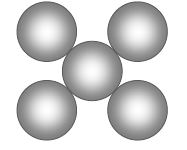
a. Face plane is fcc
b. Body diagonal plane in fcc
c. Face plane in bcc
d. Body diagonal plane in bcc
Answer : A, D
Question. Graphite is:
a. A good conductor
b. sp2 hybridized
c. An amorphous solid
d. A covalent crystal
Answer : A, B, D
Question. Which of the following exhibit Frenkel defects?
a. AgBr
b. AgCl
c. KBr
d. ZnS
Answer : A, B, D
Assertion and Reason
Note: Read the Assertion (A) and Reason (R) carefully to mark the correct option out of the options given below:
a. If both assertion and reason are true and the reason is the correct explanation of the assertion.
b. If both assertion and reason are true but reason is not the correct explanation of the assertion.
c. If assertion is true but reason is false.
d. If the assertion and reason both are false.
e. If assertion is false but reason is true.
Question. Assertion: The void space per unit cell is a minimum in the hcp and ccp structures.
Reason: The closest packing of identical spheres is observed in ccp and hcp structures.
Answer : A
Question. Assertion: Zinc blende and wurtzite both have fcc arrangement of S2– ions.
Reason: A unit cell of both has four formula units of ZnS.
Answer : E
Question. Assertion: In close packing of spheres, a tetrahedral void is surrounded by four spheres whereas octahedral void is surrounded by six spheres.
Reason: A tetrahedral void has a tetrahedral shape whereas octahedral void has an octahedral shape.
Answer : C
Question. Assertion: Triclinic system is the most unsymmetrical system.
Reason: No axial angle is equal to 90° in triclinic system.
Answer : B
Question. Assertion: Compounds of the type AII BIV O3 have pervoskite structure in which tetravalent cation (BIV) occupies the centre of cub.
Reason: BIV is most stable at the centre of cube as it is surrounded by six oxide ion.
Answer : A
Question. Assertion: Group-15-doped crystals of Si are called ntype semi conductors.
Reason: Neutrons are responsible for the semiconducting properties.
Answer : C
Question. Assertion: Non-stoichiometric comounds are called Bertholide compounds. NaCl and KCl crystal, when heated in an atmosphere of Na and K vapours, respectively, they impart violet and yellow colours to NaCl and KCl, respectively.
Reason: Metal excess defect is due to the presence of extra cations at the interstitial sites. The excess metal ions move to the interstitial sites and the electrons to the neighbouring sites. The colour results by the excitation of these electrons by absorbing suitable energy from visible light. When the excited electron comes back to the ground state, there is emission of radiation in the visible region and gives complimentary colour.
Answer : D
Question. Assertion: The side length of a cubic unit cell is related to the molar volume of an ionic crystal.
Reason: The radius ratio, r+/r- for ionic crystals provides a useful guide for the coordination number of cations and anions.
Answer : B
Question. Assertion: In sodium chloride crystal, Na+ions occupy OVs while Cl– ions occupy vertices of octahedron.
Reason: The radius ratio of Na+ : Cl– lies between 0.4 and 0.7
Answer : D
Question. Assertion: Glass is isotropic
Reason: Glass is supercooled liquid.
Answer : A
Comprehension Based
Paragraph - I
Potassium crystallizes in a body-centred cubic lattie with edge length a = 5.2Å
Question. What is the distance between nearest neighbours is:
a. 4.5Å
b. 5.2Å
c. 3.2Å
d. 6.4Å
Answer : A
Question. How many next-nearest neighbours does each K atom have?
a. 2
b. 4
c. 6
d. 8
Answer : C
Question. How many nearest neighbours does eack K atom have?
a. 2
b. 4
c. 6
d. 8
Answer : D
Question. The density of crystalline potassium is:
a. 0.121 gm/cc
b. 0.521 gm/cc
c. 1.921 gm/cc
d. 0.921 gm/cc
Answer : D
Question. What is the distance between next-nearest neighbours?
a. 4.5Å
b. 5.2Å
c. 3.2Å
d. 6.4Å
Answer : B
CBSE Class 12 Chemistry The Solid State Worksheet Set B
Very Short Answer
Q1) What is coordination number?
Q2) What are Bravais lattices?
Q3) What is packing efficiency?
Q4) What is Bohr magneton?
Q5) What is intrinsic semiconductor?
Short Answer
Q6) Distinguish between tetrahedral voids and octahedral voids?
Q7) What are the characteristics of a crystal lattice?
Q8) How face-cantered unit cells are different from end-centred unit cells?
Q9) Why solids have the closed packed structure?
Q10) Distinguish between point defects and line defects?
Long Answer
Q11) State the difference between Frenkel defects and Schottky defects?
Q12) Explain the magnetic properties?
Q13) Explain the types of cubic unit cells?
Q14) Explain the non-stoichiometric defects?
Q15) Explain the three steps of three dimensional structures of the closed packed structures?
Free study material for Chemistry
Download CBSE Practice Material: Class 12 Chemistry Unit 1 The Solid State
Download Practice Sheet: Unit 1 The Solid State (Class 12 Chemistry)
Access structured practice worksheets for Unit 1 The Solid State designed in alignment with the latest CBSE curriculum for Class 12 Chemistry. These printable problem sets help students build accuracy and prepare effectively for school tests.
Concept Clarification for Unit 1 The Solid State
Built using the official NCERT book for Class 12 Chemistry, these practice materials provide reliable academic guidance. Pair your practice with our recommended NCERT solutions to master optimal problem-solving approaches.
Additional Study Resources for Class 12 Chemistry
Explore our broader library of printable assignments, chapter notes, and mock tests designed to support continuous revision and secure higher marks in CBSE assessments.
FAQs
You can download the teacher-verified PDF for CBSE Class 12 Chemistry The Solid State Worksheet Set 02 from StudiesToday.com. These practice sheets for Class 12 Chemistry are designed as per the latest CBSE academic session.
Yes, our CBSE Class 12 Chemistry The Solid State Worksheet Set 02 includes a variety of questions like Case-based studies, Assertion-Reasoning, and MCQs as per the 50% competency-based weightage in the latest curriculum for Class 12.
Yes, we have provided detailed solutions for CBSE Class 12 Chemistry The Solid State Worksheet Set 02 to help Class 12 and follow the official CBSE marking scheme.
Daily practice with these Chemistry worksheets helps in identifying understanding gaps. It also improves question solving speed and ensures that Class 12 students get more marks in CBSE exams.
All our Class 12 Chemistry practice test papers and worksheets are available for free download in mobile-friendly PDF format. You can access CBSE Class 12 Chemistry The Solid State Worksheet Set 02 without any registration.