

Official Class 12 Chemistry Worksheets: Unit 1 The Solid State
Review targeted practice sets for Class 12 Chemistry Unit 1 The Solid State. Built according to official educational guidelines for the 2026-27 academic year, these downloadable worksheets support daily revision and core concept reinforcement.
Chapter-wise Practice Material: Unit 1 The Solid State
Access the complete worksheet PDF for Unit 1 The Solid State below. Regular practice with these targeted questions builds familiarity with standard exam patterns and helps secure higher marks in final Chemistry evaluations.
Comprehension Based
Paragraph–I
A gold single crystal has a cubic shape and the dimension of the cube is, a = 1.000cm. When irradiated with Cu Ka X-rays(λ =154.05pm) at the angle θ of 10.89° is gives a well-defined first-order diffraction pattern. The atomic weight of Au is MAu = 196.97g mol–1.
Question. How many gold mass are in the cube?
a. 5.904×10²²
b. 5.904×10²⁰
c. 5.904×10¹⁸
d. 5.904×10¹⁶
Answer : A
Question. What is the mass of the unit cell of gold?
a. 1.308x10⁻¹⁹
b. 1.308x10⁻²¹
c. 1.308x10⁻¹⁷
d. 1.308x10⁻¹⁵
Answer : B
Question. What is the density of gold?
a. 29.31g / cm3
b. 26.29g / cm3
c. 14.21g / cm3
d. 19.31g / cm3
Answer : D
Paragraph–II
A spinel is an important class of oxides consisting of two types of metal ions with the oxide ions arranged in ccp layers. The normal spinel has non-eight of the tetrahedral holes occupied by one type of metal ion and one-half of the octahedral holes occupied by another type of metal ion.
Question. Type of hole occupied by Al3+ ions is:
a. tetrahedral
b. octahedral
c. both a. and b.
d. none of these
Answer : B
Question. Type of hole occupied by Mg2+ ions is:
a. tetrahedral
b. octahedral
c. both (a) and (b)
d. none of thes
Answer : A
Match the Column
Question. Match the crystal system/unit cells listed in Column-I with their characteristics features in Column-II:
| Column I | Column II |
| (A) Simple cubic and face-centered cubic | 1. Have these cell parameters a=b=c and α = β = γ |
| (B) Cubic and rhombohedral | 2. Are two crystal systems |
| (C) Cubic and tetragonal | 3. Have only two crystal lographic angles of 90° |
| (D) Hexagomal and monoclinic | 4. Belong to same crysta system |
a. A→1,4; B→2; C→2; D→2,3
b. A→2; B→2; C→3,4; D→4
c. A→1; B→3,4; C→2,3; D→4
d. A→3; B→1,2; C→3,4; D→2
Answer : A
Question. Match the statement of Column I with those in Column II:
| Column I | Column II |
| (A) Cubic | 1. Have 2-fold axis of symmetry |
| (B) Orthorhombic | 2. Have all axial angles identical |
| (C) Tetragonal | 3. Have all edge lengths identical |
| (D) Rhombohedral | 4. More than one types of Bravias |
a. A→1,2,3,4; B→1,2,4; C→1,2,4; D→1,2,3
b. A→1,4; B→1,2; C→1,2,4; D→1,2,3
c. A→2,3,4; B→2,4; C→1,2,4; D→1,2,3
d. A→4; B→2,4; C→1,4; D→1,3
Answer : A
Question. Match the statement of Column I with those in Column II:
| Column I | Column II |
| (A) 74% occupancy of space | 1. Coordination no. of cat ion in fluorite structure |
| (B) Coordination no. 8 | 2. Cubic close packing |
| (C) Ca2+ion in CaF2 | 3. Hexagonal close packing |
| (D) Coordination no. –12 | 4. body centred cubic packing |
a. A→2; B→1,3; C→4; D→2,3
b. A→1,3; B→1,2; C→2; D→3
c. A→2,3; B→1,4; C→2; D→2,3
d. A→3,4; B→4; C→2,3; D→3
Answer : C
Question. Match the statement of Column I with those in Column II:
| Column I | Column II |
| (A) Layer structure | 1. Semiconductor |
| (B) Supercooled liquid | 2. ZnS |
| (C) Materials having the conductivity range 10–6–10–4Sm–1 | 3. Colours in alkyl halide |
| (D) Substances having Frenkel defects | 4. Graphite and CdI2 |
| (E) Substances having a fluorite structure | 5. Glass |
| (F) Creation of F-centres | 6. Coordination number 8 : 4 |
a. A→4; B→5; C→1; D→2; E→6; F→3
b. A→3; B→5; C→2; D→4; E→1; F→6
c. A→5; B→4; C→2; D→1; E→6; F→3
d. A→6; B→3; C→1; D→5; E→2; F→4
Answer : A
Integer
Question. The structure of diamond and silicon is same and can be described as atoms taking corners faces of a cube and also taking position of alternate tetrahedral voids. What is the
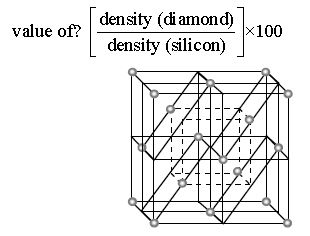
Answer : 145
Question. The crystal of a solid is square packing of identical spheres in each layer and spheres of one layer are placed just above the voids made by spheres in previous layer.
The packing efficiency of such crystal (in %) is:
[π = 3.15, √2 = 1.4]

Answer : 75
Question. AB crystallizes in a rock salt structure with A : B = 1 : 1. The shortest distance between A and B is Y1/3 nm. The formula mass of AB is 6.023 Y amu where Y is any arbitrary constant. The density in kg m–3 ?
Answer : 5
Question. If the radius of Mg2+ ion, Cs+ ion, O2–ion, S2– ion and Cl– ion are 0.65Å, 1.69Å, 1.40Å, 1.84Å and 1.81Å respectively.
Find the value of x + y − z where x,y,z=co-ordination numbers of the cations in the crystals of MgS, MgO and CsCl ?
Answer : 2
Question. The two ions A+ and B– have radii 88 and 200 pm respectively. In the closed packed crystal of compound AB, the co-ordination number of A+ is:
Answer : 6
Question. A compound AB crystallizes in rock salt structure. The ionic radius of A+ and B– are 60 pm and 100 pm respectively and if atomic masses of A and B are 200 and 120 respectively then calculate the value of x if density of the crystal = x/3.2 gm/cm3. Given 1 amu 1.6 x 10⁻²⁴ gm?
Answer : 200
Question. The average total number of ions in sphalerite structure per unit cell if there is a Shottky defects of (1) anion per unit cell:
Answer : 6
Question. A metal ‘M’ having atomic mass 31.25 crystallizes in cubic close packing and it shows “Schottky defects”. If the edge length of the cubic lattice is 500 pm and density of the metal is 1.6075 gm/ml then the number of moles of metal atom ‘M’ missing litre of the crystal. Given 1 amu 1.67 x 10⁻²⁴ gm
Answer : 2
Question. X-ray analysis of a Mn – Si alloy with 75 atomic percent of Mn showed that the unit cell is cubic and the lattice parameter, a = 2.86Å. The density of the alloy is 6.85 g/c.c. The total number of atoms in the unit cell is:
(Mutliply your answer by 10)
Answer : 5
Please click on below link to download CBSE Class 12 Chemistry Solid State Worksheet
Free study material for Chemistry
Download CBSE Practice Material: Class 12 Chemistry Unit 1 The Solid State
Chapter Practice Questions for Class 12 Chemistry
Explore reliable practice questions for Unit 1 The Solid State tailored for Class 12 Chemistry learners. Use these structured worksheets to evaluate preparedness and strengthen problem-solving skills.
Expert Practice Material for Class 12 Chemistry
Each worksheet is structured around standard CBSE textbooks, allowing students to check their working steps and correct mistakes early in their revision.
Complete Your Chapter Revision
Wrap up your chapter revision by testing your knowledge against standard question formats. Everything on our platform is provided free of charge.
FAQs
You can download the teacher-verified PDF for CBSE Class 12 Chemistry Solid State Worksheet from StudiesToday.com. These practice sheets for Class 12 Chemistry are designed as per the latest CBSE academic session.
Yes, our CBSE Class 12 Chemistry Solid State Worksheet includes a variety of questions like Case-based studies, Assertion-Reasoning, and MCQs as per the 50% competency-based weightage in the latest curriculum for Class 12.
Yes, we have provided detailed solutions for CBSE Class 12 Chemistry Solid State Worksheet to help Class 12 and follow the official CBSE marking scheme.
Daily practice with these Chemistry worksheets helps in identifying understanding gaps. It also improves question solving speed and ensures that Class 12 students get more marks in CBSE exams.
All our Class 12 Chemistry practice test papers and worksheets are available for free download in mobile-friendly PDF format. You can access CBSE Class 12 Chemistry Solid State Worksheet without any registration.