

Class 12 Chemistry Practice Set: Unit 10 Biomolecules
Explore reliable practice materials for Unit 10 Biomolecules tailored for Class 12 learners. Utilizing these Chemistry worksheets ensures thorough preparation and strengthens problem-solving speed for upcoming school assessments.
Download Unit 10 Biomolecules Worksheet PDF
Navigate directly to the printable exercises for Unit 10 Biomolecules using the digital viewer below. Each practice set allows students to isolate specific topics for thorough review and uninterrupted practice alongside standard textbooks.
Question. In the viscose process the solvent for cellulose consists of:
a. Ether
b. Copper sulphate
c. Sodium hydroxide
d. carbon disulphide
Answer : C, D
Question. In DNA, the complementary bases are:
a. Uracil and adenine
b. Adenine and thymine
c. guanine and cytosine
d. thymine and cytosine
Answer : B, C
Question. Which of the following compounds do not belong to lipids?
a. Fats
b. Amino acids
c. Phospholipids
d. Carbohydrates
Answer : B, D
Question. RNA is different from DNA because RNA contains:
a. thymine
b. Ribose sugar
c. Deoxyribose sugar
d. uracil
Answer : B, D
Question. Fat consists of:
a. Monohydroxy carboxylic acid
b. Monohydroxy aliphatic acid
c. saturated carboxylic acid
d. Dihydroxy aliphatic carboxylic acid
Answer : B, C
Question. Sucrose molecule is made up of:
a. A gluco pyranose
b. a fructo furanose
c. a fructo pyranose
d. A gluco furanose
Answer : A, B
Question. If an aqueous solution of glucoseis allowed to freeze than crystal of which will be separated out first?
a. Glucose
b. Water
c. Both of these
d. None of these
Answer : B
Question. Insulin is:
a. An amino acid
b. Protein
c. A carbohydrate
d. A lipid
Answer : B
Question. A nucleoside on hydrolysis gives:
a. an orthophosphoric acid
b. a homocyclic base
c. An aldopentose
d. a heterocyclic base
Answer : C, D
Question. Amino acids usually exist in the form of Zwitter ions.
This means that it consists of:
a. The basic group –NH2 and the acidic group–COOH
b. The basic group −NH3+ and the acidic group –CO2
c. The basic group −CO2− and the acidic group NH3+
d. No acidic or basic group
Answer : C
Question. Which of the following monosaccharide is a pentose?
a. Galactose
b. Glucose
c. Fructose
d. Arabinose
Answer : D
Question. For α−amino acids having the structure
R − CH − CO2H
|
NH2
Which of the following statements are true?
A. Water solubility is maximum at a pH when concentrations of anions and cations are equal
B. They give ninhydrin test
C. On reacting with nitrous acid give off N2
a. All
b. B
c. C
d. D
Answer : B, C
Question. The ‘iodine value’ of an oil indicates:
a. Its boiling point
b. Inflammability
c. Unsaturation present in acid contents
d. Solubility of salt in oils
Answer : C
Assertion and Reason
Note: Read the Assertion (A) and Reason (R) carefully to mark the correct option out of the options given below:
a. If both assertion and reason are true and the reason is the correct explanation of the assertion.
b. If both assertion and reason are true but reason is not the correct explanation of the assertion.
c. If assertion is true but reason is false.
d. If the assertion and reason both are false.
e. If assertion is false but reason is true.
Question. Assertion: Hydrolysis of sucrose is known as inversion of cane sugar.
Reason: Sucrose is a disaccharide.
Answer : B
Question. Assertion: Sucrose is a non-reducing sugar.
Reason: It has glycosidic linkage.
Answer : A
Question. Assertion: Glycosides are hydrolyzed in acidic conditions.
Reason: Glycosides are acetals.
Answer : D
Question. Assertion: Valine is an essential amino acid.
Reason: The lack of essential amino acids in the diet causes Kwashiorkor.
Answer : B
Question. Assertion: Sucrose is a disaccharide.
Reason: Sucrose is dextro rotatory.
Answer : B
Question. Assertion: DNA molecules and RNA molecules are found in the nucleus of a cell.
Reason: On heating the enzyme do not lose their specific activity.
Answer : D
Question. Assertion: α-amino acids exist as dipolar ions or zwitter ions.
Reason: α-amino acids are the building blocks of proteins
Answer : B
Question. Assertion: Activity of an enzyme is pH-dependent.
Reason: Change in pH affects the solubility of the enzyme in water.
Answer : B
Question. Assertion: The specific rotation of a freshly prepared solution of α-glucose decreases from +112º to +52.7º while that of β glucose increase from +19º to +57.7º.
Reason: The change in specific rotation of an optically active compound with time to an equilibrium value is called mutarotation.
Answer : B
Question. Assertion: ATP molecules are energy rich molecules.
Reason: ATP consists of a purine base adenine, pentose sugar ribose and a string of three phosphate groups.
Answer : B
Comprehension Based
Paragraph-I
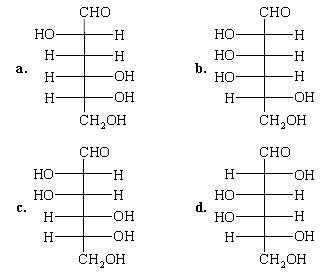
There are three aldohexoses, A, B and C. Compounds A and B yield the same optically active alditol when they are reduced with hydrogen and catalyst; A and B yield different phenylosazones when treated with phenyl hydrazine; B and C gives the same phenylosazone but different alditols. A, B and C, all are D sugars.
Question. The aldohexose ‘A’ is –?
Answer : A
Question. The aldohexose ‘B’ is –?

Answer : B
Question. The aldohexose ‘C’ is –?

Answer : D
Paragraph – II
An ordinary D(+) glucose has melting point 146ºC and specific rotation, [α]25D = +112°. One another form of D(+) glucose has melting point 150ºC and specific rotation [α]25D] = +18.7°. The two forms have significantly different optical rotations but when on aqueous solution of either form is allowed to stand, its rotation changes. The specific rotation of one form decreases and rotation of other increases. This change in rotation towards an equilibrium value is called mutarotation.


Question. Mutarotation is a characteristic feature of:
a. epimers
b. enantiomers
c. anomers
d. ring-chain isomers
Answer : C
Question. Two significant forms which exhibit mutarotation are assigned α and β − forms. For mannose, the mutarotation can be shown is brief as follows

Which form of mannose exists predominantly in aqueous form?
a. α- form
b. β- form
c. open chain form
d. none of these
Answer : A
Question. What percentage of β−D(+) glucopyranose is found at equilibrium in the aqueous solution?
a. 50%
b. ≈ 100%
c. 36%
d. 64% Passage
Answer : D
Match the Column
Question. Match the following:
| Column I (Pair of Molecules) |
Column II (Characteristics) |
| (A) Glucose – Fructose | 1. Anomers |
| (B) Fructose – Mannose | 2. Diastereomers |
| (C) Glucose – Mannose | 3. Functional isomers |
| (D) α-DGlucopyranose -β-Dglucopyranose |
4. Lobry-De-Bruyn Alberada Van Ekenstein transformation |
a. A→1, 5; B→3, 4; C→2, 4; D→1, 2
b. A→3, 2; B→3, 5; C→2, 4; D→1, 2
c. A→3, 5; B→3, 4; C→2, 4; D→1, 2
d. A→3, 5; B→3, 4; C→5, 4; D→1, 2
Answer : C
Question. Match the following:
| Column I (Molecules) |
Column II (Characteristics) |
| (A) CH3.CH(OH).CHO | 1. Carbohydrate |
| (B) HOCH2–CH(OH)CHO | 2. Amino acid |
| (C) CH3CH(NH2)COOH | 3. Positive Tollen’s test |
| (D) PhCH(CH2NH2)COOH | 4. Ninhydrin test |
a. A→2; B→1, 3; C→2, 4; D→3
b. A→3; B→1, 3; C→2, 4; D→2
c. A→3; B→1, 3; C→2, 3; D→4
d. A→4; B→2, 3; C→1, 4; D→1
Answer : B
Question. Match the following:
| Column I | Column II |
| (A) Starch | 1. Natural polymer |
| (B) Nylon-6 | 2. Synthetic polymer |
| (C) Peptide Bond | 3. Amide linkage |
| (D) Maltose | 4. Glycoside linkage |
| 5. Oligosaccharide |
a. A→2, 3; B→1, 3; C→4, D→1, 5
b. A→1, 5; B→2, 4; C→2, D→4, 5
c. A→1, 4; B→1, 3; C→5, D→3, 5
d. A→1, 4; B→2, 3; C→3, D→4, 5
Answer : D
Question. Match the Column-I with Column II:
| Column I | Column II |
| (A) Fructose | 1. Protein |
| (B) Zwitterion | 2. Inversion |
| (C) Peptide linkage | 3. α-mino acid |
| (D) Hydrolysis of cane sugar | 4. Carbohydroate |
| 5. Ketose |
a. A→1, 3; B→5; C→1, 4 D→2, 4
b. A→1, 5; B→3, 5; C→1, 2; D→2, 4
c. A→4, 5; B→3; C→1, D→2, 4
d. A→4, 5; B→3, 5; C→1, 4; D-2, 4
Answer : C
Integer
Question. Maltose contains how many oxygen atoms?
Answer : 11
Question. A nanopeptide contains …….. peptide linkages:
Answer : 8
Question. A compound of mol. wt. 180 is acetylated to give a compound of mol. wt. 390. The number of amino groups in the initial compound is?
Answer : 5
Question. pH in stomach is approximately:
Answer : 2
Question. The number of essential amino acids in man is:
Answer : 10
Question. In fructose, the possible optical isomers are:
Answer : 8
Question. Oxidation of glucose is one of the most important reactions in a living cell. What is the number of ATP molecules generated in cells from one molecule of glucose?
Answer : 38
Please click on below link to download CBSE Class 12 Chemistry Biomolecules Worksheet Set A
Free study material for Chemistry
Unit 10 Biomolecules Practice Sheet and Solutions for Class 12 Chemistry
CBSE Practice Material: Class 12 Chemistry Unit 10 Biomolecules
Explore reliable practice questions for Unit 10 Biomolecules tailored for Class 12 Chemistry learners. Use these structured worksheets to evaluate preparedness and strengthen problem-solving skills.
NCERT-Aligned Questions and Solutions
Cross-reference your completed exercises with comprehensive NCERT solutions for Class 12 Chemistry to ensure absolute clarity across all sub-topics in this chapter.
Next Steps in Your Exam Preparation
Follow up your worksheet practice by attempting the interactive online Chemistry MCQ test for this chapter to evaluate your execution speed. All platform resources are free to access.
FAQs
You can download the teacher-verified PDF for CBSE Class 12 Chemistry Biomolecules Worksheet Set 03 from StudiesToday.com. These practice sheets for Class 12 Chemistry are designed as per the latest CBSE academic session.
Yes, our CBSE Class 12 Chemistry Biomolecules Worksheet Set 03 includes a variety of questions like Case-based studies, Assertion-Reasoning, and MCQs as per the 50% competency-based weightage in the latest curriculum for Class 12.
Yes, we have provided detailed solutions for CBSE Class 12 Chemistry Biomolecules Worksheet Set 03 to help Class 12 and follow the official CBSE marking scheme.
Daily practice with these Chemistry worksheets helps in identifying understanding gaps. It also improves question solving speed and ensures that Class 12 students get more marks in CBSE exams.
All our Class 12 Chemistry practice test papers and worksheets are available for free download in mobile-friendly PDF format. You can access CBSE Class 12 Chemistry Biomolecules Worksheet Set 03 without any registration.