

Download Class 12 Chemistry Worksheets for Unit 5 Surface Chemistry
Explore reliable practice materials for Unit 5 Surface Chemistry tailored for Class 12 learners. Utilizing these Chemistry worksheets ensures thorough preparation and strengthens problem-solving speed for upcoming school assessments.
Access Unit 5 Surface Chemistry Questions and Exercises
Navigate directly to the printable exercises for Unit 5 Surface Chemistry using the digital viewer below. Each practice set allows students to isolate specific topics for thorough review and uninterrupted practice alongside standard textbooks.
Question. At the critical micelle concentration, the surfactant molecules:
a. Decompose
b. Dissociate
c. Associate
d. Become completely soluble
Answer : C
Question. Sky looks blue due to:
a. Dispersion effect
b. Reflection
c. Transmission
d. Scattering
Answer : D
Question. Which of the following electrolytes is least effective in causing flocculation of ferric hydroxide sol?
a. K4[Fe(CN)6]
b. K2CrO4
c. KBr
d. K2SO4
Answer : C
Question. Which of the following is true about catalyst?
a. It initiates reaction
b. It changes equilibrium point
c. It increase average kinetic energy
d. It accelerates the rate of reaction
Answer : D
Question. Which of the following substances gives a positively charged sol?
a. Gold
b. A metal sulphite
c. Ferric hydroxide
d. An acidic dye
Answer : C
Question. Which of the following electrolytes have maximum coagulating power?
a. CCl4
b. ZnCl2
c. KCl
d. NaCl
Answer : B
Question. The decomposition of H2O2 can be slowed down by the addition of small amount of phosphoric acid which act as:
a. Promoter
b. Inhibitor
c. Detainer
d. Stopper
Answer : B
Question. A liquid aerosol is a colloidal system of:
a. A liquid dispersed in a solid
b. A liquid dispersed in a gas
c. A gas dispersed in a liquid
d. A solid dispersed in a gas
Answer : B
Question. If the dispersed phase is a liquid and the dispersion medium is a solid, the colloid is known as:
a. A sol
b. An emulsion
c. A gel
d. A foam
Answer : C
Question. On addition of one ml solution of 10% NaCl to 10 ml gold sol in the presence of 0.25 gm of starch, the coagulation is just prevented. Starch has the following gold number:
a. 0.025
b. 0.25
c. 0.5
d. 250
Answer : D
Question. Ferric hydroxide sol is positively charged colloid. The coagulating power of NO3− ,SO42− and PO43− ions would be in the order:
a. NO3− > SO42− > PO43−
b. SO42− > NO3− > PO43−
c. PO43− > SO42− > NO3−
d. NO3− = SO43− = PO43−
Answer : C
Question. The stability of lyophilic colloids is due to:
a. Charge on their particles
b. A layer of dispersion medium on their particles
c. The smaller size of their particles
d. The large size of their particles
Answer : B
Question. Size of colloidal particles varies from:
a. 10−7 to 10−9
b. 10−9 to 10−17
c. 10−5 to 10−7
d. 10−4 to 10−10
Answer : A
Question. When a substance comes in colloidal state the surface area of the particles?
a. Increases
b. Decreases
c. Remains unchanged
d. First increases then decreases
Answer : A
Question. Which of the following molecules is most suitable to disperse benzene in water?
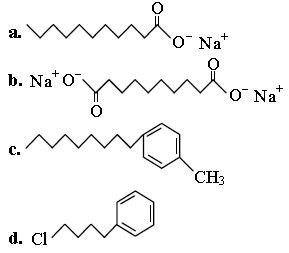
Answer : C
Question. As2S3 sol has a negative charge. Capacity to precipitate it is highest in:
a. AlCl3
b. Na3PO4
c. CaCl2
d. K2SO4
Answer : A
Question. When dispersed phase is liquid and dispersion medium is gas, then the colloidal system is called?
a. Smoke
b. Clouds
c. Emulsion
d. Jellies
Answer : B
Question. Milk can be preserved by adding a few drops of:
a. Formic acid solution
b. Formaldehyde solution
c. Acetic acid solution
d. Acetaldehyde solution
Answer : B
Question. A coagulating agent frequently added to water to remove the suspended and colloidal impurities is:
a. Mohr salt
b. Alum
c. Bleaching powder
d. Copper sulphate
Answer : B
Question. Size of colloidal particle is:
a. 1 to 10 Å
b. 20 to 50 Å
c. 10 to 1000 Å
d. 1 to 280 Å
Answer : C
Question. Pick out the correct statements:
a. Gold sold does not act as a protective colloid
b. In a reaction that follows first order kinetics the fraction reacted is given by (1− e−kt ) where ‘k’ is the rate constant
c. The temperature above which micellization takes place is known as reduced temperature
d. Hydrolysis of an ester by an alkali follows second order kinetics
Answer : A, B, D
Question. For coagulating As2S3 colloidal sol, which of the following will have the lowest coagulation value?
a. NaCl
b. KCl
c. BaCl2
d. AlCl3
Answer : D
Question. If some gelatin is mixed in colloidal solution of gold, then it does:
a. Coagulation of gold
b. Peptization of gold
c. Protection of gold sol
d. Protection of gelatin
Answer : C
Question. “Delta” at the rivers are formed due to:
a. Peptization
b. Coagulation
c. Hydrolysis
d. Precipitation
Answer : B
Question. Which of the following are correct statements?
a. Spontaneous adsorption of gases on solid surface is an exothermic process as entropy decreases during adsorption
b. Formation of micelles takes place when temperature is below Kraft temperature (Tk) and concentration is above critical micelle concentration (CMC)
c. A colloid of Fe (OH)3 is prepared by adding NaOH in FeCl3 solution, the particles of this sol will move towards cathode during electrophoresis
d. According to Hardy-Schulze rule the coagulation (flocculating) value of Fe3+ ion will be more than Ba2+ or Na+
Answer : A, C
Question. Which of the following statement(s) is true?
a. Lyphobic sol shows greater light scattering effect than lyophilic sol
b. the stability of lyophobic sol is due to presence of charge on sol particles
c. A catalyst increases the value of rate constant
d. The absolute entropy of an element is zero at 25°Cand 1 atm pressure
Answer : A, B, C
Question. Tyndall effect is shown by:
a. Sol
b. Solution
c. Plasma
d. Precipitation
Answer : A
Question. Which of the following colloids are formed when hydrogen sulphide gas is passed through a cold solution of arsenious oxide?
a. As2S3
b. As2O3
c. As2S
d. As2H2
Answer : A
Question. Maximum coagulation power is in:
a. Na+
b. Ba++
c. Al+++
d. Sn++++
Answer : D
Question. Which one is an example of gel
a. Soap
b. Cheese
c. Milk
d. Fog
Answer : B
Question. Identify correct statement among the following:
a. Gold and As2S3 sols are multi-molecular colloids
b. This graph is for Van der Waal’s adsorption as explained by freundlich
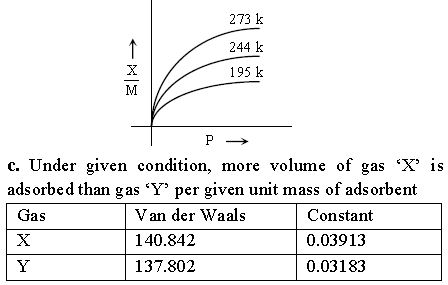
d. Coagulation of gold sol is effective with Al3+ than with Mg2+
Answer : B, C
Match the Column
Question. Match the statement of Column with those in Column II:
| Column I | Column II |
| (A) Gold number | 1. Solvent heating |
| (B) Lyophobic | 2. Coagulation |
| (C) Butter | 3. Protective colloids |
| (D) Hardy Schulze rule | 4. Solvent |
| (E) Micelles | 5. Associated colloids |
| 6. An emulsion |
a. A→ 3; B→ 4; C→ 6; D→ 2; E→ 5
b. A→ 2; B→ 4; C→ 3; D→ 5; E→ 1
c. A→ 1; B→ 3; C→ 6; D→ 4; E→ 2
d. A→ 4; B→ 1; C→ 3; D→ 2; E→ 5
Answer : A
Question. Match the statement of Column with those in Column II:
| Column I | Column II |
| (A) Purple of cassius | 1. Gel |
| (B) Cheese | 2. Gold sol |
| (C) Dialysis | 3. Robert Brown |
| (D) Brownian movement | 4. Hydrophilic |
| (E) Water-loving colloids | 5. Purification of colloidal solutions |
a. A→ 3; B→ 1; C→ 4; D→ 2; E→ 5
b. A→ 2; B→ 5; C→ 3; D→ 1; E→ 4
c. A→ 2; B→ 1; C→ 5; D→ 3; E→ 4
d. A→ 4; B→ 1; C→ 3; D→ 5; E→ 2
Answer : C
Question. Match the statement of Column with those in Column II:
| Column I | Column II |
| (A) Physisorption | 1. Multimolecular |
| (B) Chemisorption | 2. High heat of activation |
| (C) Activated adsorption | 3. High temperature required |
| (D) Desorption | 4. Low pressure required |
| (E) Electro-osmosis | 5. Determination of charge on colloidal particles |
a. A→ 1; B→ 2,3; C→ 2,3; D→ 4; E→ 5
b. A→ 2,3; B→ 4; C→ 3; D→ 1; E→ 5
c. A→ 1; B→ 3; C→ 2,3; D→ 5; E→ 4
d. A→ 4; B→ 5; C→ 3; D→ 2,3; E→ 1
Answer : A
CBSE Class 12 Chemistry Surface Chemistry Worksheet Set C
Very Short Answer
Q1) Define surface chemistry?
Q2) What is desorption?
Q3) What are the types of adsorption?
Q4) Who gave the adsorption isotherm?
Q5) Which type of adsorption involves high energy activation?
Short Answer
Q6) What do you mean by adsorption isotherm?
Q7) How adsorbate is different from adsorbent?
Q8) What are the important points for adsorption in action?
Q9) What do you mean by mechanism of adsorption?
Q10) What are the observations have been made in the case of adsorption from solution phase?
Long Answer
Q11) State the difference between chemisorption and physisorption?
Q12) What are the characteristics of physisorption?
Q13) State the difference between adsorption and desorption?
Q14) What are the characteristics of the chemisorption?
Q15) State the difference between adsorption and absorption?
Please click on below link to download CBSE Class 12 Chemistry Surface Chemistry Worksheet Set C
Free study material for Chemistry
Download CBSE Practice Material: Class 12 Chemistry Unit 5 Surface Chemistry
CBSE Practice Material: Class 12 Chemistry Unit 5 Surface Chemistry
Review targeted practice exercises for Class 12 Chemistry Unit 5 Surface Chemistry. Curated to match official CBSE guidelines, these downloadable PDF sheets support daily revision and core concept reinforcement.
NCERT-Aligned Questions and Solutions
Cross-reference your completed exercises with comprehensive NCERT solutions for Class 12 Chemistry to ensure absolute clarity across all sub-topics in this chapter.
Next Steps in Your Exam Preparation
Explore our broader library of printable assignments, chapter notes, and mock tests designed to support continuous revision and secure higher marks in CBSE assessments.
FAQs
You can download the teacher-verified PDF for CBSE Class 12 Chemistry Surface Chemistry Worksheet Set 03 from StudiesToday.com. These practice sheets for Class 12 Chemistry are designed as per the latest CBSE academic session.
Yes, our CBSE Class 12 Chemistry Surface Chemistry Worksheet Set 03 includes a variety of questions like Case-based studies, Assertion-Reasoning, and MCQs as per the 50% competency-based weightage in the latest curriculum for Class 12.
Yes, we have provided detailed solutions for CBSE Class 12 Chemistry Surface Chemistry Worksheet Set 03 to help Class 12 and follow the official CBSE marking scheme.
Daily practice with these Chemistry worksheets helps in identifying understanding gaps. It also improves question solving speed and ensures that Class 12 students get more marks in CBSE exams.
All our Class 12 Chemistry practice test papers and worksheets are available for free download in mobile-friendly PDF format. You can access CBSE Class 12 Chemistry Surface Chemistry Worksheet Set 03 without any registration.