

Practice Worksheets for Class 12 Chemistry: Unit 7 Alcohols, Phenols and Ethers
Explore reliable practice materials for Unit 7 Alcohols, Phenols and Ethers tailored for Class 12 learners. Utilizing these Chemistry worksheets ensures thorough preparation and strengthens problem-solving speed for upcoming school assessments.
Practice Unit 7 Alcohols, Phenols and Ethers Worksheets for Class 12 Chemistry
Navigate directly to the printable exercises for Unit 7 Alcohols, Phenols and Ethers using the digital viewer below. Each practice set allows students to isolate specific topics for thorough review and uninterrupted practice alongside standard textbooks.
Assertion and Reason
Note: Read the Assertion (A) and Reason (R) carefully to mark the correct option out of the options given below:
a. If both assertion and reason are true and the reason is the correct explanation of the assertion.
b. If both assertion and reason are true but reason is not the correct explanation of the assertion.
c. If assertion is true but reason is false.
d. If the assertion and reason both are false.
e. If assertion is false but reason is true.
Question. Assertion: Lucas reagent is a mixture of anhydrous ZnCl2 and concentrate HCl.
Reason: Primary alcohol produce ppt. with Lucas reagents.
Answer : C
Question. Assertion: Resorcinol turns FeCl2 solution purple.
Reason: Resorcinol have phenolic group.
Answer : A
Question. Assertion: Phenol is more reactive than benzene towards electrophilic substitution reaction.
Reason: In the case of phenol, the intermediate carbocation is more resonance stabilized.
Answer : A
Question. Assertion: The ease of dehydration of alcohols follows the order. Primary > Secondary > Tertiary.
Reason: Dehydration proceeds through the formation of oxonium ions.
Answer : C
Question. Assertion: The major products formed by heating C6H2CH2OCH3 with HI are C6H5CH, I and CH3OH.
Reason: Benzyl cation is more stable than methyl cation.
Answer : A
Question. Assertion: The pka of acetic acid is lower than that of phenol.
Reason: Phenoxide ion is more resonance stabilized.
Answer : C
Question. Assertion: Reimer-Tiemann reaction of phenol with CCl4 in
NaOH at 340 K gives salicylic acis as the major product.
Reason: The reaction occurs through intermediate formation of dichlorocarbene.
Answer : C
Question. Assertion: Acid catalysed dehydration of t-butanol is slower than n-butanol.
Reason: Dehydration involves formation of the protonated alcohol, ROH2+
Answer : C
Question. Assertion: Phenol undergo Kolbe reaction, ethanol does not.
Reason: Phenoxide ion is more basic than ethoxide ion.
Answer : C
Question. Assertion: Alcoholic fermentation involves conversion of sugar into ethyl alcohol by yeast.
Reason: Fermentation involves the slow decomposition of complex organic.
Answer : A
Question. Assertion: Tertiary alcohols give turbidity immediately with Lucas reagent.
Reason: A mixture of conc. HI + anhydrous ZnCl2 is called Lucas reagent.
Answer : C
Question. Assertion: Both symmetrical and unsymmetrical ethers can be prepared by Williamson’s synthesis.
Reason: Williamson’s synthesis is an example of nucleophilic substitution reaction.
Answer : B
Question. Assertion: Phenol reacts with acyl halides in presence of pyridine to form phenyl acetate.
Reason: Benzoylation of phenol is carried out in the presence of NH4OH.
Answer : C
Question. Assertion: Treatment of phenol with nitrous acid yields pbenzoquinone monoxime.
Reason: p-nitrosophenol and p-benzoquinone monoxime are tautomers.
Answer : B
Question. Assertion: (CH3)3 − Br and CH3CH2 ONa react to form (CH3)3 C −O−CH2CH3 .
Reason: Good yields of ethers are obtained when tertalkyl halides are treated with alkoxides.
Answer : D
Comprehension Based
Paragraph –I
The dehydration of alcohols and the conversion of alcohols to alkyl halides by treatment of hydrogen halides are similar in two important ways suggesting the formation of carbocation as key intermediate.
(a) Both reactions are protonated by acids.
(b) The reactivity of alcohols decrease in the order, tertiary > secondary>primary due to the formation of stable carbocations, which is stabilized by hyperconjugation and +I effect. The dehydration of alcohol follows three steps mechanism for acidbase catalysed dehydration of least stable tertiary butyl alcohol,

In step I, protonation (acid catalysed) of tert-butyl alcohol takes place. In step II, dissociation of tert-butyloxenium ion takes place followed by formation of carbocation. Alkene is formed in step III by deprotonation (base catalysed) of tert-butyl cation
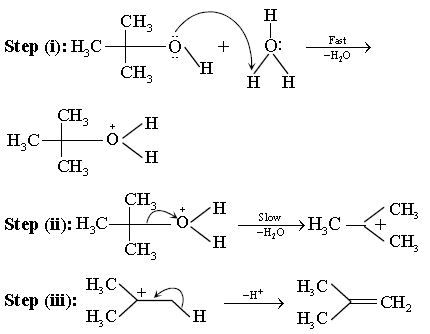
Another important reaction of alcohols is iodoform reaction given by ethanol (in primary alcohols) and are secondary alcohols having 2-ol nature. Such alcohols give yellow ppt. of CHI3 with NaOH and I2 solution.
Question. Why dehydration of vinyl alcohol is not difficult?
a. Due to high enthalpy of vinylic —C—OH bond
b. Due to unstable nature of = C—OH bond by tautomerism
c. Carbocation never forms in case of vinyl alcohol
d. Both (a) and (b) are correct
Answer : D
Question. Which carbocation will not form an intermediate?
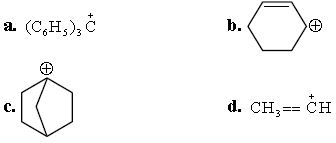
Answer : C
Question. Which will give iodoform test?
a. 2-methylpropan-2-ol
b. Ethyl acetoacetate
c. 2-methylbutan-2-ol
d. 3-methylpentant-2-ol
Answer : D
Question. The reagent used to distinguish 1-cycloethanol and 2-cycloethanol is:
a. soda lime
b. NaOH + H2O
c. acidified KMnO4
d. (aq.)FeCl3
Answer : B
Question. An alcohol on iodoform reaction give iodoform and sodium salt of unsaturated acid containing 3 carbon atoms. The alcohol is:
a. but-3-en-2-ol
b. prop-2-en-2-ol
c. pent-3-en-2-ol
d. 3-methyl-but-3-en-2-ol
Answer : A
Match the Column
Question. Match the column
| Column I | Column II |
| (A) Absolute alcohol | 1. Isopropyl alcohol |
| (B) Denaturated spirit | 2. Anhydrous alcohol |
| (C) 80º proof alcoholic liquor | 3. 20% absolute alcohol + 80% gasoline |
| (D) Power alcohol | 4. alcoholic liquors containing 40% ethanol |
| (E) Power alcohol | 5. Ethanol containing CH3 OH and pyridine. |
a.A→1; B→2; C→3; D→4; E→5
b. A→2; B→5; C→4; D→1; E→3
c. A→3; B→2; C→1; D→5; E→4
d. A→2; B→1; C→4; D→3; E→5
Answer : B
Question. Match the column.
| Column I | Column II |
| A) Wood spirit | 1. Trinitroglycerine and dinitroglycerine |
| (B) Fermentation | 2. Methyl alcohol |
| (C) Glycerine | 3. ethyl alcohol |
| (D) Lucas test | 4. Propane-1, 2, 3-triol |
| (E) Dynamite | 5. Tertiary alcohol |
a.A→1; B→2; C→3; D→5; E→4
b. A→4; B→3; C→2; D→1; E→5
c. A→3; B→2; C→1; D→4; E→5
d. A→2; B→3; C→4; D→5; E→1
Answer : D
Question. Match the column.
| Column I | Column II |
| (A) Etherates | 1. Estimation of methoxy or ethoxy groups |
| (B) Williamson’s synthesis | 2. Ether + BF3 |
| (C) Zeisel method | 3. Ether + mineral acid |
| (D) Oxonium salts | 4. RX + R′ONa |
| (E) Phenetol | 5. C6H2OH + (C2H5) SO4presence of NaOH |
a.A→1; B→2; C→3; D→4; E→5
b. A→4; B→3; C→5; D→1; E→2
c. A→2; B→4; C→1; D→3; E→5
d. A→2; B→1; C→4; D→3; E→5
Answer : C
Integer
Question. The vapour density of C2H5OHis?
Answer : 23
Question. 10 gm of a mixture of hexane and ethanol reacts with sodium to give 200 ml. of H2 at 27°C and 760 mm pressure.
The percentage of ethanol is?
Answer : 10
Question. Number of metamers represented by molecular formula C4H10O is:
Answer : 3
Question. What amount of bromine will be required to convert 2 g of phenol into 2, 4, 6-tribromophenol?
Answer : 10.22
Question. One mole of phenol reacts with bromine to form tribromophenol. How much bromine is used?
Answer : 3
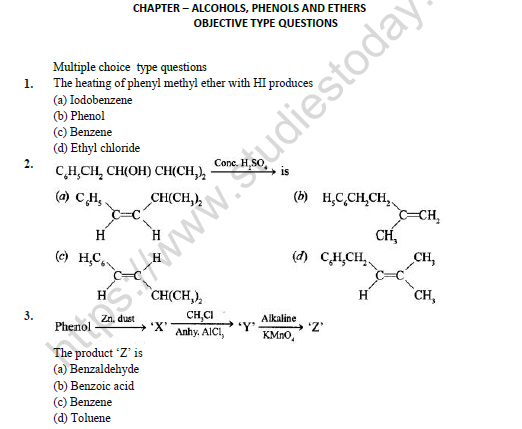
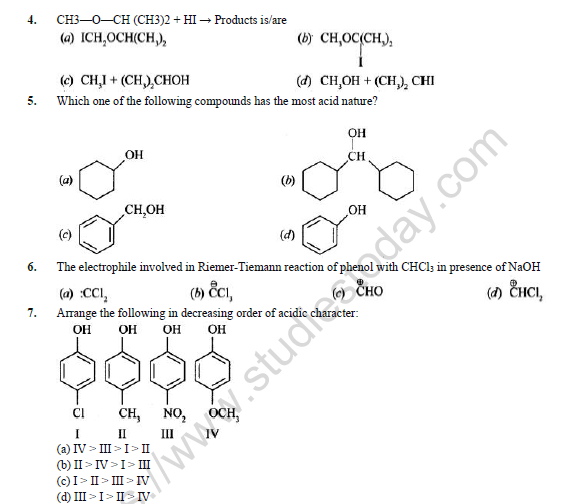

Please click on below link to download CBSE Class 12 Chemistry Alcohols Phenols And Ethers Worksheet Set C
Free study material for Chemistry
Download CBSE Practice Material: Class 12 Chemistry Unit 7 Alcohols, Phenols and Ethers
Download Practice Sheet: Unit 7 Alcohols, Phenols and Ethers (Class 12 Chemistry)
Explore reliable practice questions for Unit 7 Alcohols, Phenols and Ethers tailored for Class 12 Chemistry learners. Use these structured worksheets to evaluate preparedness and strengthen problem-solving skills.
Concept Clarification for Unit 7 Alcohols, Phenols and Ethers
Built using the official NCERT book for Class 12 Chemistry, these practice materials provide reliable academic guidance. Pair your practice with our recommended NCERT solutions to master optimal problem-solving approaches.
Additional Study Resources for Class 12 Chemistry
Follow up your worksheet practice by attempting the interactive online Chemistry MCQ test for this chapter to evaluate your execution speed. All platform resources are free to access.
FAQs
You can download the teacher-verified PDF for CBSE Class 12 Chemistry Alcohols Phenols And Ethers Worksheet Set 03 from StudiesToday.com. These practice sheets for Class 12 Chemistry are designed as per the latest CBSE academic session.
Yes, our CBSE Class 12 Chemistry Alcohols Phenols And Ethers Worksheet Set 03 includes a variety of questions like Case-based studies, Assertion-Reasoning, and MCQs as per the 50% competency-based weightage in the latest curriculum for Class 12.
Yes, we have provided detailed solutions for CBSE Class 12 Chemistry Alcohols Phenols And Ethers Worksheet Set 03 to help Class 12 and follow the official CBSE marking scheme.
Daily practice with these Chemistry worksheets helps in identifying understanding gaps. It also improves question solving speed and ensures that Class 12 students get more marks in CBSE exams.
All our Class 12 Chemistry practice test papers and worksheets are available for free download in mobile-friendly PDF format. You can access CBSE Class 12 Chemistry Alcohols Phenols And Ethers Worksheet Set 03 without any registration.