

Class 12 Chemistry Practice Set: Unit 3 Chemical Kinetics
Explore reliable practice materials for Unit 3 Chemical Kinetics tailored for Class 12 learners. Utilizing these Chemistry worksheets ensures thorough preparation and strengthens problem-solving speed for upcoming school assessments.
Download Unit 3 Chemical Kinetics Worksheet PDF
Navigate directly to the printable exercises for Unit 3 Chemical Kinetics using the digital viewer below. Each practice set allows students to isolate specific topics for thorough review and uninterrupted practice alongside standard textbooks.
Question. The unit of rate constant depends upon the
(A) molecularity of the reaction
(B) activation energy of the reaction
(C) order of the reaction
(D) temperature of the reaction
Answer : C
Question. Compounds ‘A’ and ‘B’ react according to the following chemical equation : A(g) + 2B(g) → 2C(g)
Concentration of either ‘A’ or ‘B’ were changed keeping the concentration of one of the reactants constant and rates were measured as function of initial concentration. Following results were obtained.
Choose the correct option for this reaction.

(A) Rate = k [A]2[B]
(b) Rate = k [A][B]2
(C) Rate = k [A][B]
(d) Rate = k [A]2[B]0
Answer : B
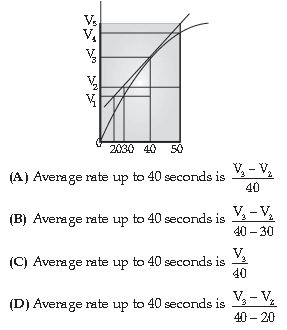
Question. A graph of volume of hydrogen released vs. time for the reaction between zinc and dilute HCl is given in figure. On the basis of the graph, mark the correct option.
Answer : C
Question. Which of the following statement is correct?
(A) The rate of a reaction decreases with passage of time as the concentration of reactants decreases.
(B) The rate of a reaction is same at any time during the reaction.
(C) The rate of a reaction is independent of temperature change.
(D) The rate of a reaction decreases with increase in concentration of reactant(s). U
Answer : A
Question. For a zero order reaction, the slope in the plot of [R] vs. time is:
(A) −K/2.303
(B) –k
(C) +K/2.303
(D) +k
Answer : B
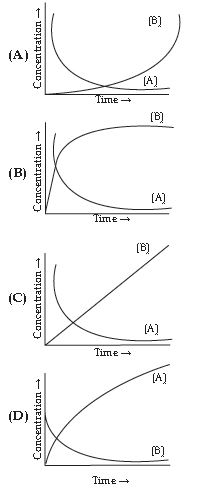
Question. Consider the reaction A ⇌ B. The concentration of both the reactants and the products varies exponentially with time. Which of the following figures correctly describes the change in concentration of reactants and products with time?
Answer : B
Question. In the presence of a catalyst, heat evolved or absorbed during reaction
(A) increases
(B) decreases
(C) remains unchanged
(D) may increase or decrease
Answer : C
Question. A first order reaction is 50% completed in 1.26 × 10¹⁴ s. How much time would it take for 100% completion ?
(A) 1.26 × 10¹⁵ s
(B) 2.52 × 10¹⁴ s
(C) 2.52 × 1028 s
(D) Infinite
Answer : D
Question. For the reaction A → B, the rate of reaction becomes three times when the concentration of A is increased by nine times. What is the order of reaction ?
(A) 1
(B) 2
(C) 1/2
(D) 0
Answer : C
Question. Rate law can be determined from balanced chemical equation if
(A) reverse reaction is involved.
(B) it is an elementary reaction.
(C) it is a sequence of elementary reactions.
(D) any of the reactants is in excess. R
Answer : B
Question. In a chemical reaction X → Y, it is found that the rate of reaction doubles when the concentration of X is increased four times. The order of the reaction with respect to X is:
(A) 1
(B) 0
(C) 2
(D) 1/2
Answer : D
Question. The half-life period for a zero order reaction is equal to: R
(A) 0.693/k
(B) 2k/[R]0
(C) 2.303/k
(D) [R]0/2k
Answer : D
Question. The value of rate constant of a pseudo-firstorder reaction:
(A) depends on the concentration of reactants present in small amount.
(B) depends on the concentration of reactants present in excess.
(C) is independent of the concentration of reactants. U
(D) depends only on temperature.
Answer : B
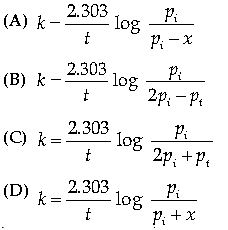
Question. Consider a first order gas phase decomposition reaction given below:
A(g) → B(g) + C(g)
The initial pressure of the system before decomposition of A was ‘pi’. After lapse of time ‘t’, total pressure of the system increased by x units and became ‘pt’. The rate constant k for the reaction is given as:
Answer : B
Question. The slope in the plot of ln[R] vs. time gives:
(A) +k
(B) +k/2.303
(C) –k
(D) −k/2.303
Answer : C
Assertion and Reason Based MCQs
Directions: In the following questions, a statement of Assertion (A) is followed by a statement of Reason (R).
Mark the correct choice as:
(A) Both (A) and (R) are true, and (R) is the correct explanation of (A).
(B) Both (A) and (R) are true, but (R) is not the correct explanation of (A).
(C) (A) is true, but (R) is false.
(D) (A) is false, but (R) is true.
Question. Assertion (A): Rate of reaction doubles when concentration of reactant is doubled if it is a first order reaction.
Reason (R): Rate constant also doubles with twice increase in the concentration of reactant.
Answer : C
Question. Assertion (A): For complex reactions molecularity and order are not same.
Reason (R): Order of reaction may be zero.
Answer : B
Question. Assertion (A): Order of the reaction can be zero or fractional.
Reason (R): We cannot determine order from balanced chemical equation.
Answer : B
Question. Assertion (A): Elementary reactions have same value of order and molecularity.
Reason (R): Molecularity is the number of molecules that participate in the reaction, while order is an experimental quantity.
Answer : B
Question. Assertion (A): Hydrolysis of an ester follows first order kinetics.
Reason (R): Concentration of water remains nearly constant during the course of the reaction.
Answer : A
Question. Assertion (A): The rate of reaction increases with the increase in temperature.
Reason (R): The reactant molecules collide less frequently on increasing temperature.
Answer : C
Question. Assertion (A): Dust particles suspended in the air inside grain elevators (unheated) can sometimes react explosively.
Reason (R): The dust particles have large surface area for the reaction.
Answer : B
Question. Assertion (A): For a first order reaction, half-life period is independent of initial concentration of the reacting species.
Reason (R): The half-life of a reaction is the time in which the reactant concentration is reduced to one half of its initial concentration.
Answer : B
Case-based MCQs
I. Read the passage given below and answer the following questions:
The rate of a reaction, which may also be called its velocity or speed, can be defined with relation to the concentration of any of the reacting substances, or to that of any product of the reaction. If the species chosen is a reactant which has a concentration c at time t the rate is - dc/dt, while the rate with reference to a product having a concentration x at time t is dx/dt. Any concentration units may be used for expressing the rate; thus, if moles per liter are employed for concentration and seconds for the time, the units for the rate are moles litre–1 sec–1. For gas reactions pressure units are sometimes used in place of concentrations, so that legitimate units for the rate would be (mm of Hg) sec–1 and atm. sec–1. The order of a reaction concerns the dependence of the rate upon the concentrations of reacting substances; thus, if the rate is found experimentally to be proportional to the αth power of the concentration of one of the reactants A, to the βth power of the concentration of a second reactant B, and so forth, via.,
rate = k CAα CAβ
the overall order of the reaction is simply
n = a + b
Such a reaction is said to be of the ath order with respect to the substance A, the bth order with respect to B. In the following questions, a statement of Assertion followed by a statement of Reason is given. Choose the correct answer out of the following choices on the basis of the above passage.
(A) Assertion and reason both are correct statements and reason is correct explanation for assertion.
(B) Assertion and reason both are correct statements but reason is not correct explanation for assertion.
(C) Assertion is correct statement but reason is wrong statement.
(D) Assertion is wrong statement but reason is correct statement.
Question. Assertion: Rate of reaction is a measure of change in concentration of reactant with respect to time.
Reason: Rate of reaction is a measure of change in concentration of product with respect to time.
Answer : B
Question. Assertion: For a chemical reaction, P + 2Q → Products, Rate = k [P]1/2[Q]1 so the order of reaction is 1.5
Reason: Order of reaction is the sum of stoichiometric coefficients of the reactants.
Answer : C
Question. Assertion: The unit of k is independent of order of reaction.
Reason: For zero order reaction, the unit of k is mol L–1s–1.
Answer : D
Question. Assertion: Reactions can occur at different speeds.
Reason: Rate of reaction is also called speed of reaction.
Answer : B
II. Read the passage given below and answer the following questions:
The rate of the reaction is proportional to the concentration of the reactant. Hydrogenation of ethene results in the formation of ethane. The rate constant, k for the reaction was found to be 2.5 × 10⁻¹⁵s–1. The concentration of the reactant reduces to one-third of the initial concentration in 5 minutes.
The following questions are multiple choice questions. Choose the most appropriate answer:
Question. Find the order of reaction.
(A) Zero order
(B) First order
(C) Second order
(D) Fractional order
Answer : B
Question. The rate law equation is:
(A) Rate = k [C2H6]
(B) Rate = k [C2H4]2
(C) Rate = k [C2H4]
(D) Rate = k [C2H4]2
Answer : C
Question. The half-life for the reaction is
(A) 2.772 × 10⁻²⁴ s
(B) 2.772 × 10⁻¹² s
(C) 1.386 × 10⁻²⁴ s
(D) 1.386 × 10⁻¹² s
Answer : A
Question. The rate constant of the reaction after 5 minutes is
(A) 0.4290 min–1
(B) 0.1297 min–1
(C) 0.2197 min–1
(D) 0.6591 min–1
Answer : C
OR
The slope of the curve in the reaction is
(A) k
(B) –k
(C) 2k
(D) –2k U
Answer : B
III. Read the passage given below and answer the following questions:
Concentration dependence of rate is called differential rate equation. Integrated differential equations give relation between directly measured experimental data i.e. concentration at different times and rate constant. The integrated rate equations are different for the reactions of different reaction orders. The first-order reaction has a rate constant 1.15 × 10⁻³s–1.
The following questions are multiple choice questions. Choose the most appropriate answer:
Question. How long will 5 g of this reactant take to reduce to 3 g?
(A) 222.189 s
(B) 444.379 s
(C) 111.095 s
(D) 888.789 s
Answer : B
Question. When the rate constant has same units as the rate of reaction, the order of the reaction is:
(A) Zero order
(B) First order
(C) Second order
(D) Fractional order
Answer : A
Question. Under which condition a bimolecular reaction is kinetically first order reaction?
(A) When two reactants are involved.
(B) When one of the reactants is in excess.
(C) When one of the reactants does not involve in reaction.
(D) None of these R
Answer : B
Question. For a reaction, A + H2O → B
Rate ∝ [A]
The order of the reaction is:
(A) Zero order
(B) Fractional order
(C) Pseudo first order
(D) Second order
Answer : C
CBSE Class 12 Chemistry Chemical Kinetics Worksheet Set A
Very Short Answer
Q1) What does thermodynamics tells?
Q2) What is chemical kinetics?
Q3) What is speed of reaction?
Q4) What is activated complex?
Q5) What is collision frequency?
Short Answer
Q6) What do you mean by instantaneous rate?
Q7) How can we express the rate of a chemical reaction?
Q8) What are the different properties for any chemical reaction chemists try to find out?
Q9) What do you understand by rate law?
Q10) Define rate expression and rate constant?
Long Answer
Q11) Difference between elementary reactions and non-elementary reaction?
Q12) Explain the factors influencing rate of a reaction?
Q13) Write short note on effects of catalyst?
Q14) Explain the factors of the integrated rate equations?
Q15) Explain the collision theory of chemical reactions?
Please click on below link to download CBSE Class 12 Chemistry Chemical Kinetics Worksheet Set A
Free study material for Chemistry
Exam Preparation Worksheet for Class 12 Chemistry Unit 3 Chemical Kinetics
Chapter Practice Questions for Class 12 Chemistry
Access structured practice worksheets for Unit 3 Chemical Kinetics designed in alignment with the latest CBSE curriculum for Class 12 Chemistry. These printable problem sets help students build accuracy and prepare effectively for school tests.
Expert Practice Material for Class 12 Chemistry
Built using the official NCERT book for Class 12 Chemistry, these practice materials provide reliable academic guidance. Pair your practice with our recommended NCERT solutions to master optimal problem-solving approaches.
Complete Your Chapter Revision
Wrap up your chapter revision by testing your knowledge against standard question formats. Everything on our platform is provided free of charge.
FAQs
You can download the teacher-verified PDF for CBSE Class 12 Chemistry Chemical Kinetics Worksheet Set 01 from StudiesToday.com. These practice sheets for Class 12 Chemistry are designed as per the latest CBSE academic session.
Yes, our CBSE Class 12 Chemistry Chemical Kinetics Worksheet Set 01 includes a variety of questions like Case-based studies, Assertion-Reasoning, and MCQs as per the 50% competency-based weightage in the latest curriculum for Class 12.
Yes, we have provided detailed solutions for CBSE Class 12 Chemistry Chemical Kinetics Worksheet Set 01 to help Class 12 and follow the official CBSE marking scheme.
Daily practice with these Chemistry worksheets helps in identifying understanding gaps. It also improves question solving speed and ensures that Class 12 students get more marks in CBSE exams.
All our Class 12 Chemistry practice test papers and worksheets are available for free download in mobile-friendly PDF format. You can access CBSE Class 12 Chemistry Chemical Kinetics Worksheet Set 01 without any registration.