

Class 12 Chemistry Practice Set: Unit 5 Surface Chemistry
Explore reliable practice materials for Unit 5 Surface Chemistry tailored for Class 12 learners. Utilizing these Chemistry worksheets ensures thorough preparation and strengthens problem-solving speed for upcoming school assessments.
Download Unit 5 Surface Chemistry Worksheet PDF
Navigate directly to the printable exercises for Unit 5 Surface Chemistry using the digital viewer below. Each practice set allows students to isolate specific topics for thorough review and uninterrupted practice alongside standard textbooks.
Question. Which is/are correct for metal sulphide sols?
a. The solution particles are positively charged due to preferential adsorption of metal ions
b. The solution particles are negatively charged due to preferential adsorption of sulphide ions
c. The cations of added electrolystes are effective in causing the coagulation of the solution
d. The solution is unstablilsed due to both electric charges and hydration of the particles
Answer :
Question. Which of the following is/are a property of hydrophilic sols?
a. High concentration of dispersed of phase can be easily attained
b. Coagulation is reversible
c. Viscosity and surface tension are nearly as that of water
d. The charge on the particles depends on the pH value of the medium; it may be positive, negative or ever zero
Answer :
Question. Which of the following catalyses the conversion of glucose into ethanol?
a. Zymase
b. Invertase
c. Maltase
d. Diastase
Answer : A
Question. The charge on As2S3 sol is due to the adsorbed:
a. H+
b. OH–
c. O2–
d. S2–
Answer : D
Question. Movement of colloidal particles under the influence of electrostatic field is:
a. Electrophoresis
b. Electrolysis
c. Dialysis
d. Ionisation
Answer : A
Question. Formation of ammonia from H2 and N2 by Haber's process using Fe is an example of:
a. Heterogeneous catalysis
b. Homogeneous catalysis
c. Enzyme catalysis
d. Non-catalytic process
Answer : A
Question. The capacity of an ion to coagulation a colloidal solution depends on:
a. its shape
b. the amount of its charge
c. the sign of the charge
d. its mass
Answer :
Question. The gold number of A, B C and D are 0.04, 0.002, 10 and 25 respectively. Protective power of A, B, C and D are in order:
a. A > B > C > D
b. B > A > C > D
c. D > C > B > A
d. C > A > B > D
Answer : A
Assertion and Reason
Note: Read the Assertion (A) and Reason (R) carefully to mark the correct option out of the options given below:
a. If both assertion and reason are true and the reason is the correct explanation of the assertion.
b. If both assertion and reason are true but reason is not the correct explanation of the assertion.
c. If assertion is true but reason is false.
d. If the assertion and reason both are false.
e. If assertion is false but reason is true.
Question. Assertion: The enthalpy of physisorption is greater than chemisorption.
Reason: Molecules of adsorbate and adsorbent are held by van der Waals forces in physisorption and by chemical bonds in chemisorption.
Answer : C
Question. Assertion: Deep electric shock causes death of an animal.
Reason: Electric shock coagulates the blood.
Answer : A
Question. Assertion: Sky appears blue colour.
Reason: Colloidal particles of dust scatter blue light.
Answer : A
Question. Assertion: An emulsion becomes stable if soap is added to it.
Reason: Soap contains hydrophilic and hydrophobic parts.
Answer : A
Question. Assertion: Physical adsoption of molecules takes place on surface only.
Reason: In this process, the bonds of the absorbed molecules are broken.
Answer : D
Question. Assertion: A catalyst is more effective in finely divided form.
Reason: Finely divided form has more surface area.
Answer : A
Question. Assertion: NH3absorb more readily over activated charcoal than CO2 .
Reason: NH3 is non-polar.
Answer : C
Question. Assertion: Lyophilic colloids are called as reversible sols.
Reason: Lyophilic sols are liquid loving.
Answer : B
Question. Assertion: Colloidal sols scatter light while true solutions do not.
Reason: The particles in the colloidal sol more much slower than that of the true solution.
Answer : B
Question. Assertion: The micelle formed by sodium stearate in water has −COO− groups at the surface.
Reason: Surface tension of water is reduced by the addition of stearate.
Answer : B
Comprehension Based
Paragraph –I
Adsorption is the tendency of accumulation of molecular species at the surface of solid or liquid. Depending upon the nature of bonds or forces of attraction between adsorbate and adsorbent it is classified between physisorption and chemisorptions.
Question. Which of the following statements are correct? (More than one correct)
a. Adsorption always leads to a decrease in enthalpy and entropy of the system
b. Adsorption arises due to unstauration in the enthalpy of valence forces of atoms or molecules on the surface
c. Adsorption increases with rise in temperature
d. Adsorption decreases the surface energy
Answer : ABD
Question. Which of the following gas molecules have maximum value of enthalpy of physisorption?
a. C2H6
b. Ne
c. H2
d. H2O
Answer : D
Question. Which of the following gases is adsorbed most by activated charcoal?
a. CO2
b. N2
c. Ar
d. C2H6
Answer : A
Question. Which of the following characteristics is not correct for physical adsorption?
a. Adsorption is spontaneous
b. ΔH and ΔS are negative
c. It is reversible in nature
d. Degree of adsorption increases with temperature
Answer : D
Paragraph –II
Substances which alter the velocity of a reaction by mere presence, without undergoing any change in mass and composition are termed catalysts and the phenomenon is known as catalysis.
Question. According to the adsorption theory of catalysis, the rate of reaction increases because:
a. Adsorption lowers the activation energy of the reaction
b. Concentration of reactant molecules at the active centers of the catalyst becomes high due to adsoption
c. Adsorption increases the activation energy of the reaction
d. Adsorption decreases the activation energy of the reaction
Answer : B
Question. In homogeneous catalytic reaction, there are three alternative paths A, B and C (shown in figure).
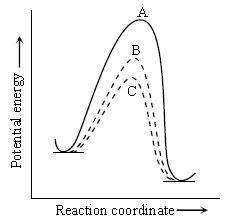
Which one of the following indicated the relative ease with which the reaction can take place?
a. A > B>C
b. C > B> A
c. B> C > A
d. A = B= C
Answer : B
Question. Which is incorrect for a catalyst?
a. A catalyst can initiate a reaction
b. A catalyst remains unchanged in quality and composition at the end of reaction
c. It does not alter the position of equilibrium in a reversible reaction
d. Catalyst is sometimes very specific in reaction
Answer : A
Question. From the given following sol how many can coagulate the haemoglobin sol?
Fe(OH)3, Ca (OH)2, Al(OH)3, starch, clay, As2S3,CdS, basic dye.
Answer : 3
Question. For the coagulation of 500 mL of arsenious sulphide sol, 3 mL of 1 M NaCl is required. What is the flocculation value of NaCl?
Answer : 4
Question. The coagulation of 100 mL of a colloidal sol of gold is completely prevented by addition of 0.03 g of Haemoglobin to it before adding 1 mL of 10% NaCl solution. Calculate the gold number of Haemoglobin.
Answer : 3
Question. The gold number of gelatin is 0.01. Calculate the amount of gelatin to be added to 1000 mL of a colloidal sol of gold to prevent its coagulation, before adding 1 mL of 10% NaCl solution:
Answer : 1
Question. 526.3 mL of 0.5 m HCl is shaken with 0.5 g of activated charcoal and filtered. The concentration of the filterate is reduced to 0.4 m. The amount of adsorption (x/m) is:
Answer : 4
CBSE Class 12 Chemistry Surface Chemistry Worksheet Set B
Very Short Answer
Q1) What is Ostwald’s process?
Q2) Define coagulation?
Q3) What are the two types of emulsions?
Q4) What are micelles?
Q5) What is Kraft temperature?
Short Answer
Q6) Distinguish between colloids and emulsions?
Q7) What are the two steps to proceed the enzyme catalysed reactions?
Q8) What do you understand by the Brownian movement?
Q9) What are the criteria of the colloids?
Q10) What do you understand by the electrokinetic potential?
Long Answer
Q11) Write short note on emulsions?
Q12) What are the applications of colloids?
Q13) Difference between lyophilic colloids and lyophobic colloids?
Q14) Write short note on Tyndall effect?
Q15) Difference between multimolecular colloids and macromolecular colloids?
Please click on below link to download CBSE Class 12 Chemistry Surface Chemistry Worksheet Set B
Free study material for Chemistry
Exam Preparation Worksheet for Class 12 Chemistry Unit 5 Surface Chemistry
CBSE Practice Material: Class 12 Chemistry Unit 5 Surface Chemistry
Explore reliable practice questions for Unit 5 Surface Chemistry tailored for Class 12 Chemistry learners. Use these structured worksheets to evaluate preparedness and strengthen problem-solving skills.
NCERT-Aligned Questions and Solutions
Built using the official NCERT book for Class 12 Chemistry, these practice materials provide reliable academic guidance. Pair your practice with our recommended NCERT solutions to master optimal problem-solving approaches.
Next Steps in Your Exam Preparation
Explore our broader library of printable assignments, chapter notes, and mock tests designed to support continuous revision and secure higher marks in CBSE assessments.
FAQs
You can download the teacher-verified PDF for CBSE Class 12 Chemistry Surface Chemistry Worksheet Set 02 from StudiesToday.com. These practice sheets for Class 12 Chemistry are designed as per the latest CBSE academic session.
Yes, our CBSE Class 12 Chemistry Surface Chemistry Worksheet Set 02 includes a variety of questions like Case-based studies, Assertion-Reasoning, and MCQs as per the 50% competency-based weightage in the latest curriculum for Class 12.
Yes, we have provided detailed solutions for CBSE Class 12 Chemistry Surface Chemistry Worksheet Set 02 to help Class 12 and follow the official CBSE marking scheme.
Daily practice with these Chemistry worksheets helps in identifying understanding gaps. It also improves question solving speed and ensures that Class 12 students get more marks in CBSE exams.
All our Class 12 Chemistry practice test papers and worksheets are available for free download in mobile-friendly PDF format. You can access CBSE Class 12 Chemistry Surface Chemistry Worksheet Set 02 without any registration.