

Class 12 Chemistry Practice Set: Solutions
Access printable practice worksheets for Solutions designed to align with the 2026-27 academic syllabus for Class 12 Chemistry. These structured exercises help students evaluate their conceptual understanding and improve exam readiness.
Download Solutions Worksheet PDF
Access the complete worksheet PDF for Solutions below. Regular practice with these targeted questions builds familiarity with standard exam patterns and helps secure higher marks in final Chemistry evaluations.
Question. If (N/10)50 mL H2SO4, (N/3)30 mL HNO3, (N/2)10 mL HCl is mixed and solution is made to 1L. Then normality of resultant solution is
(a) N/20
(b) N/40
(c) N/50
(d) N
Answer : C
Question. When a gas is bubbled through water at 298 K, a very dilute solution of the gas is obtained. Henry’s law constant for the gas at 298 K is 100 kbar. If the gas exerts a partial pressure of 1 bar, the number of millimoles of the gas dissolved in one litre of water is
(a) 0.555
(b) 5.55
(c) 0.0555
(d) 55.5
Answer : A
Question. Two liquids X and Y form an ideal solution. At 300 K, vapour pressure of the solution containing 1 mol of X and 3 mol of Y is 550 mm Hg. At the same temperature, if 1 mol of Y is further added to this solution, vapour pressure of the solution increases by 10 mm Hg. Vapour pressure ( in mm Hg) of X and Y in their pure states will be, respectively:
(a) 300 and 400
(b) 400 and 600
(c) 500 and 600
(d) 200 and 300
Answer : B
Question. Equal masses of a solute are dissolved in equal amount of two solvents A and B, respective molecular masses being MA and MB. The relative lowering of vapour pressure of solution in solvent A is twice that of the solution in solvent B. If the solutions are dilute, MA and MB are related as
(a) MA = MB
(b) 2MA = MB
(c) MA = 2MB
(d) MA = 4MB
Answer : C
Question. When two liquids A and B are mixed they form an ideal solution. At certain temperature the V.P. of the solution, that contains 3 moles of A and 1 mole of B was found to be 550 mm of Hg. The vapour pressure of a solution containing 4 moles of A and 1 mole of B was found to be 560 mm of Hg. The vapour pressure of pure liquid A is
(a) 200 mm
(b) 300 mm
(c) 400 mm
(d) 600 mm
Answer : D
Question. Two components A and B form an ideal solution. The mole fractions of A and B in ideal solution are XA and XB, while that of in vapour phase, these components have their mole fractions as YA and YB. Then, the slope and intercept of plot
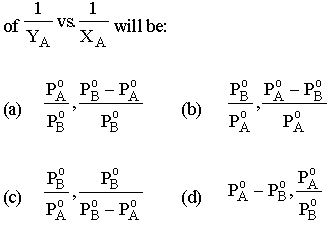
Answer : B
Question. The total vapour pressure of a 4 mole % solution of NH3 in water at 293 K is 50.0 torr. The vapour pressure of pure water is 17.0 torr at this temperature. Applying Henry’s and Raoult’s laws, the total vapour pressure for a 5 mole % solution is
(a) 58.25 torr
(b) 33 torr
(c) 42.1 torr
(d) 52.25 torr
Answer : A
Question. Vapour pressure of benzene at 30°C is 121.8 mm Hg. When 15 g of a non-volatile solute is dissolved in 250 g of benzene its vapour pressure decreased to 120.2 mm Hg. The molecular weight of the solute is (Mo. wt. of solvent = 78)
(a) 356.2
(b) 456.8
(c) 530.1
(d) 656.7
Answer : A
Question. A solution of urea (mol. mass 56 g mol-1) boils at 100.18°C at the atmospheric pressure. If Kf and Kb for water are 1.86 and 0.512 K kg mol-1 respectively, the above solution will freeze at
(a) 0.654°C
(b) - 0.654°C
(c) 6.54°C
(d) - 6.54°C
Answer : B
Question. π1, π2, π3 and π4 atm are the osmotic pressures of 5% (mass/volume) solutions of urea, fructose, sucrose and KCl respectively at certain temperature. The correct order of their magnitudes is :
(a) π1 > π4 > π2 > π3
(b) π1 > π4 > π2 > π3
(c) π4 > π1 > π2 > π3
(d) π4 > π1 > π3 > π2
Answer : C
Question. 0.010M solution an acid HA freezes at –0.0205ºC. If Kf for water is 1.860 K kg mol–1, the ionization constant of the conjugate base of the acid will be (assume 0.010 M = 0.010 m)
(a) 1.1 × 10⁻⁴
(b) 1.1 × 10⁻³
(c) 9.0 × 10⁻¹¹
(d) 9.0 × 10⁻¹²
Answer : C
Question. ΔTf /Kf has the same value of 1 mol kg–1 for 8% AB2 and 10% A2B by mass of solvent, both AB2 and A2B being non- electrolytes. Atomic masses of A and B will be respectively
(a) 20, 40
(b) 20, 50
(c) 40, 20
(d) 50, 40
Answer : C
Question. The vapour pressure of a solvent decreases by 10 mm of Hg when a non-volatile solute was added to the solvent. The mole fraction of the solute in the solution is 0.2. What should be the mole fraction of the solvent if the decrease in the vapour pressure is to be 20 mm of Hg ?
(a) 0.8
(b) 0.6
(c) 0.4
(d) 0.2
Answer : B
Question. Which of the following pairs of solution are isotonic at the same temperature ?
(a) 0.1 M Ca(NO3)2 and 0.1 M Na2SO4
(b) 0.1 M NaCl and 0.1 M Na2SO4
(c) 0.1 M urea and 0.1 M MgCl2
(d) 0.2 M urea and 0.1 M NaCl
Answer : A
Question. 23.5 g of phenol was dissolved in 500 g of a solvent having depression constant Kf of 12.0 K Kg mol–1. If the depression in freezing point of solution was found to be 3.60 K, the percent dimerization of phenol in the solvent is
(a) 89
(b) 85
(c) 80
(d) 92
Answer : C
Question. A certain non-volatile electrolyte contains 40% carbon, 6.7% hydrogen and 53.3% oxygen. An aqueous solution containing 5% by mass of of the solute boils at 100.15°C. The molecular formula of the compound is (Kb = 0.51°C/m)
(a) HCHO
(b) CH3OH
(c) C2H5OH
(d) C6H12O6
Answer : D
Question. A storage battery contains a solution of H2SO4 38% by weight. At this concentration, van’t Hoff factor is 2.50. The temperature of which the battery contents freeze is (K′f = 1.86 K mol–1 kg)
(a) 225.45
(b) 235.85
(c) 249.92
(d) 243.92
Answer : D
Question. An industrial waste water is found to contain 8.2% Na3PO4 and 12% MgSO4 by mass in solution. If % ionisation of Na3PO4 and MgSO4 are 50 and 60 respectively then its normal boiling point is [Kb(H2O) = 0.50 K kg mol–1] :
(a) 102.3°C
(b) 103.35°C
(c) 101.78°C
(d) None of these
Answer : C
Question. The plot of total vapour pressure as a function of mole fraction of the components of an ideal solution formed by mixing liquids X and Y is

Answer : B
Question. The values of the Henry’s law constant of Ar, CO2, CH4, and O2 in water at 25 °C are 40.30, 1.67, 0.41.and 34.86 kbar, respectively. The order of their solubility in water at the same temperature and pressure is
(a) Ar > O2 > CO2 > CH4
(b) CH4 > CO2 > Ar > O2
(c) CH4 > CO2 > O2 > Ar
(d) Ar > CH4 > O2 > CO2
Answer : C
Numeric Value Answer
Question. Two liquids A and B are miscible in all proportions and form ideal solution. At 350 K the vapour pressure of pure A is 24.0 kPa and that of pure B is 12.0 kPa. A mixture of 60% (by mole) of A and 40% of B is distilled at this temperature. A small amount of distillate is collected and redistilled at the same temperature. The mole percent of A in the second distillate at initial stage is ________.
Answer : 0.857
Question. Two beaker A and B present in a closed vessel. Beaker A contains 152.4 g aqueous solution of urea, containing 12 g of urea. beaker B contains 196.2 g glucose solution, containing 18 g of glucose. Both solutions allowed to attain the equilibrium. The mass % of glucose in its solution at equilibrium is _______.
Answer : 14.49
Question. A solution containing 10 g per dm3 of urea (molecular mass = 60 g mol–1) is isotonic with a 5% solution of a non-volatile solute. The molecular mass of this non-volatile solute is _______.
Answer : 300
Question. The freezing point of 0.08 molal NaHSO4 is – 0.345°C. If assume 100% ionisation of NaHSO4, calculate the percentage of HSO4 – , ions that transfers a proton to water. (Kf for H2O = 1.86 K molality–1).
Answer : 300
Question. 2 g of benzoic acid dissolved in 25 g of C6H6 shows a depression in freezing point equal to
1.62 K. Molal depression constant of C6H6 is 4.9 K mol–1 kg. The percentage association of acid if it forms double molecule in solution is ________.
Answer : 99.2
Question. The amount of urea to be dissolved in 500 c.c. of water (K = 1.86°C mol–1) to produce a depression of 0.186°C in the freezing point is ________.
Answer : 3
Question. 0.400 g of an acid HA (mol. mass = 80) was dissolved in 100 g of water. The solution showed a depression of freezing point of 0.12 K. The dissociation constant (in multiple of 10–3) of the acid at about 0°C, given Kf (water) = 1.86 K Kg mol–1 is (Assume molarity of solution » molality)
Answer : 6
Question. An element X (Atomic mass = 25) exists as X4 is benzene. 51g of saturated solution of X in benzene was added to 50.0 g of pure benzene. The resulting solution showed a depression of freezing point of 0.55 K. The solubility of X per 100 g of benzene is (Kf for benzene = 5.5 K kg mol–1)
Answer : 2
Question. At 10°C, the osmotic pressure of urea solution is 500 mm. The solution is diluted and the temperature is raised to 25°C, when the osmotic pressure is found to be 105.3 mm. Determine extent of dilution.
Answer : 5
Question. A solution containing 28 g phosphorus in 315 g CS2 (b. pt. 46.3°C) boils at 47.98°C. K′b for CS2 is 2.34 K mol–1 kg. _______ are the no. of atom of phosphorus present in its molecular formula.
Answer : 4
Please click on below link to download CBSE Class 12 Chemistry Solutions Worksheet
Free study material for Chemistry
Download CBSE Practice Material: Class 12 Chemistry Solutions
CBSE Practice Material: Class 12 Chemistry Solutions
Access structured practice worksheets for Solutions designed in alignment with the latest CBSE curriculum for Class 12 Chemistry. These printable problem sets help students build accuracy and prepare effectively for school tests.
NCERT-Aligned Questions and Solutions
Cross-reference your completed exercises with comprehensive NCERT solutions for Class 12 Chemistry to ensure absolute clarity across all sub-topics in this chapter.
Next Steps in Your Exam Preparation
Follow up your worksheet practice by attempting the interactive online Chemistry MCQ test for this chapter to evaluate your execution speed. All platform resources are free to access.
FAQs
You can download the teacher-verified PDF for CBSE Class 12 Chemistry Solutions Worksheet from StudiesToday.com. These practice sheets for Class 12 Chemistry are designed as per the latest CBSE academic session.
Yes, our CBSE Class 12 Chemistry Solutions Worksheet includes a variety of questions like Case-based studies, Assertion-Reasoning, and MCQs as per the 50% competency-based weightage in the latest curriculum for Class 12.
Yes, we have provided detailed solutions for CBSE Class 12 Chemistry Solutions Worksheet to help Class 12 and follow the official CBSE marking scheme.
Daily practice with these Chemistry worksheets helps in identifying understanding gaps. It also improves question solving speed and ensures that Class 12 students get more marks in CBSE exams.
All our Class 12 Chemistry practice test papers and worksheets are available for free download in mobile-friendly PDF format. You can access CBSE Class 12 Chemistry Solutions Worksheet without any registration.