
CBSE Class 12 Chemistry Chemical Kinetics Question Bank Set 02

Download Class 12 Chemistry Worksheets for Unit 3 Chemical Kinetics

Explore reliable practice materials for Unit 3 Chemical Kinetics tailored for Class 12 learners. Utilizing these Chemistry worksheets ensures thorough preparation and strengthens problem-solving speed for upcoming school assessments.

Access Unit 3 Chemical Kinetics Questions and Exercises

Navigate directly to the printable exercises for Unit 3 Chemical Kinetics using the digital viewer below. Each practice set allows students to isolate specific topics for thorough review and uninterrupted practice alongside standard textbooks.
QUESTION BANK
Chemical Kinetics
 
VSA QUESTIONS (1 - MARK QUESTIONS)
 
1. Why does the rate of a reaction not remain constant throughout the reaction process?
 
2. What is meant by order of a reaction being zero?
 
3. What is the shape of graph between log k vs1/T. What is the relationship between its slope and activation energy (Ea) ?
 
4. For a chemical reaction rate constant k = 5.3 × 10⁻⁴mol L–1 s–1.what will be the order of the reaction?
 
5. Express the rate of reaction in terms of disappearance of hydrogen and appearance of ammonia in the given reaction. N2(g) + 3 H2 (g)→ 2NH3 (g)
 
6. For the elementary step of a chemical reaction : A + H2O → Brate = [A]1.
What is the molecularity and order of the reaction.
 
7. Mention one example of pseudo first order reaction.
 
8. For the reaction Cl2(g)+NO (g) → 2NOCl(g),the rate law is expressed as rate =k[Cl2] [NO]2. What is the overall order of this reaction?
 
SA (I) QUESTIONS (2 - MARK QUESTIONS)
 
9. What do you mean by the rate law and rate constant of a reaction? Identify the order of a reaction if the units of its rate constant are
i. L-1mol s-1
ii. Lmol-1 s-1
 
10. A reaction is second order with respect to a reactant A. How is the rate of this reaction altered if the concentration of A is
i. Doubled
ii. Reduced to half?
11. Explain the terms
i. Rate determining step of areaction
ii. Molecularity of a reaction
 
12. iii. The rate constant for a reaction of zero order in A is 0.0030 mol L-1s-1. How long will it take for the initial concentration of A to fall from 0.10M to 0.075 M?
 
13. A first order reaction takes 40 minutes for 30% decomposition. Calculate its t1/2 value.
 
14. Show that for a first order reaction,the time required for half life is independent of initial concentration.
 
15. A reactant has a half life of 10 minutes.
i. Calculate the rate constant for the first order reaction.
ii. What fraction of the reactant will be left after an hour of the reaction has occurred?
 
16. Calculate the rate constant of a reaction at 293 K, given that: Ea=103 KJ/Mol, k=7.87x 10⁻⁷s-1, at 273 K,R=8.314 JK-1mol-1
 
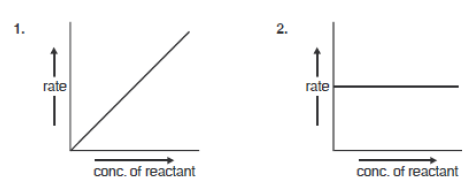
17. The graphs (1 and 2) given below are plots of rate of reaction verses concentration of the reaction. Predict the order from the graphs

CBSE Class 12 Chemistry Chemical Kinetics Question Bank Set B 1

 
SA (II) QUESTIONS (3- MARK QUESTIONS)
 
17. For a decomposition reaction, the values of rate constant k , at two different temperatures are given below.
K1=2.15x10⁻⁸Lmol-1s-1 at 650 K , K2=2.39 x10⁻⁷Lmol-1s-1 at 700 K Calculate the value of activation energy for this reaction R=8.314JK-1mol-1
 
 
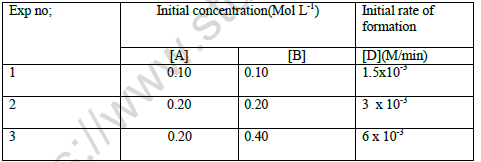
18. Consider the reaction 2A+B → C+ D
Following results were obtained in experiments designed to study the rate of reaction.

CBSE Class 12 Chemistry Chemical Kinetics Question Bank Set B 2

i. Write the rate law for the reaction.
ii. Calculate the value of rate constant for the reaction
iii. Which of the following possible reaction mechanisms is constant with the rate law found in (i)
 
I. A+B → C+ E (slow) A+E → D (fast)
II. B → C+ E (slow) A+E→ F (fast)
A+F→ D (fast)
 
19.. Explain the following :
i. A lump of coal burns at moderate rate in air while coal dust burns explosively.
ii. Average rate of reaction does not give the true picture of the reaction.
iii. Reactions of high molecularity are less in number.
 
20. i. Write four points of difference between order and molecularity of a reaction.
ii. List four methods for determination of order of reactions?
 
21. The decomposition of PH3 proceeds according to the following equation.
4PH3(g) → P4(g)+6 H2(g)
 
It is found that the reaction follows the following rate equation, Rate =k [PH3].The half life of PH3 is 37.9 s at 120 oC.
i. How much time is required for ¾ th of PH3 to decompose?
ii. What fraction of the original sample of PHremains behind after 1 minute?
 
LONG ANSWER QUESTION (5- MARK QUESTION)
 
22. i. Defineelementary reaction in a process.
ii. State the role of activated complex in a reaction and state its relation with activation energy.
iii. H2O2 (aq) decomposes to H2O(l) and O2 (g) in a reaction that is of first order in H2O2 and has a rate constant K=1.06 x10⁻³min -1.
a) How long will it take 15% of a sample of H2O2 to decompose?
b) How long will it take 85% of a sample of H2O2 to decompose?


Please click on below link to download CBSE Class 12 Chemistry Chemical Kinetics Question Bank Set B

Unit 3 Chemical Kinetics Practice Sheet and Solutions for Class 12 Chemistry

Download Practice Sheet: Unit 3 Chemical Kinetics (Class 12 Chemistry)

Review targeted practice exercises for Class 12 Chemistry Unit 3 Chemical Kinetics. Curated to match official CBSE guidelines, these downloadable PDF sheets support daily revision and core concept reinforcement.

Concept Clarification for Unit 3 Chemical Kinetics

Built using the official NCERT book for Class 12 Chemistry, these practice materials provide reliable academic guidance. Pair your practice with our recommended NCERT solutions to master optimal problem-solving approaches.

Additional Study Resources for Class 12 Chemistry

Wrap up your chapter revision by testing your knowledge against standard question formats. Everything on our platform is provided free of charge.

FAQs

Where can I download the latest PDF for CBSE Class 12 Chemistry Chemical Kinetics Question Bank Set 02?

You can download the teacher-verified PDF for CBSE Class 12 Chemistry Chemical Kinetics Question Bank Set 02 from StudiesToday.com. These practice sheets for Class 12 Chemistry are designed as per the latest CBSE academic session.

Are these Chemistry Class 12 worksheets based on the 2026-27 competency-based pattern?

Yes, our CBSE Class 12 Chemistry Chemical Kinetics Question Bank Set 02 includes a variety of questions like Case-based studies, Assertion-Reasoning, and MCQs as per the 50% competency-based weightage in the latest curriculum for Class 12.

Do you provide solved answers for CBSE Class 12 Chemistry Chemical Kinetics Question Bank Set 02?

Yes, we have provided detailed solutions for CBSE Class 12 Chemistry Chemical Kinetics Question Bank Set 02 to help Class 12 and follow the official CBSE marking scheme.

How does solving CBSE Class 12 Chemistry Chemical Kinetics Question Bank Set 02 help in exam preparation?

Daily practice with these Chemistry worksheets helps in identifying understanding gaps. It also improves question solving speed and ensures that Class 12 students get more marks in CBSE exams.

Is there any charge for the Class 12 Chemistry practice test papers?

All our Class 12 Chemistry practice test papers and worksheets are available for free download in mobile-friendly PDF format. You can access CBSE Class 12 Chemistry Chemical Kinetics Question Bank Set 02 without any registration.