
CBSE Class 12 Chemistry Chemical Kinetics Worksheet Set D

Access the latest CBSE Class 12 Chemistry Chemical Kinetics Worksheet Set D. We have provided free printable Class 12 Chemistry worksheets in PDF format, specifically designed for Unit 3 Chemical Kinetics. These practice sets are prepared by expert teachers following the 2025-26 syllabus and exam patterns issued by CBSE, NCERT, and KVS.

Unit 3 Chemical Kinetics Chemistry Practice Worksheet for Class 12

Students should use these Class 12 Chemistry chapter-wise worksheets for daily practice to improve their conceptual understanding. This detailed test papers include important questions and solutions for Unit 3 Chemical Kinetics, to help you prepare for school tests and final examination. Regular practice of these Class 12 Chemistry questions will help improve your problem-solving speed and exam accuracy for the 2026 session.

Download Class 12 Chemistry Unit 3 Chemical Kinetics Worksheet PDF

Question. (i) What is the order of the reaction whose rate constant has same units as the rate of reaction ?
(ii) For a reaction A + H2O → B; Rate ∝ [A]. What is the order of this reaction?
Answer. (i) Zero order
(ii) Pseudo-first order

Question. State a condition under which a bimolecular reaction is kinetically first order reaction. 
Answer. Let us take a bimolecular reaction :
A + B → Product
Rate = k [A] [B]
When concentration of [B] is taken in excess then rate law will become:
Rate = k [A]
where, k = constant
The rate depends only on one of the reactant as there is negligible change in its concentration so it is bimolecular but is of first order.

Question. (i) For which reaction, the rate of reaction does not decrease with time?
(ii) What is the order of photochemical reaction?
Answer. (i) For zero order reaction the rate of reaction does not decrease with time because it does not depend on concentration of reactants.
(ii) Zero Order reaction.

Question. Explain the following terms:
(i) Rate constant (k)
(ii) Half-life period of reaction (t1/2).
Answer. (i) Rate constant (k): Rate constant is rate of the reaction when the concentration of reactants is unity.
(ii) Half-life period of a reaction (t1/2): Half-life of a reaction is the time in which the concentration of a reactant is reduced to half of its original value.

Question. (i) Explain why H2 and O2 do not react at room temperature.
(ii) Write the rate equation for the reaction
A2 + 3B2 → 2C, if the overall order of the reaction is zero. 
Answer. (i) Due to high activation energy of the reaction between O2 and H2.
(ii) Rate = k [A2]0[B2]0

Question. (i) The rate of reaction decreases with the progress of reaction. Why?
(ii) Reactions having molecularity more than three occur rarely. Why? 
Answer. (i) The rate of reaction depends on the concentration of reactants. Since, the concentration of reactants decreases with time, so rate of reaction also decreases.
(ii) It is because of the fact that collision of more than three molecules is not possible at a time.

Question. (i) What is the order of the reaction whose rate constant has same units as the rate of reaction ?
(ii) For a reaction A + H2O → B; Rate ∝ [A].
What is the order of this reaction ?
Answer. (i) Zero order 
(ii) Pseudo-first order
 

CHEMICAL KINETICS
 
1. Why does the rate of a reaction not remain constant throughout the reaction process? (2010)
 
2. The rate of a reaction is 1.2 x 10⁻³ L/mol/s. What is the order of the reaction?
 
3. Define the following terms :
 
a) Half-life of a reaction (t½)
b) Rate constant (k) (2015)
 
4. A first order decomposition reaction takes 40 minutes for 30% decomposition. Calculate its t1/2 value. (2008)
 
5. Show that for a first order reaction, the time required for half the change is independent of initial concentration. (2010)
 
6. A reaction is first order in A and second order in B.
a) Write differential rate equation.
b) How is the rate affected when the concentration of A is tripled?
How is the rate affected when the concentration of both A and B are doubled?
 
7. An artifact containing wood has only 80% of the C14 activity found in a living tree. Estimate the age of the artifact if t1/2 of C14 is 5730 years.
 
8. The time required for 10% completion of a first order reaction at 298 K is equal to that required for its 25% completion at 308K.if the value of A is 4 x 10¹⁰/s, calculate k at 318K and Ea
 
9. (a) For a reaction A + B → P, the rate is given by Rate = k[A]2[B]
(i) How is the rate of reaction affected if the concentration of A is doubled?
(ii) What is the overall order of reaction if B is present in large excess?
(b) A first order reaction takes 23.1 minutes for 50% completion. Calculate the time required for 75% completion of this reaction.
(Given : log 2 = 0.301, log 3 = 0.4771, log 4 = 0.6021)
 
10. a) Explain the following terms:
i) Order of reaction
ii) Molecularity of a reaction
b) The rate of a reaction increases four times when the temperature changes from 300K to 320K. Calculate the energy of activation of the reaction assuming that it does not change with temperature. (R = 8.314 J K-1 mol-1)
 
11.Time required to decompose SO2Cl2 to half of its initial amount is 60 minutes. If the decomposition is a first order reaction, calculate the rate constant of the reaction.
 
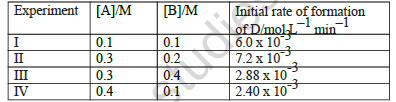
12.The following results have been obtained during the kinetic studies of the reaction: 2A + B → C + D

CBSE Class 12 Chemistry Chemical Kinetics Worksheet Set A 1

Determine the rate law and rate constant for the reaction.
 
13.For the decomposition of azoisopropane into hexane and nitrogen at 543K , the following data were obtained. Calculate the rate constant.
 
T(sec)                 P (mm of Hg)
  0                          35
  360                      54
  720                      63


Please click on below link to download CBSE Class 12 Chemistry Chemical Kinetics Worksheet Set A

~ Class 12 Chemistry (Old Chapters)
CBSE Class 12 Chemistry Chemistry in Everyday Life Question Bank
CBSE Class 12 Chemistry Chemistry in Everyday Life Worksheet Set A
CBSE Class 12 Chemistry Chemistry in Everyday Life Worksheet Set B
CBSE Class 12 Chemistry General principles and Processes of isolation of elements Question Bank
CBSE Class 12 Chemistry General Principles and Processes of Isolation of Elements Worksheet Set A
CBSE Class 12 Chemistry General Principles And Processes of Isolation of Elements Worksheet Set B
CBSE Class 12 Chemistry General Principles And Processes of Isolation of Elements Worksheet Set C
CBSE Class 12 Chemistry General Principles And Processes of Isolation of Elements Worksheet Set D
CBSE Class 12 Chemistry General Principles And Processes of Isolation of Elements Worksheet Set E
CBSE Class 12 Chemistry In Everyday Life Question Bank
CBSE Class 12 Chemistry In Everyday Life Worksheet Set A
CBSE Class 12 Chemistry Polymers Worksheet Set A
CBSE Class 12 Chemistry Polymers Worksheet Set B
CBSE Class 12 Chemistry Polymers Worksheet Set C
CBSE Class 12 Chemistry Polymers Worksheet Set D
CBSE Class 12 Chemistry Solid State Question Bank
CBSE Class 12 Chemistry Solid State Question Bank Set A
CBSE Class 12 Chemistry Solid State Question Bank Set B
CBSE Class 12 Chemistry Solid State Worksheet
CBSE Class 12 Chemistry Surface Chemistry Question Bank
CBSE Class 12 Chemistry Surface Chemistry Question Bank Set A
CBSE Class 12 Chemistry Surface Chemistry Question Bank Set B
CBSE Class 12 Chemistry Surface Chemistry Worksheet Set A
CBSE Class 12 Chemistry Surface Chemistry Worksheet Set B
CBSE Class 12 Chemistry Surface Chemistry Worksheet Set C
CBSE Class 12 Chemistry Surface Chemistry Worksheet Set D
CBSE Class 12 Chemistry Surface Chemistry Worksheet Set E
CBSE Class 12 Chemistry The P Block Elements Question Bank
CBSE Class 12 Chemistry The P Block Elements Question Bank Set A
CBSE Class 12 Chemistry The P Block Elements Question Bank Set B
CBSE Class 12 Chemistry The p Block Elements Worksheet Set A
CBSE Class 12 Chemistry The p Block Elements Worksheet Set B
CBSE Class 12 Chemistry The p Block Elements Worksheet Set C
CBSE Class 12 Chemistry The P Block Elements Worksheet Set E
CBSE Class 12 Chemistry The P Block Elements Worksheet Set F
CBSE Class 12 Chemistry The Solid State Worksheet Set A
CBSE Class 12 Chemistry The Solid State Worksheet Set B

Unit 3 Chemical Kinetics CBSE Class 12 Chemistry Worksheet

Students can use the Unit 3 Chemical Kinetics practice sheet provided above to prepare for their upcoming school tests. This solved questions and answers follow the latest CBSE syllabus for Class 12 Chemistry. You can easily download the PDF format and solve these questions every day to improve your marks. Our expert teachers have made these from the most important topics that are always asked in your exams to help you get more marks in exams.

NCERT Based Questions and Solutions for Unit 3 Chemical Kinetics

Our expert team has used the official NCERT book for Class 12 Chemistry to create this practice material for students. After solving the questions our teachers have also suggested to study the NCERT solutions  which will help you to understand the best way to solve problems in Chemistry. You can get all this study material for free on studiestoday.com.

Extra Practice for Chemistry

To get the best results in Class 12, students should try the Chemistry MCQ Test for this chapter. We have also provided printable assignments for Class 12 Chemistry on our website. Regular practice will help you feel more confident and get higher marks in CBSE examinations.

Where can I download latest CBSE Practice worksheets for Class 12 Chemistry Unit 3 Chemical Kinetics

You can download the CBSE Practice worksheets for Class 12 Chemistry Unit 3 Chemical Kinetics for the latest session from StudiesToday.com

Are the Class 12 Chemistry Unit 3 Chemical Kinetics Practice worksheets available for the latest session

Yes, the Practice worksheets issued for Unit 3 Chemical Kinetics Class 12 Chemistry have been made available here for the latest academic session

Is there any charge for the Practice worksheets for Class 12 Chemistry Unit 3 Chemical Kinetics

There is no charge for the Practice worksheets for Class 12 CBSE Chemistry Unit 3 Chemical Kinetics you can download everything free

How can I improve my scores by solving questions given in Practice worksheets in Unit 3 Chemical Kinetics Class 12 Chemistry

Regular revision of practice worksheets given on studiestoday for Class 12 subject Chemistry Unit 3 Chemical Kinetics can help you to score better marks in exams

Are there any websites that offer free Practice test papers for Class 12 Chemistry Unit 3 Chemical Kinetics

Yes, studiestoday.com provides all the latest Class 12 Chemistry Unit 3 Chemical Kinetics test practice sheets with answers based on the latest books for the current academic session