

Download CBSE MCQs for Class 9 Science: Chapter 04 Structure of the Atom
Access targeted multiple-choice questions for Chapter 04 Structure of the Atom designed to align with the latest CBSE academic syllabus for Class 9 Science. These objective practice sets help students evaluate their conceptual understanding and improve exam readiness.
Chapter-wise Objective Questions: Chapter 04 Structure of the Atom
View or download the dedicated Chapter 04 Structure of the Atom MCQ resource below. Practicing these 50 objective questions regularly builds familiarity with standard exam patterns and helps secure higher marks in final Science evaluations.
Question: In a neutral atom, the number of protons is equal to
(b) number of electrons
(d) number of neutrons + number of electrons
(b) 1/12 th mass of hydrogen atom
(d) 1/12 th mass of helium atom
(b) James Chadwick
(d) John Dalton
(b) half the mass of an electron
(d) half the mass of a proton
(b) electrons and neutrons
(d) protons and neutrons
(b) Z
(d) N
(b) hydrogen
(d) carbon
(b) decreasing order of atomic number
(d) increasing order of atomic number
(b) S
(d) N
(b) calcium
(d) aluminium
(b) Hydrogen
(d) Carbon
(b) less than one
(d) zero
(b) the nucleus of helium
(d) an atom of hydrogen
(b) a helium nucleus
(d) a proton
(b) the number of neutrons in one atom
(d) the number of protons in one atom
(b) J.J. Thomson
(d) Rutherford
(b) 11, 12, 11
(d) 23, 11, 23
(b) 4
(d) 8
(b) Ice and steam
(d) Hydrogen and deuterium
(b) isobar of oxygen
(d) isobar of carbon
(b) Deuterium
(d) Chlorine
(b) Isobars
(d) Both isotopes and allotropes
(b) 36
(d) 56
(b) M-shell
(d) K-shell
(b) Y – X
(d) X
(b) radioactivity
(d) none of these
(a) Chemical properties of elements
(b) Physical properties of elements
(c) Both physical and chemical properties of elements
(d) Neither physical nor chemical properties of elements
(a) 18 Ar40,20 Ca40,
(b) 19 K39 , 19+[K+]39
(c) 18 Ar40,19 K39
(d) 18 Ar40,19 K39 ,20 Ca40
Question: Which of the following are isotopes: 1 1 H, 1 2D,1 3 T,1 1 H+
(a) 1 1 H, 1 2D,1 3 T
(b) 1 1 H, 1 1 H+
(c) 1 1 H, 1 2D,1 1 H+
(d) 1 1 H, 1 3 T,1 1 H+
Question: Which of the following does not have one electron in its valance shell
(a) Na
(b) Ca
(c) Li
(d) H
Question: Which of the following does not have 8 valence electrons:
(a) He
(b) Ne
(c) Ar
(d) Cl
(a) E=19, P=19, N= 20
(b) E=18, P=19, N= 20
(c) E=18, P=19, N= 19
(d) E=19, P=20, N= 20
Question: Which of the following statements does not belong to Bohrs model?
(a) The electrons radiate energy during revolution due to force of attraction between nucleus and electrons
(b) Energy of the electrons in the orbit is quantized
(c) The electrons in the orbit nearest to the nucleus is the lowest energy
(d) Electrons revolve around the nucleus in different orbits having fixed energies
Question: When a gold foil is bombarded by a beam of α particle, only a few of them get deflected whereas most go straight undeflecte This is because
(a) The volume of nucleus is much smaller than that of the atom
(b) The force of attraction exerted on α particles by the electrons is insufficient
(c) The force of repulsion acting on the fast moving α particles is very small
(d) The neutrons have no effect on α particles
Question: Composition of the nuclei of two atomic species are given:
P
(a) 16,16; 1sobars
(b) 16,16; isotopes
(c) 17,15; isotopes
(d) 17,15; isotopes
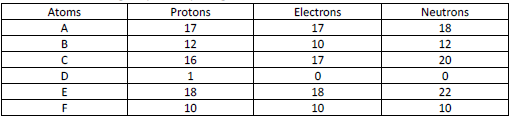
Question: Which of the following are positively charged ions:
A 17 17 18
(b) A and B
(c) C and D
(d) D and F
Question: If K, L, M, N shells of an atom are full, the total number of electrons in the atom are:
(a) 60
(b) 26
(c) 42
(d) 36
Question: Which of the following is correct?
Column 1 Column 2
B. Protons ii. No charge
C. Neutrons iii. Negative charge
(a) A-iii, B-i, C-ii
(b) A-iii, B-ii, C-i
(c) A-ii, B-iii, C-i
(d) A-ii, B-i, C-iii
Question: A student weighs 30kg. Suppose his body is entirely made of electrons. How any electrons are there in his body? Mass of an electron= 9.1X10⁻³¹kg
(a) 3.29 X1031
(b) 3.29 X1030
(c) 3.29 X10²³
(d) 3.29 X1032
Question: The charge/ mass ratio of electron:
(a) Remains constant
(b) Depends on the nature of the electrodes
(c) Depends upon nature of the gas
(d) Depends on both nature of the gas and nature of the electrode
(a) Rutherford
(b) Chadwick
(c) Thomson
(d) Goldstein
Question: The fluorescence on the walls of discharge tube is due to:
(a) Cathode rays
(b) Anode rays
(c) Canal rays
(d) None of the above
Question: The isotope used to remove the brain tumours and treatment of cancer is
(a) U-235
(b) Na-24
(c) Iodine
(d) C0-60
Question: The nucleons are
(a) Protons and electrons
(b) Neutrons and electrons
(c) Protons and neutrons
(d) None of these
Question: How many electrons in a Hydrogen (H) atom:
(a) One
(b) Two
(c) Three
(d) Four
Question: The atomic number of the element with maximum number of unpaired electrons is:
(a) 23
(b) 33
(c) 15
(d) 26
Answer : D
Question: 13Al27 is a stable isotope. 13Al29 is expected to disintegrate by:
a.α emission
(b) β emission
(c) Positron emission
(d) Proton emission
Question: The atomic number of an element having mass number 23 and number of neutron 12 is ________.
(a) 23
(b) 11
(c) 12
(d) 35
Answer: B
Question: Isotopes are
(a) atoms of the same element
(b) atoms of different elements
(c) molecules of the same element
(d) radicals of the same element
(a) Size of an element
(b) Valency of an element
(c) Molar mass of the element
(d) None of these
(a) P-32
(b) I-131
(c) Co-60
(d) any of these
Question: When alpha-particles are sent through a thin metal foil, most of them go straight through the foil because
(a) alpha-particles are positively charged
(b) alpha-particles are much smaller than electrons
(c) alpha-particles move with low velocity
(d) most part of the atom is empty
Question: The electronic configuration of an atom with atomic number 19 is:
(a) 2, 8, 8, 1
(b) 1, 2, 2, 8
(c) 2, 8, 9
(d) 2, 10, 7

(b) H2
(c) He
(d) Ar
Free study material for Science
Practice MCQs for Class 9 Science Chapter 04 Structure of the Atom
About Chapter 04 Structure of the Atom MCQs for Class 9 Science
Test your conceptual understanding of Chapter 04 Structure of the Atom with these targeted multiple-choice questions. Designed in alignment with the latest CBSE curriculum for Class 9 Science, these problem sets build accuracy and prepare students for objective exams.
How to Verify Your MCQ Answers
Built using the official NCERT book for Class 9, these Science objective sets provide reliable academic guidance. Pair your practice with our recommended NCERT solutions to master optimal problem-solving approaches.
Enhance Speed with Online MCQ Tests
Wrap up your chapter revision by testing your knowledge against standard question formats. Everything on our platform is provided free of charge.
FAQs
You can get most exhaustive CBSE Class 9 Science Structure of the Atom MCQs Set 02 for free on StudiesToday.com. These MCQs for Class 9 Science are updated for the 2026-27 academic session as per CBSE examination standards.
Yes, our CBSE Class 9 Science Structure of the Atom MCQs Set 02 include the latest type of questions, such as Assertion-Reasoning and Case-based MCQs. 50% of the CBSE paper is now competency-based.
By solving our CBSE Class 9 Science Structure of the Atom MCQs Set 02, Class 9 students can improve their accuracy and speed which is important as objective questions provide a chance to secure 100% marks in the Science.
Yes, Science MCQs for Class 9 have answer key and brief explanations to help students understand logic behind the correct option as its important for 2026 competency-focused CBSE exams.
Yes, you can also access online interactive tests for CBSE Class 9 Science Structure of the Atom MCQs Set 02 on StudiesToday.com as they provide instant answers and score to help you track your progress in Science.