
CBSE Class 9 Science Chemistry MCQs

Practice CBSE Class 9 Science Chemistry MCQs provided below. The MCQ Questions for Class 9 Chemistry Science with answers and follow the latest CBSE/ NCERT and KVS patterns. Refer to more Chapter-wise MCQs for CBSE Class 9 Science and also download more latest study material for all subjects

MCQ for Class 9 Science Chemistry

Class 9 Science students should review the 50 questions and answers to strengthen understanding of core concepts in Chemistry

Chemistry MCQ Questions Class 9 Science with Answers


Question. Name the solute in common salt solution :
a) H2O
b) NH4Cl 
c) NaOH
d) NaCl

Question. Pick out a colloid from the following :
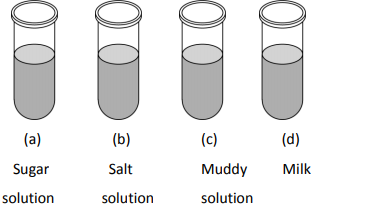
class_9_chemistry_MCQs_1


Question. Which of the following is property of true solution ?
a) Homogeneous
b) Heterogeneous 
c) Translucent
d) None of these

Question. The process of separation of insoluble solids from a liquid is called :
a) Filtration
b) Decantation
c) Sedimentation
d) Evaporation

Question. Which of the following mixtures is stable?
a) Milk in water
b) Sugar in water 
c) Sand in water
d) Wheat flour in cold water 

Question. Egg albumin in water forms :
a) True solution
b) Colloidal solution
c) Suspension
d) None of these

Question. Which of the following represents a correct set of observations for a mixture of common salt and water?
Transparency           Stability            Filtration
a) Transparent            Unstable           No residue
b) Transparent            Stable               No residue
c) Translucent             Stable               No residue
d) Opaque                  Unstable            Residue 

2. To prepare a) a mixture b) a compound
using iron filings and sulphur powder and distinguish between these on the basis of:
i. appearance i.e., homogeneity and heterogeneity
ii. behaviour towards a magnet
iii. behaviour towards carbon disulphide as a solvent.
iv. effect of heat.

Question. The color of Sulphur is :
a) White
b) Colorless
c) Green
d) Yellow

Question. FeS is not attracted by magnet because :
a) It has lost properties of its components.
b) It is not made up of iron.
c) It is a mixture
d) It is black in color.

Question. Sulphur is soluble in :
a) Water
b) Carbon disulphide 
c) Both (a) and (b)
d) Neither (a) not (b) 

Question. In FeS , the particles of iron and sulphur are : 
a) Visible
b) Not visible 
c) Visible under microscope
d) None of these

Question. Iron reacts with sulphur to form FeS at : 
a) High temperature
b) Low temperature 
c) Moderate temperature
d) Below 0oC
 
Question. When a mixture of iron fillings and sulphur is heated , the colour of the mixture changes from : 
a) Black to yellow
b) Yellow to black 
c) Greyish yellow to black
d) Black to brown 
 
Question. Which of the following has lowest melting point : 
a) Iron
b) Sulphur 
c) Iron sulphide
d) Carbon 
 
3. To carry out the following reactions and classify them as physical or chemical changes. 
a. Iron with copper sulphate solution in water. 
b. Burning of magnesium in air. 
c. Zinc with dilute sulphuric acid 
d. Heating of copper sulphate 
e. Sodium sulphate with barium chloride in the form of their solutions in water.

Question. The colour of hydrated copper sulphate is :
a) Blue
b) Colourless
c) Brown
d) Yellow

Question. What happens when Zn granules react with dilute sulphuric acid :
a) Bubbles due to colourless , odourless gas are formed and colourless solution is obtained .
b) No reaction takes place.
c) Pungent smelling gas comes out.
d) No gas evolved.

Question. Fe + CuSO4 → FeSO4 + Cu is an example of :
a) Displacement reaction
b) Decomposition reaction
c) Redox reaction
d) Double decomposition

Question. What happens when iron nails are added to copper sulphate solution :
a) The solution becomes pale green and reddish brown copper metal gets deposited.
b) The solution becomes colourless
c) There is no reaction
d) Copper displaces iron

Question. BaSO4 is :
a) White ppt
b) Colourless
c) Blue solution
d) Blue ppt.

Question. Magnesium oxide , when placed on moist red litmus paper :
a) It remains red
b) It turns blue
c) It becomes white
d) It becomes black

Question. What is the nature of SO2 :
a) Acidic
 b) Basic
c) Neutral
d) All of these
 
4. To separate the components of a mixture of sand , common salt and ammonium chloride (or camphor) by sublimation.
 
Question. Sublimation is the process in which :
a) Liquid changes into gaseous state
b) Solid changes into liquid state
c) Solid directly changes into gaseous form
d) Solid first converts into liquid , then into vapour form.

Question. Which of the following substances sublimes on heating :
a) Iodine
b) Camphor
c) Naphthalene
d) All of these

Question. In a mixture of sand, common salt and ammonium chloride , the substance that sublimes is:
a) Ammonium chloride
b) Sand
c) Common salt
d) All of these

Question. Recovery of salt from salt solution in water can be done by :
a) Evaporation
b) Distillation
c) Filtration
d) None of these
 
Question. What do you observe in the inner side of the funnel during sublimation of NH4Cl
a) Particles of white solid
b) Yellow fumes
c) Vapours of sodium chloride
d) No fumes are deposited
 
Question. Which of the following mixtures cannot be separated by sublimation :
a) Ammonium chloride & sodium chloride
b) Ammonium chloride & sand
c) Ammonium chloride & iodine
d) Ammonium chloride & copper sulphate
 
Question. A mixture of common salt and ammonium chloride is heated in a china dish covered with an inverted funnel with stem closed with a cotton plug. After the experiment the china dish will contain :
a) Common salt
b) Ammonium chloride
c) Both (a) and (b)
d) None of these.
 
5. To determine the melting point of ice and the boiling point of water.
 
Question. Which of the following will help in determining the melting point of ice accurately ?
a) Ice made from tap water
b) Ice made from distilled water
c) Ice made mixed with salt
d) None of these
 
Question. In determination of melting point of ice , the ice is contaminated with some non-volatile impurity, like common salt, melting point of ice will :
a) Increase
b) Decrease
c) May increase or decrease
d) Does not change
 
Question. What is the melting point of ice?
a) 0oC
b) 100oC
c) 273 K
d) Both (a) and (c)
 
Question. Which vessel is used to determine the melting point of ice ?
a) Beaker
b) R B Flask
c) Conical Flask
d) Measuring Flask
 
Question. At what temperature ice and water both exist together under normal atmospheric pressure ?
a) Below 273.16 K
b) Above 273.16 K
c) At 273.16 K
d) None of these
 
Question. In determining the boiling point of water , correct reading is obtained when :
a) Temperature start rising
b) Water starts boiling
c) Whole of water evaporates
d) Temperature becomes constant
 
Question. Water evaporates faster :
a) In still air
b) In humid air
c) In dry air
d) In windy & dry air
 
6. To verify the law of conservation of mass in a chemical reaction.
 
Question. What does the law of conservation of mass state?
a) It states that mass is neither created nor destroyed.
b) It states that mass can be created or destroyed.
c) It states that mass cannot be created but can be destroyed.
d) It states that mass can be created but cannot be destroyed.
 
Question. If you melt 100 g of ice will you get the same mass of water ?
a) Yes
b) No
c) May be
d) Sometimes
 
Question. State the chemical reaction between Barium Chloride (aqueous) & Sodium Sulphate (aqueous) .
a) BaCl2 (aq) + Na2SO4 (aq)  BaSO4 (white ppt) + 2NaCl (aq)
b) BaCl2 (aq) + Na2SO4 (aq)  BaSO3 (red ppt) + 2NaCl (aq)
c) Both (a) & (b)
d) None of these
 
Question. Which of the following reaction does not conform to law of conservation of mass ?
a) Burning of candle
b) Melting of ice
c) Fusion reaction occurring in sun
d) Combustion of fuel
 
Question. In the reaction 2NaN2→ 2Na +3N2 , if 850 g of NaN2 is decomposed to give 265.20 g of Na , how much N2 is produced ?
a) 584.80 g
b) 265.20 g
c) 850 g     
d) 484.20 g
 
Question. In chemical reactions how does law of conservation of mass contribute in writing chemical equations ?
a) It does not help.
b) Equations can be balanced by writing their correct co – efficient
c) Both (a) and (b)
d) None of these
 
Question. In accordance with the law of conservation of mass give the co-efficient of O2 in the equation:
C5H12 + O2 → 5CO2 + 6H2O
a) 4
b) 6
c) 8
d) 2


MCQs for Chemistry Science Class 9

Students can use these MCQs for Chemistry to quickly test their knowledge of the chapter. These multiple-choice questions have been designed as per the latest syllabus for Class 9 Science released by CBSE. Our expert teachers suggest that you should practice daily and solving these objective questions of Chemistry to understand the important concepts and better marks in your school tests.

Chemistry NCERT Based Objective Questions

Our expert teachers have designed these Science MCQs based on the official NCERT book for Class 9. We have identified all questions from the most important topics that are always asked in exams. After solving these, please compare your choices with our provided answers. For better understanding of Chemistry, you should also refer to our NCERT solutions for Class 9 Science created by our team.

Online Practice and Revision for Chemistry Science

To prepare for your exams you should also take the Class 9 Science MCQ Test for this chapter on our website. This will help you improve your speed and accuracy and its also free for you. Regular revision of these Science topics will make you an expert in all important chapters of your course.

Where can I access latest CBSE Class 9 Science Chemistry MCQs?

You can get most exhaustive CBSE Class 9 Science Chemistry MCQs for free on StudiesToday.com. These MCQs for Class 9 Science are updated for the 2025-26 academic session as per CBSE examination standards.

Are Assertion-Reasoning and Case-Study MCQs included in the Science Class 9 material?

Yes, our CBSE Class 9 Science Chemistry MCQs include the latest type of questions, such as Assertion-Reasoning and Case-based MCQs. 50% of the CBSE paper is now competency-based.

How do practicing Science MCQs help in scoring full marks in Class 9 exams?

By solving our CBSE Class 9 Science Chemistry MCQs, Class 9 students can improve their accuracy and speed which is important as objective questions provide a chance to secure 100% marks in the Science.

Do you provide answers and explanations for CBSE Class 9 Science Chemistry MCQs?

Yes, Science MCQs for Class 9 have answer key and brief explanations to help students understand logic behind the correct option as its important for 2026 competency-focused CBSE exams.

Can I practice these Science Class 9 MCQs online?

Yes, you can also access online interactive tests for CBSE Class 9 Science Chemistry MCQs on StudiesToday.com as they provide instant answers and score to help you track your progress in Science.