

Class 12 Chemistry Practice Assignments: CBSE Class 12 Chemistry Coordination Compound Notes and Questions
Review targeted academic assignments with the CBSE Class 12 Chemistry Coordination Compound Notes and Questions. Built according to official CBSE standards for the 2026-27 term, these downloadable Class 12 Chemistry worksheets support effective daily practice for Unit 5 Coordination Compounds.
Download Unit 5 Coordination Compounds Assignment PDF with Solutions
Access the complete assignment PDF for Class 12 Chemistry below. Regular practice with these targeted academic tasks builds familiarity with standard question patterns and helps secure higher marks in final school evaluations.
The compounds which contain dative bonds between metal atom and surrounding species is called co-ordination compounds .
The branch of inorganic chemistry which deals with hte study of preparation properties of coordination compound is called co-ordination chemistry.
K4[Fe(CN)6], [CuNH3)4]SO4
POINTS TO REMEMBER:
1.Coordination compounds
Coordination compounds are compounds in which a central metal atom or ion is linked to a
number of ions or neutral molecules by coordinate bonds or which contain complex ions. Examples- K4[Fe(CN)6]; [ Cu(NH3)4]SO4; Ni(CO)4
2.The main postulates of Werner’s theory of coordination compounds
i) In coordination compounds metals show two types of linkages or valencies- Primary and Secondary.
ii) The primary valencies are ionisable and are satisfied by negative ions.
iii) The secondary valencies are non- ionisable and are satisfied by neutral molecules or negative ions. The secondary valence is equal to the C.N and is fixed for a metal.
iv) The ions or groups bound by secondary linkages to the metal have characteristic spatial arrangements corresponding to different coordination nos.
3.Difference between a double salt and a complex
Both double salts as well as complexes are formed by the combination of two or more stable compounds in stoichiometric ratio.
However, double salts such as carnallite, KCl.MgCl2.6H2O, Mohr‘s salt, FeSO4.(NH4)2SO4.6H2O, potash alum, KAl(SO4)2.12H2O, etc. dissociate into simple ions completely when dissolved in water.
However, complex ions such as [Fe(CN)6]4– of K4[Fe(CN)6], do not dissociate into Fe2+ and CN– ions.
IMPOTANT TERMINOLOGY
(i) Coordination entity: It constitutes the central metal ion or atom bonded to a fixed number of ions or molecules represented within a square bracket.
(ii) Central atom/ ion: In a coordination entity,
the atom/ion to which a fixed number of ions/groups are bound in a definite geometrical arrangement around it, is called the central atom or ion.
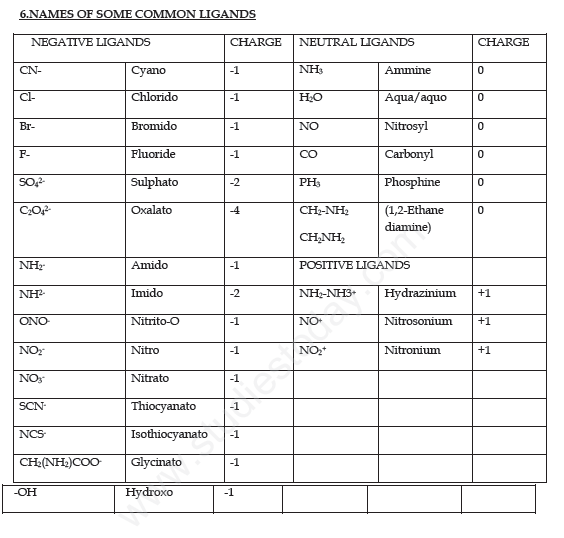
iii) Ligands: The neutral or negative ions bound to the central metal or ion in the coordination entity.
These donate a pair/s of electrons to the central metal atom /ion. Ligands may be classified as-
a) Monodentate/Unidentate: Ligands bound to the central metal atom/ion through a single donor atom. Ex- Cl- ; H2O ; NH3 ; NO2-.
Please refer to more CBSE Class 12 Chemistry Coordination Compound Notes and Questions
Free study material for Chemistry
Chapter Assignment & Practice Material for Class 12 Chemistry Unit 5 Coordination Compounds
Chapter Practice Questions for Class 12 Chemistry
Explore reliable practice questions for Unit 5 Coordination Compounds tailored for Class 12 learners. Use these structured worksheets to evaluate preparedness and strengthen core problem-solving skills.
Maximize Exam Scores with Chapter Practice Sets
- Syllabus Compliance: Sets reflect current CBSE evaluation criteria and official marking frameworks.
- Multi-Format Practice: Includes varied problem types designed to deepen comprehension across all sub-topics.
- Time Management: Routine practice optimizes pacing to finish school examinations comfortably within schedule.
Steps to Complete Unit 5 Coordination Compounds Assignments Successfully
- Concept Foundation: Review the NCERT book for Class 12 Chemistry thoroughly before diving into assignment tasks.
- Self-Evaluation: Solve exercises independently before inspecting professional answer guides.
- Progress Monitoring: Note down complex formulas or concepts, clearing them up using available online practice aids.
FAQs
You can download free PDF assignments for Class 12 Chemistry Unit 5 Coordination Compounds from StudiesToday.com. These practice sheets have been updated for the 2026-27 session covering all concepts from latest NCERT textbook.
Yes, our teachers have given solutions for all questions in the Class 12 Chemistry Unit 5 Coordination Compounds assignments. This will help you to understand step-by-step methodology to get full marks in school tests and exams.
Yes. These assignments are designed as per the latest CBSE syllabus for 2026. We have included huge variety of question formats such as MCQs, Case-study based questions and important diagram-based problems found in Unit 5 Coordination Compounds.
Practicing topicw wise assignments will help Class 12 students understand every sub-topic of Unit 5 Coordination Compounds. Daily practice will improve speed, accuracy and answering competency-based questions.
Yes, all printable assignments for Class 12 Chemistry Unit 5 Coordination Compounds are available for free download in mobile-friendly PDF format.