

School Assignments for Class 12 Chemistry: Unit 2 Electrochemistry
Explore structured practice materials through the CBSE Class 12 Chemistry Electrochemistry Notes and Questions. Tailored for Class 12 learners, utilizing these Chemistry assignments ensures thorough preparation and strengthens foundational knowledge before final CBSE evaluations.
Practice Class 12 Chemistry Assignments: Unit 2 Electrochemistry
Navigate directly to the solved Chemistry assignments using the digital viewer below. Each practice set includes detailed step-by-step solutions, allowing students to instantly cross-check their work and identify areas requiring further revision.
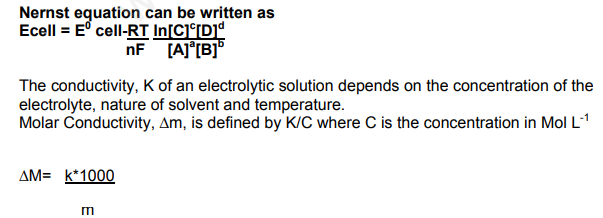
Kohlrausch law of independent migration of ions. The law states that limiting conductivity of an electrolyte can be represented as the sum of the individual contribution to the anion and cation of the electrolyte.
Faraday’s laws of Electrolysis
I. The amount of chemical reaction which occurs at any electrode during electrolysis by a current is proportional to the quantity of electricity passed through the electrolyte.
II. The amount of different substances liberated by the same quantity of electricity passing through the electrolytic solution is proportional to their chemical equivalent weights. Batteries and full cells are very useful forms of galvanic cells There are mainly two types of batteries.
Corrosion of metals is an electrochemical phenomenon In corrosion metal is oxidized by loss of electrons to oxygen and formation of oxides.
Anode (Oxidation): 2Fe(s) →2Fe2+ + 4e-
Cathode (Reduction): O2(g) + 4H+(aq) + 4e-→2H2O
Atmospheric Oxidation:
2Fe2+(aq) + 2H2O(l) + 1/2O2(g)→Fe2O3(s) + 4H+(aq)
1. What is the effect of temperature on molar conductivity?
Ans. Molar conductivity of an electrolyte increases with increase in temperature.
2. Why is it not possible to measure single electrode potential?
Ans. (It is not possible to measure single electrode potential because the half cell containing single electrode cannot exist independently, as charge cannot flow on its own in a single electrode.)
3. Name the factor on which emf of a cell depends:-
Ans. Emf of a cell depends on following factora. Nature of reactants.
b. Concentration of solution in two half cells.
d. Pressure of gas.
4. What are the units of molar conductivity?
5. What is the EMF of the cell when the cell reaction attains equilibrium?
Ans. Zero
6. What is the electrolyte used in a dry cell?
Ans. A paste of NH4Cl, MnO2 and C
7. How is cell constant calculated from conductance values?
Ans. Cell constant= specific conductance/ observed conductance.
8. What flows in the internal circuit of a galvanic cell.
Ans. Ions
9. Define electrochemical series.
Ans. The arrangement of various electrodes in the decreasing or increasing order of their standard reduction potentials is called electrochemical series.
QUESTIONS CARRYING TWO MARKS
1. How can you increase the reduction potential of an electrode.? For the reaction
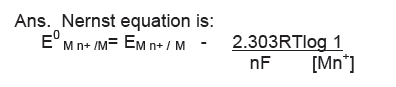
a. increase in concentration of Mn+ ions in solution
b. by increasing the temperature.
2. Calculate emf of the following cell at 298K
Question The weight of silver (at. wt. = 108) displaced by a quantity of electricity which displaces 5600 mL of O2 at STP will be
(a) 5.4 g
(b) 10.8 g
(c) 54.0 g
(d) 108.0 g
Question. How many grams of cobalt metal will be deposited when a solution of cobalt(II) chloride is electrolyzed with a current of 10 amperes for 109 minutes?(1 Faraday = 96,500 C; Atomic mass of Co = 59 u)
(a) 4.0
(b) 20.0
(c) 40.0
(d) 0.66
Question. Al2O3 is reduced by electrolysis at low potentials and high currents. If 4.0 × 10⁴ amperes of current is passed through molten Al2O3 for 6 hours, what mass of aluminium is produced? (Assume 100% current efficiency, at. mass of Al = 27 g mol–1)
(a) 8.1 × 10⁴ g
(b) 2.4 × 10⁵ g
(c) 1.3 × 10⁴ g
(d) 9.0 × 10³ g
Question. 4.5 g of aluminium (at. mass 27 amu) is deposited at cathode from Al3+ solution by a certain quantity of electric charge. The volume of hydrogen produced at STP from H+ ions in solution by the same quantity of electric charge will be
(a) 44.8 L
(b) 22.4 L
(c) 11.2 L
(d) 5.6 L
Question. In electrolysis of NaCl when Pt electrode is taken then H2 is liberated at cathode while with Hg cathode it forms sodium amalgam. The reason for this is
(a) Hg is more inert than Pt
(b) more voltage is required to reduce H+ at Hg than at Pt
(c) Na is dissolved in Hg while it does not dissolve in Pt
(d) conc. of H+ ions is larger when Pt electrode is taken.
Question. A 5 ampere current is passed through a solution of zinc sulphate for 40 minutes. The amount of zinc deposited at the cathode is
(a) 0.4065 g
(b) 65.04 g
(c) 40.65 g
(d) 4.065 g
Question. Sodium is made by the electrolysis of a molten mixture of about 40% NaCl and 60% CaCl2 because
(a) Ca++ can reduce NaCl to Na
(b) Ca++ can displace Na from NaCl
(c) CaCl2 helps in conduction of electricity
(d) this mixture has a lower melting point than NaCl.
Question. When CuSO4 is electrolysed using platinum electrodes,
(a) copper is liberated at cathode, sulphur at anode
(b) copper is liberated at cathode, oxygen at anode
(c) sulphur is liberated at cathode, oxygen at anode
(d) oxygen is liberated at cathode, copper at anode.
Question. On electrolysis of dilute sulphuric acid using platinum electrodes, the product obtained at the anode will be
(a) hydrogen
(b) oxygen
(c) hydrogen sulphide
(d) sulphur dioxide
Question. A device that converts energy of combustion of fuels like hydrogen and methane, directly into electrical energy is known as
(a) dynamo
(b) Ni-Cd cell
(c) fuel cell
(d) electrolytic cell.
Question. The efficiency of a fuel cell is given by
(a) ΔG/DS
(b) ΔG/DH
(c) ΔS/DG
(d) ΔH/DG
Question. Zinc can be coated on iron to produce galvanized iron but the reverse is not possible. It is because
(a) zinc is lighter than iron
(b) zinc has lower melting point than iron
(c) zinc has lower negative electrode potential than iron
(d) zinc has higher negative electrode potential than iron.
Question. The most convenient method to protect the bottom of ship made of iron is
(a) coating it with red lead oxide
(b) white tin plating
(c) connecting it with Mg block
(d) connecting it with Pb block.
Question. To protect iron against corrosion, the most durable metal plating on it, is
(a) copper plating
(b) zinc plating
(c) nickel plating
(d) tin plating.
Question. Effect of dilution on conductivity of solution:
(a) Increases
(b) Decreases
(c) Unchanged
(d) None of the above
Question. Through a solution of CuSO4 a current of 3 amperes was passed for 2 hours. At cathode 3 g of Cu2+ions were discharged. The current efficiency is [At. wt. of Cu = 63.5]
(a) 33.3%
(b) 42.2%
(c) 48.7%
(d) 54.4%
Question. Which shows electrical conductance?
(a) Sodium
(b) Diamond
(c) Potassium
(d) Graphite
Question. Which cannot displace hydrogen from its compound?
(a) Al
(b) Fe
(c) Hg
(d) Pb
Question. For reducing one mole of Cr2O72- to Cr3+ the charge required is :
(a) 3 × 96500 coulomb
(b) 6 ×96500 coulomb
(c) 0.3 Faradays
(d) 0.6 Faradays
Free study material for Chemistry
Chapter Assignment & Practice Material for Class 12 Chemistry Unit 2 Electrochemistry
Chapter Practice Questions for Class 12 Chemistry
Access structured practice assignments for Unit 2 Electrochemistry designed in alignment with the latest CBSE curriculum for Class 12 Chemistry. These printable sets cover objective and descriptive problem types to support thorough revision.
Why Practice Class 12 Chemistry Assignments?
- Curriculum Standards: Assignments match modern CBSE sample formats to ensure relevant preparation.
- Thorough Revision: Detailed problem sets reinforce core concepts and eliminate conceptual weak spots.
- Execution Speed: Timed practice with assignment sets sharpens overall response timing.
Steps to Complete Unit 2 Electrochemistry Assignments Successfully
- Initial Reading: Begin by reading the NCERT book for Class 12 Chemistry to build a baseline understanding.
- Independent Testing: Attempt assignment questions unassisted, then verify work using provided answer keys.
- Supplementary Aids: Leverage revision notes and worksheets whenever you encounter difficult topics.
FAQs
You can download free PDF assignments for Class 12 Chemistry Unit 2 Electrochemistry from StudiesToday.com. These practice sheets have been updated for the 2026-27 session covering all concepts from latest NCERT textbook.
Yes, our teachers have given solutions for all questions in the Class 12 Chemistry Unit 2 Electrochemistry assignments. This will help you to understand step-by-step methodology to get full marks in school tests and exams.
Yes. These assignments are designed as per the latest CBSE syllabus for 2026. We have included huge variety of question formats such as MCQs, Case-study based questions and important diagram-based problems found in Unit 2 Electrochemistry.
Practicing topicw wise assignments will help Class 12 students understand every sub-topic of Unit 2 Electrochemistry. Daily practice will improve speed, accuracy and answering competency-based questions.
Yes, all printable assignments for Class 12 Chemistry Unit 2 Electrochemistry are available for free download in mobile-friendly PDF format.