

School Assignments for Class 12 Chemistry: Organic Chemistry
Review targeted academic assignments with the CBSE Class 12 Chemistry Organic Chemistry Questions. Built according to official CBSE standards for the 2026-27 term, these downloadable Class 12 Chemistry worksheets support effective daily practice for Organic Chemistry.
Practice Class 12 Chemistry Assignments: Organic Chemistry
Navigate directly to the solved Chemistry assignments using the digital viewer below. Each practice set includes detailed step-by-step solutions, allowing students to instantly cross-check their work and identify areas requiring further revision.
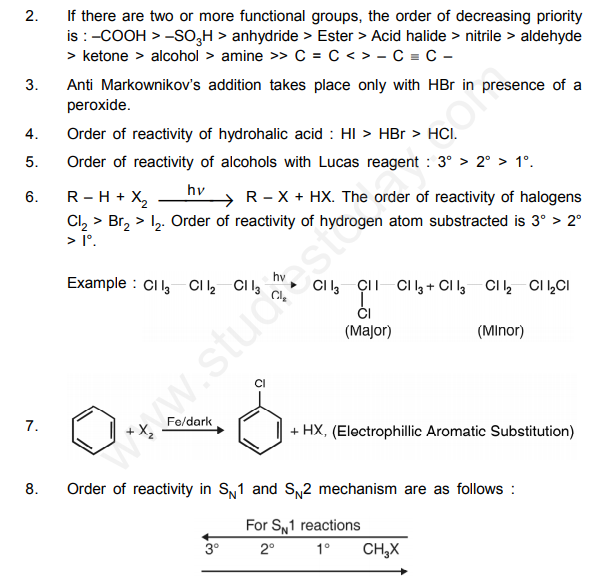
9. In case of optically active alkyl halide, SN2 mechanism results in the inversion of configuration while SN1 mechanism in racemisation.
10. Aryl halides are much less reactive towards nucleopillic substitution reactions. Presence of electron withdrawing groups (like –NO2 , –CN, –COOH etc.) at o– and/or p-position to halogen increases the rate of reaction.
12. All the three types of monohydric alcohols (1°, 2° or 3°) except methanol can be prepared from Grignard Reagent
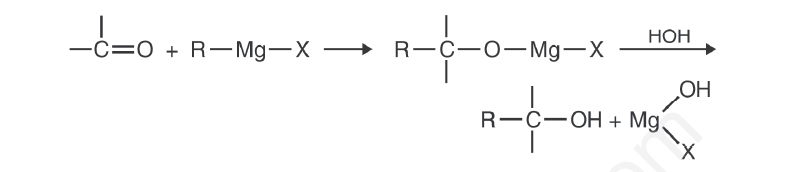
13. Alcohols
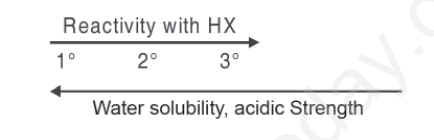
14. Presence of electron withdrawing group increases the acid strength of alcohol, phenol and carboxylic acid while presence of electron donating group decreases the acid strength. E.W.G. : NO2, –X, –CN, –COOH, etc., E.D.G. : –R, –OR, –OH, –NH2 etc.
15. In electrophilic aromatic substitution reaction, ring activating groups like –OH, –NH2, –OR, are o– and p– directing whereas ring deactivating groups like –CHO, > C = 0, –COOH, –NO2, –SO3H are m-directing. Halogens (F, Cl, Br and I) are deactivating but are o– and p– directing groups.
16. 3° alcohols are resistant to oxidation due to lack of -hydrogen.
17. Order of Acid strength : Alcohol < Phenol < Carboxylic acid, it is because of resonance stabilization of phenoxide and carboxylate ion. In carboxylate ion negative charge is delocalised over two oxygen atoms. while in phenoxide ion it is delocalised over one oxygen atom and the less electronegative C atom of benzene ring.
18. All organic compounds which form intermolecular H-bonds with water are soluble in water.
19. Intermolecular H-bonds of p- and m- nitrophenol increases water solubility/ Acid strength while intramolecular H-bonds in o-nitrophenol decreases
Please refer to the link below for CBSE Class 12 Chemistry Organic Chemistry Questions
Free study material for Chemistry
Chapter Assignment & Practice Material for Class 12 Chemistry Organic Chemistry
Chapter Practice Questions for Class 12 Chemistry
Review targeted chapter assignments for Class 12 Chemistry Organic Chemistry. Built according to official CBSE guidelines, these downloadable problem sets help students build accuracy and prepare effectively for school tests.
Key Advantages of Solving Organic Chemistry Assignments
- Curriculum Standards: Assignments match modern CBSE sample formats to ensure relevant preparation.
- Thorough Revision: Detailed problem sets reinforce core concepts and eliminate conceptual weak spots.
- Execution Speed: Timed practice with assignment sets sharpens overall response timing.
Steps to Complete Organic Chemistry Assignments Successfully
- Concept Foundation: Review the NCERT book for Class 12 Chemistry thoroughly before diving into assignment tasks.
- Self-Evaluation: Solve exercises independently before inspecting professional answer guides.
- Progress Monitoring: Note down complex formulas or concepts, clearing them up using available online practice aids.
FAQs
You can download free PDF assignments for Class 12 Chemistry Organic Chemistry from StudiesToday.com. These practice sheets have been updated for the 2026-27 session covering all concepts from latest NCERT textbook.
Yes, our teachers have given solutions for all questions in the Class 12 Chemistry Organic Chemistry assignments. This will help you to understand step-by-step methodology to get full marks in school tests and exams.
Yes. These assignments are designed as per the latest CBSE syllabus for 2026. We have included huge variety of question formats such as MCQs, Case-study based questions and important diagram-based problems found in Organic Chemistry.
Practicing topicw wise assignments will help Class 12 students understand every sub-topic of Organic Chemistry. Daily practice will improve speed, accuracy and answering competency-based questions.
Yes, all printable assignments for Class 12 Chemistry Organic Chemistry are available for free download in mobile-friendly PDF format.